General Context-Free Grammar Parsing Application of grammar rewrite - - PDF document

general context free grammar parsing application of
SMART_READER_LITE
LIVE PREVIEW

General Context-Free Grammar Parsing Application of grammar rewrite - - PDF document

General Context-Free Grammar Parsing Application of grammar rewrite rules A phrase structure grammar S Also known as a context-free grammar (CFG) NP VP S NP VP DT the DT NNS VBD DT NNS


slide-1
SLIDE 1

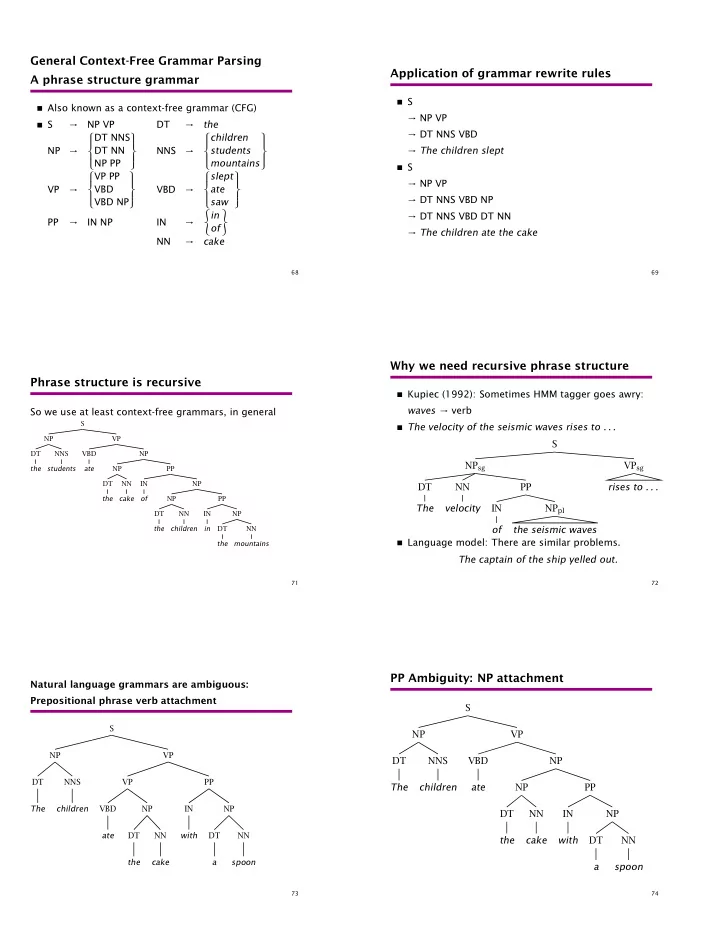
General Context-Free Grammar Parsing A phrase structure grammar

Also known as a context-free grammar (CFG) S

→ NP VP DT → the NP →      DT NNS DT NN NP PP      NNS →      children students mountains      VP →      VP PP VBD VBD NP      VBD →      slept ate saw      PP → IN NP IN →

  • in
  • f
  • NN

→ cake

68

Application of grammar rewrite rules

S

→ NP VP → DT NNS VBD → The children slept

S

→ NP VP → DT NNS VBD NP → DT NNS VBD DT NN → The children ate the cake

69

Phrase structure is recursive

So we use at least context-free grammars, in general

S NP DT the NNS students VP VBD ate NP NP DT the NN cake PP IN

  • f

NP NP DT the NN children PP IN in NP DT the NN mountains

71

Why we need recursive phrase structure

Kupiec (1992): Sometimes HMM tagger goes awry:

waves → verb

The velocity of the seismic waves rises to . . .

S NPsg DT The NN velocity PP IN

  • f

NPpl the seismic waves VPsg rises to . . .

Language model: There are similar problems.

The captain of the ship yelled out.

72

Natural language grammars are ambiguous: Prepositional phrase verb attachment

S NP DT The NNS children VP VP VBD ate NP DT the NN cake PP IN with NP DT a NN spoon

73

PP Ambiguity: NP attachment

S NP DT The NNS children VP VBD ate NP NP DT the NN cake PP IN with NP DT a NN spoon

74

slide-2
SLIDE 2

Attachment ambiguities in a real sentence

The board approved [its acquisition] [by Royal Trustco Ltd.] [of Toronto] [for $27 a share] [at its monthly meeting].

75

Ambiguity

Programming language parsers resolve local ambigui-

ties with lookahead

Natural languages have global ambiguities: I saw that gasoline can explode Size of embedded NP?

76

What is parsing?

We want to run the grammar backwards to find the struc-

tures

Parsing can be viewed as a search problem Parsing is a hidden data problem We search through the legal rewritings of the grammar We want to find all structures for a string of words (for

the moment)

We can do this bottom-up or top-down This distinction is independent of depth-first/bread-

first etc. – we can do either both ways

Doing this we build a search tree which is different

from the parse tree

77

State space search

States: Operators: Start state: Goal test: Algorithm

Put start state on stack solutions = {} loop if stack is empty, return solutions state = remove-front(stack) if goal(state) push(state, solutions) stack = push(expand(state, operators), nodes) end

78

Another phrase structure grammar

S → NP VP N → cats VP → V NP N → claws VP → V NP PP N → people NP → NP PP N → scratch NP → N V → scratch NP → e P → with NP → N N PP → P NP

79

cats scratch people with claws

S NP VP NP PP VP 3 choices NP PP PP VP

  • ops!

N VP cats VP cats V NP 2 choices cats scratch NP cats scratch N 3 choices – showing 2nd cats scratch people

  • ops!

cats scratch NP PP cats scratch N PP 3 choices – showing 2nd . . . cats scratch people with claws

80

slide-3
SLIDE 3

Phrase Structure (CF) Grammars

G = T, N, S, R

T is set of terminals N is set of nonterminals For NLP, we usually distinguish out a set P ⊂ N of

preterminals which always rewrite as terminals

S is start symbol (one of the nonterminals) R is rules/productions of the form X → γ, where X

is a nonterminal and γ is a sequence of terminals and nonterminals (may be empty)

A grammar G generates a language L

81

Recognizers and parsers

A recognizer is a program for which a given grammar

and a given sentence returns yes if the sentence is ac- cepted by the grammar (i.e., the sentence is in the lan- guage) and no otherwise

A parser in addition to doing the work of a recognizer

also returns the set of parse trees for the string

82

Soundness and completeness

A parser is sound if every parse it returns is valid/correct A parser terminates if it is guaranteed to not go off into

an infinite loop

A parser is complete if for any given grammar and sen-

tence it is sound, produces every valid parse for that sentence, and terminates

(For many purposes, we settle for sound but incomplete

parsers: e.g., probabilistic parsers that return a k-best list)

83

Top-down parsing

Top-down parsing is goal directed A top-down parser starts with a list of constituents to

be built. The top-down parser rewrites the goals in the goal list by matching one against the LHS of the gram- mar rules, and expanding it with the RHS, attempting to match the sentence to be derived.

If a goal can be rewritten in several ways, then there is a

choice of which rule to apply (search problem)

Can use depth-first or breadth-first search, and goal or-

dering.

84

Bottom-up parsing

Bottom-up parsing is data directed The initial goal list of a bottom-up parser is the string

to be parsed. If a sequence in the goal list matches the RHS of a rule, then this sequence may be replaced by the LHS of the rule.

Parsing is finished when the goal list contains just the

start category.

If the RHS of several rules match the goal list, then there

is a choice of which rule to apply (search problem)

Can use depth-first or breadth-first search, and goal or-

dering.

The standard presentation is as shift-reduce parsing.

85

Problems with top-down parsing

Left recursive rules A top-down parser will do badly if there are many dif-

ferent rules for the same LHS. Consider if there are 600 rules for S, 599 of which start with NP, but one of which starts with V, and the sentence starts with V.

Useless work: expands things that are possible top-down

but not there

Top-down parsers do well if there is useful grammar-

driven control: search is directed by the grammar

Top-down is hopeless for rewriting parts of speech (preter-

minals) with words (terminals). In practice that is always done bottom-up as lexical lookup.

Repeated work: anywhere there is common substructure

86
slide-4
SLIDE 4

Problems with bottom-up parsing

Unable to deal with empty categories: termination prob-

lem, unless rewriting empties as constituents is some- how restricted (but then it’s generally incomplete)

Useless work: locally possible, but globally impossible. Inefficient when there is great lexical ambiguity (grammar-

driven control might help here)

Conversely, it is data-directed: it attempts to parse the

words that are there.

Repeated work: anywhere there is common substructure Both TD (LL) and BU (LR) parsers can (and frequently

do) do work exponential in the sentence length on NLP problems.

87

Principles for success: what one needs to do

Left recursive structures must be found, not predicted Empty categories must be predicted, not found

An alternative way to fix things

Grammar transformations can fix both left-recursion and

epsilon productions

Then you parse the same language but with different

trees

Linguists tend to hate you. But they shouldn’t providing you can fix the trees post

hoc.

88