General Philosophy General Philosophy Dr Peter Millican Millican, - - PowerPoint PPT Presentation

general philosophy general philosophy
SMART_READER_LITE
LIVE PREVIEW

General Philosophy General Philosophy Dr Peter Millican Millican, - - PowerPoint PPT Presentation

General Philosophy General Philosophy Dr Peter Millican Millican, Hertford College , Hertford College Dr Peter Lecture 4: Lecture 4: Two Cartesian Topics Two Cartesian Topics Scepticism, and the Mind Scepticism, and the Mind Last Time


slide-1
SLIDE 1

General Philosophy General Philosophy

Dr Peter Dr Peter Millican Millican, Hertford College , Hertford College

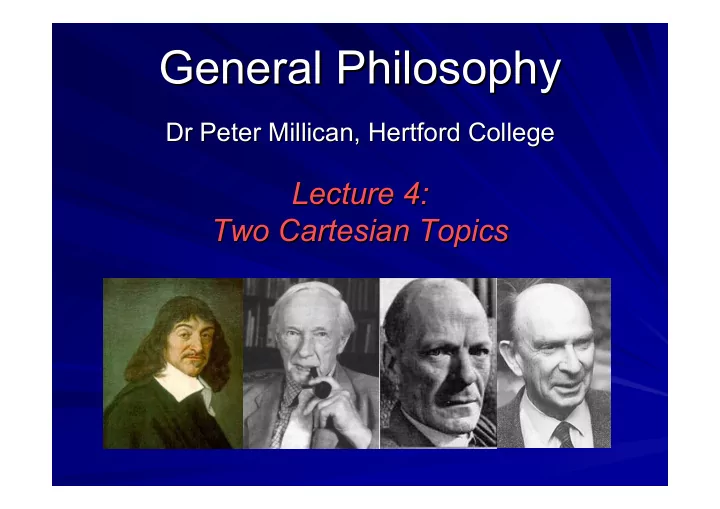
Lecture 4: Lecture 4: Two Cartesian Topics Two Cartesian Topics

slide-2
SLIDE 2

2 2

Scepticism, and the Mind Scepticism, and the Mind

Last Time Last Time … …

… … we looked at scepticism about INDUCTION. we looked at scepticism about INDUCTION.

This Lecture This Lecture … …

… … will move on to SCEPTICISM concerning will move on to SCEPTICISM concerning the external world, most famously exemplified the external world, most famously exemplified in Descartes in Descartes’ ’ first first Meditation Meditation, and his related , and his related claims about the nature of MIND AND BODY. claims about the nature of MIND AND BODY.

The Next Lecture The Next Lecture … …

… … will say more about modern responses to will say more about modern responses to SCEPTICISM, and focus on KNOWLEDGE. SCEPTICISM, and focus on KNOWLEDGE.

slide-3
SLIDE 3

3 3

Two Kinds of Scepticism Two Kinds of Scepticism

Vertical Scepticism Vertical Scepticism

– – Inferring from one kind of thing to Inferring from one kind of thing to a different a different kind kind (e.g. inferring from one (e.g. inferring from one’ ’s sensations or s sensations or appearances, to the existence of real physical appearances, to the existence of real physical

  • bjects that cause them).
  • bjects that cause them).

Horizontal Scepticism Horizontal Scepticism

– – Inferring things Inferring things of the same kind

  • f the same kind as one has

as one has experienced (e.g. inferring from one experienced (e.g. inferring from one’ ’s s sensations or appearances, to expect similar sensations or appearances, to expect similar sensations or appearances in the future). sensations or appearances in the future).

slide-4
SLIDE 4

4 4

External World Scepticism External World Scepticism

It can seem that ( It can seem that (“ “vertical vertical” ”) external world ) external world scepticism is far more worrying than scepticism is far more worrying than ( (“ “horizontal horizontal” ”) inductive scepticism: ) inductive scepticism:

– – Maybe I am just dreaming, and there is no Maybe I am just dreaming, and there is no external world at all. external world at all. – – Maybe an evil demon is causing me to have Maybe an evil demon is causing me to have illusions of an external world. illusions of an external world. – – Maybe a wicked scientist has my brain in a Maybe a wicked scientist has my brain in a vat, and is creating these illusions. vat, and is creating these illusions.

slide-5
SLIDE 5

5 5

Descartes Descartes’ ’ Approach Approach

The only way to defeat scepticism is to The only way to defeat scepticism is to withhold assent from anything that isn withhold assent from anything that isn’ ’t t completely certain. completely certain. When I consider When I consider “ “I think, therefore I am I think, therefore I am” ”, it , it is quite impossible for me to be mistaken. is quite impossible for me to be mistaken. So I am completely certain of this, at least. So I am completely certain of this, at least. By contemplating this first certainty, I By contemplating this first certainty, I understand what makes it certain is that I understand what makes it certain is that I clearly and distinctly perceive it clearly and distinctly perceive it to be true. to be true.

slide-6
SLIDE 6

6 6

Descartes and God Descartes and God

Hence I can establish as a general rule Hence I can establish as a general rule that that anything I clearly and distinctly anything I clearly and distinctly perceive is true perceive is true. . I clearly and distinctly perceive that God I clearly and distinctly perceive that God must exist, because only a perfect being must exist, because only a perfect being could be the ultimate cause of such a could be the ultimate cause of such a perfect idea as my idea of God. perfect idea as my idea of God. A perfect God cannot deceive, so I know A perfect God cannot deceive, so I know that my faculties are essentially reliable. that my faculties are essentially reliable.

slide-7
SLIDE 7

7 7

The Cartesian Circle The Cartesian Circle

Descartes seems to be Descartes seems to be “ “boot-strapping boot-strapping” ”: :

– – proving the existence of God by relying on his proving the existence of God by relying on his mental faculties. mental faculties. – – then appealing to the existence of God to then appealing to the existence of God to justify reliance on his mental faculties. justify reliance on his mental faculties.

Isn Isn’ ’t this viciously circular? t this viciously circular?

– – If my faculties might be defective, then how If my faculties might be defective, then how can I trust my proof of the existence of God in can I trust my proof of the existence of God in the first place? How can the first place? How can any any anti-sceptical anti-sceptical argument even get off the ground? argument even get off the ground?

slide-8
SLIDE 8

8 8

Moore Moore’ ’s Response s Response

G.E. Moore famously claimed to refute this G.E. Moore famously claimed to refute this sort of scepticism by appeal to common- sort of scepticism by appeal to common- sense knowledge: sense knowledge:

– – Here Here’ ’s one hand [he holds up a hand], and s one hand [he holds up a hand], and here here’ ’s another [he holds up the other]. s another [he holds up the other]. – – If this is a hand, then there is an external If this is a hand, then there is an external world. world. – – Therefore there is an external world, and Therefore there is an external world, and scepticism is refuted. scepticism is refuted.

slide-9
SLIDE 9

9 9

Two Arguments from Two Arguments from “ “P implies Q P implies Q” ”

Modus Ponens Modus Ponens

P implies Q P implies Q P P → → Q Q P is true P is true P P therefore therefore Q is true Q is true ∴ ∴ Q Q

Modus Tollens Modus Tollens

P implies Q P implies Q P P → → Q Q Q is false Q is false ¬ ¬Q Q therefore therefore P is false P is false ∴ ∴ ¬ ¬P P

slide-10
SLIDE 10

10 10

One person One person’ ’s s modus ponens modus ponens … …

Deuteronomy 20:16-17 Deuteronomy 20:16-17 commands multiple commands multiple genocide to avoid religious pollution. genocide to avoid religious pollution.

The religious fundamentalist might say: The religious fundamentalist might say:

Everything in the Bible is true Everything in the Bible is true. . Therefore genocide is sometimes desirable. Therefore genocide is sometimes desirable.

The humane philosopher would say: The humane philosopher would say:

Genocide is never desirable Genocide is never desirable. . Therefore not everything in the Bible is true. Therefore not everything in the Bible is true.

Which underlined premise is more plausible? Which underlined premise is more plausible?

slide-11
SLIDE 11

11 11

… … is another is another’ ’s s modus tollens modus tollens … …

– – If this is a hand, then there is an external world. If this is a hand, then there is an external world.

Moore says: Moore says:

– – We know this is a hand We know this is a hand. . – – Therefore we know there is an external world. Therefore we know there is an external world.

The sceptic says: The sceptic says:

– – We don We don’ ’t know that there is an external world t know that there is an external world. . – – Therefore we don Therefore we don’ ’t know that this is a hand. t know that this is a hand.

Moore will claim that his premise is more Moore will claim that his premise is more plausible than the sceptic plausible than the sceptic’ ’s. s.

slide-12
SLIDE 12

12 12

Internalism and Externalism Internalism and Externalism

We We’ ’d like to agree with Moore, but it seems d like to agree with Moore, but it seems hard to justify a claim to knowledge so hard to justify a claim to knowledge so crudely: don crudely: don’ ’t we need some t we need some philosophical philosophical argument argument rather than a bare common-sense rather than a bare common-sense claim to justify knowing that this is a hand? claim to justify knowing that this is a hand? But But “ “internalist internalist” ” arguments, like Cartesian arguments, like Cartesian boot-strapping, have difficulty doing the job. boot-strapping, have difficulty doing the job. So many recent philosophers have moved So many recent philosophers have moved towards towards externalism externalism (next lecture, and (next lecture, and compare Mellor compare Mellor’ ’s approach to induction). s approach to induction).

slide-13
SLIDE 13

13 13

Cartesian Dualism Cartesian Dualism

The view for which Descartes The view for which Descartes is now best known: is now best known:

– – The body is The body is material material, composed of matter , composed of matter whose essence (i.e. fundamental property from whose essence (i.e. fundamental property from which other properties follow) is which other properties follow) is extension extension. . – – The mind is composed of The mind is composed of immaterial substance immaterial substance whose essence is whose essence is thinking thinking. .

This This substance dualism substance dualism is to be contrasted is to be contrasted with with property dualism property dualism (i.e. there are both (i.e. there are both physical and non-physical physical and non-physical properties properties). ).

slide-14
SLIDE 14

14 14

A Bad Argument for Dualism A Bad Argument for Dualism

In his In his Discourse Discourse, Descartes argues like this: , Descartes argues like this:

I can doubt that my body exists. I can doubt that my body exists. I cannot doubt that I exist. I cannot doubt that I exist. ∴ ∴ I am not identical with my body. I am not identical with my body.

Compare: Compare:

I can doubt that Hesperus is Phosphorus. * I can doubt that Hesperus is Phosphorus. * I cannot doubt that Phosphorus is Phosphorus. I cannot doubt that Phosphorus is Phosphorus. ∴ ∴ Hesperus is not Phosphorus. Hesperus is not Phosphorus. * * Hesperus = the Evening Star; Phosphorus = the Morning

Hesperus = the Evening Star; Phosphorus = the Morning Star; in fact Star; in fact both both are appearances of the planet Venus. are appearances of the planet Venus.

slide-15
SLIDE 15

15 15

Leibniz Leibniz’ ’s Law s Law

If If a a and and b b are the same thing, then any are the same thing, then any property of property of a a must also be a property of must also be a property of b b: :

Fa Fa, a=b , a=b ╞ ╞ Fb Fb – – If If F F is the property of is the property of being doubted by me to being doubted by me to exist exist, , a a is is me me, and , and b b is is my body my body, we get , we get Descartes Descartes’ ’ argument from the argument from the Discourse. Discourse. – – Likewise Likewise F F could be the property of could be the property of being being doubted by me to be Prime Minister doubted by me to be Prime Minister (etc.) (etc.)

To simplest way to avoid the fallacy is to To simplest way to avoid the fallacy is to deny that these are genuine properties. deny that these are genuine properties.

slide-16
SLIDE 16

16 16

A Better Argument for Dualism A Better Argument for Dualism

Descartes Descartes’ ’ argument in argument in Meditation Meditation VI is less VI is less fallacious, but has questionable premises: fallacious, but has questionable premises:

– – I have a clear understanding of myself as I have a clear understanding of myself as (potentially) a thinking, non-extended thing. (potentially) a thinking, non-extended thing. – – I have a clear understanding of body as I have a clear understanding of body as (potentially) extended and non-thinking. (potentially) extended and non-thinking. – – Anything I clearly and distinctly understand could Anything I clearly and distinctly understand could be created by God accordingly. be created by God accordingly. – – So I could exist separately from my body, and it So I could exist separately from my body, and it follows that I am genuinely distinct from it. follows that I am genuinely distinct from it.

slide-17
SLIDE 17

17 17

From Doubt to Essence From Doubt to Essence

Even in the Even in the Meditations Meditations, Descartes tries to , Descartes tries to motivate his claim to know the essence of motivate his claim to know the essence of mind (as thinking) from his doubt argument: mind (as thinking) from his doubt argument:

“ “what shall I now say that I am [when I might be what shall I now say that I am [when I might be deceived by an evil demon, or dreaming]? deceived by an evil demon, or dreaming]? … … At present I am not admitting anything except At present I am not admitting anything except what is necessarily true. I am, then, in a strict what is necessarily true. I am, then, in a strict sense only a thing that thinks; that is, I am a sense only a thing that thinks; that is, I am a mind, or intelligence, or intellect, or reason mind, or intelligence, or intellect, or reason … … what kind of thing? what kind of thing? … … a thinking thing. a thinking thing.

slide-18
SLIDE 18

18 18

Epistemology Epistemology → → Metaphysics? Metaphysics?

The way in which we come to know The way in which we come to know, or be , or be certain, of something need not reflect its certain, of something need not reflect its ultimate nature (or ultimate nature (or why it is that way why it is that way). ).

– – From From I am thinking I am thinking, it plausibly follows that (in , it plausibly follows that (in at least one sense) at least one sense) I am a thing that thinks I am a thing that thinks. . – – But it does But it does not not necessarily follow that necessarily follow that I am I am something whose essence is to think something whose essence is to think. . – – Nor does it follow that the thing that thinks Nor does it follow that the thing that thinks could exist without being extended. (Imagine could exist without being extended. (Imagine if a piece of matter were made able to think.) if a piece of matter were made able to think.)

slide-19
SLIDE 19

19 19

Possibly Distinct Possibly Distinct → → Actually Distinct? Actually Distinct?

The final move of Descartes The final move of Descartes’ ’ argument argument seems more defensible, in a sense: seems more defensible, in a sense:

God God could have could have created my mind and body created my mind and body as separate entities. as separate entities. ∴ ∴ It is possible It is possible for my mind and body to exist for my mind and body to exist separately. separately. ∴ ∴ My mind and body My mind and body are in fact are in fact distinct things. distinct things.

But But “ “could have could have” ” must be must be metaphysical metaphysical possibility, not possibility, not epistemology epistemology ( (“ “might have might have for all I know for all I know” ”). So this begs the question. ). So this begs the question.

slide-20
SLIDE 20

20 20

The Distinct Substances Problem The Distinct Substances Problem

“ “How can two such distinct substances How can two such distinct substances interact at all? interact at all?” ”

– – A problem for Descartes, who takes causation A problem for Descartes, who takes causation to be ultimately to be ultimately intelligible intelligible. . – – Not a problem Not a problem in principle in principle on a Humean view of

  • n a Humean view of

causation: causation is a matter of lawlike causation: causation is a matter of lawlike correlation rather than intelligible connexion. correlation rather than intelligible connexion. – – But it But it’ ’s hard to see what such s hard to see what such “ “laws laws” ” could be could be like, so a difficulty remains (cf. the like, so a difficulty remains (cf. the “ “explanatory explanatory gap gap” ” between physical and mental). between physical and mental).

slide-21
SLIDE 21

21 21

The Causal Closure Principle The Causal Closure Principle

The The causal closure principle causal closure principle is that physical is that physical events (or their probabilities) are events (or their probabilities) are determined entirely by physical causes. determined entirely by physical causes.

– – Also called Also called “ “the completeness of physics the completeness of physics” ”. . – – In this form, the principle is compatible with In this form, the principle is compatible with physical events physical events’ ’ being to some extent being to some extent random random. . – – Casts doubt on Casts doubt on non non-physical causation.

  • physical causation.

Commonly believed, though its evidential Commonly believed, though its evidential base is not base is not so so clear. clear.

slide-22
SLIDE 22

22 22

Problems Explaining Interaction Problems Explaining Interaction

The causal closure principle seems to The causal closure principle seems to leave no room for a distinct mental leave no room for a distinct mental substance capable of influencing the body. substance capable of influencing the body. Even if we deny the principle, mind/body Even if we deny the principle, mind/body interaction seems mysterious. interaction seems mysterious. It It’ ’s hard to see how an immaterial mind s hard to see how an immaterial mind could have could have evolved evolved alongside the body. alongside the body.

– – Do animals have one too? Do animals have one too? – – Is having a mind Is having a mind “ “all or nothing all or nothing” ”? ?

slide-23
SLIDE 23

23 23

Mind and Body: Different Views Mind and Body: Different Views

Interactionism Interactionism

– – The mind can causally influence the body (e.g. The mind can causally influence the body (e.g. movement), and movement), and vice-versa vice-versa (e.g. pain). (e.g. pain).

Epiphenomenalism Epiphenomenalism

– – The mind is an The mind is an “ “epiphenomenon epiphenomenon” ” – – caused by caused by events in the brain, but itself causally inert. events in the brain, but itself causally inert. (this account is particularly hard to square with (this account is particularly hard to square with evolution evolution – – how could such a mind evolve?) how could such a mind evolve?)

Physicalism Physicalism

– – Only physical things exist, hence there is Only physical things exist, hence there is nothing to the mind beyond the physical brain. nothing to the mind beyond the physical brain.

slide-24
SLIDE 24

24 24

The Knowledge Argument (Jackson) The Knowledge Argument (Jackson)

Imagine a scientist (Mary) who learns all the Imagine a scientist (Mary) who learns all the physical facts about colour and colour physical facts about colour and colour perception, but who can see only in black, perception, but who can see only in black, white, and shades of grey. white, and shades of grey. If she then acquires normal sight, when she If she then acquires normal sight, when she sees colours sees colours she learns what they look like she learns what they look like, , something she didn something she didn’ ’t know before. t know before. Hence these phenomenal colour properties Hence these phenomenal colour properties cannot be physical. We are forced into cannot be physical. We are forced into property property dualism, if not dualism, if not substance substance dualism. dualism.

slide-25
SLIDE 25

25 25

What is a Physical Cause? What is a Physical Cause?

What are the properties of physical matter? What are the properties of physical matter?

– – If matter is just inert, extended (and possibly If matter is just inert, extended (and possibly impenetrable) stuff, then it impenetrable) stuff, then it’ ’s hard to see how it s hard to see how it could possibly be the causal basis of thought. could possibly be the causal basis of thought. – – But quantum But quantum “ “matter matter” ” has all sorts of weird has all sorts of weird properties: charge, spin, properties: charge, spin, “ “charm charm” ”, , “ “strangeness strangeness” ”. . – – Could matter have some proto-psychic property Could matter have some proto-psychic property too ( too (panpsychism panpsychism: mind is a fundamental feature : mind is a fundamental feature

  • f the universe)? Would this then be
  • f the universe)? Would this then be physical?!

physical?! – – Physicalism generally shuns such Physicalism generally shuns such “ “spooks spooks” ”. .

slide-26
SLIDE 26

26 26

Non-Physical Explanation Non-Physical Explanation

Even with Even with “ “non-spooky non-spooky” ” physicalism, it physicalism, it doesn doesn’ ’t follow that everything in the world t follow that everything in the world can be explained in physical terms. can be explained in physical terms.

– – Why does my calculator show Why does my calculator show “ “132 132” ” when I when I type type “ “11 x 12 = 11 x 12 =“ “ ? ? – – Answer: because 11 x 12 is equal to 132. The Answer: because 11 x 12 is equal to 132. The explanation appeals to explanation appeals to mathematical mathematical facts, not facts, not just just physical physical facts about the calculator. facts about the calculator.

Likewise evolutionary explanation etc. (e.g. Likewise evolutionary explanation etc. (e.g. in terms of the logic of game theory). in terms of the logic of game theory).

slide-27
SLIDE 27

27 27

The Hardware/Software Analogy The Hardware/Software Analogy

It is tempting to see the relation between It is tempting to see the relation between brain and mind as analogous to that brain and mind as analogous to that between hardware and software. between hardware and software.

– – This treats the mind as clearly This treats the mind as clearly distinguishable distinguishable from the body, but not a from the body, but not a distinct substance distinct substance. .

Explains away another Cartesian argument: Explains away another Cartesian argument:

Body is divisible. Body is divisible. Mind is not divisible. Mind is not divisible. ∴ ∴ Body and mind are distinct. Body and mind are distinct.

slide-28
SLIDE 28

28 28

Ryle and Category Mistakes Ryle and Category Mistakes

The classic category mistake: The classic category mistake:

– – “ “I I’ ’ve seen all these colleges and offices, but ve seen all these colleges and offices, but where is the University where is the University? ?” ” – – Supposes the University to be a separate thing. Supposes the University to be a separate thing.

“ “Mind Mind” ” as a category mistake: as a category mistake:

– – “ “People behave in these various ways, so People behave in these various ways, so they they must have a mind must have a mind distinct from their body. distinct from their body.” ” – – Instead, Instead, “ “having a mind having a mind” ” just is a matter of how just is a matter of how

  • ne behaves. It
  • ne behaves. It’

’s not a separate s not a separate thing thing. .

slide-29
SLIDE 29

29 29

Strawson and Strawson and “ “Many Minds Many Minds” ”

If one does think of the mind as a separate If one does think of the mind as a separate thing from the body, an thing from the body, an “ “entity entity” ” in its own in its own right, then this raises the question of how right, then this raises the question of how such entities are to be such entities are to be individuated individuated. . How can I know my brain isn How can I know my brain isn’ ’t linked to t linked to lots of different minds thinking in unison? lots of different minds thinking in unison?

– – Possible answer: I can Possible answer: I can’ ’t be t be certain certain, but it , but it’ ’s an s an extravagant and arbitrary hypothesis. extravagant and arbitrary hypothesis. – – However Strawson would probably see even However Strawson would probably see even the possibility as a the possibility as a reductio ad absurdum reductio ad absurdum. .

slide-30
SLIDE 30

30 30

The Hard Problem The Hard Problem

Physicalism can comfortably accommodate: Physicalism can comfortably accommodate:

– – Non-physical explanation (e.g. in terms of Non-physical explanation (e.g. in terms of purposes, as with a chess computer); purposes, as with a chess computer); – – A notion of A notion of “ “mind mind” ” analogous to software. analogous to software.

But the But the “ “hard problem hard problem” ” (Chalmers) remains: (Chalmers) remains:

– – Why is all this accompanied by Why is all this accompanied by phenomenal phenomenal consciousness consciousness (i.e. conscious experience)? (i.e. conscious experience)?

Can this justify substance dualism after all? Can this justify substance dualism after all?

– – Or should we rather admit that we simply don Or should we rather admit that we simply don’ ’t t (yet) understand it? Maybe we never will! (yet) understand it? Maybe we never will!