General purpose I/O bus is not enough - - PowerPoint PPT Presentation

general purpose i o bus is not enough bandwidth of 1gbps
SMART_READER_LITE
LIVE PREVIEW

General purpose I/O bus is not enough - - PowerPoint PPT Presentation

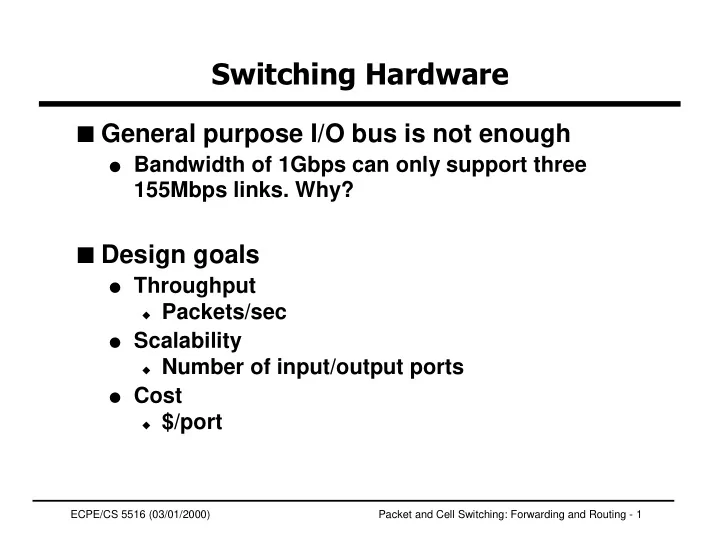
General purpose I/O bus is not enough Bandwidth of 1Gbps can only support three 155Mbps links. Why? Design goals Throughput Packets/sec Scalability Number of


slide-1
SLIDE 1

ECPE/CS 5516 (03/01/2000) Packet and Cell Switching: Forwarding and Routing - 1

  • ■ General purpose I/O bus is not enough
  • Bandwidth of 1Gbps can only support three

155Mbps links. Why?

■ Design goals

  • Throughput

◆ Packets/sec

  • Scalability

◆ Number of input/output ports

  • Cost

◆ $/port

slide-2
SLIDE 2

ECPE/CS 5516 (03/01/2000) Packet and Cell Switching: Forwarding and Routing - 2

  • ■ Can be defined in terms of
  • Total bandwidth: ATM networks
  • Forwarding rate in packets/sec: Switched Ethernet

■ Throughput is a function of traffic

  • Need to model traffic accurately

■ Traffic modeling parameters

  • Packet arrival time
  • Destination distribution
  • Packet size distribution
slide-3
SLIDE 3

ECPE/CS 5516 (03/01/2000) Packet and Cell Switching: Forwarding and Routing - 3

  • ■ Cost is a function of number of I/O ports (n)

■ Scalability can be thought of as the rise in cost

with increasing n.

■ Switch designs also have hardware limitations

when the number of ports becomes very large

slide-4
SLIDE 4

ECPE/CS 5516 (03/01/2000) Packet and Cell Switching: Forwarding and Routing - 4

  • Input

port Input port Input port Input port Output port Output port Output port Output port Switching Fabric

slide-5
SLIDE 5

ECPE/CS 5516 (03/01/2000) Packet and Cell Switching: Forwarding and Routing - 5

  • ■ Ports communicate with the outside world
  • Optoelectronics

■ Ports also support the routing model.

  • E.g for VC model, ports manage connection

setup/routing/teardown

■ Fabrics are fast bit pushers. They take data from

the input port and move it to an output port.

■ Complexity of determining the output port for a

packet is handled by the input ports.

■ Such fabrics are called self-routing

slide-6
SLIDE 6

ECPE/CS 5516 (03/01/2000) Packet and Cell Switching: Forwarding and Routing - 6

  • ■ Performance bottlenecks
  • Input port: header analysis, routing table lookup

■ Buffering can occur at the

  • Input port
  • Fabric
  • Output port

■ Design and implementation of buffers have the

greatest impact on performance

■ Simple scheme:

  • Input buffering with FIFO queue
  • Drawback: head of line blocking. Max. throughput 59%

■ Buffering discipline determines QoS

slide-7
SLIDE 7

ECPE/CS 5516 (03/01/2000) Packet and Cell Switching: Forwarding and Routing - 7

  • ■ Every input is connected to every output.

■ Can handle data arriving at all n inputs

simultaneously

slide-8
SLIDE 8

ECPE/CS 5516 (03/01/2000) Packet and Cell Switching: Forwarding and Routing - 8

  • ■ Speed of the output buffer has to be

proportional to n

■ Complexity of the switch fabric grows as n2

slide-9
SLIDE 9

ECPE/CS 5516 (03/01/2000) Packet and Cell Switching: Forwarding and Routing - 9

  • ■ Assumption:
  • Not all input ports need to get to the same
  • utput port simultaneously

■ The design supports no more than L inputs

  • ut of n to proceed to the output

■ Note:

  • Choice of L is hard. Servers on an output port

can ruin the above assumption

slide-10
SLIDE 10

ECPE/CS 5516 (03/01/2000) Packet and Cell Switching: Forwarding and Routing - 10

  • ■ Knockout has 3 components
  • A set of packet filters that determine the inputs

destined for the current output

  • A set of knockout concentrators. Each

concentrator has n inputs and L outputs. Given n inputs destined for the same output, it selects L out of them fairly. The remaining n – L inputs are discarded

◆ Fairness implies that no input gets dropped

more or less than any other

  • A per output buffer that can accept L inputs at a

time.

slide-11
SLIDE 11

ECPE/CS 5516 (03/01/2000) Packet and Cell Switching: Forwarding and Routing - 11

  • ■ Uses a tennis tournament

style knockout system.

■ You play division I first, if

you lose, you go to division II, if you lose again you go to division III and so on till L

■ If you lose in division L,

you’re kicked out.

D

1 2 3 4 Outputs Inputs

D D D D D D D D D D D D D

slide-12
SLIDE 12

ECPE/CS 5516 (03/01/2000) Packet and Cell Switching: Forwarding and Routing - 12

  • ■ Simple option:
  • Speed of output buffer is L * link

speed.

■ Problem: requires very fast

buffers

■ Knockout uses a clever round

robin buffering scheme with L parallel buffers and a shifter.

■ The fabric writes data to L

buffers simultaneously. The

  • utput port reads from one

(c) Shifter Buffers (b) Shifter Buffers (a) Shifter Buffers

slide-13
SLIDE 13

ECPE/CS 5516 (03/01/2000) Packet and Cell Switching: Forwarding and Routing - 13

  • ■ Number of packet filters = n

■ Size of output buffer/port = L ■ Complexity of concentrator/output port: n *

  • L. This is proportional to n
  • Total cost of concentrators = n2

■ Total complexity is proportional to n2

slide-14
SLIDE 14

ECPE/CS 5516 (03/01/2000) Packet and Cell Switching: Forwarding and Routing - 14

  • ■ Used a high speed bus to transfer data between input port and

shared memory.

■ Output port reads data from shared memory.

Mux Buffer memory Demux Write control Read control Inputs Outputs

… …

slide-15
SLIDE 15

ECPE/CS 5516 (03/01/2000) Packet and Cell Switching: Forwarding and Routing - 15

  • ■ Offer better resource utilization through

statistical multiplexing

■ Disadvantage:

  • The speed of the buses between the MUX and

memory and DEMUX and memory has to scale linearly with number of inputs. This restricts the use of this design

■ Shared memory switches are commercially

very common.