Genetic determinants of dabigatran plasma levels and their relation - - PowerPoint PPT Presentation

genetic determinants of dabigatran plasma levels and
SMART_READER_LITE
LIVE PREVIEW

Genetic determinants of dabigatran plasma levels and their relation - - PowerPoint PPT Presentation

Genetic determinants of dabigatran plasma levels and their relation to bleeding Guillaume Pare MD On behalf of RE-LY Genetics: Guillaume Pare MD, Niclas Eriksson PhD, Thorsten Lehr PhD, Stuart Connolly MD, John Eikelboom MD, Michael D. Ezekowitz


slide-1
SLIDE 1

Guillaume Pare MD

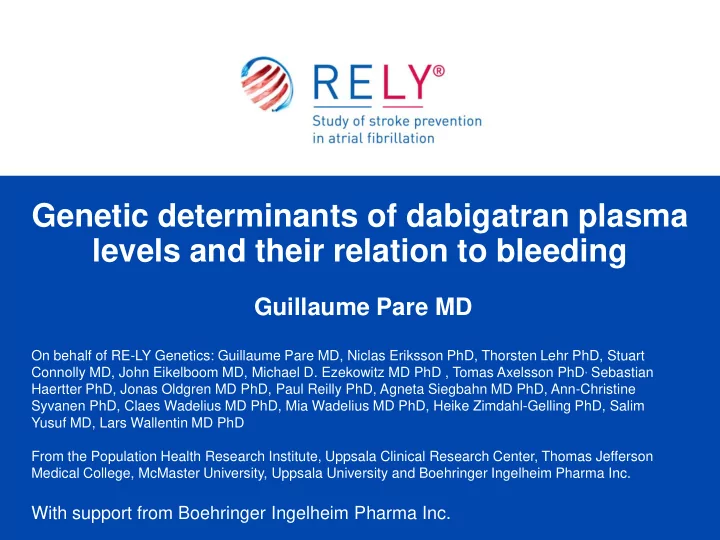
Genetic determinants of dabigatran plasma levels and their relation to bleeding

On behalf of RE-LY Genetics: Guillaume Pare MD, Niclas Eriksson PhD, Thorsten Lehr PhD, Stuart Connolly MD, John Eikelboom MD, Michael D. Ezekowitz MD PhD , Tomas Axelsson PhD, Sebastian Haertter PhD, Jonas Oldgren MD PhD, Paul Reilly PhD, Agneta Siegbahn MD PhD, Ann-Christine Syvanen PhD, Claes Wadelius MD PhD, Mia Wadelius MD PhD, Heike Zimdahl-Gelling PhD, Salim Yusuf MD, Lars Wallentin MD PhD From the Population Health Research Institute, Uppsala Clinical Research Center, Thomas Jefferson Medical College, McMaster University, Uppsala University and Boehringer Ingelheim Pharma Inc.

With support from Boehringer Ingelheim Pharma Inc.

slide-2
SLIDE 2

Background

  • Dabigatran etexilate is effective and safe in

prevention of stroke in AF patients compared with warfarin

  • Dabigatran etexilate is an oral prodrug that is

rapidly converted by esterases (CES1) to the active agent dabigatran

  • We hypothesized genetic factors are responsible for

some of the inter-individual variability in dabigatran exposure

slide-3
SLIDE 3

RE-LY Trial

  • AF patients with at least one additional RF for stroke
  • 18,113 patients with median follow-up of 2.0 years
  • Randomized trial of two fixed doses of dabigatran

etexilate (110 and 150 mg bid) and open-label warfarin

  • 110 mg as effective as warfarin
  • 150 mg superior to warfarin
  • Both doses had lower minor and major bleeds
slide-4
SLIDE 4

Methods Summary

Genome-wide analysis (551,203 markers) of dabigatran peak and trough concentration (N=1,490) Identification of genetic determinants of peak and trough concentration Association testing of genetic determinants of dabigatran concentration with safety and efficacy outcomes (N=1,694)

slide-5
SLIDE 5

Methods

  • Primary efficacy endpoint defined as stroke or systemic embolism
  • Primary safety endpoint define as any bleeding, minor and major
  • 1,694 dabigatran etexilate-treated RE-LY participants of European

ancestry successfully genotyped

  • Illumina Human610-quad beadchip (551,203 SNPs passed QC)
  • 807 warfarin-treated participants also genotyped
  • 1,490 participants also had peak (1 to 3H) and trough

concentrations measured by HPLC-MS/MS

slide-6
SLIDE 6

Study Population

Warfarin Dabigatran 110 mg Dabigatran 150 mg Baseline characteristics

N 807 849 845 Age 72.2 (7) 71.7 (7.5) 71.9 (7.6) Female (%) 273 (33.8%) 259 (30.5%) 272 (32.2%) BMI (Kg/m2) 29.4 (5.6) 28.9 (5.7) 29.2 (5.3) CHADS2 2.0 (1.1) 2.0 (1.2) 2.0 (1.1) History of Stroke (%) 83 (10.3%) 91 (10.7%) 77 (9.1%) History of Diabetes (%) 158 (19.6%) 178 (21.0%) 159 (18.8%) Aspirin Use (%) 228 (28.3%) 265 (31.2%) 234 (27.7%)

Dabigatran concentration

Number with measurements (%)

  • 752 (88.6%)

738 (87.3%) Trough Concentration (ng/mL)

  • 73 (48)

105 (72)* Peak Concentration (ng/mL)

  • 156 (94)

220 (133)*

Events

Ischemic Stroke or Systemic Emboli (%) 12(1.5%) 15(1.8%) 17(2.0%) Any Bleed (%) 325(40.3%)* 289(34.0%) 298(35.3%) Major Bleed (%) 45(5.6%) 49(5.8%) 52(6.2%) Minor Bleed (%) 306(37.9%)* 270(31.8%) 275(32.5%)

slide-7
SLIDE 7

Peak and Trough Concentration GWAS

SNP Chromosome Position (bp) Locus Function MAF (Allele)

Fold Change per Minor Allele (95%CI)

P-Value

Peak Concentration rs4148738 7 87000985 ABCB1 Intron 0.45 (G) 1.12 (1.08-1.17) 8.2 x 10⁻⁸ rs8192935 16 54419295 CES1 Intron 0.33 (A) 0.88 (0.84-0.92) 3.2 x 10⁻⁸ Trough Concentration rs4580160 16 54326141 CES1P2 Intron 0.30 (A) 0.88 (0.84-0.92) 1.7 x 10⁻⁸ rs2244613 16 54402110 CES1 Intron 0.18 (C) 0.85 (0.81-0.90) 1.2 x 10⁻⁸

  • MAF: Minor allele frequency
  • Linear regression with adjustment for dose, age, sex, BMI, CrCl, PPI, P-gp inhibitor use and first 10 principal components
  • Additive genetic model (gene-dose effect)
  • Significance set at P < 9 x 10⁻⁸
slide-8
SLIDE 8

ABCB1 Locus – Peak Concentration

  • Log10( P-

value)

slide-9
SLIDE 9

CES1 Locus – Peak Concentration

  • Log10( P-

value)

slide-10
SLIDE 10

CES1 Locus – Trough Concentration

  • Log10( P-

value)

slide-11
SLIDE 11

Association with Events

rs4148738

(ABCB1; Peak concentration)

rs8192935

(CES1; Peak concentration)

rs2244613

(CES1; Trough concentration)

Event

OR (95%CI) * P OR (95%CI) * P OR (95%CI) * P

Ischemic Stroke or Systemic embolism 0.88(0.53-1.46) 0.62 0.76(0.43-1.34) 0.34 0.70(0.33-1.47) 0.34 Any Bleeding 0.94(0.82-1.09) 0.44 0.89(0.76-1.03) 0.13 0.67(0.55-0.82) 7x10⁻⁵ Major Bleeding 1.14(0.85-1.52) 0.40 0.88(0.64-1.21) 0.44 0.66(0.43-1.01) 0.06 Minor Bleeding 0.94(0.81-1.09) 0.38 0.89(0.76-1.05) 0.17 0.70(0.57-0.85) 4x10⁻⁴

  • *: Odds ratio per minor allele (gene-dose effect)
  • Logistic regression with adjustment for dose, age, sex, CHADS2, ASA, CrCl and first 10 principal components
  • Significance set at P < 0.05
slide-12
SLIDE 12

Survival Analysis

Freedom from bleed according to rs2244613 carrier status

slide-13
SLIDE 13

Conclusions

  • ABCB1 and CES1 loci are associated with dabigatran concentration
  • Dabigatran etexilate is a substrate of ABCB1
  • CES1 is responsible for the biotransformation of dabigatran etexilate into

dabigatran

  • 32.8% of Europeans are carriers of the CES1 SNP rs2244613
  • Each minor allele is associated with 15% decrease in trough concentration
  • Carriers have 27% decrease in relative risk of bleed
  • 14% decrease in relative risk of bleed for low vs high dose of dabigatran

etexilate in the parent study

  • No association with efficacy – but modest statistical power
slide-14
SLIDE 14

Thanks!

Population Health Research Institute, Uppsala Clinical Research Center, Thomas Jefferson Medical College, McMaster University, Uppsala University and Boehringer Ingelheim Pharma Inc.