Genetic drift (two types) Genetic drift: changes in allele - - PowerPoint PPT Presentation

genetic drift two types
SMART_READER_LITE
LIVE PREVIEW

Genetic drift (two types) Genetic drift: changes in allele - - PowerPoint PPT Presentation

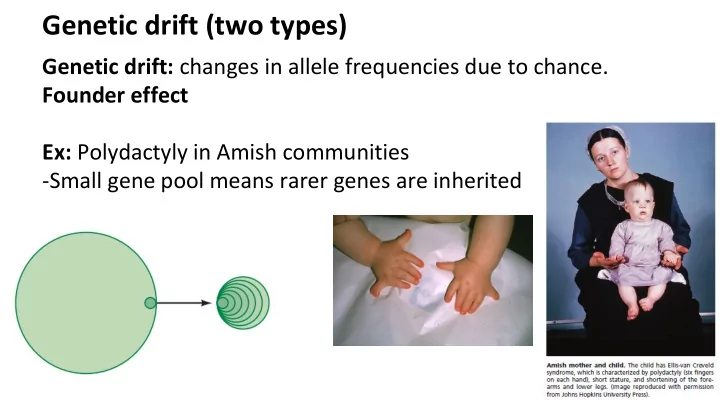
Genetic drift (two types) Genetic drift: changes in allele frequencies due to chance. Founder effect Ex: Polydactyly in Amish communities -Small gene pool means rarer genes are inherited 1 Genetic drift (two types) Genetic bottleneck: population


slide-1
SLIDE 1

Genetic drift (two types)

Genetic drift: changes in allele frequencies due to chance. Founder effect Ex: Polydactyly in Amish communities

  • Small gene pool means rarer genes are inherited

1

slide-2
SLIDE 2

Genetic drift (two types)

Genetic bottleneck: population shrinks to only a few people. Ex: Pingelap islanders are mostly colorblind.

2

slide-3
SLIDE 3

Gene flow (migration)

Gene flow: Exchange of genes between populations.

  • AKA migration

Ex: Low occurrence of hominin speciation in the past million years explained by migration.

3

slide-4
SLIDE 4

Natural selection

  • Acts on variation produced and redistributed

by mutations, recombination, genetic drift, and gene flow.

  • Differential reproductive success relative to

the environment.

4

slide-5
SLIDE 5

Anthropology example: Sickle-cell anemia

  • Lethal, genetically inherited blood disease.
  • The phenotype of a mutated hemoglobin allele
  • Collapses red blood cells into sickles

5

slide-6
SLIDE 6

Sickle-cell trait: Natural selection in humans

6

slide-7
SLIDE 7

Expect: Selection against sickle-cell allele. Instead: 30% some regional populations are carriers.

7

Anthropology example: Sickle-cell anemia

slide-8
SLIDE 8

Correlation between geographic locations with a malarial pressure and high frequencies of SCT

8

Anthropology example: Sickle-cell anemia

slide-9
SLIDE 9

Geographic distribution: Mediterranean, Arabian peninsula, Southeast Asia, West Africa.

9

Anthropology example: Sickle-cell anemia

slide-10
SLIDE 10

10

Anthropology example: Sickle-cell anemia

slide-11
SLIDE 11

Macroevolution

Classification

Kingdom: Animalia Phyla: Chordata Class: Mammalia Order: Primate Family: Hominidae Genus: Homo Species: sapiens

11

slide-12
SLIDE 12

Classifying biology

12

Question: Based on physical traits alone, which is the most similar?

  • Classification based on evolutionary relationships
slide-13
SLIDE 13

13

Homologies

Homologies: similarities between groups due to common descent. Ex: birds, bats, mice, crocs all have four limbs Contrast with analogies: similarities due to common function

slide-14
SLIDE 14

Two types of homologies

Ancestral traits: similarities in many taxonomic groups inherited from a remote ancestor. Derived traits: modified from the ancestral conditions.

14

slide-15
SLIDE 15

15

Schools of classification

Evolutionary systematics: hypothesizes about ancestor-descendant relationships over time

  • Make phylogenetic trees
slide-16
SLIDE 16

16

Schools of classification

Cladistics: use shared derived traits to identify new species Clades: lineages sharing a common ancestor.