Genetics of Human Consultant: InCarda Atrial Fibrillation Advisory - - PowerPoint PPT Presentation

genetics of human
SMART_READER_LITE
LIVE PREVIEW

Genetics of Human Consultant: InCarda Atrial Fibrillation Advisory - - PowerPoint PPT Presentation

9/8/2012 Disclosures Gregory M Marcus, MD, MAS Research: SentreHeart, Baylis, Gilead Genetics of Human Consultant: InCarda Atrial Fibrillation Advisory Board: Janssen UC Speakers Fees: St. Jude Medical SF Medical Center a clinical


slide-1
SLIDE 1

9/8/2012 1

sf

gh

San Francisco General Hospital

San Francisco VA Medical Center

Medical Center

Heart & Vascular Center

UC SF

Cardiovascular Research Institute

Gladstone Institute

  • f Cardiovascular Disease

Genetics of Human Atrial Fibrillation

Gregory M Marcus, MD, MAS

…a clinical research perspective

Research: SentreHeart, Baylis, Gilead Consultant: InCarda Advisory Board: Janssen Speaker’s Fees: St. Jude Medical

Disclosures

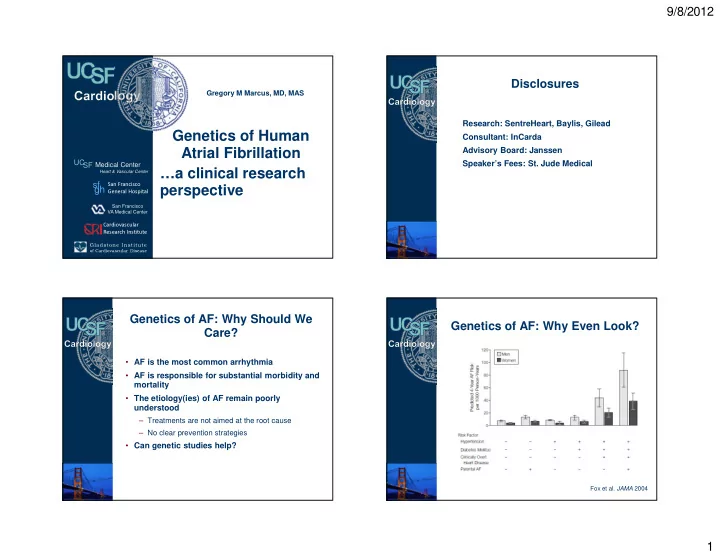
  • AF is the most common arrhythmia
  • AF is responsible for substantial morbidity and

mortality

  • The etiology(ies) of AF remain poorly

understood

– Treatments are not aimed at the root cause – No clear prevention strategies

  • Can genetic studies help?

Genetics of AF: Why Should We Care? Genetics of AF: Why Even Look?

Fox et al. JAMA 2004

slide-2
SLIDE 2

9/8/2012 2 Genetics of AF: Why Even Look?

Marcus et al. Heart Rhythm 2008

Genetics of AF: Monogenic Studies

Chen et al. Science 2003

Genetics of AF: Monogenic Studies

Chen et al. Science 2003

  • Chinese family with an autosomal dominant AF
  • Mapped to a mutation in KCNQ1
  • Functional studies revealed a gain in potassium

channel function

  • Consistent with a shortening of the refractory

period THEREFORE:

  • AF can be caused by a genetic defect
  • Confirmed a mechanism of AF

Mahida et al. Cardiovasc Res 2011

slide-3
SLIDE 3

9/8/2012 3 Genetics of AF: Monogeneic Studies

1. Ellinor et al. Heart 2004 2. Ellinor et al. BMC Med Genet 2006 3. Otway et al. J Am Coll Cardiol 2007

  • So what?
  • AF can be genetic
  • Mechanisms of AF can be better understood
  • AF has multiple etiologies
  • Maybe we really do need to tailor therapies

Genetics of AF: Monogeneic Studies

1. Ellinor et al. Heart 2004 2. Ellinor et al. BMC Med Genet 2006 3. Otway et al. J Am Coll Cardiol 2007

  • Screening for genes identified from family studies

in other cohorts failed to identify mutations.1-3

Genetics of AF: Monogeneic Studies

Gollub Heart Rhythm 2011

  • Michael Gollub’s point:
  • Nobel Laureates Brown and Goldstein’s study
  • f a homozygous familial hypercholesterolemia
  • A rare genetic disease affecting 1 in 1 million

individual’s led to understanding the role of HMG CoA reductase in cholesterol metabolism

  • Largely because of that work, 30 million

patients WITHOUT THAT SPECIFIC DISEASE are now on statins

Genetics of AF: Candidate Genes

Mahida et al. Cardiovasc Res 2011

slide-4
SLIDE 4

9/8/2012 4 Genetics of AF: Candidate Genes

  • CRITICISMS:
  • Low pretest probability
  • 30,000 genes
  • Non-coding regions generally not

considered

  • Corollary: Deciphering the meaning of

positive findings

  • Sequencing may find many mutations
  • SNPs

SNPs and Haplotypes

  • Single Nucleotide Polymorphism (SNP)
  • Present in >1% or >5% of the population
  • Distinct from a mutation
  • Haplotype (SNPs that travel together)
  • Linkage Dysequilibrium (LD)
  • Great: Can use “tagging SNPs”
  • Not so great: Maybe the finding is in LD with

something else

T A C

3,000 nucleotides

C T T

3,000 nucleotides

Genetics of AF: Candidate Genes

  • CRITICISMS:
  • Low pretest probability
  • 30,000 genes
  • Non-coding regions generally not

considered

  • Corollary: Deciphering the meaning of

positive findings

  • Sequencing may find many mutations
  • SNPs
  • Multiple hypothesis testing

Multiple Hypothesis Testing

  • P value: IF the null hypothesis is true, the

probability that the findings observed are due to chance alone

  • 0.05 or 1 in 20
  • 20 INDEPENDENT tests expect at least one will

be positive 5% of the time due to chance alone

  • There is SOME biological plausibility/ pre-test

probability

  • SNPs are often NOT independent
slide-5
SLIDE 5

9/8/2012 5 Multiple Hypothesis Testing

  • In candidate gene studies:
  • Multiple SNP testing
  • What model was used?
  • “We found an association with this SNP!”
  • Theoretical exercise- assume:
  • Population with GG, GC, and CC genotypes
  • Evidence favors an association with the C

allele

  • Dominant model = CC+ GC v. GG (any disease

allele v none)

  • Recessive model = CC v. GC + CC (both disease

alleles v the rest)

  • Additive model = CCGCGG (210)

(incremental effect for each additional allele)

Genetics of AF: Candidate Genes

  • CRITICISMS:
  • Low pretest probability
  • Corollary: Deciphering the meaning of

positive findings

  • Multiple hypothesis testing
  • Population stratification
  • Publication bias
  • Lack of replication1
  • 1. Sinner et al. Heart Rhythm 2011

Genetics of AF: Candidate Genes

Marcus et al. Am Heart J 2008

IL-6 levels associated with prevalent AF

Genetics of AF: Candidate Genes

Marcus et al. Am Heart J 2008 Guadino et al. Circulation 2003

1 2 3 4 5 6

IL-6 (pg/ml) GG GC CC

  • 174G/C

p=0.002

1 2 3 4 5 6

IL-6 (pg/ml) GG GC CC

  • 174G/C

p=0.002

slide-6
SLIDE 6

9/8/2012 6 Genetics of AF: Candidate Genes

  • IL-6 promoter and AF:
  • Second open heart surgery study showed an

association between the C allele, higher IL-6 levels and AF1

  • 1. Bittar et al. Heart Surg Forum 2005

Genome Wide Association Studies

  • Hypothesis free
  • Multiple hypothesis testing must be addressed
  • Replication is critical
  • THOUSANDS OF PATIENTS NEEDED

Gudbjartsson et al. Nature 2007

Genome Wide Association Studies

  • Hypothesis free
  • Multiple hypothesis testing must be addressed
  • Replication is critical
  • CRAZY LOW (BONFERRONI-CORRECTED) P

VALUES NEEDED

Gudbjartsson et al. Nature 2007

Genome Wide Association Studies

  • Hypothesis free
  • Multiple hypothesis testing must be addressed
  • Replication is critical
  • REPLICATION WAS PERFORMED

Gudbjartsson et al. Nature 2007

slide-7
SLIDE 7

9/8/2012 7 Genome Wide Association Studies

  • Hypothesis free
  • Multiple hypothesis testing must be addressed
  • Replication is critical
  • SMALL EFFECT SIZES

…so not the whole explanation

Gudbjartsson et al. Nature 2007

%cases (%controls)

Genome Wide Association Studies

  • SNPs are in a non-coding “gene desert”
  • Closest gene (50,000 base pairs away) is PITX2

Gudbjartsson et al. Nature 2007

Genome Wide Association Studies

  • Opened up a new area of study in AF
  • PITX2 encodes a transcription factor critical

in development

  • Involved in determining right-left

asymmetry,1-3 suppressing development of a left sided sinus node,4 is important in development of pulmonary vein myocardium,5 and PITX2c knock-out animal models are prone to atrial arrhythmias6

1. Piedra et al. Cell 1998 2. Logan M et al. Cell 1998 3. Yoshioka et al. Cell 1998 4. Mommersteeg et al. Circ Res 2007 5. Mommersteeg et al. Circ Res 2007 6. Wang et al. Proc Natl Acad Sci USA 2010

Genome Wide Association Studies

  • The causal pathways are not yet fully known
  • But the association appears to be true

1. Lubitz et al. ME Circ Arrhythm Electrophysiol 2010

slide-8
SLIDE 8

9/8/2012 8

  • Rigorous GWAS studies of AF
  • SNPs in intronic region of ZFHX3, which plays a

role in regulation of cell growth in neurons and skeletal muscle

  • No clear link to AF yet
  • Rigorous GWAS study in lone AF (although

included HTN)

  • SNP in intronic region of KCNN3, a calcium-

activated potassium channel expressed in the heart

slide-9
SLIDE 9

9/8/2012 9 A Different Approach

  • African Americans are known to have a

significantly lower prevalence of atrial fibrillation compared to Whites.1-4

1. Psaty et al. Circulation 1997 2. Go et al. JAMA 2001 3. Alonso et al. Am Heart J 2009 4. Marcus et al. Am J Med 2010

A Different Approach

  • African Americans generally have a higher

burden of risk factors for atrial fibrillation – Hypertension1 – Diabetes2 – Larger body mass index3 – Heart Failure4

  • Understanding this paradox may provide new

information regarding the cause of atrial fibrillation

1. Kramer et al. Am J Hyperten 2004 2. Carter et al. Ann Intern Med.1996 3. Ford et al. Circulation 2009 4. Bibbins-Domingo et al. N Engl J Med 2009

A Different Approach

  • African Americans represent a population

admixed with African and European ancestry1,2 e

cause of atrial fibrillation

1. Rosenberg et al. Am J Hum Genet 2003 2. Parra et al. Am J Hum Genet 1998

slide-10
SLIDE 10

9/8/2012 10 Ancestral Informative Marker

Cytosine Guanine

Ancestral Informative Marker

African Ancestry European Ancestry

13 14 15 16 17 18 19 20 21 22 X Y 1 3 4 5 6 7 8 9 10 11 12 2

Predictor: 10% European Ancestry Outcome: Incident AF

Meta-Analysis

Adjusted Hazard Ratio

Adjusted for: age, sex, BMI, hypertension, diabetes, heart failure, left ventricular hypertrophy, history of MI, and study site

African Ancestry European Ancestry

13 14 15 16 17 18 19 20 21 22 X Y 1 3 4 5 6 7 8 9 10 11 12 2

slide-11
SLIDE 11

9/8/2012 11

Marcus et al. Heart Rhythm 2008

  • Concordance rate for AF was 22% among

monozygotic (identical) twins versus 11% of dizygotic twins e cause of atrial fibrillation

  • Three of 15 lone AF patients were found to have

somatic mutation in GJA5

  • Functional studies supported dysfunctional

effects of the mutations observedfibrillation

Sinner et al. Cardiovasc Res 2011

slide-12
SLIDE 12

9/8/2012 12 Ultimately….

  • The goal will be to better guide therapy
  • To identify patients at risk
  • To identify effective targets for prevention and

treatment

….potentially putting those of us that like to do AF ablation out of business

Pharmacogenetics Ablatogenetics

Gene panel: IL-6, Cx, RAS Gene panel: PITX2 Gene panel: KCNN3

Na K Ca Drug Rx

Ablatogenetics Thank You