Geographical Names as a Cultural Expression: an Analysis of the - - PowerPoint PPT Presentation

geographical names as a cultural expression an analysis
SMART_READER_LITE
LIVE PREVIEW

Geographical Names as a Cultural Expression: an Analysis of the - - PowerPoint PPT Presentation

Geographical Names as a Cultural Expression: an Analysis of the City of Petrpolis RJ, Brazil Beatriz C. P. de Souza, Paulo Mrcio L. de Menezes, Bruna S. Miceli, Alessa F. Duque Estrada Federal University of Rio de Janeiro,


slide-1
SLIDE 1

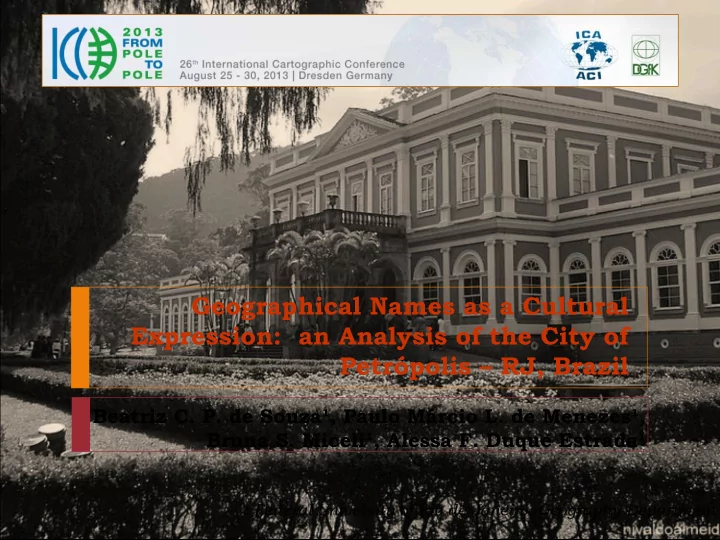
Geographical Names as a Cultural Expression: an Analysis of the City of Petrópolis – RJ, Brazil

Beatriz C. P. de Souza¹, Paulo Márcio L. de Menezes¹, Bruna S. Miceli¹, Alessa F. Duque Estrada¹

¹ Federal University of Rio de Janeiro, Geography Department

slide-2
SLIDE 2

Summary

1. Introduction 2. The City of Petrópolis - RJ 3. The acquisition of the geographical names and the systematization of the analysis 4. Toponym as a Cultural Expression 5. The geographical names of Petrópolis: Cultural origin and Motivations 6. Final Considerations and Future Stages 7. References

slide-3
SLIDE 3
  • 1. Introduction

Toponym Research: multidisciplinary; facilitate the establishment of various relations with the cultural, social, political, economical and natural aspects of a studied area;

Special importance for Geographic and Cartographic Sciences: “names may reflect a ‘humanized landscape’, through its own

personification, resulting in a separation and differentiation from any other land. Based on this, geographical names can display a fundamental geographic language that indicates numerous aspects about a place. (MENEZES e SANTOS, 2006)”

slide-4
SLIDE 4
  • 1. Introdução

Objectives:

Analyze the cultural origins of the current geographical

names of the city of Petrópolis with the aim of verifying the influence of German immigration;

Identify, by the toponymic motivations, relations between

the human being and the place;

slide-5
SLIDE 5

2. The City of Petrópolis - RJ

slide-6
SLIDE 6

Petrópolis has an important historical legate in the national perspective since, in the second half of the nineteenth century, it was used as summer residence for the Imperial Family;

The effective settlement of Petrópolis has intimate relationship with the affection that D. Pedro I had for the location. He met the place in 1822;

  • D. Pedro I abdicated the throne in 1831. In 1834, he passed

away before the actual construction of his palace;

In 1843, D. Pedro II restarted the “Settlement of the Summer Palace” and ordered the foundation of Petrópolis nominating the German Major Júlio Frederico Köeler to coordinate this project.

2. The City of Petrópolis - RJ

slide-7
SLIDE 7

Source: www.fonte.abril.com.br

2. The City of Petrópolis - RJ

Source: www.petropolisemcena.blogspot.com Source: www.fotola.com/ Source: www.viagensfamiliamorettipadulla.blogspot.com.br

slide-8
SLIDE 8

3. The acquisition of the geographical names and the systematization of the analysis

slide-9
SLIDE 9

4. Toponym as a Cultural Expression

slide-10
SLIDE 10

4. Toponym as a Cultural Expression

The geographical names are essential: “map without names is a soulless map because a geographic coordinate has no history, no cultural , anthropological , linguistic, ethnolinguist, socioeconomic aspects and games of power.” (SANTOS, 2008)

Corrêa (2007) affirms that toponym is a significant cultural record and expresses an effective appropriation

  • f space by some cultural group and so becoming an

important identity element;

slide-11
SLIDE 11

4. Toponym as a Cultural Expression

The act of naming a place is essentially human, establishing a cultural relation directly connected to its population and the way to get to know the place or the area.

The notion of toponymic motivation consisting of the research of impulses that led to the emergence of the toponym developed by Dick (1990).

slide-12
SLIDE 12

5. The geographical names of Petrópolis: Cultural

  • rigin and Motivations

Origin of the geographical names:

Origin Quantity Portuguese 87 Native 24 European (Non-Lusitanian) 5 African 4 Others 1 Undetermined 4 Total 125

slide-13
SLIDE 13

5. The geographical names of Petrópolis: Cultural

  • rigin and Motivations
slide-14
SLIDE 14

Toponymic Motivations: 5. The geographical names of Petrópolis: Cultural

  • rigin and Motivations
slide-15
SLIDE 15
  • 6. Final Considerations and Future Stages

The current studied maps do not show a considerable quantity of geographical names with a Germanic origin Influence of scale;

The geographical names presented a strong Portuguese influence since the majority of the toponyms are from this language;

Concerning the toponymic motivations, it was realized that portuguese and indigenous names have opposite standards.

slide-16
SLIDE 16
  • 7. References

ANTUNES, Alessandra; CARVALINHOS, Patrícia. Toponímia Brasileira: Origens Históricas. In: CONGRESSO NACIONAL DE LINGÜISTICA E FILOLOGIA, 11. 2007, Rio de Janeiro. Toponímia brasileira. Origens históricas. Disponível em: http://www.filologia.org.br/xicnlf/ Acessado em 15/09/2010. CLAVAL, P. “A volta do cultural” na Geografia. Mercator – Revista de Geografia da UFC, n. 01, 2002. CORRÊA, R. L. A Geografia Cultural e o Urbano. In: CORRÊA, R L. e ROZENDAHL, Z. (Orgs.). Introdução a Geografia Cultural. Rio de Janeiro: Bertrand, Brasil, 2003. p. 167-187. _______________. Temas e Caminhos da Geografia Cultural: uma breve reflexão. In: Zeny Rosendahl e Roberto

  • Lobato. (Org.). Temas e Caminhos da Geografia Cultural. Rio de Janeiro: EDUERJ, 2010, v.

1, p. 48-72. CORRÊA, R. L.; ROSENDAHL, Z. Geografia Cultural: introduzindo a temática, os textos e uma agenda. In: CORRÊA,

  • R. L.; ROSENDAHL, Z. (Orgs.). Introdução à

Geografia Cultural. 2ª

  • ed. Rio de Janeiro: Bertrand, Brasil, 2007.

COSGROVE, D. E. Em direção a uma geografia cultural radical: problemas da teoria. Espaço e Cultura, Rio de Janeiro,

  • n. 3, p. 5-29, jan./jun. 1998b.

_______________. Geografia cultural do milênio. In: ROSENDAHL, Zeny; CORRÊA, R. L. Manifestações da cultura no espaço. Rio de Janeiro: Ed. Uerj, 1999a. p. 17-46. COSGROVE, D. E.; JACKSON, P. Novos rumos da geografia cultural. In: CORRÊA, Roberto Lobato; ROSENDAHL,

  • Zeny. Geografia cultural: um século (II). Rio de Janeiro: Ed. UERJ, 2000. p. 15-32.

DICK, Maria Vicentina de Paula do Amaral. A motivação toponímica e a realidade brasileira. São Paulo: Arquivo do Estado, 1990.

slide-17
SLIDE 17

FURTADO, Sebastião da Silva. A Toponímia e a Cartografia. Ministério da Guerra – Diretoria do Serviço Geográfico. Rio de Janeiro: 1960. HAESBAERT, R. Identidades territoriais. In: ROSENDAHL, Zeny; CORRÊA, Roberto Lobato. Manifestações da cultura no espaço. Rio de Janeiro, Ed. Uerj, 1999. p. 169-190. HAESBAERT, Rogério; LIMONAD, Éster. O território em tempos de globalização. Geo Uerj, Rio de Janeiro, n. 5, p. 7-19, 1999. MATA, Sérgio da. O desencantamento da Toponímia. In: ROSENDAHL, Z. e CÔRREA, R. L. (orgs.). Geografia: Temas sobre Cultura e Espaço. Rio de Janeiro: EdUERJ, 1998. MENEZES, Paulo Márcio Leal de, SANTOS, Cláudio João Barreto dos. Geonímia do Brasil: Pesquisa, Reflexões e Aspectos

  • Relevantes. In: Revista Brasileira de Cartografia nº

58/2, 2006. SANTOS, Cláudio João Barreto dos. Geonímia do Brasil: A Padronização dos Nomes Geográficos num Estudo de Caso dos Municípios Fluminenses. Tese de doutorado. Rio de Janeiro: UFRJ, IGEO, 2008. SANTOS, Cláudio João Barreto dos. A retomada da pesquisa da Geonímia do Brasil: algumas reflexões e aspectos

  • relevantes. Geo Uerj, Rio de Janeiro. Disponível em http://www.geouerj.com/PDF/Claudiojoao.pdf. Acesso em:

15/07/2011 SEEMANN, Jörn . Cartografia e cultura: abordagens para a geografia cultural. In: Zeny Rosendahl; Roberto Lobato Correa. (Org.). Temas e caminhos da geografia cultural. Rio de Janeiro: Editora de UERJ, 2010, v. 1, p. 115-156. SILVA, J. C. Memória Topográfica e Histórica sobre os Campos dos Goitaczses. 2ª

  • ed. Rio de Janeiro:Leuzinger, 1907 ( 1ª

ed., 1819 ). SILVA, J. Romão da. Geonomásticos Cariocas de Procedência Indígena. Secretaria Geral de Educação e Cultura do Estado da Guanabara. Rio de Janeiro, 1961. _______________. Denominações Indígenas na Toponímia Carioca. Rio de Janeiro: Livraria Editora Brasiliana, 1966. TUAN, YI-FU. Place: an experiential perspective. Disponível em: <http://www.jstor.org/stable>. Acesso em: 06/04/2011.
  • 7. References
slide-18
SLIDE 18

Thank you for your attention!

beatrizdesouza.ufrj@gmail.com