
SLIDE 1
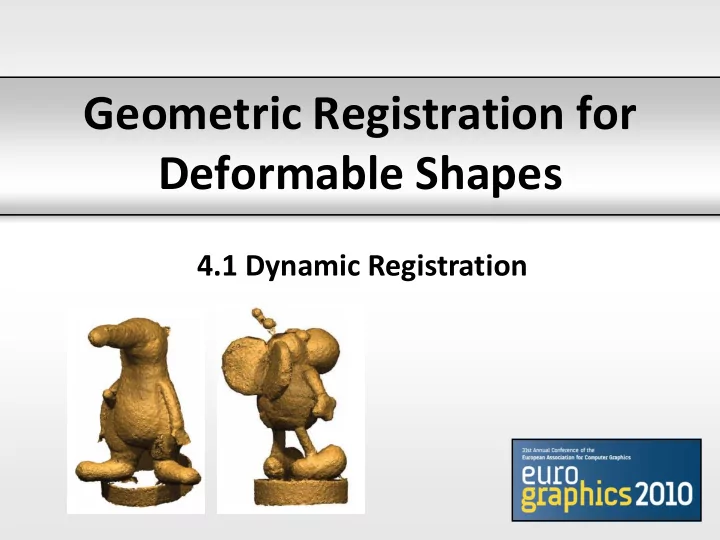
Geometric Registration for Deformable Shapes 4.1 Dynamic - - PowerPoint PPT Presentation
Geometric Registration for Deformable Shapes 4.1 Dynamic Registration Scan Registration Eurographics 2010 Course Geometric Registration for Deformable Shapes Scan Registration Solve for inter-frame motion: Eurographics 2010 Course
Eurographics 2010 Course – Geometric Registration for Deformable Shapes
Eurographics 2010 Course – Geometric Registration for Deformable Shapes
Solve for inter-frame motion:
Eurographics 2010 Course – Geometric Registration for Deformable Shapes
Solve for inter-frame motion:
Eurographics 2010 Course – Geometric Registration for Deformable Shapes
Given: A set of frames {P0, P1, ... Pn} Goal: Recover rigid motion {α1, α2, ... αn} between adjacent frames
Eurographics 2010 Course – Geometric Registration for Deformable Shapes
Eurographics 2010 Course – Geometric Registration for Deformable Shapes
Eurographics 2010 Course – Geometric Registration for Deformable Shapes
tj tj+1 tj+2
Eurographics 2010 Course – Geometric Registration for Deformable Shapes
Eurographics 2010 Course – Geometric Registration for Deformable Shapes
j
t ∆
Eurographics 2010 Course – Geometric Registration for Deformable Shapes
Eurographics 2010 Course – Geometric Registration for Deformable Shapes
Tangential point movement → velocity vectors orthogonal to surface normals
Eurographics 2010 Course – Geometric Registration for Deformable Shapes
Tangential point movement → velocity vectors orthogonal to surface normals
) ( ). (
~ ~
=
j i j i
p n p v
Eurographics 2010 Course – Geometric Registration for Deformable Shapes
(rigid) velocity vectors →
Eurographics 2010 Course – Geometric Registration for Deformable Shapes
(rigid) velocity vectors !
Eurographics 2010 Course – Geometric Registration for Deformable Shapes
Eurographics 2010 Course – Geometric Registration for Deformable Shapes
Plane fitting using PCA using chosen neighborhood points.
Eurographics 2010 Course – Geometric Registration for Deformable Shapes
Update neighborhood with current velocity estimate.
Eurographics 2010 Course – Geometric Registration for Deformable Shapes
Stable, but more expensive.
Eurographics 2010 Course – Geometric Registration for Deformable Shapes
Perform local surface triangulation (tetrahedralization).
Eurographics 2010 Course – Geometric Registration for Deformable Shapes
Stable, but more expensive.
Eurographics 2010 Course – Geometric Registration for Deformable Shapes
ICP point-plane Dynamic registration
Eurographics 2010 Course – Geometric Registration for Deformable Shapes
Eurographics 2010 Course – Geometric Registration for Deformable Shapes
Eurographics 2010 Course – Geometric Registration for Deformable Shapes
Eurographics 2010 Course – Geometric Registration for Deformable Shapes
(2,200 frames)
Eurographics 2010 Course – Geometric Registration for Deformable Shapes
Eurographics 2010 Course – Geometric Registration for Deformable Shapes
Eurographics 2010 Course – Geometric Registration for Deformable Shapes
scan #1 : scan #50 scan #1 : scan #100
Eurographics 2010 Course – Geometric Registration for Deformable Shapes
Eurographics 2010 Course – Geometric Registration for Deformable Shapes
scan #1 : scan #50 scan #1 : scan #100
Eurographics 2010 Course – Geometric Registration for Deformable Shapes
rigid components
Eurographics 2010 Course – Geometric Registration for Deformable Shapes
Eurographics 2010 Course – Geometric Registration for Deformable Shapes
Eurographics 2010 Course – Geometric Registration for Deformable Shapes
Eurographics 2010 Course – Geometric Registration for Deformable Shapes
thank you