GEOMETRICAL STABILITY OF CFRP LAMINATE CONSIDERING PLY ANGLE - - PDF document

geometrical stability of cfrp laminate considering ply
SMART_READER_LITE
LIVE PREVIEW

GEOMETRICAL STABILITY OF CFRP LAMINATE CONSIDERING PLY ANGLE - - PDF document

18 TH INTERNATIONAL CONFERENCE ON COMPOSITE MATERIALS GEOMETRICAL STABILITY OF CFRP LAMINATE CONSIDERING PLY ANGLE MISALIGNMENT Y. Arao 1* , J. Koyanagi 2, S. Takeda 2 , S. Utsunomiya 2 , H. Kawada 1 1 Department of Mechanical and Systems


slide-1
SLIDE 1

18TH INTERNATIONAL CONFERENCE ON COMPOSITE MATERIALS

Abstract Accurate geometrical stability is required for the precise structures like telescopes. It was reported that symmetrical CFRP (Carbon Fiber Reinforced Plastics) laminates show unpredictable deformation due to the ply angle misalignment and temperature

  • change. This ply angle misalignment is unavoidable.

One of the answer to mitigate the deformation due to the ply angle misalignment is to chose effective stacking sequence. We discussed here the effective stacking sequence to reduce the thermal deformation. 1 Introduction Since CFRP has excellent thermal stability in addition to high specific stiffness and strength, it can be used as the main material for precise structures like telescopes[1]. The main mirror can be made larger than conventional mirrors by using CFRP, which can drastically improve the resolution of the

  • telescope. The main mirror requires accurate

dimensional stability for long-term. For instance, a mirror of 3.5m diameter must keep its surface- geometry deviation within 5 µm RMS (root mean square)[2]. In general, the P-V (Peak to Valley) value

  • f reflecting mirror must be kept within λ/8. λ

means the wave length of interest. λ/8 is named Rayleigh limit. If the mirror deforms more than the value of Reyleigh limits, the resolution of reflective mirror decreases. Therefore, geometrical stability in CFRP laminates is critical problem for using CFRP to precise structures. CFRP mirrors have been developed by lots of researchers[3]-[7]. The smooth mirror surface can be created by transcription and polishing techniques. However, the unpredictable deformation with the temperature change is unsolved problems. To reduce the out-of-plane deformation, symmetric stacking sequence is usually adopted. The problem is that there is no ideal symmetric laminate. This is because ply angle misalignment is inevitable when we stacked ply. The symmetrical laminates are specifically asymmetric. Laminates show not only the in-plain deformation but also show out-of-plane deformation with the temperature change. Author et

  • al. found that a standard deviation of approximately

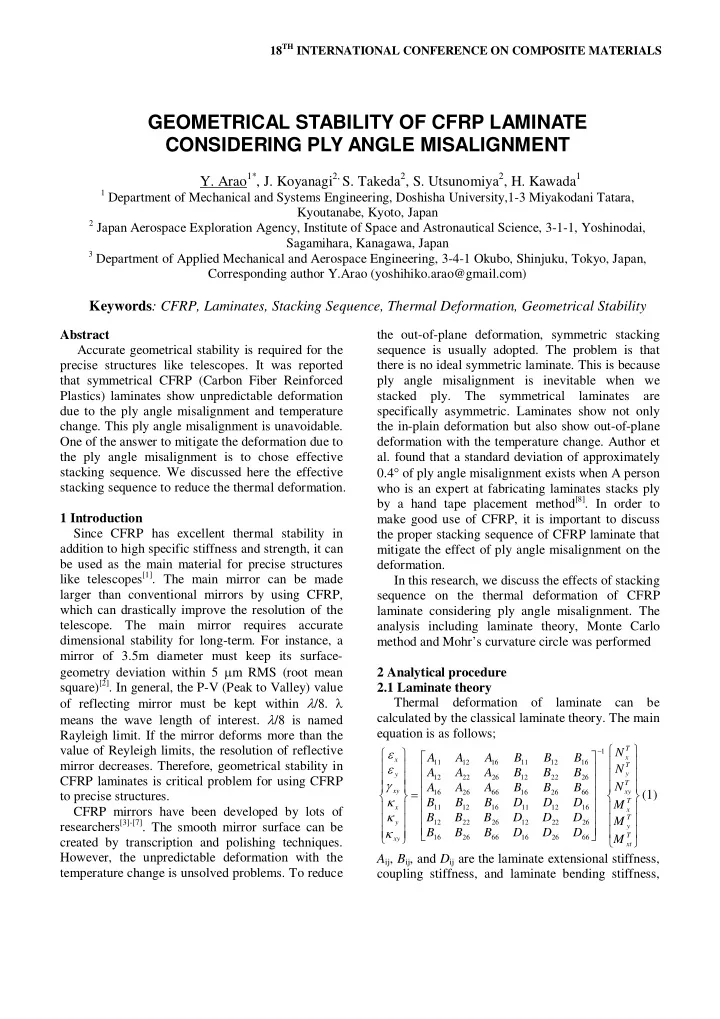
0.4° of ply angle misalignment exists when A person who is an expert at fabricating laminates stacks ply by a hand tape placement method[8]. In order to make good use of CFRP, it is important to discuss the proper stacking sequence of CFRP laminate that mitigate the effect of ply angle misalignment on the deformation. In this research, we discuss the effects of stacking sequence on the thermal deformation of CFRP laminate considering ply angle misalignment. The analysis including laminate theory, Monte Carlo method and Mohr’s curvature circle was performed 2 Analytical procedure 2.1 Laminate theory Thermal deformation of laminate can be calculated by the classical laminate theory. The main equation is as follows;

                                  =                  

− T xt T y T x T xy T y T x xy y x xy y x

M M M N N N D D D B B B D D D B B B D D D B B B B B B A A A B B B A A A B B B A A A

1 66 26 16 66 26 16 26 22 12 26 22 12 16 12 11 16 12 11 66 26 16 66 26 16 26 22 12 26 22 12 16 12 11 16 12 11

κ κ κ γ ε ε

(1) Aij, Bij, and Dij are the laminate extensional stiffness, coupling stiffness, and laminate bending stiffness,

GEOMETRICAL STABILITY OF CFRP LAMINATE CONSIDERING PLY ANGLE MISALIGNMENT

  • Y. Arao1*, J. Koyanagi2, S. Takeda2, S. Utsunomiya2, H. Kawada1

1 Department of Mechanical and Systems Engineering, Doshisha University,1-3 Miyakodani Tatara,

Kyoutanabe, Kyoto, Japan

2 Japan Aerospace Exploration Agency, Institute of Space and Astronautical Science, 3-1-1, Yoshinodai,

Sagamihara, Kanagawa, Japan

3 Department of Applied Mechanical and Aerospace Engineering, 3-4-1 Okubo, Shinjuku, Tokyo, Japan,

Corresponding author Y.Arao (yoshihiko.arao@gmail.com)

Keywords: CFRP, Laminates, Stacking Sequence, Thermal Deformation, Geometrical Stability

slide-2
SLIDE 2
  • respectively. NT and MT mean hygrothermal force

due to the temperature change and the resultant moments per unit length. NT and MT are given by

{ }

[ ] [

]{ }

( )

1 1 1 T − − =

− ∆ =∑

k k ij k n k

z z T Q T N α

(2) {

}

[ ] [

] { } ( )

2 1 2 1 1 T

2 1

− − =

− ∆ = ∑

k k k ij k n k

z z T Q T M α

(3) See reference [9] to understand detail descriptions for laminate theory. In this analysis, matrix Bij is an important parameter. It is obvious according to equation (1) that the curvature κ occurs with axial force NT if Bij matrix is not zero It means that the

  • ut-of-plane deformation occurs by temperature

change or moisture absorption . In the case of ideally symmetric laminate, Bij matrix becomes zero. However, the laminates have some ply angle misalignment, and Bij matrix is practically not zero. The curvature κ occurred by temperature change can be calculated using equation (1). 2.2 Mohr’s circle of curvature From equation (1), curvatures κx, κy, κxy can be

  • btained. In general, dimensional stability of mirror

is evaluated by P-V value. We introduce the procedure to determine P-V value using each

  • curvatures. In order to determine the P-V value,

main curvatures κ1 and κ2 should be calculated from κx, κy and κxy. Based on the main curvatures, we can easily determine the P-V value. Hyer proposed the procedure to calculate the main curvatures using Mohr’s circle of curvature[10]. Mohr’s circle of curvature is the same concept with the Mohr’s strain

  • circle. Fig. 2 is the concept of mohr’s circle of
  • curvature. Horizontal axis is a bending curvature κb

and vertical axis is a twisted curvature κtw. The center point of the circle is always on the horizontal axis, and the coordinate of the center circle is described as follow:

2

y x

C κ κ + =

(4) Radius of circle can be written as

2 2

2 2         +         − =

xy y x

R κ κ κ

(5) Main curvature κ1 and κ2 are,

C R C R − = + =

2 1

κ κ

(6) The relationship between curvature radius and height is given by

        + = h h c 4 2 1

2

ρ

(7) Each letter definitions are shown in Fig. 3. c denotes length in horizontal direction and curvature can be

  • btained as a reciprocal number of curvature radius.

If the height in equation (7) is extremely small, the second term of right side becomes negligible, and curvature radius is in inverse proportion to the

  • height. In other word, curvature is proportional with

the height. In the case of asymmetric laminates and infinitesimal deformation, κ1 and κ2 show opposite sign each other. So h1 and h2 become opposite sign. P-V value hpv is written as

2 1 pv

h h h − =

(8) Here κpv is described as follow:

R 2

2 1 pv

= − = κ κ κ

(9) We can evaluate the P-V value of the laminate with circle form by using equation (4)-(9). 2.3 Monte Carlo Method The Monte Carlo method is a statistical analysis technique for obtaining approximate values by iterating the calculation using random numbers. The solution for an unsolvable problem can be

κ1 κ2 C (κx,κxy/2) (κy,-κxy/2)

  • Fig. 2 Mohr’s circle of curvature

κb κtw

  • Fig. 3 Definition of each letters

c/2 h ρ r

c/2 h ρ c/2 h ρ c/2 h ρ r
slide-3
SLIDE 3

approximated by performing a sufficient number of

  • iterations. In this analysis, random numbers based on

the normal distribution were given as ply angle

  • misalignments. The probability density function is

defined as follows:

( )

        − − ⋅ =

2 2

2 exp 2 1 ) ( s x s x f µ π

(10) where µ is the mean value and s is the standard

  • deviation. In this analysis, the mean value is 0, and s

was assumed to 0.4º. This value is determined based

  • n the previous research[8]. This statistical meaning

is that the random number within ± 0.4º will be chosen approximate 68% and the numbers within ± 0.8º will be abstracted approximately 95%. The probability to chose above 1º of ply angle misalignment is extremely low. This ply angle misalignment is the value when a person who is an expert at fabricating laminates cut the prepreg tapes and stacked them carefully. Precise structures are usually made by a hand tape placement and autoclave method to fabricate high quality CFRP laminates. First, the random numbers were generated and they were added to each layers. In the case of 24 ply laminates, 24 random number were chosen based on the nominal distribution, and added to each layers. From each ply angle, thermal deformation can be calculated by classical laminate theory in equation (1). Using equation (1) – (9), κpv can be determined. In this analysis, we repeated the analysis up to 10,000 times. The mean value of κpv can be obtained as follow:

N

N i i

=

=

1 2 pv, mean pv,

κ κ

(11) where N is the number of repetition, i.e. 10,000 in this analysis The commercial matrix manipulation program Matlab 2007a was used in this analysis. 2.4 Mechanical properties of materilas Pitch based high-elasticity carbon fiber is usually adopted to the dimensional stable structure. Therefore, prepreg tapes made of pitch-based high- elasticity carbon fiber (K63712, Mitsubishi Chemical) and thermosetting epoxy resin (AY33, Mitsubishi Chemical) was prepared. Unidirectional laminates were fabricated by an autoclave method. Mechanical properties of the laminates in fiber, transverse, and ±45º directions were examined based

  • n JIS K7073. CTEs (Coefficient of Thermal

Expansions) in the fiber and transeverse direction were also obtained by using a thermomechanical analyser (Thermoplus TMA8230, Rigaku). Table 1 shows the mechanical properties of unidirectional laminates . Subscript 1 denotes the fiber direction and subscript 2 means transverse direction. Fig. 5 is the experimental results for CTEs. CTE in fiber directions showed negative values, on the other hand, CTE in transverse direction exhibited considerable large value compared to the CTE in fiber direction. The negative CTE in fiber direction is due to the negative CTE of high-elasticity carbon fiber. CTE in transverse direction slightly varied with temperature. In this analysis, we assumed CTE is a constant value as shown in Table 1. Thickness of the laminate strongly affects κpv. If the thickness of laminate increases, bending stiffness of the laminate increases. As a results the deformation of the laminate

  • decreases. In order to focus an effect of stacking

sequence against the thermal deformation, we assumed that the thickness of the laminate is a constant value

  • f 2.4mm. Because
  • f this

assumption, increasing the total number of layer corresponds to using thinner layer

  • 3. Analytical result

3.1 Effect of ply angle We can choose the ply angle of the laminates

  • arbitrarily. However, in light of practical use,

rotation angles of each layers are 30°, 45°, 60°or 90°,

  • respectively. In these common stacking sequence,

the most effective stacking sequence to reduce out-

  • f-plane-deformation is discussed. Thickness of the

laminates and total number of ply affect the thermal

  • deformation. Therefore, they were assumed 2.4mm

and 24 ply, respectively.

  • Fig. 4 is an effect of stacking angle against the

thermal deformation. κpv,means was calculated when temperature of laminates varies 1K. It was found that the thermal deformation of cross-ply laminate [0/90]6 was larger than other quai-istropic laminates. Large twisted deformation (κxy) was observed for the cross-ply laminates, because they do not include the fibers in ±45º direction. As a results, κpv for cross ply laminates exhibited larger deformation compared

slide-4
SLIDE 4

to the other stacking sequence. It was reported that CFRP cross-ply laminates that have the dimension

  • f 300 x 300 x 2.3 mm showed the out-of-plane

deformation about 300-800µm by absorbing water[8]. Quasi-isotropic laminates with the same material and geometry

  • f

above laminate deformed approximately 60-80µm by moisture absorption[11]. The difference of deformation for cross-ply laminates and quasi-isotropic laminates was approximately 10 times. The analytical results corresponded to the experimental tendency. The difference of thermal deformation for [0/60/120]4s, [- 45/0/45/90]3s and [0/30/60/90/120/150]2s was quite small. 3.2 Effect of total ply number In order to discuss the effect of total ply number against the thermal deformation, thermal deformation analysis was performed with various total ply number. As mentioned above, the thickness

  • f the laminate was a constant value of 2.4mm. and

increasing ply number correspond to the use of thinner layer. Fig. 5 shows the effect of total ply number against the thermal deformation. When the number of repeat n is 1, large deformation was

  • bserved for all stacking sequence. However, if the

number of repeat n became 2, the amount of deformation decreased less than half. The effect of ply angle misalignment might be reduced by increasing total ply number. This effects reduces the thermal deformation of the laminates. It is worth noting that increasing ply number becomes modest effect for thermal deformation when total ply number is more than 24ply. For example, in the case

  • f [-45/0/45/90]ns, the deformation decreased from

5.12 x 10⁻⁸mm-1 to 1.97 x 10⁻⁸mm-1(approximately 60% reduction) when the ply number varied from 8ply to 16ply. On the other hand, the deformation decreased 15.7 x 10⁻⁹mm-1 from to 13.5 x 10⁻⁹mm-1 (only 14% reduction) when the ply number varied from 24ply to 32ply. Because of the limitation of the thickness and working efficiency, the range of 16ply to 24ply is appropriate ply number for light and precise CFRP plate in the case of [-45/0/45/90]ns

  • laminates. If the total number of ply is more than

24ply, the dependency of stacking sequence on thermal deformation was extremely small. Meanwhile, the thermal deformation depends on the stacking sequence of laminate if the total ply number is less than 16 ply. It was presumed that the stacking sequence is an important factor in case that the total number is few. Conclusions Thermal deformation analysis considering ply angle misalignment was performed. The effects of stacking sequence and total ply number against the thermal deformation was discussed. It was found that the cross-ply laminates deformed 10 times larger than quasi-isotropic laminates. This tendency corresponds to the experimental results reported

  • ther paper. The effect of ply angle misalignment

might be reduced by increasing total ply number. This effects reduces the thermal deformation of the laminates.

  • Fig. 4 Effect of stacking angle on the thermal

deformation 10 20 30 40 Number of ply κ pv,mean mm-1 120 100 80 60 40 20 [×10-9] [0/60/120]ns [-45/0/45/90]ns [0/30/60/90/120/150]ns

  • Fig. 5 Effect of ply number against the thermal

deformation

slide-5
SLIDE 5

References [1] C.J. Niels, U.N.N. Hans, S.Jorgen “CFRP lightweight structures for extremely large telescope”. Composite Structures, Vol.82, pp 310-316, 2008. [2] D.Abusafieh, S. Federico, S. Connel, E.J. Cohen, P.B. Willis “Dimensional stability of CFRP composite for space based reflectors”. Proceedings of SPIE, Vol.4444, pp.9-16, 2001. [4] Parker JE, Lyons JJ. “Development of optically flat mirrors using graphite/epoxy laminates.” Proceedings of SPIE Vol. 2540, pp.118-124, 1995 [5] Abt B, Helwig G, Scheulen D. “Composite technology for lightweight optical mirror.” Proceedings of SPIE, Vol.1236, pp.696-703, 1990 [6] Romeo RC, Martin RN. “Progress in 1m-class, lightweight, CFRP composite mirrors for the ULTRA telescope.” Proceedings of SPIE, Vol.6273, 62730S, 2006. [7] Chen PC, Bowers CW, Content DA, Marzouk M, Romeo RC. “Advances in very lightweight composite mirror technology.” Optical Engineering Vol.39, pp.2320-2329, 2000. [8] Arao Y., Koyanagi J., Utsunomiya S., Kawada H., “Effect of ply angle misalignment on out-of- plane deformation

  • f

symmetrical CFRP laminates” Composite Structures, Vol. 93, pp.1225-1230, 2011. [9] Gibson RF, “Principles of composite material mechanics”, McGraw-Hill Inc. 1994. [10] Hyer, M.W., “Some observations on the cured shape of thin unsymmetric laminates”, Journal of Composite Materials Vol. 15, pp.175-194, 1981. [11] Arao, Y., Koyanagi, J., Terada, H., Utsunomiya, S., Kawada, H., “Geometrical ch ange of quasi- isotropic laminate under a hot and humid environment”, Proceedings of JISSE, 2009.