SLIDE 1
1
Computer Graphics
CSE 167 [Win 17], Lecture 18: Texture Mapping Ravi Ramamoorthi
http://viscomp.ucsd.edu/classes/cse167/wi17
Many slides from Greg Humphreys, UVA and Rosalee Wolfe, DePaul tutorial teaching texture mapping visually Chapter 11 in text book covers some portions
To Do
§ Prepare for final push on HW 4 § We may have a brief written assignment
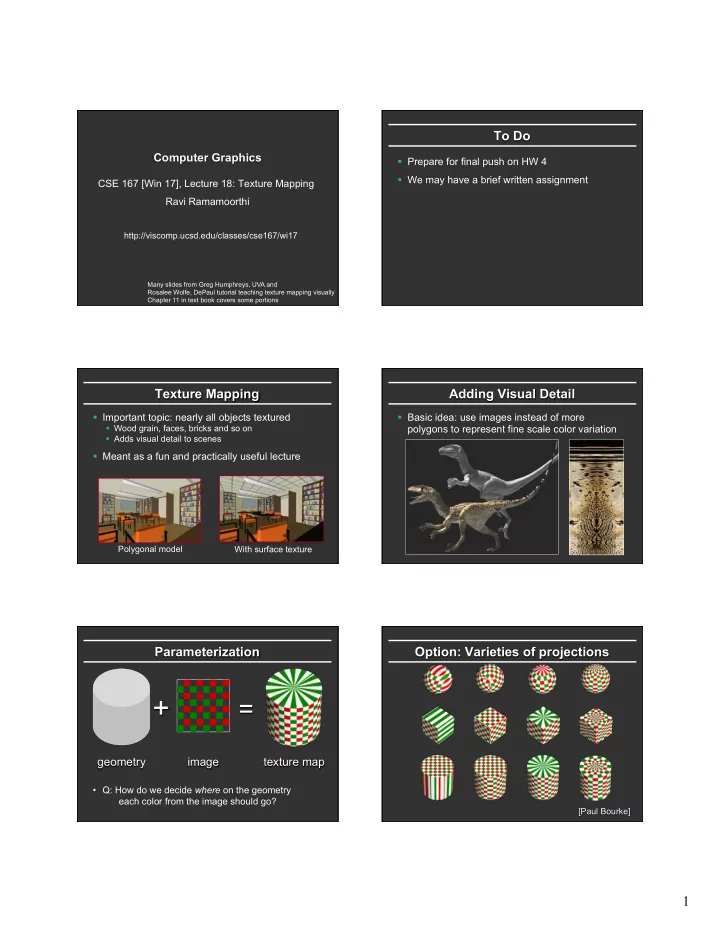
Texture Mapping
§ Important topic: nearly all objects textured
§ Wood grain, faces, bricks and so on § Adds visual detail to scenes
§ Meant as a fun and practically useful lecture
Polygonal model With surface texture
Adding Visual Detail
§ Basic idea: use images instead of more polygons to represent fine scale color variation
Parameterization
geometry
+
=
image texture map
Q: How do we decide where on the geometry each color from the image should go?
Option: Varieties of projections
[Paul Bourke]
SLIDE 2
2
Option: unfold the surface
[Piponi2000]
Option: make an atlas
[Sander2001]
charts atlas surface
Option: it’ ’s the artist’s problem Outline
§ Types of projections § Interpolating texture coordinates § Broader use of textures
How to map object to texture?
§ To each vertex (x,y,z in object coordinates), must associate 2D texture coordinates (s,t) § So texture fits “nicely” over object
Idea: Use Map Shape
§ Map shapes correspond to various projections
§ Planar, Cylindrical, Spherical
§ First, map (square) texture to basic map shape § Then, map basic map shape to object
§ Or vice versa: Object to map shape, map shape to square
§ Usually, this is straightforward
§ Maps from square to cylinder, plane, sphere well defined § Maps from object to these are simply spherical, cylindrical, cartesian coordinate systems
SLIDE 3
3
Planar mapping
§ Like projections, drop z coord (s,t) = (x,y) § Problems: what happens near z = 0?
Cylindrical Mapping
§ Cylinder: r, θ, z with (s,t) = (θ/(2π),z)
§ Note seams when wrapping around (θ = 0 or 2π)
Spherical Mapping
§ Convert to spherical coordinates: use latitude/long.
§ Singularities at north and south poles
Cube Mapping Cube Mapping Outline
§ Types of projections § Interpolating texture coordinates § Broader use of textures
SLIDE 4 4
1st idea: Gouraud interp. of texcoords
Scan line
I1 I2 I3 y1 y2 y3 ys Ia Ib Ia = I1(ys − y2) + I2(y1 − ys) y1 − y2 Ia = I1(ys − y3) + I3(y1 − ys) y1 − y3 Ia = Ia(xb − xp) + Ib(xp − xa) xb − xa I p
Actual implementation efficient: difference equations while scan converting
Artifacts
§ Wikipedia page § What artifacts do you see? § Why? § Why not in standard Gouraud shading? § Hint: problem is in interpolating parameters
Interpolating Parameters
§ The problem turns out to be fundamental to interpolating parameters in screen-space
§ Uniform steps in screen space ≠ uniform steps in world space
Texture Mapping
Linear interpolation
Correct interpolation with perspective divide
Hill Figure 8.42
Interpolating Parameters
§ Perspective foreshortening is not getting applied to
- ur interpolated parameters
§ Parameters should be compressed with distance § Linearly interpolating them in screen-space doesn’t do this
Perspective-Correct Interpolation
§ Skipping a bit of math to make a long story short…
§ Rather than interpolating u and v directly, interpolate u/z and v/z
§ These do interpolate correctly in screen space § Also need to interpolate z and multiply per-pixel
§ Problem: we don’t know z anymore § Solution: we do know w ~ 1/z § So…interpolate uw and vw and w, and compute u = uw/w and v = vw/w for each pixel
§ This unfortunately involves a divide per pixel
§ Wikipedia page
SLIDE 5 5
Texture Map Filtering
§ Naive texture mapping aliases badly § Look familiar?
int uval = (int) (u * denom + 0.5f); int vval = (int) (v * denom + 0.5f); int pix = texture.getPixel(uval, vval);
§ Actually, each pixel maps to a region in texture
§ |PIX| < |TEX|
§ Easy: interpolate (bilinear) between texel values
§ |PIX| > |TEX|
§ Hard: average the contribution from multiple texels
§ |PIX| ~ |TEX|
§ Still need interpolation!
Mip Maps
§ Keep textures prefiltered at multiple resolutions
§ For each pixel, linearly interpolate between two closest levels (e.g., trilinear filtering) § Fast, easy for hardware
§ Why “Mip” maps?
MIP-map Example
§ No filtering: § MIP-map texturing:
AAAAAAAGH MY EYES ARE BURNING Where are my glasses?
Outline
§ Types of projections § Interpolating texture coordinates § Broader use of textures
Texture Mapping Applications
§ Modulation, light maps § Bump mapping § Displacement mapping § Illumination or Environment Mapping § Procedural texturing § And many more
Modulation textures
) ) ) ( ) ( ( ( ) , (
S S T T L L L n S D A A E
I K I K I S R V K L N K I K I t s T I + +
+ =
∑
Map texture values to scale factor
Wood texture Texture value
SLIDE 6 6
Bump Mapping
§ Texture = change in surface normal!
Sphere w/ diffuse texture Swirly bump map Sphere w/ diffuse texture and swirly bump map
Displacement Mapping Illumination Maps
§ Quake introduced illumination maps or light maps to capture lighting effects in video games Texture map: Texture map + light map:
Light map
Environment Maps
Images from Illumination and Reflection Maps: Simulated Objects in Simulated and Real Environments Gene Miller and C. Robert Hoffman SIGGRAPH 1984 “Advanced Computer Graphics Animation” Course Notes
Solid textures
Texture values indexed by 3D location (x,y,z)
Expensive storage, or Compute on the fly, e.g. Perlin noise à
Procedural Texture Gallery
SLIDE 7
7