GeoShred, A New Kind of Musical Instrument Pat Scandalis - - PowerPoint PPT Presentation

geoshred a new kind of musical instrument
SMART_READER_LITE
LIVE PREVIEW

GeoShred, A New Kind of Musical Instrument Pat Scandalis - - PowerPoint PPT Presentation

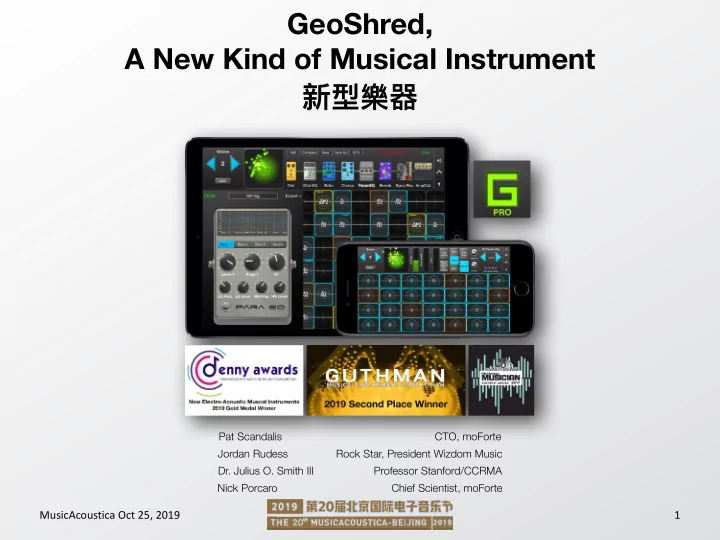
GeoShred, A New Kind of Musical Instrument Pat Scandalis CTO, moForte Jordan Rudess Rock Star, President Wizdom Music Dr. Julius O. Smith III


slide-1
SLIDE 1

MusicAcoustica Oct 25, 2019

GeoShred, A New Kind of Musical Instrument 新型樂器

1

Pat Scandalis CTO, moForte Jordan Rudess Rock Star, President Wizdom Music

  • Dr. Julius O. Smith III Professor Stanford/CCRMA

Nick Porcaro Chief Scientist, moForte

slide-2
SLIDE 2

MusicAcoustica Oct 25, 2019

About Pat

  • 36 years in the Silicon Valley as an

Engineer

  • Built my first monophonic

electronic instrument from a Radio Shack kit in 1970

  • Gigged with an Arp Avatar guitar

synth (1978)

  • Computer modeling of vibrating

strings and membranes for senior thesis in Physics (1982)

  • Researcher in Physical Modeling

at Stanford/CCRMA (1994)

  • CEO/CTO of moForte

2

slide-3
SLIDE 3

MusicAcoustica Oct 25, 2019

This Deck and our Full Deck on Physical Modeling Technology:

3

Go to the “News and Media” section at http://www.moforte.com Or The Full Physical Modeling Deck:

http://www.moforte.com/berklee-voltage-physical-modeling/

This Deck

www.moforte.com/musicacoustica2019

slide-4
SLIDE 4

MusicAcoustica Oct 25, 2019 4

An instrument where a performer can fluidly express multiple independent voices … fingers. An instrument that is both pitch fluid, and helps the performer precisely reach desired musical pitches in any temperament.

Imagine a new kind of musical instrument …

slide-5
SLIDE 5

MusicAcoustica Oct 25, 2019

This is GeoShred

5

GeoShred is an award winning, fluidly expressive musical instrument that runs on multi-touch devices. It has a unique performance surface with an “almost magic” pitch rounding algorithm, which is paired with a physical model

  • f the physics of strings. Further, it’s unique expressive

control can be used to control other synthesizers.

slide-6
SLIDE 6

MusicAcoustica Oct 25, 2019

Why?

6

As performing musicians, what we do, is translate emotional expression, feelings, into musical performance. We wanted to create a new kind of musical instrument that would help performers with musical expression.

slide-7
SLIDE 7

MusicAcoustica Oct 25, 2019

Tens of Thousands of Artists in 48 Countries Perform GeoShred

7

27% of GeoShred Users are in India

slide-8
SLIDE 8

MusicAcoustica Oct 25, 2019 8

Artists

slide-9
SLIDE 9

MusicAcoustica Oct 25, 2019

The GeoShred Story

  • History

Performance Surface + Physical Model

  • GeoShred Performance Surface

Musical Expression

  • Controllable Physical Models


History, GeoShred Model

  • Pro Features

Bringing GeoShred’s expression to other synths

9

slide-10
SLIDE 10

MusicAcoustica Oct 25, 2019 10

History

GeoShred is a collaboration between Rock Star and mobile music innovator 
 Jordan Rudess, 
 Stanford/CCRMA Professor 


  • Dr. Julius O. Smith III, 


Nick Porcaro and 
 Pat Scandalis


slide-11
SLIDE 11

MusicAcoustica Oct 25, 2019

Performance Surface + Physical Model

GeoShred is a fusion of Jordan’s musical performance ideas from an earlier instrument 
 (Geo Synthesizer)
 
 And advanced DSP models of the physics of strings that Julius, Nick and Pat have been working

  • n for the past 35 years


Physical Models have been around for years, unique performance surfaces have been around for years. 
 
 What we did is combine a unique performance surface with a physical model. 


11

slide-12
SLIDE 12

MusicAcoustica Oct 25, 2019

Early Guitar Model (1996)

  • Versions of the model

have been around since 1996 (Sondius)

  • Mobile devices with

sensors and multi- touch screens created a new opportunity to create a performable, expressible version of the model.

12

slide-13
SLIDE 13

MusicAcoustica Oct 25, 2019

Early Guitar Model (1996)

  • Versions of the model

have been around since 1996 (Sondius)

  • Mobile devices with

sensors and multi- touch screens created a new opportunity to create a performable, expressible version of the model.

13

slide-14
SLIDE 14

MusicAcoustica Oct 25, 2019

Geo Synthesizer (2011)

14

Jordan’s ideas about a fluid multi-touch instrument, with pitch rounding were realized in 2011 with Geo Synthesizer, based on sampling.

slide-15
SLIDE 15

MusicAcoustica Oct 25, 2019 15

The Rock Star and the Professor

slide-16
SLIDE 16

MusicAcoustica Oct 25, 2019

Performance Surface and Musical Expression

16

slide-17
SLIDE 17

MusicAcoustica Oct 25, 2019

Keyboard

  • Tuned in 4ths, but can

be any tuning

  • Variable number of

strings and frets

17

slide-18
SLIDE 18

MusicAcoustica Oct 25, 2019

Keyboard

  • Alternate Note Names
  • Any scale, including over 200 ragas
  • Any Temperament

18

slide-19
SLIDE 19

MusicAcoustica Oct 25, 2019

Diatonic Keyboard

  • Only notes in the scale
  • Pitch rounding works

with non-uniform intervals.

  • Makes it possible for

more people to play GeoShred

19

slide-20
SLIDE 20

MusicAcoustica Oct 25, 2019

Pitch Expression (KeyX)

  • The GeoShred Keyboard has

a pitch rounding feature that makes it possible play in tune while sliding fluidly on the glass.

  • Initial touches are always

in-tune.

  • Sliding will seek toward

being in-tune.

  • Pitch Rounding can be

turned off to enable full microtonal performances.

20

slide-21
SLIDE 21

MusicAcoustica Oct 25, 2019

KeyY and KeyZ Expression

  • KeyY and KeyZ are often assigned to a swell
  • r filter sweep.
  • However, they can be assigned to any of ~170

expressive controls in the model

21

slide-22
SLIDE 22

MusicAcoustica Oct 25, 2019

The Physical Model of Strings (and Effects)

22

slide-23
SLIDE 23

MusicAcoustica Oct 25, 2019

What is Physical Modeling Synthesis?

  • Methods in which a sound is

generated using a mathematical model of the physical source of sound.

  • Any gestures that are used to

interact with a real physical system can be mapped to parameters yielded an interactive and expressive performance experience.

  • Physical modeling is a collection
  • f different techniques specific to

each sound generation process.

23

Physics + Math 物理 + 數學

Samples

slide-24
SLIDE 24

MusicAcoustica Oct 25, 2019

  • Chordaphones - Guitars
  • Aerophones - Woodwinds
  • Membranophones - Drums

24

  • Idiophones - Mallet Instruments
  • Electrophones - Virtual Analog
  • Game Sounds
  • Voice

Taxonomy of Modeling Areas

Hornbostel–Sachs Classification

slide-25
SLIDE 25

MusicAcoustica Oct 25, 2019

The Voder (1937-39) - Homer Dudley

  • Analog Electronic

Speech Synthesis

  • Analog model of the

vocal tract

  • Develop from

research on voice compression at Bell Labs.

  • Featured at the 1939

Worlds fair

25

slide-26
SLIDE 26

MusicAcoustica Oct 25, 2019

Kelly-Lochbaum Vocal Tract Model (1961)

26

slide-27
SLIDE 27

MusicAcoustica Oct 25, 2019

Daisy Bell (1961)

  • Daisy Bell
  • Vocal part by Kelly and Lochbaum

(1961)

  • Musical accompaniment by Max

Mathews

  • Computed on an IBM 704
  • Based on Russian speech-vowel data

from Gunnar Fant’s book

  • Probably the first digital physical-

modeling synthesis sound example by any method

  • Inspired Arthur C. Clarke to adapt it for

“2001: A Space Odyssey” the Hal 9000’s “first song”

27

slide-28
SLIDE 28

MusicAcoustica Oct 25, 2019

Karplus-Strong (KS) Algorithm (1983)

28

  • Discovered (1978) as “self-modifying

wavetable synthesis”

  • Wavetable is preferably initialized with

random numbers

  • Licensed to Mattel
  • The first musical use of the algorithm was

in the work “May All Your Children Be Acrobats” written in 1981 by David A. Jaffe.

slide-29
SLIDE 29

MusicAcoustica Oct 25, 2019

EKS Algorithm (Jaffe-Smith 1983)

29

  • Musical Example “Silicon Valley

Breakdown” (Jaffe 1992)

  • Musical Example BWV-1041 (used to

intro the NeXT machine 1988)

slide-30
SLIDE 30

MusicAcoustica Oct 25, 2019

Digital Waveguide Models (Smith 1985)

  • Equivalent to d'Alembert's Solution to

the Partial Differential Equation for a string (1747)

  • Used for the Yamaha VL Family (1994)
  • Shakuhachi, Tenor Sax

30

slide-31
SLIDE 31

MusicAcoustica Oct 25, 2019

Digital Waveguide Models (Smith 1985)

  • Equivalent to d'Alembert's Solution to

the Partial Differential Equation for a string (1747)

  • Used for the Yamaha VL Family (1994)
  • Shakuhachi, Tenor Sax

31

slide-32
SLIDE 32

MusicAcoustica Oct 25, 2019

Sheila Vocal Track Modeling (Cook 1990)

32

Perry Cook’s SPASM "Singing Physical Articulatory Synthesis Model”

slide-33
SLIDE 33

MusicAcoustica Oct 25, 2019

Sheila Vocal Track Modeling (Cook 1990)

33

Perry Cook’s SPASM "Singing Physical Articulatory Synthesis Model”

slide-34
SLIDE 34

MusicAcoustica Oct 25, 2019

Coupled Mode Synthesis (CMS) (Van Duyne) (1996)

  • Modeling of percussion sounds
  • Modal technique with coupling
  • Tibetan Bell Model
  • Wind Chime Model
  • Tubular Bells Model
  • Percussion Ensemble
  • Taiko Ensemble

34

slide-35
SLIDE 35

MusicAcoustica Oct 25, 2019

Coupled Mode Synthesis (CMS) (Van Duyne) (1996)

  • Modeling of percussion sounds
  • Modal technique with coupling
  • Tibetan Bell Model
  • Wind Chime Model
  • Tubular Bells Model
  • Percussion Ensemble
  • Taiko Ensemble

35

slide-36
SLIDE 36

MusicAcoustica Oct 25, 2019

Coupled Mode Synthesis (CMS) (Van Duyne) (1996)

  • Modeling of percussion sounds
  • Modal technique with coupling
  • Tibetan Bell Model
  • Wind Chime Model
  • Tubular Bells Model
  • Percussion Ensemble
  • Taiko Ensemble

36

slide-37
SLIDE 37

MusicAcoustica Oct 25, 2019

Coupled Mode Synthesis (CMS) (Van Duyne) (1996)

  • Modeling of percussion sounds
  • Modal technique with coupling
  • Tibetan Bell Model
  • Wind Chime Model
  • Tubular Bells Model
  • Percussion Ensemble
  • Taiko Ensemble

37

slide-38
SLIDE 38

MusicAcoustica Oct 25, 2019

Coupled Mode Synthesis (CMS) (Van Duyne) (1996)

  • Modeling of percussion sounds
  • Modal technique with coupling
  • Tibetan Bell Model
  • Wind Chime Model
  • Tubular Bells Model
  • Percussion Ensemble
  • Taiko Ensemble

38

slide-39
SLIDE 39

MusicAcoustica Oct 25, 2019

Virtual Analog (Stilson-Smith) (1996)

  • Alias-Free Digital Synthesis of Classic Analog

Waveforms

  • Digital implementation of the Moog VCF. Four

identical one-poles in series with a feedback loop.

  • Sounds great!

39

slide-40
SLIDE 40

MusicAcoustica Oct 25, 2019

Full Ensembles all Physical Modeling (1997)

  • Stanford OTL/CCRMA created

the Sondius project to assist with commercializing physical modeling technologies.

  • The result was a modeling tool

known as SynthBuilder, and a set of models covering about two thirds of the General MIDI set.

  • Many modeling techniques were

used including EKS, Waveguide, Commuted Synthesis, Coupled Mode Synthesis, Virtual Analog.

40

slide-41
SLIDE 41

MusicAcoustica Oct 25, 2019

Full Ensembles all Physical Modeling (1997)

  • Stanford OTL/CCRMA created

the Sondius project to assist with commercializing physical modeling technologies.

  • The result was a modeling tool

known as SynthBuilder, and a set of models covering about two thirds of the General MIDI set.

  • Many modeling techniques were

used including EKS, Waveguide, Commuted Synthesis, Coupled Mode Synthesis, Virtual Analog.

41

slide-42
SLIDE 42

MusicAcoustica Oct 25, 2019

The GeoShred Model

  • A hybrid of Extended Karplus-Strong,

Waveguide, Commuted Synthesis with extensions:

  • Harmonics and pinch harmonics
  • Pre-computed pickup excitations
  • Collisions for fret excitation
  • Sitar Bridge model
  • Body Model
  • Hexaphonic split
  • Doubling of courses
  • Statistical variations
  • Calibrated from real recordings

42

slide-43
SLIDE 43

MusicAcoustica Oct 25, 2019

String Model Physical Parameters

  • Feedback with Deep Dive
  • Material
  • Fret Scraping
  • Harmonics
  • String Scraping
  • Pick Position
  • String Stiffness
  • String Doubling
  • Sitar Bridge
  • Statistical Variations

43

slide-44
SLIDE 44

MusicAcoustica Oct 25, 2019

Effects

  • 21 Build in effects
  • Many are circuit models
  • EQs, Distortions, Wah, Moog

Filter, Phaser, Flangers, Tremolo, Echos, Reverb

  • Any of the 200 parameters in

GeoShred can be tied to musically expressive controls including Key[X|Y|Z], Expression [X|Y] and Sliders

44

slide-45
SLIDE 45

MusicAcoustica Oct 25, 2019

And Support for South Asian Music

45

  • Pitch Rounding

Supports Gamakas

  • Sitar Model with

Sympathetic Strings

  • Svara Note Names
  • 200 Built-in Ragas
  • Sympathetic

Resonator and Tanpura

slide-46
SLIDE 46

MusicAcoustica Oct 25, 2019

Beyond Real

  • Any of the 200

parameters in GeoShred can expressed musically.

  • Multiple Parameters

can be expressed with a single control.

  • Parameters can be

manipulated by a lookup table system called “Curves”.

  • New sounds can be

created that are beyond real.

46

slide-47
SLIDE 47

MusicAcoustica Oct 25, 2019

Pro Features

  • MIDI IN/OUT
  • MPE (MIDI Poly Phonic

Expression) IN/OUT

  • AudioBus
  • InterApp Audio
  • AUv3 Plugin

47

slide-48
SLIDE 48

MusicAcoustica Oct 25, 2019

GeoShred’s Expressive Control Used with other Synthesizers

48

slide-49
SLIDE 49

MusicAcoustica Oct 25, 2019

What Comes Next?

  • Desktops, AU/VST
  • Localization (Chinese First)
  • GeoShred as an instrument
  • platform. More modeling

algorithms from the back room

  • Additional Models
  • Virtual Analog
  • Percussion
  • Woodwinds
  • FM
  • Other
  • Hardware
  • Maybe, Alien Orchestras

49

slide-50
SLIDE 50

MusicAcoustica Oct 25, 2019

Chinese Localization (2020)

50

slide-51
SLIDE 51

MusicAcoustica Oct 25, 2019

Thanks!

51

slide-52
SLIDE 52

MusicAcoustica Oct 25, 2019

Quick Demo

52

slide-53
SLIDE 53

MusicAcoustica Oct 25, 2019

Thanks!

53

And CCRMA

  • Mary Albertson
  • Simone Capitani
  • Chris Chafe
  • John Chowning
  • Perry Cook
  • Jon Dattorro
  • David Jaffe
  • Joe Koepnick
  • Romain Michon
  • Denis Labrecque
  • Scott Levine
  • Fernando Lopez-Lezcano
  • Yann Orlarey
  • Stephane Letz
  • Stanford OTL
  • Danny Petkevich
  • Bill Putnam
  • Danielle Rudess
  • Kent Sandvik
  • Tim Stilson
  • David Van Brink
  • Scott Van Duyne
  • Yamaha
slide-54
SLIDE 54

MusicAcoustica Oct 25, 2019

Anticipated Questions

54

slide-55
SLIDE 55

Why Android is a Challenging Platform for Audio Products Targeted for Musicians

  • Most Android devices have audio 


latency/jitter issues.

  • Roli has measured a Mobile Audio

Quality Index MAQi.

  • With the exception of a few Android

devices, only iOS devices have suitable audio latency/jitter properties

slide-56
SLIDE 56

MusicAcoustica Oct 25, 2019

What about Latency?

  • The largest source of latency (for ios) appears to between

screen interaction and the guitar model. Note that the audio buffer latency is about 5ms.

  • We started at 180ms screen to audio out.
  • We brought this down to 25-35ms by replacing Apple's

gesture handlers with a custom gesture handler. This makes

  • sense. Gesture handling requires analysis of a moderate

amount of state to initiate an action.

  • MIDI to Audio Latency is about 20-30ms.
  • PowerStomp which is audio-in/effects chain/audio out is

around 18ms.

  • Latency to the internal speakers on iOS devices seems to

have gotten a bit poorer over time. Probably due to DSP processing for the head phone jack.

56