Geospace Dynamics Constellation (GDC) Jared Leisner Science and - - PowerPoint PPT Presentation

geospace dynamics constellation gdc
SMART_READER_LITE
LIVE PREVIEW

Geospace Dynamics Constellation (GDC) Jared Leisner Science and - - PowerPoint PPT Presentation

Geospace Dynamics Constellation (GDC) Jared Leisner Science and Technology Definition Team (STDT) GDC Program Scientist NASA Heliophysics Division Kick-off Meeting May 2018 Introduction 1) Welcome 2) STDT Membership 3) Scope of STDT


slide-1
SLIDE 1

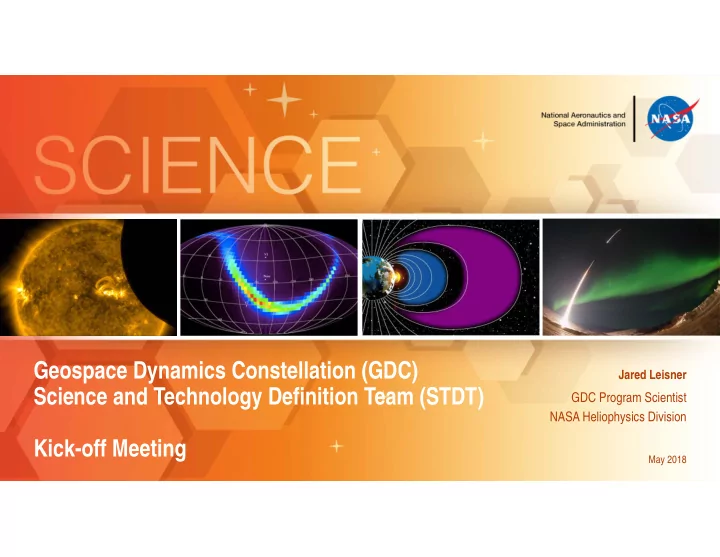
Geospace Dynamics Constellation (GDC) Science and Technology Definition Team (STDT) Kick-off Meeting

Jared Leisner

GDC Program Scientist NASA Heliophysics Division

May 2018
slide-2
SLIDE 2

1) Welcome 2) STDT Membership 3) Scope of STDT Charge 4) STDT Discussions 5) Public Comments

Introduction

2

slide-3
SLIDE 3
  • Welcome to the kick-off of the GDC STDT!
  • We are grateful to the members of the Heliophysics community that have

showed their interest in and enthusiasm for this mission and this STDT.

  • This process could not work without your active participation.

Welcome

3

slide-4
SLIDE 4
  • Yee, Jeng-hwa (Sam) [Co-chair]
  • de la Beaujardiere, Odile [Co-chair]
  • Anderson, Brian
  • Bale, Stuart
  • Bishop, Rebecca
  • Cattell, Cynthia
  • Clemmons, James
  • Connor, Hyunju
  • Dymond, Ken
  • Gelinas, Lynette
  • Goncharenko, Larisa
  • Heelis, Rod
  • Jaynes, Allison
  • Lu, Gang
  • Matsuo, Tomoko
  • Mlynczak, Martin
  • Pfaff, Robert
  • Randall, Cora
  • Ridley, Aaron
  • Zesta, Eftyhia

STDT Membership

4

slide-5
SLIDE 5
  • GDC is the LWS mission recommended by the 2013 Decadal Survey.
  • The DS science questions address the flow of energy from the solar wind through the magnetosphere

and to the ITM system, and the complex interaction between these regions.

  • The STDT is charged with

1. validating and updating the science objectives from the Decadal Survey, and 2. producing design reference missions for GDC, especially for those architectures enabled by technology advances since the Decadal Survey.

  • The STDT’s final report is expected to present multiple mission architectures, with an examination
  • f their scientific returns and trade-offs.
  • This report will be delivered to HPAC, who will convey it intact to Heliophysics Division with a

recommendation of their own.

Scope of STDT Charge

5

slide-6
SLIDE 6
  • At a high level, the STDT’s discussions and report will not involve any

particular matter that could give an individual or institution an advantage in any subsequent NASA activities.

  • All STDT implementation discussions will focus on measurement requirements, without

specifying instruments. The mission design work will use model instruments that are not chosen by the STDT.

  • The RFI responses and other public comments will have references to potential

science payloads or other specific capabilities (e.g. models, ground-based

  • bservatories) redacted. For instance, comments on the need for modeling to link the

multiple observations are welcome, but comments on the merits of particular models have been excluded.

STDT Discussions

6

slide-7
SLIDE 7
  • At this meeting, the STDT’s discussions will focus on the science questions and
  • bjectives.
  • The STDT will start with the Decadal Survey science questions, and will focus down to more

refined science objectives.

  • This includes the consideration of whether any science questions of other Decadal Survey-

recommended missions overlap with GDC and could be met with this mission.

  • At the next meeting, when the objectives are finalized, the STDT will discuss the

measurement requirements.

  • Those measurement requirements will then lead to implementation requirements.
  • e.g. measurement (non-)colocation, pointing requirements, measurement altitude(s)
  • The STDT will then discuss different mission architectures, including their science

trades, before moving on to work on the design reference missions.

STDT Discussions

7

slide-8
SLIDE 8
  • NASA encourages the public to submit material to for the STDT’s

consideration.

  • Members of the public will not be able to comment during this meeting and are

instead encouraged to direct comments to hq-stdt-gdc@mail.nasa.gov. These comments will be conveyed to the STDT and posted on the GDC STDT webpage.

Public Comments

8

slide-9
SLIDE 9

Questions?

9