GI Tumor Board 70yo F without significant PMH presents w/3 months of - - PDF document

gi tumor board
SMART_READER_LITE
LIVE PREVIEW

GI Tumor Board 70yo F without significant PMH presents w/3 months of - - PDF document

3/8/2018 18 th Multidisciplinary Management of Cancers: A Casebased Approach 18 th Multidisciplinary Management of Cancers: A Casebased Approach Case #1 GI Tumor Board 70yo F without significant PMH presents w/3 months of diarrhea and


slide-1
SLIDE 1

3/8/2018 1

18th Multidisciplinary Management of Cancers: A Case‐based Approach

GI Tumor Board

Edward Kim Naseem Esteghamat May Cho Arta Monjazeb George Fisher Daniel Chang Sisi Haraldsdottir George Poultsides Kenzo Hirose Alan Venook Margaret Tempero Andrew Ko Thomas Semrad

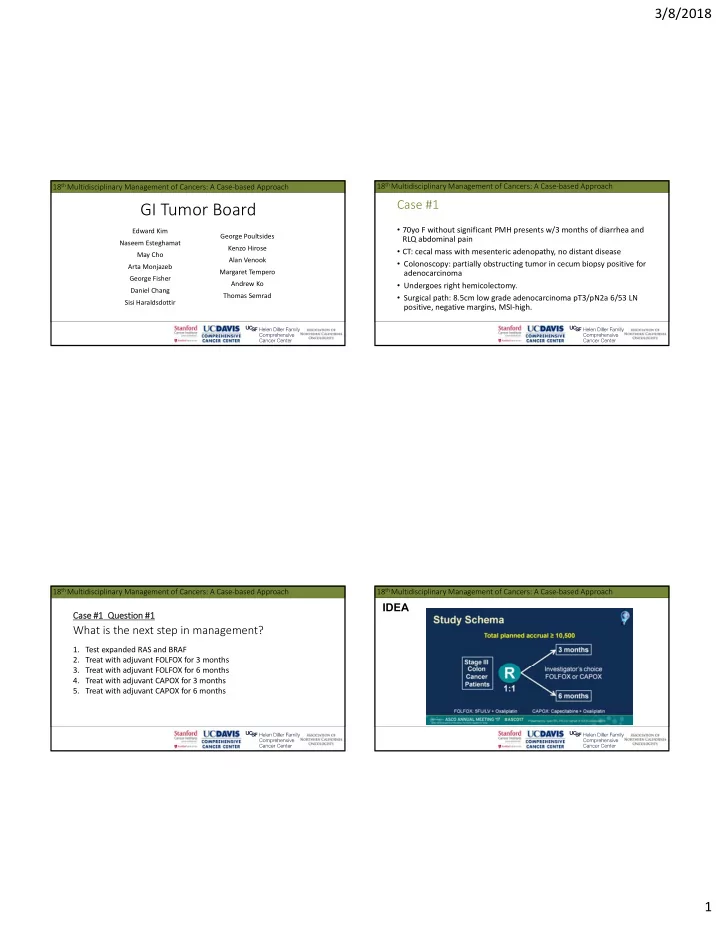
Case #1

  • 70yo F without significant PMH presents w/3 months of diarrhea and

RLQ abdominal pain

  • CT: cecal mass with mesenteric adenopathy, no distant disease
  • Colonoscopy: partially obstructing tumor in cecum biopsy positive for

adenocarcinoma

  • Undergoes right hemicolectomy.
  • Surgical path: 8.5cm low grade adenocarcinoma pT3/pN2a 6/53 LN

positive, negative margins, MSI‐high. 18th Multidisciplinary Management of Cancers: A Case‐based Approach

Case #1 Question #1

What is the next step in management?

  • 1. Test expanded RAS and BRAF
  • 2. Treat with adjuvant FOLFOX for 3 months
  • 3. Treat with adjuvant FOLFOX for 6 months
  • 4. Treat with adjuvant CAPOX for 3 months
  • 5. Treat with adjuvant CAPOX for 6 months

18th Multidisciplinary Management of Cancers: A Case‐based Approach

IDEA

18th Multidisciplinary Management of Cancers: A Case‐based Approach

slide-2
SLIDE 2

3/8/2018 2

3m vs 6m

18th Multidisciplinary Management of Cancers: A Case‐based Approach

Low risk High risk

18th Multidisciplinary Management of Cancers: A Case‐based Approach

FOLFOX CAPOX

18th Multidisciplinary Management of Cancers: A Case‐based Approach

Low risk High risk

FOLFOX CAPOX

18th Multidisciplinary Management of Cancers: A Case‐based Approach

slide-3
SLIDE 3

3/8/2018 3

IDEA Clinical Consensus: Risk-based approach to adjuvant chemotherapy in stage III colon cancer

18th Multidisciplinary Management of Cancers: A Case‐based Approach

Case #1 Question #2

In this patient with stage III colon cancer, would BRAF status change your approach to adjuvant therapy?

  • 1. Yes
  • 2. No

18th Multidisciplinary Management of Cancers: A Case‐based Approach

Case #1 continued

  • Patient completed 6 months of adjuvant

FOLFOX with discontinuation of

  • xaliplatin after cycle 9 due to sensory

neuropathy

  • CT scan 2 months after completion of

adjuvant FOLFOX reveals a 1.8cm liver lesion which on retrospect review may have been faintly present on pre‐

  • perative imaging
  • Molecular profiling reveals RAS wt, BRAF

wt, MSI‐high 18th Multidisciplinary Management of Cancers: A Case‐based Approach

Case #1 Question #3

What is the next step in management?

  • 1. Surgical resection of liver metastasis
  • 2. Liver directed therapy (eg SIRT, RFA, SBRT)
  • 3. FOLFIRI
  • 4. PD‐1 inhibitor

18th Multidisciplinary Management of Cancers: A Case‐based Approach

slide-4
SLIDE 4

3/8/2018 4

18th Multidisciplinary Management of Cancers: A Case‐based Approach

Case #1 Take Home Points

  • In patients with T1‐T3,N1 disease, consider 3 months of adjuvant therapy.

Pre‐planned subgroup analysis showed non‐inferiority of 3 vs 6 months of adjuvant therapy.

  • For patients with T4 or N2 disease, discuss risks and benefits of 3 vs 6

months of adjuvant therapy. Non‐inferiority was not met in this subgroup

  • 3 months confers significantly less neurotoxicity
  • Consider toxicity profiles when deciding between CAPOX AND FOLFOX

18th Multidisciplinary Management of Cancers: A Case‐based Approach

Case #2

A 62yo M w/no significant PMH presents with 3 month history of epigastric pain with associated anorexia. ‐ CT reveals hypodense mass in pancreatic head with >1800 encasement of the superior mesenteric artery ‐ EUS‐FNA confirms pancreatic adenocarcinoma. 18th Multidisciplinary Management of Cancers: A Case‐based Approach

Case #2 Question #1

What is the next step in management?

  • 1. Start FOLFIRINOX
  • 2. Start gemcitabine/nab‐paclitaxel
  • 3. Radiation oncology consultation
  • 4. Surgical oncology consultation

18th Multidisciplinary Management of Cancers: A Case‐based Approach

slide-5
SLIDE 5

3/8/2018 5

18th Multidisciplinary Management of Cancers: A Case‐based Approach 18th Multidisciplinary Management of Cancers: A Case‐based Approach

Case #2 Clinical Course

  • Patient receives 6 months of gemcitabine/nab‐paclitaxel
  • CT scans after 2 and 4 months of treatment showed stable disease
  • Patient developed grade 3 sensory neuropathy and nab‐paclitaxel is

discontinued during cycle 6

  • CT scan after 6th month still showed stable disease and no evidence of

distant disease 18th Multidisciplinary Management of Cancers: A Case‐based Approach

Case #2 Question #2

What is the next step in management?

  • 1. Surgical resection
  • 2. Chemoradiation
  • 3. SBRT
  • 4. Continue chemotherapy with gemcitabine alone
  • 5. Continue chemotherapy but change regimen
  • 6. Treatment break

18th Multidisciplinary Management of Cancers: A Case‐based Approach

slide-6
SLIDE 6

3/8/2018 6

LAP07

  • Assess OS with chemotherapy vs chemoradiotherapy in locally

advanced pancreatic cancer with progression‐free disease after gemcitabine based therapy

  • Evaluate effect of Erlotinib on OS in locally advanced pancreatic

cancer

  • Gemcitabine vs Gemcitabine + Erlotinib

18th Multidisciplinary Management of Cancers: A Case‐based Approach

LAP07

Hammel, P et al. “2016. JAMA. 315(17); 1844‐1853.

18th Multidisciplinary Management of Cancers: A Case‐based Approach

Case #2 Clinical Course

  • Patient elected to take a break from chemotherapy
  • Subsequent imaging about 4 months later shows metastatic

progression to the liver and peritoneum

  • He continues to have symptomatic sensory neuropathy

18th Multidisciplinary Management of Cancers: A Case‐based Approach

Case #2 Question #3

What is the next step in management?

  • 1. FOLFIRNOX
  • 2. FOLFIRI
  • 3. FOLFOX
  • 4. 5FU/nanoliposomal‐irinotecan

18th Multidisciplinary Management of Cancers: A Case‐based Approach

slide-7
SLIDE 7

3/8/2018 7

NAPOLI‐1

18th Multidisciplinary Management of Cancers: A Case‐based Approach

NAPOLI‐1 ‐ OS

18th Multidisciplinary Management of Cancers: A Case‐based Approach

Case #2 Take Home Points

  • There is no standard of care best option for locally advanced pancreatic

adenocarcinoma

  • Both frontline regimens of FOLFIRINOX and Gem/nab‐paclitaxel are reasonable options

based on extrapolation from randomized trial data in the metastatic setting

  • Chemoradiotherapy has not been proven to improve OS compared to chemotherapy

alone in locally advanced pancreatic cancer following gemcitabine based therapy

  • Nanoliposomal Irinotecan in combination with fluorouracil extends survival in patients

with metastatic pancreatic ductal adenocarcinoma who previously received gemcitabine‐based chemotherapy – compared to fluorouracil.

18th Multidisciplinary Management of Cancers: A Case‐based Approach

Case #3

  • 63yo woman presents with fatigue and

jaundice

  • CT scan reveals biliary dilation and mass

distally

  • ERCP confirms a CBD stricture and

brushings are positive for adenocarcinoma

  • ECOG PS 0

18th Multidisciplinary Management of Cancers: A Case‐based Approach

slide-8
SLIDE 8

3/8/2018 8

Case #3 Question #2

What is the next step in management?

  • 1. Chemotherapy – gemcitabine and cisplatin
  • 2. Chemoradiation with capecitabine
  • 3. Surgery

18th Multidisciplinary Management of Cancers: A Case‐based Approach

Case #3 followup

  • Patient undergoes whipple resection
  • Pathology confirms a 2.5cm moderately differentiated extrahepatic

cholangiocarcinoma

  • 1/18 Lymph nodes are positive
  • Negative margins

18th Multidisciplinary Management of Cancers: A Case‐based Approach

Case #3 Question #2

What is the next step in management?

  • 1. Chemotherapy – capecitabine
  • 2. Chemotherapy – gemcitabine and cisplatin
  • 3. Chemotherapy with gemcitabine/capecitabine ‐> chemoradiation

with capecitabine

  • 4. Chemoradiation with capecitabine

18th Multidisciplinary Management of Cancers: A Case‐based Approach

BILCAP

18th Multidisciplinary Management of Cancers: A Case‐based Approach

slide-9
SLIDE 9

3/8/2018 9

BILCAP

18th Multidisciplinary Management of Cancers: A Case‐based Approach

Future directions

  • ACTICCA‐1 – adjuvant therapy for resected cholangio or GB cancer
  • riginal design = gem/cis vs placebo

‐> based on BILCAP ‐> gem/cis vs capecitabine Primary endpoint ‐ DFS 18th Multidisciplinary Management of Cancers: A Case‐based Approach

Case #3 Take Home Points

  • Capecitabine improves median overall survival compared to

surveillance in patients with biliary tract cancer following macroscopic complete resection

  • Unclear whether multi‐drug regimens and incorporation of

chemoradiation add benefit in the adjuvant setting

18th Multidisciplinary Management of Cancers: A Case‐based Approach

Case #4

  • 62 yo woman presents with upper GI bleeding
  • EGD reveals a large ulcerative gastric mass positive for

adenocarcinoma

  • EUS reveals T3N1 disease
  • Diagnostic laparoscopic evaluation with cytology of peritoneal

washings is negative 18th Multidisciplinary Management of Cancers: A Case‐based Approach

slide-10
SLIDE 10

3/8/2018 10

Case #4 Question #1

What is the next step in management?

  • 1. Surgery
  • 2. ECF
  • 3. EOX
  • 4. FOLFOX
  • 5. FLOT
  • 6. chemoradiation

18th Multidisciplinary Management of Cancers: A Case‐based Approach

MAGIC Trial – Perioperative Chemotherapy

18th Multidisciplinary Management of Cancers: A Case‐based Approach

MAGIC ‐> FLOT

18th Multidisciplinary Management of Cancers: A Case‐based Approach

FLOT FLTO FTLO FTOL FOLT FOTL TFLO TFOL TLOF TLFO TOLF TOFL OLFT OLTF OTLF OTFL OFLT OFTL LFTO LFOT LTOF LTFO LOTF LOFT

18th Multidisciplinary Management of Cancers: A Case‐based Approach

slide-11
SLIDE 11

3/8/2018 11

FLOT4 ‐ Toxicity

18th Multidisciplinary Management of Cancers: A Case‐based Approach 18th Multidisciplinary Management of Cancers: A Case‐based Approach

UK OE05 Trial of neoadjuvant chemo

18th Multidisciplinary Management of Cancers: A Case‐based Approach

UK OE05 Trial of neoadjuvant chemo

18th Multidisciplinary Management of Cancers: A Case‐based Approach

slide-12
SLIDE 12

3/8/2018 12

Case #4 Clinical Course

  • Patient received FOLFOX with perioperative intent
  • Repeat imaging shows stable to slight improvement
  • She undergoes surgical resection
  • Pathology reveals a Tumor Regression Score of 3 = Poor response
  • Minimum or no treatment effect; extensive residual cancer cells

18th Multidisciplinary Management of Cancers: A Case‐based Approach

Case #4 Question #2

What is the next step in management?

  • 1. Adjuvant chemo – same regimen as pre‐operative
  • 2. Adjuvant chemo – switch regimen to different from pre‐operative
  • 3. No adjuvant therapy
  • 4. Chemoradiation

18th Multidisciplinary Management of Cancers: A Case‐based Approach

Case #4 Take Home Points

  • FLOT chemotherapy is a new peri‐operative chemotherapy regimen
  • ption for gastric cancer
  • Based on toxicity profile – select patients carefully
  • True benefit of adjuvant component of perioperative therapy remains

unclear 18th Multidisciplinary Management of Cancers: A Case‐based Approach