SLIDE 1
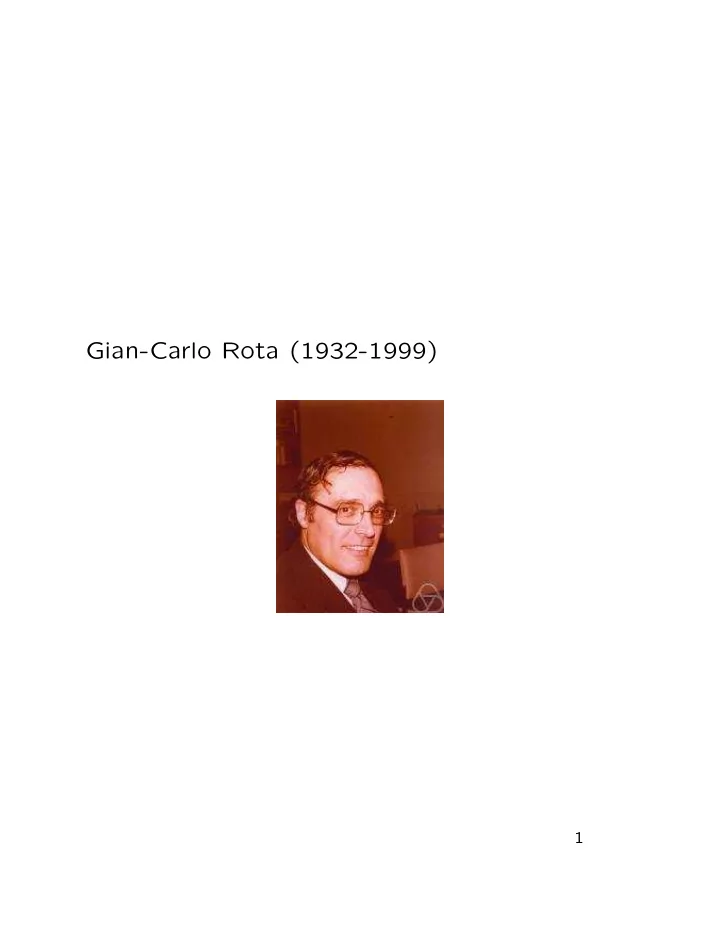
Gian-Carlo Rota (1932-1999)
1
SLIDE 2
From the 2004 OU MathDay Math Olympics: Problem: Name a famous mathematician. College version: Problem: Name a famous 20th-century math- ematician. One Possible Solution: Gian-Carlo Rota
2
SLIDE 3
Rota at work
3
SLIDE 4
–Born in Vigevano, Italy in 1932. –Rota was the son of an anti-Fascist who was condemned to death by Mussolini. The father and his family escaped by crossing over the Alps to Switzerland. –Rota came to the US in 1950 to be an under- graduate at Princeton, and received his doctor- ate from Yale in 1956. He became a US citizen in 1961. –After postdoctoral positions at Courant Insti- tute and Harvard, he went to MIT and was a professor there for the rest of his life. He held many visiting positions, and spent a lot of time at the Los Alamos National Laboratory.
4
SLIDE 5 –Published more than 150 articles. –Supervised 46 doctoral students. –Received many honors and awards, including the Steele prize in 1988. –Founded Journal of Combinatorial Theory in 1965, and Advances in Mathematics in 1967. All of these are outstanding achievements, but there are quite a few 20th-century mathemati- cians who had similar accomplishments, yet are not well-known outside of their own research
- specialities. Why is Rota truly famous in the
general mathematical community?
5
SLIDE 6 Rota’s writing Rota wrote extensively about mathematics and mathematicians. Many of his essays are col- lected in the book Indiscrete Thoughts, from which I took the passages that I will show you. A good summary of Rota’s writing style is given by Reuben Hirsch in his introduction to Indiscrete Thoughts: “He loves contradiction. He loves to
- shock. He loves to simultaneously en-
tertain you and make you uncomfort- able.”
6
SLIDE 7 Review of the book Sphere Packings, Lattices and Groups, by J. H. Conway and N. J. A. Sloane: This is the best survey of the best work in one
- f the best fields of combinatorics, written by
the best people. It will make the best read- ing by the best students interested in the best mathematics that is now going on. Review of another book called Recent philoso- phers: When pygmies cast long shadows, it must be late in the day.
7
SLIDE 8 Rota thought deeply about the nature of math- ematics itself. We will start with an example
- f his writing about mathematics, taken from
- ne of his essays. It is characteristically full of
surprises, contradictory arguments, and bold statements to challenge our preconceptions. It concerns the perennial question of whether mathematics is “invented” or “discovered”. It also introduces one of Rota’s recurring themes: that mathematical advances are eventually re- fined and abstracted until finally they are seen to be “trivial.” (Note: In his writing, Rota often used very complex syntax, unusual vocabulary, phrases from other languages, and so on. To make the text more suitable for this presentation, I have simplified his original writing in places.)
8
SLIDE 9
Are mathematical ideas invented or discovered? This question has been repeatedly posed by philosophers through the ages and will proba- bly be with us forever. We will not be con- cerned with the answer. What matters is that by asking the question, we acknowledge that mathematics has been leading a double life.
9
SLIDE 10 In the first of its lives, mathematics deals with facts, like any other science. It is a fact that the altitudes of a triangle meet at a point; it is a fact that there are only seventeen kinds of symmetry in the plane; it is a fact that every finite group of odd order is solvable. The work
- f a mathematician consists of dealing with
such facts in various ways. . . In its second life, mathematics deals with proofs. A mathematical theory begins with definitions and derives its results from clearly agreed-upon rules of inference. Every fact of mathemat- ics must be put into an axiomatic theory and formally proved if it to be accepted as true. Axiomatic exposition is indispensable in math- ematics because the facts of mathematics, un- like the facts of physics, cannot be experimen- tally verified.
10
SLIDE 11 We have sketched two seemingly clashing con- cepts of mathematical truth. Both concepts force themselves upon us when we observe the development of mathematics. The first concept is similar to the classical con- cept of the truth of a law of natural science. According to this first view, mathematical the-
- rems are statements of fact; like all facts
- f science, they are discovered by observation
and experimentation. It matters little that the facts of mathematics might be “ideal,” while the laws of nature might be “real.” Whether real or ideal, the facts of mathematics are out there in the world and are not creations of someone’s mind.
11
SLIDE 12 The second view seems to lead to the opposite
- conclusion. Proofs of mathematical theorems,
such as the proof of the Prime Number The-
- rem, are achieved at the cost of great intel-
lectual effort. They are then gradually whit- tled down to trivialities. Doesn’t the process
- f simplification that transforms a fifty-page
proof into a half-page argument support the assertion that theorems of mathematics are creations of our own intellect? Every mathematical theorem is eventually proved
- trivial. The mathematician’s ideal of truth is
triviality, and the community of mathemati- cians will not cease its beaver-like work on a newly discovered result until it has shown to everyone’s satisfaction that all difficulties in the early proofs were merely shortcomings of understanding, and only an analytic triviality is to be found at the end of the road.
12
SLIDE 13 Rota thought a lot about different kinds of
- mathematicians. For example:
Mathematicians can be subdivided into two types: problem solvers and theorizers. Most mathematicans are a mixture of the two, al- though it is easy to find extreme examples of both types.
13
SLIDE 14
To the problem solver, the supreme achieve- ment in mathematics is the solution to a prob- lem that had been given up as hopeless. It matters little that the solution may be clumsy; all that counts is that it should be first and that the proof be correct. Once the problem solver finds the solution, he will permanently lose in- terest in it, and will listen to new and simplified proofs with an air of boredom. For him, math- emtics consists of a sequence of challenges to be met, an obstacle course of problems. To the problem solver, mathematical exposi- tion is regarded as an inferior undertaking. New theories are viewed with deep suspicion, as in- truders who must prove their worth by posing challenging problems before they can gain at- tention. The problem solver resents general- izations, especially those that may succeed in trivializing the solution of one of his problems.
14
SLIDE 15 To the theorizer, the supreme achievement of mathematics is a theory that sheds sudden light
- n some incomprehensible phenomenon. Suc-
cess in mathematics does not lie in solving problems but in their trivialization. The mo- ment of glory comes with the discovery of a new theory that does not solve any of the old problems, but renders them irrelevant. To the theorizer, mathematical concepts re- ceived from the past are regarded as imperfect instances of more general ones yet to be dis-
- covered. To the theorizer, the only mathemat-
ics that will survive are the definitions. Theo- rems are tolerated as a necessary evil since they play a supporting role— or rather, as the theo- rizer will reluctantly admit, an essential role— in the understanding of definitions.
15
SLIDE 16
If I were a space engineer looking for a mathe- matician to help me send a rocket into space, I would choose a problem solver. But if I were looking for a mathematician to give a good education to my child, I would unhesitatingly prefer a theorizer.
16
SLIDE 17 Rota was very interested in the teaching of mathematics. The following passage is from an essay on “beauty in mathematics.” Note how Rota connects this topic with the chal- lenges of teaching mathematics, then ends on an unexpectedly dark note: The beauty of a piece of mathematics is fre- quently associated with shortness of statement
How we wish that all beauti- ful pieces of mathematics shared the snappy immediacy of Picard’s theorem. This wish is rarely fulfilled. A great many beautiful argu- ments are long-winded and require extensive buildup. Familiarity with a huge amount of background material is the condition for un- derstanding mathematics. A proof is viewed as beautiful only after one is made aware of previous clumsier proofs.
17
SLIDE 18
Despite the fact that most proofs are long, despite our need for extensive background, we think back to instances of appreciation of math- ematical beauty as if they had been perceived in a moment of bliss, in a sudden flash like a light bulb suddenly being lit. The effort put into understanding the proof, the background material, the difficulties encountered in unrav- eling an intricate sequence of inferences fade and magically disappear the moment we be- come aware of the beauty of a theorem. The painful process of learning fades from memory and only the flash of insight remains.
18
SLIDE 19 We would like mathematical beauty to con- sist of this flash; mathematical beauty should be appreciated with the instantaneousness of a light bulb being lit. But it is an error to pretend that the appreciation of mathematical beauty is what we feel it should be, an instantaneous
- flash. This denial of factual truth occurs much
too frequently. The light bulb mistake is often taken as a paradigm in teaching mathematics. Forgetful
- f our learning pains, we demand that our stu-
dents display a flash of understanding with ev- ery argument we present. Worse yet, we mis- lead our students by trying to convince them that such flashes of understanding are the core
- f mathematical appreciation.
Every good teacher knows that students will not learn by merely grasping the formal truth
- f a statement. A mathematical theorem may
be enlightening or not, just as it may be true
19
SLIDE 20 If the statements of mathematics were formally true but in no way enlightening, mathematics would be a curious game played by weird peo-
- ple. Enlightenment is what keeps the mathe-
matical enterprise alive. Mathematicians seldom acknowledge the phe- nomenon of enlightenment for at least two rea-
- sons. First, unlike truth, enlightenment is not
easily formalized. Second, enlightenment ad- mits degrees: some statements are more en- lightening than others. Mathematicians dis- like concepts admitting degrees, and will go to great lengths to deny the logical role of any such concept. Mathematical beauty is the ex- pression mathematicians have invented in order to obliquely admit the phenomenon of enlight- enment while avoiding acknowledgment of the fuzziness of this phenomenon. They say that a theorem is beautiful when what they really mean is that the theorem is enlightening.
20
SLIDE 21
The term “mathematical beauty,” together with the light bulb mistake, is a trick mathemati- cians have devised to avoid facing up to the messy phenomenon of enlightenment. It is a copout, one step in a cherished activity of mathematicians, that of building a perfect world immune to the messiness of the ordinary world, a world where what we think should be true turns out to be true, a world that is free from the disappointment, the ambiguities, the fail- ures of that other world in which we live.
21
SLIDE 22
Rota’s advice: 1. Every lecture should make only one main point. Every lecture should state one main point and repeat it over and over, like a theme with vari- ations. An audience is like a herd of cows, moving slowly in the direction they are being driven towards. If we make one main point, we have a good chance that the audience will take the right direction; if we make several points, then the cows will scatter all over the field. The audience will lose interest and everyone will go back to the thoughts they interrupted in order to come to the lecture.
22
SLIDE 23
Running overtime is the one unforgivable error a lecturer can make. After fifty minutes (one microcentury, as von Neumann used to say) everybody’s attention will turn elsewhere even if we are trying to prove the Riemann hypothe-
- sis. One minute overtime can destroy the best
- f lectures.
- 3. Give them something to take home.
I often meet, in airports, in the street and oc- casionally in embarrassing situations, alumni who have taken one or more courses from me. Most of the time they admit that they have forgotten the subject of the course, and all the mathematics I thought I had taught them. However, they will gladly recall some joke, some anecdote, some quirk, some side remark, or some mistake I made.
23
SLIDE 24
- 4. Make sure the blackboard is spotless.
It is particularly important to erase those dis- tracting whirls that are left when we run the eraser over the blackboard in a non-uniform fashion. By starting with a spotless blackboard, you will subtly convey the impression that the lecture they are about to hear is equally spotless.
- 5. Be prepared for old age.
My late friend Stan Ulam used to remark that his life was sharply divided into two halves. In the first half, he was always the youngest per-
- ns in the group; in the second half, he was
always the oldest. There was no transitional period.
24
SLIDE 25 I now realize how right he was. The etiquette
- f old age does not seem to have been writ-
ten up, and we have to learn it the hard way. It depends on a basic realization, which takes time to adjust to. You must realize that, af- ter reaching a certain age, you are no longer viewed as a person. You become an institution, and you are expected to behave like a piece of period furniture or an architectural landmark. It matters little whether you keep publishing or
- not. If your papers are no good, they will say,
“What did you expect, at his age?” and if an
- ccasional paper of yours is found to be inter-
esting, they will say, “What did you expect? He has been working at this all his life!” The
- nly sensible response is to enjoy playing your
newly-found role as an institution.
25
SLIDE 26
You are not alone in believing that your own field is better than those of your colleagues. We all believe the same about our own fields. Remember, when talking to outsiders, have nothing but praise for your colleagues in all fields, even for those in combinatorics [Rota’s field]. All public shows of disunity are ulti- mately harmful to the well-being of mathemat- ics. 7. Remember that even the grocery bill is a piece of mathematics Once, during a year at a liberal arts college, I was assigned to teach a course on “Mickey Mouse math.” I was stung by a colleague’s remark that the course “did not deal with real mathematics.” But the grocery bill, a com- puter program, and class field theory are three instances of mathematics.
26
SLIDE 27
- 8. Do not look down on good teachers
Mathematics is the greatest undertaking of man-
- kind. All mathematicians know this. Yet many
people do not share this view, and consequently most of our income will have to come from teaching. And the more students we teach, the more of our friends we can appoint to our department. Those few colleagues who are successful at teaching undergraduate courses should earn our thanks as well as our respect. It is counterproductive to turn up our noses at those who bring home the dough. When Mr. Smith dies and decides to leave his fortune to our mathematics department, it will be because he remembers his good teacher
- Dr. Jones, not because of all the research pa-
pers you have written.
27