Goals of Program Optimization (1 of 2) Goal: Improve program - - PowerPoint PPT Presentation

goals of program optimization 1 of 2
SMART_READER_LITE
LIVE PREVIEW

Goals of Program Optimization (1 of 2) Goal: Improve program - - PowerPoint PPT Presentation

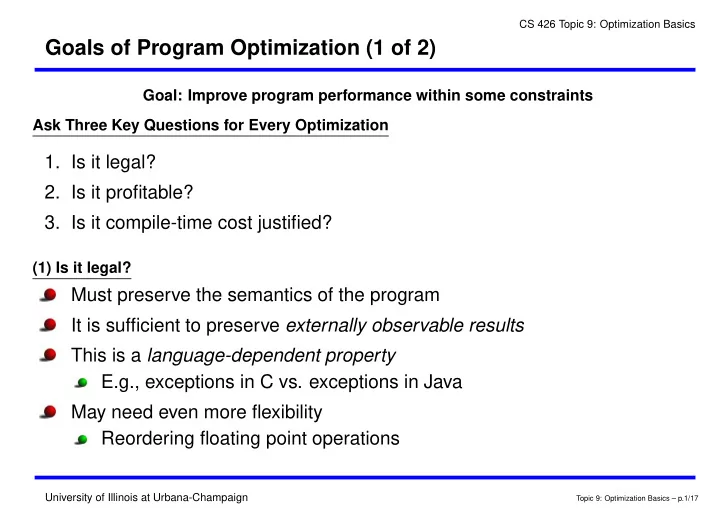
CS 426 Topic 9: Optimization Basics Goals of Program Optimization (1 of 2) Goal: Improve program performance within some constraints Ask Three Key Questions for Every Optimization 1. Is it legal? 2. Is it profitable? 3. Is it compile-time cost


slide-1
SLIDE 1

CS 426 Topic 9: Optimization Basics University of Illinois at Urbana-Champaign

Goals of Program Optimization (1 of 2)

Goal: Improve program performance within some constraints Ask Three Key Questions for Every Optimization

  • 1. Is it legal?
  • 2. Is it profitable?
  • 3. Is it compile-time cost justified?

(1) Is it legal?

Must preserve the semantics of the program It is sufficient to preserve externally observable results This is a language-dependent property E.g., exceptions in C vs. exceptions in Java May need even more flexibility Reordering floating point operations

Topic 9: Optimization Basics – p.1/17

slide-2
SLIDE 2

CS 426 Topic 9: Optimization Basics University of Illinois at Urbana-Champaign

Goals of Program Optimization (2 of 2)

(2) Is it profitable?

Improve performance of average or common case Limit negative impact in cases where performance is reduced Predicting performance impact is often non-trivial Choosing profitable optimization sequences is a major challenge

(3) Is its compile-time cost justified?

The list of possible optimizations is huge It is easy to go overboard: try everything Must be justified by performance gain E.g., whole-program (interprocedural) optimizations usually O4

Topic 9: Optimization Basics – p.2/17

slide-3
SLIDE 3

CS 426 Topic 9: Optimization Basics University of Illinois at Urbana-Champaign

Classifying Optimizations (1 of 2)

We can classify optimizations along 3 axes (1) By scope Local ≡ within a single basic block Peephole ≡ on a window of instructions Loop-level ≡ on one or more loops or loop nests Global ≡ for an entire procedure Interprocedural ≡ across multiple procedures or whole program

(2) By machine information used

Machine-independent ≡ uses no machine-specific information Machine-dependent ≡ otherwise

Topic 9: Optimization Basics – p.3/17

slide-4
SLIDE 4

CS 426 Topic 9: Optimization Basics University of Illinois at Urbana-Champaign

Classifying Optimizations (2 of 2)

(3) By effect on structure of program:

Algebraic transformations ≡ uses algebraic properties E.g., identities, commutativity, constant folding . . . Code simplification transformations ≡ simplify complex code sequences Control-flow simplification ≡ simplify branch structure Computation simplification ≡ replace expensive instructions with cheaper ones (e.g., constant propagation) Code elimination transformations ≡ eliminates unnecessary computations DCE, Unreachable code elimination Redundancy elimination transformations ≡ eliminate repetition Local or global CSE, LICM, Value Numbering, PRE Reordering transformations ≡ changes the order of computations Loop transformations ≡ change loop structure Code scheduling ≡ reorder machine instructions

Topic 9: Optimization Basics – p.4/17

slide-5
SLIDE 5

CS 426 Topic 9: Optimization Basics University of Illinois at Urbana-Champaign

Topics in Program Optimization

  • 1. A catalog of local and peephole optimizations

focus on What, not How

  • 2. Control flow graph and loop structure
  • 3. Global dataflow analysis

2 example dataflow problems (a) reaching definitions (b) available expressions (c) live variables (d) def-use and use-def chains

  • 4. Some key global optimizations

Sparse Conditional Constant Propagation (SCCP) Loop-Invariant Code Motion (LICM) Global Common Subexpression Elimination (GCSE)

Topic 9: Optimization Basics – p.5/17

slide-6
SLIDE 6

CS 426 Topic 9: Optimization Basics University of Illinois at Urbana-Champaign

Local and Peephole Optimizations (1 of 3)

(1) Unreachable code elimination

Code after an unconditional jump and with no branches to it Code in a branch never taken (Often eliminated during global constant propagation)

(2) Flow-of-control optimizations

If simplification: constant conditions, nested equivalent conditions Straightening: merge basic blocks that are always consecutive Branch folding: unconditional jump to unconditional jump conditional jump to unconditional jump unconditional jump to conditional jump

Topic 9: Optimization Basics – p.6/17

slide-7
SLIDE 7

CS 426 Topic 9: Optimization Basics University of Illinois at Urbana-Champaign

Local and Peephole Optimizations (2 of 3)

(3) Algebraic simplifications

exploit algebraic identities, commutativity, . . .

x + 0, y ∗ 1, 18 ∗ z ∗ 14

(4) Redundant instruction elimination

Redundant loads and stores: LD a → R0 ST R0 → a Usually caused by compiler-generated code Conditional branch always taken Usually caused by global constant propagation

Topic 9: Optimization Basics – p.7/17

slide-8
SLIDE 8

CS 426 Topic 9: Optimization Basics University of Illinois at Urbana-Champaign

Local and Peephole Optimizations (3 of 3)

(5) Reduction in strength

Replace x2 by x ∗ x Replace 2n ∗ x by x << n if integer x Replace x/4 by x ∗ 0.25 if real division

(6) Machine idioms and Instruction Combining

(Or could be done during Instruction Selection, e.g., with Burg) Multiply-Add instruction: r3 ← r3 + r1 ∗ r2 Auto-increment or auto-decrement addressing modes Conditional move instructions Predicated instructions See Section 18.1.1 in Muchnick’s book for some strange idioms

Topic 9: Optimization Basics – p.8/17

slide-9
SLIDE 9

CS 426 Topic 9: Optimization Basics University of Illinois at Urbana-Champaign

Flow Graphs

A fundamental representation for global optimizations. Definitions Flow Graph: A triple G=(N,A,s), where (N,A) is a (finite) directed graph, s ∈ N is a

designated “initial” node, and there is a path from node s to every node

n ∈ N.

Entry node: A node with no predecessors. Exit node: A node with no successors. Properties

There is a unique entry node, which must be s (Reachability assumption) Assumption is safe: can delete unreachable code Assumption may be conservative: some branches never taken. Control Flow Graphs are usually sparse. That is, | A |= O(| N |). In fact, if

  • nly binary branching is allowed | A |≤ 2 | N |.

Topic 9: Optimization Basics – p.9/17

slide-10
SLIDE 10

CS 426 Topic 9: Optimization Basics University of Illinois at Urbana-Champaign

Control Flow Graphs

Definitions

Review slides on Control Flow Graphs in the IR lecture

CFG Construction :

Read Section 8.4.1 of Aho et al. for the algorithm to partition a procedure into basic blocks. This is required material.

Topic 9: Optimization Basics – p.10/17

slide-11
SLIDE 11

CS 426 Topic 9: Optimization Basics University of Illinois at Urbana-Champaign

Dominance in Flow Graphs

Let d, d1, d2, d3, n be nodes in G.

Definitions

d dominates n (write “d dom n”) iff every path in G from s to n contains d. d properly dominates n if d dominates n and d = n.

Properties

s dom d, ∀ nodes d in G.

Partial Ordering: The dominance relation of a flow graph G is a partial

  • rdering:

Reflexive : n dom n is true ∀ n. Antisymmetric : If d dom n, then n dom d cannot hold. Transitive : d1 dom d2 ∧ d2 dom d3 =

⇒ d1 dom d3

Topic 9: Optimization Basics – p.11/17

slide-12
SLIDE 12

CS 426 Topic 9: Optimization Basics University of Illinois at Urbana-Champaign

Immediate Dominance

More Properties

The dominators of a node form a chain: If d1 dom n and d2 dom n and d1 = d2, then: it must hold that d1 dom d2 or d2 dom d1.

= ⇒ “Last” dominator for every node n = s (on any path) is unique

Definition

d is the immediate dominator of n (write “d idom n”) if d is the last dominator on any

path from initial node to n, d = n

Topic 9: Optimization Basics – p.12/17

slide-13
SLIDE 13

CS 426 Topic 9: Optimization Basics University of Illinois at Urbana-Champaign

Dominator Tree

Drawing Dominators as A Graph

Given a flow graph G, construct a new graph with the same nodes as G, and an edge n1 → n2 iff n1 dom n2.

  • Q. What is the shape of this graph?

Given a flow graph G, construct a new graph with the same nodes as G, and an edge n1 → n2 iff n1 idom n2.

  • Q. What is the shape of this graph?

Definition The latter graph defined above is called the Dominator Tree. Properties

The root of the Dominator Tree is s. Every node except s has exactly one immediate dominator → its parent in the Dominator Tree

Topic 9: Optimization Basics – p.13/17

slide-14
SLIDE 14

CS 426 Topic 9: Optimization Basics University of Illinois at Urbana-Champaign

Defining loops in Flow Graphs

Naive definitions of a loop in a control flow graph

A cycle identifies a loop? A strongly connected component (SCC) identifies a loop?

Why Defining Loops is Challenging

Easy case: Structured nested loops: FOR or WHILE Harder case: Arbitrary flow and exits in loop body, but unique loop “entry” Hardest case: No unique loop “entry” (“irreducible loops”)

Topic 9: Optimization Basics – p.14/17

slide-15
SLIDE 15

CS 426 Topic 9: Optimization Basics University of Illinois at Urbana-Champaign

Defining Loops

Idea: Use dominance to define Natural Loops Back Edge : An edge n → d where d dom n Natural Loop : Given a back edge, n → d, the natural loop corresponding to n → d

is the set of nodes {d + all nodes that can reach n without going through d}

Loop Header: A node d that dominates all nodes in the loop

Header is unique for each natural loop Why?

⇒ d is the unique entry point into the loop

Uniqueness is very useful for many optimizations

Topic 9: Optimization Basics – p.15/17

slide-16
SLIDE 16

CS 426 Topic 9: Optimization Basics University of Illinois at Urbana-Champaign

Preheader: An optimization convenience

The Idea

If a loop has multiple incoming edges to the header, moving code out of the loop safely is complicated Preheader gives a safe place to move code before a loop

The Transformation

Introduce a pre-header p for each loop (let loop header be d):

  • 1. Insert node p with one out edge: p → d
  • 2. All edges that previously entered d should now enter p

Topic 9: Optimization Basics – p.16/17

slide-17
SLIDE 17

CS 426 Topic 9: Optimization Basics University of Illinois at Urbana-Champaign

Reducible and Irreducible Flow Graphs

Reducible flow graph:

A flow graph G is called reducible iff we can partition the edges into 2 sets:

  • 1. forward edges: should form a DAG in which every node is reachable from

initial node

  • 2. other edges must be back edges: i.e., only those edges n → d where

d dom n

Otherwise graph is called irreducible.

Idea: Every “cycle” has at least one back edge

⇒ All “cycles” in a reducible graph are natural loops

Not true in an irreducible graph!

Topic 9: Optimization Basics – p.17/17