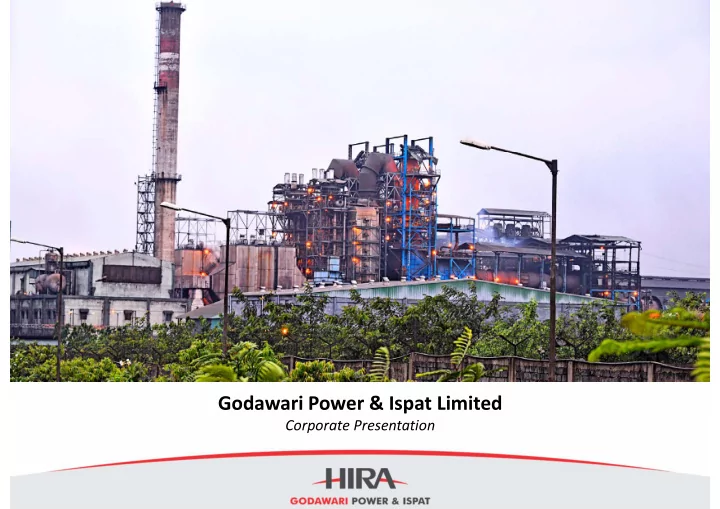
Godawari Power & Ispat Limited Corporate Presentation - - PowerPoint PPT Presentation
Godawari Power & Ispat Limited Corporate Presentation Disclaimer The views expressed here may contain information derived from publicly available sources that have not been independently verified, and no representation or warranty is
- The views expressed here may contain information derived from publicly available sources that have not been independently verified, and no representation or warranty is made as to the accuracy,
completeness, reasonableness or reliability of this information. This presentation should not be relied upon as a recommendation or forecast by Godawari Power & Ispat Limited and any of their subsidiaries, joint ventures and associates and cannot be relied upon as a guide to future performance.
- This presentation contains 'forward‐looking statements' – that is, statements related to future, not past, events. In this context, forward‐looking statements often address our expected future business
and financial performance, and often contain words such as 'expects,' 'anticipates,' 'intends,' 'plans,' 'believes,' 'seeks,' or 'will.' Any forward looking information in this presentation including, without limitation, any tables, charts and/or graphs, has been prepared on the basis of a number of assumptions which may prove to be incorrect. Forward–looking statements by their nature address matters that are, to different degrees, uncertain. These uncertainties may cause our actual future results to be materially different that those expressed in our forward‐looking statements. We do not undertake to update our forward‐looking statements. We caution you that reliance on any forward‐looking statement involves risk and uncertainties, and that, although we believe that the assumption on which
- ur forward‐looking statements are based are reasonable, any of those assumptions could prove to be inaccurate and, as a result, the forward‐looking statement based on those assumptions could be
materially incorrect.
- In no event shall the Company or its directors be responsible to any person or entity for any loss or damage, whether direct, indirect, incidental, consequential or otherwise, arising out of access or use
- r dissemination of information contained in this presentation, including, but not limited to, loss of profits. No representation, warranty, guarantee or undertaking (express or implied) is made as to,
and no reliance should be placed on, the accuracy, completeness or correctness of any information, including any estimates, targets and opinions, contained herein, and no liability whatsoever is accepted as to any errors, omissions or misstatements contained herein and, accordingly, none of the Company, its advisors and representative and any of its or their affiliates, officers, directors, employees or agents, and anyone acting on behalf of such persons accepts any responsibility or liability whatsoever, in negligence or otherwise, arising directly or indirectly from this presentation or its contents or otherwise arising in connection therewith.
- You must make your own assessment of the relevance, accuracy and adequacy of the information contained in this presentation and must make such independent analysis as you may consider
necessary or appropriate for such purpose. Any opinions expressed in this presentation are subject to change without notice and past performance is not indicative of future results. By attending this presentation, you acknowledge that you will be solely responsible for your own assessment of the market and the market position of the Company and that you will conduct your own analysis and be solely responsible for forming your own view of the potential future performance of the Company’s business.
- The information in this presentation has been prepared for use in presentations by Company for information purposes only and does not constitute, or should be regarded as, or form part of any offer,
invitation, inducement or advertisement to sell or issue, or any solicitation or any offer to purchase or subscribe for, any securities of the Company in any jurisdiction, including the United States and India, nor shall it, or the fact of its distribution form the basis of, or be relied on in connection with, any investment decision or any contract or commitment to purchase or subscribe for any securities of the Company in any jurisdiction, including the United States and India. This presentation does not constitute a recommendation by the Company or any other party to sell or buy any securities of the
- Company. This presentation and its contents are not and should not be construed as a prospectus or an offer document, including as defined under the Companies Act, 2013, to the extent notified and in
force or an offer document under the Securities and Exchange Board of India (Issue of Capital and Disclosure Requirements) Regulations, 2009 as amended.
- This presentation contains certain supplemental measures of performance and liquidity that are not required by or presented in accordance with Indian GAAP, and should not be considered as an
alternative to profit, operating revenue or any other performance measures derived in accordance with Indian GAAP or an alternative to cash flow from operations as a measure of liquidity of the Company.
- By accessing this presentation, you accept this disclaimer and any claims arising out of the use of the information from this presentation shall be governed by the laws of India and only the courts in
Mumbai, and no other courts, shall have jurisdiction over the same.
- The data presented is as of 31st March 2018.
Disclaimer
1
Overview
2
Godawari Power & Ispat Limited (GPIL)
Corporate Structure
3
Godawari Power and Ispat Ltd. Ardent Steel Ltd. Godawari Energy Ltd. Godawari Green Energy Ltd.
76.34% 51.30% 76.12%
Raipur Infrastructure Company Ltd. Chattisgarh Captive Coal Mining Ltd. Chhattisgarh Ispat Bhumi Ltd.
33.30% 25.93% 35.36%
Company overview
- Incorporated in 1999 (CIN: L27106CT1999PLC013756)
- Started commercial operations in FY01 with sponge iron capacity of
105,000 TPA
- Promoted by Mr. Bajrang Lal Agrawal, Mr. N. P. Agrawal, Mr. Hanuman
Prasad Agarwal and Mr. Dinesh Agrawal of HIRA Group
- Engaged in captive mining of iron ore and manufacturing and selling of
iron ore pellets, sponge iron, steel billets, rolled products (TMT, Wire Rod), Ferro alloys, and Hard Black (HB) wires with captive power
- generation. Also engaged in generation of solar thermal power.
Shareholding Pattern
32.64% 67.36% Public Promoters and Promoter Group Mar ‘18
Corporate Structure
Hira Ferro Alloys Ltd. Jagdamba Power & Alloys Ltd.
48.45% 33.96%1 Associates Subsidiaries Joint Ventures
1 Subject to receipt of necessary regulatory and other approvals, the company is proposed to be
amalgamated with GPIL
- Raised INR 100 Cr through QIP to set up a new pellet plant
- Acquired 75% stake in Ardent Steel Ltd.
- Completed its IPO and raised INR 70 Cr
- Commenced production of ferro‐alloys
- 1st phase of expansion completed; hard black wire production commenced
- Name of company changed to “Godawari Power and Ispat Ltd.”
- Started 1st phase of expansion, including sponge iron, steel billet and captive power generation
- New facility to manufacture ferro‐alloys and hard black Wire
- Initial project to manufacture steel billets became operational
GPIL | Evolution
4
CY1999 CY2003 CY2004 CY2005 CY2006 CY2008 CY2010 CY2011 CY2013
- Incorporated in 1999
- Pellet Plant of 0.6 mn MTPA achieved COD, Operations in Ari Dongri mines also started;
- Won a bid to set up a 50MW solar thermal power plant under JNNSM; formed Godawari Green Energy Ltd.
- Merged Hira Industries (an associate concern) and RR Ispat Ltd. (A wholly owned subsidiary) with the company
- Pellet plant of 0.6 mn MTPA in ASL achieved COD
- Commissioned expansion plan for new 1.5 mn MTPA pelletisation plant
- Commissioned coal gasification units, achieving cost savings in production of iron ore pellets
- Commissioned a 50MW solar thermal power plant
CY2016‐17
- Mining capacity expanded to 2.0 mn MTPA
- Modernization of steel melting shop
- Debt restructuring completed
CY2001
- Sponge Iron plant with annual capacity of 105,000 tonnes commissioned in FY2001
CY2002
- Power plant for generation and transmission of electricity commenced operation
- Completion of 2nd phase of expansion for sponge iron, steel billets and power generation
CY2007
GPIL | Plants and Mines
5
Rajasthan Solar Power Plant Mine Location Plant premises Chhattisgarh Solar Thermal Power Plant Nokh, Jaisalmer: 50MW Odisha Iron ore captive mine Ari Dongri: 1.4 mn MTPA Pelletisation Plant Keonjhar: 0.6 mn MTPA Iron ore captive mine Boria Tibu: 0.6 mn MTPA Siltara Integrated Plant 2.1 mn MTPA Iron pellets 0.5 mn MTPA Sponge iron 0.4 mn MTPA Steel billets 0.1 mn MTPA HB wire 73 MW power 25 MW power1 16,500 MTPA Ferro alloys Urla Rolling Mill 0.2 mn MTPA Wire‐rod mill
1 25MW to be added into GPIL subject to receipt of necessary regulatory and other approvals for
amalgamation of Jagdamba Power & Alloys Ltd.
Manufacturing Process
6
Pellets Direct Reduced Iron (DRI) process Steel Melting Shop Wire Drawing Ferro‐Alloys Division Market Sponge Iron Billet Steam, Dolochar Power (73 MW) Iron Ore (from captive mines) Coal
Fines Sized ore Sized coal Coal fines
Mild Steel Rounds
7
Operational highlights
Key themes
GPIL | Moving towards full utilization and complete integration
8
Favourable industry dynamics
- Iron and steel industry seeing rising demand across
the world; production slowdown in China has turned India into a net exporter of steel
- Domestic uptick in the construction and
infrastructure will result in growth Moving forward in the value chain
- GPIL occupies multiple spot in the iron and steel
processing value chain
- Has gradually moved up from captive iron ore
mining to manufacturing steel and ferro‐alloys
- Expansion in rolling mills and power generation
Strengthening financial profile
- Sustained recovery in operational performance
since H2FY17
- Regularized all accounts, and graduated from junk
(BB+) to investment grade (BBB‐) credit rating in just 12 months Backward integration: captive mining and linkages
- Significant ramp‐up in mining of captive iron ore
- ver the past few quarters
- Resulting in operational efficiency and cost savings
- Coal linkages to procure coal at fixed costs to
insulate against market price shocks
Our Product portfolio
Wide portfolio of value‐added iron and steel products, supplemented by solar power generation
Integrated producer of value‐added iron, steel and power…
9
Pellets Sponge Iron
- Used in the production of steel and alloys
- Has gained wide acceptance following ban on
plants that use sintered iron fines
- Sponge or Direct Reduced Iron (DRI) is a vital
input for the steel industry
- Serves as an energy‐efficient feedstock
- Serve as intermediate inputs to
steel plants, as well as industries such as construction and infrastructure Wire Rods HB Wire Iron and Steel Billets
- Hard black wires are made from
rolled steel by wire drawing
- Serve as raw material to
construction and infrastructure
- Standard form of processed iron or steel with
a square cross section
- Formed after hot rolling, and thus exhibit
high ductility Ferro‐alloys
- Production of silico‐manganese,
which is used in the production
- f steel
Solar thermal power
- Generation of power through
solar thermal power plant
- Power sold through a long‐term
PPA with NTPC
…benefitting from increasing global and domestic demand…
Strong demand expected from China, India, US and EU
6.9% 3.5% 0.8% 3.9% 5.9% 2.9% 4.5‐5.5% 5‐6% 7‐8% 0.00% 1.00% 2.00% 3.00% 4.00% 5.00% 6.00% 7.00% 8.00% 20 40 60 80 100 120 FY12 FY13 FY14 FY15 FY16 FY17 FY18P FY19P FY22P Steel Consumption (MT) Y‐o‐Y growth (%)
Increased Government spending in India is expected to spur demand for steel
Source: CRISIL Report – “Steel Products”
Construction sector likely to be the biggest consumer
10
GPIL is benefitting from globally increasing demand for iron ore pellets and rising steel consumption
MT CAGR 3.4% CAGR 6‐6.5% 50% 16% 13% 4% 17%
Breakup of global steel consumption (FY17E)
Construction Mechanical Engineering Automotive Electric Equipment Others 1,534 1,547 1,499 1,515 1,622 1,648 1,680 1,764 2013 2014 2015 2016 2017 2018P 2019P 2022P Global Steel Demand (MT)
Demand drivers | India
Source: CRISIL Report – “Steel Products”
…and uptick in demand several sectors in India
11
There is a strong pull in steel demand due to various initiatives and policies undertaken by the Government
Infra Project Execution Push for Affordable Housing Railways and Metro to boost demand Robust growth of Automobile Industry
- Execution of projects in steel intensive
sectors like railways, urban infrastructure and metro rail
- Building and construction, which constitutes
about 35% of steel demand will grow at a moderate pace
- Faster execution in construction of
Affordable Housing will result in potential upside in demand for steel
- Over the next few years steel demand from
automobile industry is expected to grow at a healthy pace, supported by strong growth in passenger and commercial vehicles (CAGR
- f 8‐10%)
- Metro and railway project is expected to
grow at a healthy CAGR of 8‐10% through FY 2022
- Its share of steel demand will go up to 30%
from 27% currently
35% 39% 41% 42% 10% 10% 11% 11% 12% 11% 15% 14% 16% 16% 16% 17% 27% 24% 17% 16% 0% 20% 40% 60% 80% 100% FY13‐17 FY 16‐17 FY 18‐19 (P) FY 18‐22 (P) Road Railway Urban Development Irrigation Others
Increasing share of infrastructure in steel demand…
Increasing share of Infrastructure Huge spending expected in infrastructure…
Source: CRISIL Report – “Steel Products”
…with increasing share of roads
12
The domestic steel industry will benefit from rapid growth in infrastructure sector
13.8 23.3 1.9 1.8 ‐ 5.0 10.0 15.0 20.0 25.0 FY13‐17 FY18‐22 (P) Infra Industrial 35% 27% 10% 9% 19% Steel Demand by Sector FY 17 Building & Construction Infrastructure Automotive Vehicle Capital & Consumer Others 30% 30% 11% 8% 21% Steel Demand by Sector FY22P Building & Construction Infrastructure Automotive Vehicle Capital & Consumer Others
…backed by healthy demand from automobile sector…
Healthy growth projections in automobile segment
4% ‐2% 5% 10% 4% 6% 7‐9% 8‐10% 13‐15% 9‐11% 8‐10% 10‐12% 8‐10% 8‐10% 5‐7% ‐5% 0% 5% 10% 15% Cars & UV Commercial Vehicle Two Wheelers FY12‐FY17 FY17 FY18E FY19P FY16‐FY22 (P)
Pickup visible in India’s share in world steel trade
Source: CRISIL Report – “Steel Products”
Strong growth in automobiles, and a pickup in exports is expected to bolster the Indian steel industry
13
24.2% 32.4% 37.0% 36.0% 16.7% 14.4% 13.5% 13.5% 15.2% 12.9% 11.2% 10.0% 11.4% 11.1% 10.6% 10.2% 9.4% 9.4% 9.9% 10.4% 4.0% 3.6% 2.5% 3.4% 19.0% 16.2% 15.3% 16.5% 0% 20% 40% 60% 80% 100% 2013 2014 2015 2016 China Japan EU South Korea Russia India Others
…will lead to improving utilizations over the next few years
Increasing per capita consumption of steel Capacity utilization expected to reach ~88% in 2022
Source: CRISIL Report – “Steel Products” 14
Increasing per capita steel consumption along with better capacity utilization will help improve our bottom line
52.8 55.9 57.3 57.6 58.6 61.2 63 50 52 54 56 58 60 62 64 2010 2011 2012 2013 2014 2015 2016
Per capita steel consumption
82% 81% 80% 81% 74% 77% 77% 79% 83% 85% 88% 20% 25% 30% 35% 40% 45% 50% 55% 60% 65% 70% 75% 80% 85% 90% 95% 15 30 45 60 75 90 105 120 135 150 165 180 2012 2013 2014 2015 2016 2017 2018P 2019P 2020P 2021P 2022P Crude steel capacity (mn tonnes) Crude steel production (mn tonnes) Capacity utilisation
9,062 7,872 7,798 5,067 4,360 4,944 5,107 5,306 6,207 20,771 18,276 18,934 13,310 12,383 14,662 15,394 16,435 19,768 31,836 28,742 29,493 22,510 21,830 25,961 26,074 26,783 31,579 35,256 33,778 33,409 27,034 25,982 30,144 30,995 31,169 36,832 38,391 34,685 36,169 28,080 28,063 31,896 32,738 33,065 38,591 53,367 51,670 53,365 43,139 52,696 61,058 64,017 63,913 68,985 10,000 20,000 30,000 40,000 50,000 60,000 70,000 80,000 FY13 FY14 FY15 FY16 FY17 Q1FY18 Q2FY18 Q3FY18 Q4FY18 Iron Ore Pellets Sponge Iron Steel Billets MS Rounds HB Wire Ferro Alloys
Realization/MT for various iron, steel and affiliated products
Improving realizations across the product basket…
15
Realizations have been steadily rising across GPIL’s product portfolio over the past few quarters, are expected to rise further
…and successful backward integration through captive mines…
326.4 446.2 662.2 1,175.1 1,579.7 200 400 600 800 1,000 1,200 1,400 1,600 1,800 FY14 FY15 FY16 FY17 FY18 Iron Ore Mined ('000 MT)
Captive iron ore mines with annual capacity of ~2.0 mn tons… …which are increasingly contributing low cost raw material
16
Captive production of iron ore accounted for ~80% of GPIL’s raw material requirement in FY18 Captive mine at Boria Tibu started production in October 2016 Iron ore production
- nly through
captive mine at Ari Dongri
- Iron ore from captive mines costs less than iron ore procured from open
market, leading to cost savings and improved margins
0% 10% 20% 30% 40% 50% 60% 70% 80% 90% 500 1,000 1,500 2,000 2,500 3,000 3,500 4,000 FY14 FY15 FY16 FY17 FY18 Cost / ton (Captive) Cost / ton (Market) % in‐house consumption
…with long term linkages and agreements for other key inputs…
Coal Power
55% 45%
Coal source
Coal India Linkage Other parties
- Coal is used as a fuel for the captive power
plants
- Also used in reducing agent in the
manufacture of sponge iron
- Long term linkage with Coal India for coal
procurement
Water
- Agreement with Chhattisgarh Ispat Bhoomi
Limited to draw 10,000 KL of water / day
- Stored in 2 constructed reservoirs with
combined capacity of ~49,100 M3
17
Strong linkages and agreement has helped us in saving costs and achieving better margins
FY18
- In‐plant power generation capacity of
73MW
- Also operates a 50MW solar thermal plant
in Rajasthan under long term PPA
- 53MW of captive energy from waste heat
recovery and coal‐fired thermal plant
- 20 MW of biomass power capacity which
qualifies for Renewable Energy Credits
- Power requirements fulfilled by captive
sources; excess sold on grid
41% 43% 16%
Total Power Generation (MW)
Solar Waste heat + Thermal Biomass FY18
- Lower costs of raw material procurement, and recovery in realizations of
products have reflected in margins
- Generation of EBITDA and Cash Profit back to FY15 levels in just 9
months of FY18
…is leading to a strengthened financial profile for GPIL
2.0 3.0 2.1 0.0 1.0 2.0 3.0 4.0 FY16 FY17 FY18
Net D/E (x)
23,603 30,606 60,556 2,664 4,646 34,649 10,000 20,000 30,000 40,000 50,000 60,000 70,000 FY16 FY17 FY18 EBITDA Cash Profit
Note: Cash Profit = Profit After Tax + Depreciation; Note: EBITDA = Profit Before Tax + Finance Cost + Depreciation
1 As rated by CARE ratings
Improving EBITDA and cash profit generation… …has enabled a reduction in leverage… …resulting in improved credit rating metrics
18
Resulting in highest EBITDA for us since inception Company has already paid down the debt for FY18 as decreed under the loan restructuring scheme
Oct‐16 Feb‐18 Apr‐18
Credit Rating1 D BB+ BBB‐
Junk grade Investment grade
19
Strategies
GPIL | Growth strategies
20
Key Strategies
Asset Sweating
- To maintain the capacity utilization factor of
all operating plants at maximum levels
- To maximize utilization of captive iron ore
mines and steel plant to realize full cost efficiencies
Financial strengthening
- Reduce leverage to sustainable levels to
strengthen the balance sheet
- Further strengthen financial profile to regain
higher credit ratings and gain access to lower cost funds
Moving up the value chain
- To increase the production of higher value‐
added steel products including billets, wire‐ rods and wires
- To move up the steel processing and
manufacturing value chain
21
Financial snapshot
Profit & Loss Snapshot (consolidated)
22
Particulars (INR lakhs) FY16 FY17 FY18
Revenue from operations 220,369.7 199,408.0 258,883.6 Other Income 1,890.3 1,530.4 865.7 Total Revenue 222,260.0 200,938.3 259,749.3 Less: Expenses Cost of Materials Consumed 127,205.7 111,717.1 137,900.9 Employee Benefit Expenses 9,255.4 7,701.8 9,675.4 Other Expenses 62,196.1 50,913.4 51,617.5 EBITDA 23,602.8 30,606.1 60,555.5 Share of profit / (loss) from associates and JVs (450.9) 27.0 340.0 Depreciation and amortization expenses 12,649.1 12,008.6 13,179.6 Operating Profit (EBIT) before exceptional items 10,502.8 18,624.5 47,715.9 Finance costs 25,200.2 25,914.9 26,331.2 Profit Before Taxes before exceptional items (14,697.3) (7,290.4) 21,384.7 Less: Exceptional Items ‐ ‐ 551.6 Profit from Ordinary Activities before tax (14,697.3) (7,290.4) 20,833.1 Income Tax Expense (4,712.6) 71.9 (636.3) Net Profit for the period (9,984.8) (7,362.3) 21,469.4
Balance Sheet (consolidated)
23
Particulars (INR lakhs) FY16 FY17 FY18
Net Worth 89,826.3 85,025.6 108,370.5 Non‐Controlling Interest 10,336.5 15,332.1 16,038.8 Debt Long Term Debt 136,601.0 197,986.3 187,294.5 Short Term Debt 34,075.8 19,549.8 13,440.6 Other Long Term Liabilities 660.5 817.6 1,030.2 Current liabilities Accounts Payable 44,392.4 12,467.5 16,114.1 Other Current Liabilities (including current maturities of LT Debt) 35,938.6 9,476.1 18,923.7 Total Liabilities and Equity 341,494.7 325,322.8 345,173.6 Non Current Assets Net Fixed Assets 219,860.4 222,207.1 213,767.7 Other Long Term Assets 46,197.2 37,325.7 50,588.2 Current Assets Inventory 40,978.3 30,436.2 43,230.4 Accounts Receivable 9,823.9 11,355.9 15,583.6 Loans and Advances and Other Current Assets 14,829.2 18,884.9 16,783.4 Cash and Cash Equivalents (Including bank balances) 9,805.7 5,113.0 5,220.3 Total Application of Funds 341,494.7 325,322.8 345,173.6
Key Financial Metrics
24
Key Ratios FY16 FY17 FY18
Revenue Growth (9.5%) (9.6%) 29.3% EBITDA Margin 10.6% 15.2% 23.3% PAT Margin (4.5%) (3.7%) 8.3% Return on Equity (12.6%) (10.6%) 23.3% Return on Capital Employed 4.9% 7.0% 17.1% Net Debt/Equity 2.0x 3.0x 2.1x Interest Service Coverage Ratio 0.4x 0.7x 1.8x
Note: Revenue Growth = growth of total revenue (inclusive of other income) EBITDA Margin = EBITDA / Total Revenue PAT Margin = PAT / Total Revenue RoE = PAT / Net Worth RoCE = EBIT / (Long Term Debt + Net Worth) Net Debt / Equity = (Long Term Debt + Short Term Debt – Cash and Cash Equivalents) / Net Worth Interest Service Coverage Ratio = EBIT / Finance Cost
25
Annexure
Subsidiary | Godawari Green Energy
Company snapshot Shareholding pattern Operating metrics Summary financials
26
Godawari Green Energy operates the solar thermal power plant in Rajasthan
- Facility located in village Naukh, Jaisalmer, Rajasthan
- GGEL has been set up to implement project awarded under Jawaharlal
Nehru National Solar Mission, Phase I of Govt. of India
- The plant is operational since FY14
- Take‐off arrangement under fixed price PPA with NTPC Vidyut Vyapar
Nigam (NVVN) for 25 years at 12.20 per unit of power supplied
- Project debt structured under 5‐25 scheme for infrastructure project
thereby giving a repayment tenor of 15 years 76.12% 23.88% GPIL and its Promoters Shiv‐Vani Energy Limited
Particulars (INR lakhs) FY16 FY17 FY18 Revenue from Operations 10,537.6 11,134.6 10,655.9 EBITDA 9,639.5 10,251.64 8,986.2 EBITDA Margin (%) 91.5% 92.1% 84.3% Depreciation 3,019.4 3,076.1 3,107.9 Finance Costs 6,312.7 6,243.7 5,801.5 PAT (41.5) 648.4 61.3 PAT Margin (%) (0.4%) 5.8% 0.6%
FY18
21.0% 21.5% 22.0% 22.5% 23.0% 23.5% 24.0% 75 80 85 90 95 100 105 FY16 FY17 FY18 Generation (mn units) Sales (mn units) CUF (%)
Subsidiary | Ardent Steel
- The company has a total production capacity of 0.6mn MTPA pellet
which located in Phuljhar, Keonjhar, Odisha
- The plant uses iron ore from the merchant mines in Barbil, located in the
Keonjhar district
- The company has completed setting up an iron ore pelletisation plant
with a capacity of 0.6 MTPA since July 2010
- The debt has also been restructured by the lenders for a long tenor in
FY17
Company snapshot Shareholding pattern Operating metrics Summary financials
27
Ardent Steel operates the iron pelletization plant in Odisha 76.34% 23.66% Godawari Power & Ispat Limited Others
Particulars (INR lakhs) FY16 FY17 FY18 Revenue from Operations 18,040.3 14,707.5 29,886.1 EBITDA (2,993.0) 2,797.0 7,642.3 EBITDA Margin (%) (16.6%) 19.0% 25.6% Depreciation 1,514.6 1,114.5 1,122.1 Finance Costs 1,994.8 2,160.8 2,225.3 PAT (4,471.4) (323.7) 2,818.2 PAT Margin (%) (24.8%) (2.2%) 9.4%
0% 20% 40% 60% 80% 100% 120% ‐ 1,000 2,000 3,000 4,000 5,000 6,000 FY16 FY17 FY18 Avg realization (INR/ton) CUF (%)
FY18
1,30,228.2 1,54,025.8 1,49,858.8 14,390.0 17,277.0 15,103.0 53,332.3 50,071.3 47,380.3 ‐ 50,000.0 1,00,000.0 1,50,000.0 2,00,000.0 FY16 FY17 FY18
Total Debt (Long Term + Short Term) (INR lakhs)
GPIL ASL GGEL
GPIL | Debt Profile, Restructuring and Turnaround
28
Due to operational efficiency and successful backward integration, GPIL has been able to turn its business around rapidly
September 2016 – March 2017 2018
- Lenders agreed in‐principle for restructuring of debt in September 2016
- Restructuring package implemented in March 2017; Debt repayment regularized
- Lenders agree to elongation of tenor of facilities with part conversion of short
term debt to long term debt
- No haircuts taken by lenders
- Improvement in price realizations of finished products and operational efficiency
- Gradual revival in operations
leading to improved financials
- Credit rating improved from “D”
to “BB+” in Feb 2018
- Credit rating upgraded again to
“BBB‐” in April 2018 (investment grade)
June 2016
- Default in debt repayment due to
lower cashflow on account of 40‐ 50% fall in price of GPIL’s products over the course of 12‐ 18 months
- GPIL started discussions with
lenders for corrective action plan
Total debt composition across GPIL and subsidiaries Course of debt restructuring and subsequent turnaround
29