
SLIDE 1
Prepared for:
The Golden Hill Local Development Corporation
Wednesday April 18th, 2012
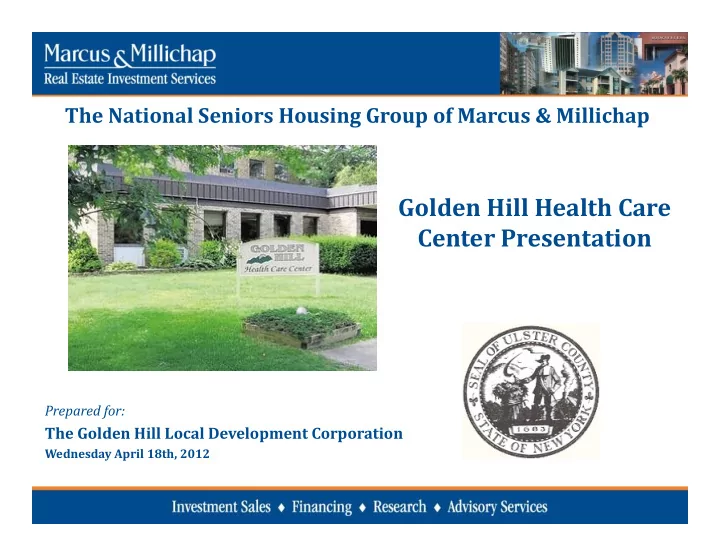
Golden Hill Health Care Center Presentation Prepared for: The Golden - - PowerPoint PPT Presentation
The National Seniors Housing Group of Marcus & Millichap Golden Hill Health Care Center Presentation Prepared for: The Golden Hill Local Development Corporation Wednesday April 18th, 2012 New York State Long Term Care Landscape Factors Effecting
Wednesday April 18th, 2012
‐Unsustainable Employment Agreements ‐Above market salaries and automatic wage increases ‐Year over year double digit increases in legacy costs ‐Year over year double digit increases in health insurance premiums ‐Inability to realize economies of scale‐single facility ownership ‐Overstaffing
2
Unrivaled Access to Investors Specialized Senior Housing Expertise National Confidential Marketing Platform Industry Leader in County Home Transactions Mark L. Myers
National Seniors Housing Group, Senior Director 8750 W. Bryn Mawr Avenue, Suite 600 Chicago, IL 60631 Office: 773‐867‐1470 Cell Phone: 773‐383‐6821 License: IL 475.102753 Email: mmyers@marcusmillichap.com
Marcus & Millichap Real Estate Investment Services has been the premier provider of investment real estate services since 1971. Marcus & Millichap has established itself as a leading, and expanding, investment real estate company, with more than 1,200 agents in 70
Our Seniors Housing Group is unique in that it is a boutique brokerage group, with a sole focus on seniors housing, within a national platform that provides the broadest depth of market coverage. The Seller benefits from the best of both worlds, the attention of a boutique with the power and presence of a national firm.
Joshua Jandris
National Seniors Housing Group, Senior Associate 8750 W. Bryn Mawr Avenue, Suite 600 Chicago, IL 60631 Office: 773‐867‐1482 Cell Phone: 312‐399‐9797 License: IL 476.388237 Email: jjandris@marcusmillichap.com
3
Name of Property License
Location Closing Date Sales Price
Brighton of Medford SNF 142 MA 4/12/12 $7,500,000 Riverbend Assisted Living Community ALF 97 IN 3/30/12 $15,300,000 Premiere Estates Portfolio SNF/AL 420 NE & IA 3/12/12 $12,000,000 New Hampton Care Center SNF 70 IA 3/12/12 $4,200,000 Mattoon Healthcare & Rehabilitation SNF 85 IL 1/12/12 $3,200,000 Pershing Convalescent Center SNF 51 IL 12/10/11 $1,260,000 Posada Del Sol Health Care Center SNF 149 AZ 12/11/11 $7,800,000 Grand Court Belleville ILF 74 IL 9/9/11 $1,950,000 Eastview Manor Care Center SNF 90 MO 9/10/11 $700,000 American Senior Communities ALF/ILF 390 IN 9/11/11 $52,000,000 Sunrise of Horsham Land Transaction Land PA 9/1/11 $1,400,000 Webster House IL/AL 41 CA 8/30/11 $1,900,000 Sunrise of West Orange Land Transaction Land NJ 8/31/11 $1,120,000 Summit Pointe of Macedonia ALF/ILF 150 OH 8/1/11 $27,250,000 Careage Management Portfolio ALF/SNF 631 NE & IA 7/10/11 $27,656,000 Sunrise of Cranberry ALF 60 PA 7/11/11 $12,000,000 Sunrise of Fox Chapel ALF 46 PA 7/11/11 $3,900,000 Geneva Care Center SNF 106 IL 7/9/11 $6,100,000 American Senior Communities ALF/ILF 151 IN 7/10/11 $30,400,000 Lynwood Manor SNF 99 MI 6/11/11 $2,900,000 The Arbor of Itasca Lease/Purchase SNF 144 IL 6/11/11 $6,500,000
SNF 119 IL 6/11/11 $1,450,000 American Senior Communities ALF 197 IN 6/11/11 $40,360,000 Salem County Nursing Home SNF 116 NJ 6/11/11 $7,500,000 Lincoln Manor SNF 140 IL 5/11/11 $6,500,000 Nursing Home Managers Portfolio SNF 477 IL 4/11/11 $6,500,000 Sunrise of Allentown ALF 86 PA 4/11/11 $9,000,000 Kenwell Senior Living Community SNF 148 NY 3/11/11 $3,230,000 Golden Living Center SNF 97 WI 3/11/11 $3,950,000 Sunrise of Napa ALF 72 CA 2/10/11 $2,025,000 Sunrise of Shaker Heights ALF 59 OH 2/11/11 $3,187,500 Sunrise of Hamilton ALF 46 OH 2/11/11 $3,187,500 Cypress Court ALF 126 AZ 1/11/11 $12,855,000 Chula Vista Care Center SNF 106 AZ 1/11/11 $5,800,000 Sunrise of Floral Vale ALZ 36 PA 1/11/11 $4,500,000
TOTALS 4,821 $337,081,000
$2.16 Billion of Transactions
Transactions Closed
Transactions closed or under contract in the last 28 months
$1.95 Billion of Seniors Housing Transactions
Transaction Volume: $337M
Nursing Facility Transaction Volume: $115M
4
Sussex County Homestead (Sussex County, NJ) 102 bed skilled nursing facility Three weeks into the marketing process Sealed Bid Auction Process in May 2012 Valley View Rehab & Nursing Center (Orange County, NY) 360 bed skilled nursing facility Currently accepting offers Sealed Bid Process in May 2012 Horace Nye Nursing Home (Essex County, NY) 100 bed skilled nursing facility Negotiating Bids—all offers at or above list price List Price—$4,000,000 Chautauqua County Home (Chautauqua County, NY) 216 bed skilled nursing facility Deadline to submit bids is April 16, 2012 List Price—Undisclosed
County Facility
Registration Agreements Signed
Sussex County Homestead (Sussex County, NJ) 34* Valley View (Orange County, NY) 53 Chautauqua County Home (Chautauqua County, NY) 46 Horace Nye Nursing Home (Essex County, NY) 46 Buttonwood Hospital (Burlington County, NJ) 57 Cumberland Manor (Cumberland County, NJ) 55 Posada del Sol (Pima County, AZ) 37 Salem County Home (Salem County, NJ) 41 Weatherwood (Carbon County, PA) 47 Laurel Crest (Camrbia County, PA) 50+
*Sussex County Homestead has only been available to the market for three weeks.
5
Cumberland Manor (Cumberland County, NJ)
196 bed skilled nursing facility Under contract to sell as of January 2012 Contract Price—$14,000,000 Customized sales process to meet County’s
requirements and earned a price $4.0M greater than minimum bid level Buttonwood Hospital (Burlington County, NJ)
200 bed skilled nursing facility Under contract to sell as of March 2012 Contract Price—$15,000,000 Procured buyer for facility at minimum bid level
despite losing appx. $5M in state reimbursements two weeks before auction Laurel Crest (Cambria County, PA)
370 bed skilled nursing facility Sold in January 2010 Sale Price‐‐$14,250,000 Drove sales price from $11 Million to $14.25
Million over three rounds of bidding Weatherwood (Carbon County, PA)
200 bed skilled nursing facility Sold in July 2010 Sale Price—$11,050,000 Drove sales price from $8 Million to $11
Million over three rounds of bidding Posada Del Sol (Pima County, AZ)
149 bed skilled nursing facility Sold in December 2011 Sale Price—$7,800,000 At time of sale, achieved price $2.8M greater
than the most recent County‐procured appraisal Salem County Home (Salem County, NJ)
New Jersey 116 Bed skilled nursing Facility Sold in June 2011 Sale Price—$7,500,000 Drove sales price from $6 Million to $7.5 Million
and closed within 90 days of engagement
6
County Home Case Study:
Scenario: We were engaged approximately 45 days ago, to market for sale, the 360‐bed Valley View Nursing Home. It is widely known that the facility is experiencing significant operating deficits, over $20 Million for 2011. The ever‐increasing legacy costs, coupled with the
believes that the only real solution to "right‐sizing“ the operating costs for Valley View is to privatize it, and we are in the process of helping them effectuate that strategy. Outcome: To date, we have received approximately 53 Registration Agreements from potential bidders for Valley View, and we have arranged 7 tours of the
View will be intense because of its strong occupancy, robust revenue and proximity to New York City. We expect the Purchase Price for Valley View to exceed $20 Million. Due to the nature of the facility’s current Collective Bargaining Agreement (CBA) with the CSEA, buyers are aware that the present benefit and wage packages can be eliminated, or mitigated upon privatization. Conceivably, a new owner’s path to profitability will involve a new Collective Bargaining Agreement with CSEA’s private arm, or by introducing a new union to Valley View; which has been the case with the 7 other County nursing homes we have marketed for sale in NY, NJ, IL and WI.
7
8
Valley View Center Marketing Timeline Action Item Timing
Create Marketing Materials Individual Offering Memorandums E-Brochures Registration Agreements Online Data Room (Liaison) March 12th, 2012 Distribute Marketing Materials (Email Database of 4,000 Owners/Operators and Investors) Contact Potential Buyers and Review Materials Obtain Draft Purchase & Sale Agreement (PSA) from Seller & Updated third Party Reports (Environmental, ALTA Survey, Title Work) from Seller and place these and all Other Due Diligence Materials into Password-Protected Data Room Conduct tours of the subject facility with potential buyers. March 12th, 2012- April 27th, 2012 Call for Offers | Proposed Bid Deadline Tour Potential Buyers’ Facilities Second Bid Round (if necessary): Bids Submitted as Marked Up Versions of Seller’s Draft PSA May 4th, 2012 By May 4th-22nd, 2012 May 22nd, 2012 Select Qualified Buyer and Close Bidding Process Right of First Refusal Waiting Period Finalize and Execute the Asset Purchase Agreement and Administrative Service Agreement Earnest Money Becomes Non-Refundable By June 1st, 2012 June 1-July 15, 2012 July 15th-July 31st, 2012 Licensure Submission by Buyer By August 15, 2012 *Buyer takes over under ASA, MSA, CSA, Friendly Receivership or
September 1, 2012 Licensure Approval and Closing By March 2013
*Pending issue is how the buyer will take over operations prior to Change of Ownership, “CHOW;” whether it is via a Management Services Agreement (MSA), a Consulting Services Agreement (CSA), Friendly Receivership, or some other form of ownership. 9
10
Golden Hill Health Care Center Marketing Timeline Action Item Timing
Create Marketing Materials Individual Offering Memorandums E-Brochures Registration Agreements Online Data Room (Liaison) April 27th, 2012 Distribute Marketing Materials (Email Database of 4,000 Owners/Operators and Investors) Contact Potential Buyers and Review Materials Obtain Draft Purchase & Sale Agreement (PSA) from Seller & Updated third Party Reports (Environmental, ALTA Survey, Title Work) from Seller and place these and all Other Due Diligence Materials into Password-Protected Data Room Conduct tours of the subject facility with potential buyers. April 30th, 2012- June 15th, 2012 Call for Offers | Proposed Bid Deadline Tour Potential Buyers’ Facilities Second Bid Round (if necessary): Bids Submitted as Marked Up Versions of Seller’s Draft PSA June 21st, 2012
By June 21st-July 12, 2012
July 12th, 2012 Select Qualified Buyer and Close Bidding Process Right of First Refusal Waiting Period Finalize and Execute the Asset Purchase Agreement and Administrative Service Agreement Earnest Money Becomes Non-Refundable By July 20th, 2012 July 20th-Sep 3rd, 2012 Sep 3rd-Sept. 17th, 2012 Licensure Submission by Buyer By October 1, 2012 *Buyer takes over under ASA, MSA, CSA, Friendly Receivership or
October 15, 2012 **Licensure Approval and Closing By April 2013
run can be determined by the GHLDC
Process
*Pending issue is how the buyer will take over operations prior to Change
(MSA), a Consulting Services Agreement (CSA), Friendly Receivership, or some other form of ownership. **Marcus & Millichap has no bearing on the speed of Change of Ownership approvals. However, selecting a buyer that has navigated the process previously or one with an attorney that has, will greatly increase the likelihood of a smooth and expedited transition.
11
*As the purpose of this slide was to highlight some of the services provided, a more comprehensive list can be found in the appendix.
12
‐Appendix F_County Home Restrictions Analysis
13
As our payment is contingency based, GHLDC will not incur any costs as it relates to the payment of Marcus & Millichap until a ready, willing and able buyer is procured by M&M in conjunction with the GHLDC, and a transaction is closed. All costs related to the marketing of Golden Hill will be paid for by M&M, including air travel and lodging if and when necessary.
14
13 British American Blvd. | Suite 2 | Latham, New York 12110 | P 518.867.8383 | F 518.867.8384 | www.leadingageny.org
TO: RHCF Members FROM: Dan Heim, Executive Vice President Darius Kirstein, Senior Policy Analyst DATE: December 15, 2011 SUBJECT: Details/Estimated Impacts of Final Statewide Pricing Methodology ROUTE TO: Administrator, Department Heads
ABSTRACT: Department of Health finalizes nursing home statewide pricing methodology.
Introduction LeadingAge New York and other associations met on December 14 with Department of Health (DOH) officials for a briefing on the state’s final methodology on Medicaid nursing home pricing, which will be implemented effective January 1, 2012. We also discussed a possible settlement option proposed by DOH that, if agreed to, could result in additional funding during and after the transition to the pricing system. DOH has made changes to the pricing methodology and transition plan that address some of the concerns we have raised about the level of redistribution and volatility that pricing would bring
to revise the initial pricing proposal to address the potential redistributions of funding we were seeing globally at the sponsorship and regional level, as well as the significant level of volatility evident at the facility level. During this same period, we continued to work with the Healthcare Association of New York State and the Continuing Care Leadership Coalition to address these concerns. We are grateful for the input provided over the last several weeks by the LeadingAge NY nursing home cabinet and its finance workgroup, as well as members at large.
2 Changes to the Methodology In response to input from LeadingAge NY and other groups, DOH made two fundamental changes to the statewide pricing methodology they proposed in midNovember:
direct and indirect components, the new system will divide all facilities into two peer
while the second will be “all other” facilities (i.e., <300 bed freestanding facilities). 300+ bed and hospitalbased status are based on the existing designations. Every facility will receive direct and indirect prices based on a blend of 50% of the statewide price (which includes all facilities) and 50% of the relevant peer group price (i.e., either the 300+/hospital based group or the “all other” group).
implementation, with annual facilityspecific gain/loss limits of 2.5% in 2012; 5% in 2013; 7.5% in 2014 and 10% in 2015. The Department has added a year to the transition, which will limit 2012 gains/losses to 1.75%, and to 2.5% in 2013; 5% in 2014; 7.5% in 2015; and 10% in 2016. Full implementation of pricing will occur beginning in 2017. LeadingAge NY believes these changes are positive, but we continue to have concerns about the lack of an ongoing gain/loss cap beyond 2016, as well as other issues. DOH shares our concern about the estimated negative impacts to certain financially challenged facilities and specialty units/facilities, and agreed to more closely examine these situations and work with us to try to address them in some way in the future. DOH also clarified their position on three system elements that were addressed in their November proposal:
model, and updated every six months based on the roster submission process. Casemix will be allowed to “float” (i.e., changes in casemix will be made outside of the gain/loss limits and no longer be subject to a “scaleback” adjustment as in rebasing, but could be constrained if overall spending were to exceed the Medicaid global cap). However, in an effort to minimize retroactive rate adjustments under statewide pricing, DOH is planning to begin prospectively adjusting rates for casemix by lagging casemix by six months. This means, for example, that instead of being based on July 2012 case mix data, the July 2012 rates will be based on January 2012 casemix data. The initial pricing rates will be based on January 2011 casemix, which will remain in effect until July 2012. Under the current process, casemix adjustments to the rates are not made until 45 months after the effective date of the rates, necessitating a retroactive adjustment.
comply, there would be no effect on their reimbursement. Beginning in 2013, DOH will make payments to facilities based on performance on the selected quality measures. The $50 million allocation would apparently be funded out of the reimbursement base, which we are concerned about. LeadingAge NY and other stakeholders will serve on a workgroup to establish the quality measures.
3
addons for dementia ($8), bariatric ($17) and TBI ($36) patients. These payments will be made outside of the annual gain/loss limitations, and will be based on the same schedule as noted above for casemix changes (i.e., a 6month lag). However, DOH will begin requiring facilities to document how these funds are spent and the resulting outcomes for the patients. Further details are not yet available on this requirement. A description of the final statewide pricing methodology, together with examples and calculation details is provided in the PowerPoint presentation DOH provided to us on December 14. FacilitySpecific Impacts and DOH Webinar DOH has just provided us with a facilityspecific listing of the estimated impacts of the pricing system during the 5year transition period (i.e., 201216) and at full implementation (i.e., 2017 and beyond). You can access the listing by clicking here. As you will see, we have developed and included in the impacts document a list of the major assumptions used to develop the estimated impacts. The Department will be recording a Webinar this coming Tuesday, December 20, which will shortly thereafter be made available to all facilities. The Webinar will summarize the methodology and basis for the estimated impacts, and describe the upcoming implementation plan. Next Steps in Process State law, enacted as part of the 201112 budget, authorizes the Department to implement a statewide pricing methodology effective no later than January 1, 2012. However, federal approval is also needed before payments under the new system can begin. The state intends to publish a public notice next week generally describing the final methodology, and shortly thereafter submit a Medicaid state plan amendment (SPA) to the Centers for Medicare & Medicaid Services (CMS) for the change to statewide pricing. Although the methodology will take effect January 1, 2012, DOH said that CMS approval and actual implementation is not likely to occur until April 2012, necessitating rate adjustments retroactive to January 1, 2012. As part of the process of submitting the SPA to CMS, the Department will be performing the calculation of the Medicare “upper payment limit” (UPL). Besides assuring CMS that the statewide pricing rates would not result in payments exceeding what would be paid under Medicare principles of reimbursement, the UPL also determines the amount of intergovernmental transfer funds that can be paid to public facilities. Possible Litigation and Appeals Settlement Although the statewide pricing methodology described above is final, DOH also proposed a “universal litigation and appeals settlement” for consideration by the industry. If fully agreed upon, this proposed settlement could result in additional funding during and after the transition to the pricing system. To summarize, the state carries a potential liability of $100 million or more on its books for the settlement of nursing home Medicaid rate litigation and rate appeals. In exchange for the withdrawal of all pending litigation and outstanding operating rate and methodologyrelated capital component appeals (i.e., for rate periods prior to 1/1/12), the state would make $100
4 million available to ensure that: (1) no facility incurs a loss from statewide pricing in the first two years of transition; and (2) the facilities that would benefit from pricing would have their gains accelerated in the first three years of transition. More details on how the proposal would work are provided in the PowerPoint presentation DOH distributed at yesterday’s meeting. LeadingAge NY will be working with its members and legal counsel to closely review this proposal, and we will provide input to DOH on it by early January, as they have requested. We will continue to provide you with information on statewide pricing, as it becomes available. If you have questions in the meantime, please contact Darius Kirstein at dkirstein@leadingageny.org or Dan Heim at dheim@leadingageny.org; or call us at (518) 867 8383.
Select your home using the drop‐down menu:
YEAR 1 YEAR 2 YEAR 3
YEAR 4
YEAR 5 YEAR 6 Line Number 1.75% Gain/Loss 2.5% Gain/Loss 5.0% Gain/Loss 7.5% Gain/Loss 10% Gain/Loss No Constraint
DIRECT COMPONENT CALCULATION 9
Peer Grp. Blend Direct Mean (Part B Inel.)
102.54 108.38 113.00 114.32 114.85 115.37
10
Peer Grp. Blend Direct Mean (Part B Eligible)
101.12 106.88 111.43 112.73 113.25 113.76
11
2007 Peer Grp. All Payer CMI
0.9075 0.9075 0.9075 0.9075 0.9075 0.9075
12
2011 Jan Facility Medicaid only CMI
0.7800 0.7800 0.7800 0.7800 0.7800 0.7800
13
CMI Change % [line 12/line 11] 0.8595 0.8595 0.8595 0.8595 0.8595 0.8595
14
Direct WEF
1.0268 1.0268 1.0268 1.0268 1.0268 1.0268
15
Direct Component with CMI & WEF (B Inel.) [Line 9*13*14] 90.50 95.65 99.73 100.89 101.36 101.82
16
Direct Component with CMI & WEF (B Eligible) [Line 10*13*14] 89.24 94.32 98.34 99.49 99.95 100.40
INDIRECT COMPONENT CALCULATION 18
Peer Grp. Blend Indirect Mean
50.82 53.71 56.00 56.66 56.92 57.18
19
Indirect WEF
1.0141 1.0141 1.0141 1.0141 1.0141 1.0141
20
Indirect with WEF [line 18*19] 51.54 54.47 56.79 57.46 57.72 57.98
NON‐COMPARABLE COMPONENT 22
Non‐Comparable (facility‐specific 2007)
8.95 8.95 8.95 8.95 8.95 8.95
NEW OPERATING RATE (Before Special Population Add‐ons) 24
Operating Rate (B Inel.) [lines 15+20+22] 150.99 159.08 165.48 167.30 168.03 168.75
25
Operating Rate (B Eligible) [lines 16+20+22] 149.73 157.75 164.09 165.90 166.62 167.34
MEDICAID VOLUME (2010 MEDICAID DAYS) 27
2010 B Eligilbe Days
430 430 430 430 430 430
28
2010 B Inel. Days
76,442 76,442 76,442 76,442 76,442 76,442
29
Rate times Days [lines (24*27)+(25*28)] 11,510,818 12,127,157 12,614,690 12,753,829 12,809,233 12,864,110
APPLICATION OF STOP‐LOSS/GAIN 31
Maximum/Minimum Revenue Using Constraint 13,609,341 13,505,453 13,159,159 12,812,865 12,466,572 na
32
Estimated Annual Revenue with Loss/Gain Limit Applied 13,609,341 13,505,453 13,159,159 12,812,865 12,809,233 na
33
Estimated Annual Medicaid Revenue Change Percentage (Before Add‐ons) ‐1.75% ‐2.50% ‐5.00% ‐7.50% ‐7.53% ‐7.13%
SPECIAL POPULATION ADD‐ONS APPLIED AFTER STOP‐LOSS/GAIN TEST 35
TBI/BMI/ Dementia Add‐ons (Jan 2011)
200,750 200,750 200,750 200,750 200,750 200,750
36
Estimated Annual Mcaid Rev. Under Pricing
13,810,091 13,706,203 13,359,909 13,013,615 13,009,983 13,064,860
COMPARISON RATE 38
7/7/2011 Rate less Capital (B ineligible)
180.61 180.61 180.61 180.61 180.61 180.61
39
7/7/2011 Rate less Capital (B ineligible)
180.19 180.19 180.19 180.19 180.19 180.19
40
Estimated Annual Mcaid Rev. (Using 7/7/2011 Operating Rates and 2010 Medicaid days)
13,851,746 13,851,746 13,851,746 13,851,746 13,851,746 13,851,746
41
Estimated Annual Impact
(41,656) (145,544) (491,837) (838,131) (841,763) (786,886)
42
Percent Impact (Add‐ons Included) ‐0.3% ‐1.1% ‐3.6% ‐6.1% ‐6.1% ‐5.7%
Note: Estimates are based on 2010 Medicaid volume and use January 2011 CMI which will be updated semi‐annually starting July 2011
Click below to access the LeadingAge memo on the new methodology
Click here for memo
LeadingAge NY December 2011
Andrew M. Cuomo GOVERNOR State of New York Nirav R. Shah, M.D., M.P.H COMMISSIONER New York State DOH Jason A. Helgerson MEDICAID DIRECTOR & DEPUTY COMMISSIONER Office of Health Insurance Programs
1.
The New York State Department of Health (NYSDOH) recently announced that a customer satisfaction survey of enrollees in Medicaid managed long-term care plans (MLTCs) rate their plans
and 84 percent said the plan helped them and their families manage their illness better. Ratings of plan communication were also high with 85 percent indicating that the plan explains services clearly and 98 percent reporting that they were treated with courtesy and respect. MLTC plans provide long-term care services such as home care and adult day care to people who are chronically ill or have disabilities, allowing them to stay in their homes and communities as long as possible. The MLTC plan arranges and pays for a large selection of long-term care health and social services including nursing home services when the enrollee is no longer able to stay in his/her home. The report is based on a standardized satisfaction survey conducted in 2011. Members also rated their caregivers very highly: 87 percent rated the quality of care provided by their care managers as good or excellent with similar levels of satisfaction with their visiting nurses, 86 percent. "These satisfaction results indicate that managed long-term care will provide excellent service while making our Medicaid system sustainable," said Jason Helgerson, New York State Medicaid Director. The goal of moving this population to care management is also to improve outcomes. New York currently ranks last in the nation in terms of inappropriate hospital admissions for Medicaid patients. The MLTC program creates incentives for the plans to keep people healthier and in their homes. A more detailed report of these findings and additional information about the MLTC program are located at: http://www.health.ny.gov/health_care/managed_care/mltc/.
Visit us online: www.health.ny.gov
VOLUME 28 - NUMBER 2 The Medicaid Update is a monthly publication of the New York State Department of Health.
February 2012 New York State Medicaid Update
2 | P a g e
POLICY AND BILLING GUIDANCE
Report Indicates Consumer Satisfaction Rates High Among Members of New York’s Managed Long-Term Care Plans ................................................. cover New Populations to Enroll in Medicaid Managed Care ........................................................................................................................................................ page 3 Health Department Regulations Adopted for Observation Unit Operating Standards ......................................................................................................... page5 Infants with Low Birth Weight and Infants with Disabilities under Six Months of Age in Medicaid Managed Care ............................................................. page 6 Beneficiaries with End Stage Renal Disease Must Enroll in Medicaid Managed Care ........................................................................................................ page 7 Billing for Post-op Follow-up Days ....................................................................................................................................................................................... page 8
PHARMACY UPDATES
Prescription and OTC Emergency Contraception/Covered Benefit for Medicaid, Medicaid Managed Care and Family Health Plus................................. page 9 Frequently Asked Questions (FAQ) for Brand Less than Generic Program ........................................................................................................................ page 10 Information for Prescribers Regarding Recent Changes to the Medicaid Prior Authorization Programs ............................................................................ page 11 Drug Acquisition Costs and Associated Costs of Dispensing .............................................................................................................................................. page 12 Information Regarding Frequency/Quantity/ Duration (F/Q/D) Editing ................................................................................................................................ page 13 EPIC Members .................................................................................................................................................................................................................... page 14 EPIC FAQ ............................................................................................................................................................................................................................. page 15
ALL PROVIDERS
CMS Discretionary Enforcement Period for 5010 Compliance Ends March 31, 2012......................................................................................................... page 16 Medicaid to Discontinue Distribution of Version 4010 Remittances .................................................................................................................................... page 16 Issuance of IRS Form 1099 ................................................................................................................................................................................................. page 17 Determining Utilization Threshold Status ............................................................................................................................................................................. page 18 Provider Directory ................................................................................................................................................................................................................ page 19
New York City Human Resources Administration (HRA) has a new phone #!
February 2012 New York State Medicaid Update
3 | P a g e
Effective April 1, 2012, and contingent on New York State receiving the necessary federal approvals, the following circumstances will no longer be sufficient reasons for non-dually eligible beneficiaries (Medicaid beneficiaries NOT in receipt of Medicare benefits) to be exempt or excluded from enrolling in a Medicaid managed care plan in mandatory counties. These changes are needed in order to enroll additional populations into Medicaid managed care or other care coordination programs over the next two years, as required by the Governor’s Medicaid Redesign Team (MRT) and authorizing legislation. These include:
condition;
Long Term Home Health Care Program (LTHHCP), Care at Home (CAH) program, Traumatic Brain Injury (TBI) program, Nursing Home Transition and Diversion (NHTD) waiver program and the Intermediate Care Facilities for the developmentally disabled program (ICF/DD). All providers are strongly encouraged to enter into contractual arrangements with Medicaid managed care plans in their service area in order to continue to provide needed services to members once they transition into a Medicaid managed care plan. Current Medicaid recipients who fall into one of the above categories and who receive a mandatory informational/enrollment packet, will have thirty days to choose a Medicaid managed care plan. Anyone who fails to choose a plan within thirty days will be automatically assigned to a plan. New Medicaid applicants are expected to choose a plan upon application or they will be automatically assigned. Providers are encouraged to assist their patients in choosing a plan in which the provider participates. Persons with self-identified approved exemptions will receive an “End of Exemption” letter and will be afforded time to apply for an alternate exemption, if available. Persons with ESRD – Please see separate article on enrollment of this population.
Homeless Individuals
Enrollment of homeless individuals will be phased in beginning April 2012. Where identifiable, the state will make every effort to target families with children prior to enrolling single individuals and childless couples. Undomiciled individuals (street homeless) will be targeted last for enrollment to allow ample time to educate these harder to locate individuals. Over a six month period, all homeless individuals will be enrolled statewide. Medicaid managed care plans will be required to include in their network providers who traditionally treat the homeless population, including at least two federally qualified health centers (FQHCs) with designation under Section 330H of the Public Health Services Act, where available. Additional information will be provided in subsequent Medicaid Updates.
Policy and Billing Guidance
February 2012 New York State Medicaid Update
4 | P a g e
Chronic Illness Demonstration Program (CIDP) Participants
The CIDP is scheduled to phase out as of March 31, 2012, and participants will no longer be excluded from Medicaid managed care as of April 1, 2012. CIDP providers will be assisting participants in choosing a health plan that includes the providers the consumer is seeing.
Disabled and Low Birth Weight Infants – Please see
separate article on enrollment of this population.
Waiver Program “Look-alikes”
“Look-alikes” are persons who are not enrolled in the waiver program, but have needs similar to persons enrolled in the waiver, and are eligible for nursing home level of care, or care in an ICF/DD, but remain in the community. Please note that all individuals with Restriction Exemption Code 95 (RE95), as designated by OPWDD, will remain exempt from mandatory enrollment into managed care until such time as the proposed People First 1115 demonstration waiver is fully implemented within their county of residence. The LTHHCP waiver program provides enhanced services to individuals who are elderly or disabled, and who are medically eligible for nursing home care to allow them to remain in the
i.e., individuals who are eligible for nursing home level of care but whose needs can safely be met in the community and are not currently enrolled in the waiver program. Additionally, individuals who “look like” participants in the Traumatic Brain Injury (TBI) program, the Care at Home (CAH) program, and who “look like” residents of Intermediate Care Facilities for the mentally retarded (ICF/DD) will be required to enroll in Medicaid managed care. “Look-alike” exempt persons will receive an end of exemption letter to allow an individual to apply for an alternate exemption, if applicable, prior to receiving a mandatory informational/enrollment packet.
Transitional Care Requirements for New Enrollees
Individuals newly enrolled in a Medicaid managed care plan who are undergoing a course of treatment may be eligible to continue the course of treatment with their current provider for a transitional period, regardless of whether the provider is in the plan’s network. Non-participating providers may provide transitional care for a period of up to 60 days from date of enrollment. For persons with an already approved course of treatment, such as home care or personal care services, participating providers may provide transitional care until the health plan’s approved treatment plan is in place. While transitional care is required to be covered by the plan, prior authorization rules through the plan must be followed. Information on other exemptions and exclusions from enrollment in Medicaid managed care, as well as information on how to apply for another exemption not listed above, is available from NY Medicaid Choice at (800) 505-5678, the Local Departments of Social Services (LDSS) or in New York City, the Human Resources Department (HRA). See box above to register for a webinar on new populations enrolling in Medicaid managed care, as well as new benefits that will be covered by Medicaid managed care plans. For a list of managed care plans by county, please visit: www.nyhealth.gov/health_care/managed_care/pdf/cnty_dir.pdf. For more information on the Medicaid Redesign Team initiatives now being implemented, please visit: http://nyhealth.gov/health_care/medicaid/redesign. If you have any managed care enrollment questions, please e-mail: OMCmail@health.state.ny.us.
Policy and Billing Guidance
February 2012 New York State Medicaid Update
5 | P a g e
New York State Medicaid, including Medicaid managed care and Family Health Plus (FHPlus) plans, have reimbursed providers, effective April 1, 2011, for hospital observation services delivered in observation units. Payment has been contingent upon approval of a site-specific waiver from the Office of Health Systems Management (OHSM), Division of Certification and Surveillance. Effective January 11, 2012, Title 10 of the New York Code of Rules and Regulations, Section 405.19, was amended establishing observation unit operating standards. Accordingly, new observation units must be established in compliance with the process and standards set forth in section 405.19, rather than through a
meet the new standards identified in the recently filed regulations. The regulations governing provision of observation services are available online at: http://w3.health.state.ny.us/dbspace/NYCRR10.nsf/56cf2e25d626f9f785256538006c3ed7/8525652c00680c3 e8525652c00630a77?OpenDocument&Highlight=0,405.19. New York State Medicaid will continue to reimburse hospitals for observation services delivered in an
recently adopted regulations, facilities that had been granted a waiver are required to comply with the provisions of the new regulatory standards within 24 months of the effective date of the regulation change (i.e., January 11, 2014). Facilities that are not in compliance with the regulations by January 11, 2014, will not be eligible for reimbursement. Previously published billing instructions for observation services may be found in the May 2011 Medicaid Update at: http://www.health.ny.gov/health_care/medicaid/program/update/2011/2011-05.htm#eme. Please contact the Division of Certification and Surveillance at (518) 402-1003, if you have questions about the process for establishing an observation unit or operating standards. If you have questions about Medicaid reimbursement for observation services, please contact the Division of Program Development and Management at (518) 473-2160.
Policy and Billing Guidance
February 2012 New York State Medicaid Update
6 | P a g e
Effective April 1, 2012*, infants born on or after April 1, 2012, weighing less than 1200 grams and infants under six months of age who are disabled will no longer be excluded from enrolling in a Medicaid managed care plan and will be enrolled in Medicaid managed care. These changes are being made in response to recent legislation requiring New York State to enroll additional populations into Medicaid managed care or other care coordination programs over the next three years. Infants born prior to April 1, 2012, that are already enrolled in fee-for-service will remain in fee-for-service until they are six months old, at which time they will receive an enrollment packet with a choice of plan. If the infant’s mother is enrolled in a Medicaid managed care plan (HIV-SNP in New York City), the infant will be automatically enrolled in the mother’s plan. If the mother is enrolled in a Family Health Plus (FHPlus) plan, and that plan also has a Medicaid managed care product, the infant will be enrolled in that plan’s Medicaid managed care
managed care plan. If the mother fails to choose a plan, the infant will automatically be assigned to a plan. Providers are encouraged to assist their patients in choosing a plan in which the provider participates. Managed care plans are responsible for notifying the local social services district (LDSS), or HRA in New York City, of any enrollee that is pregnant within thirty days of becoming aware of the pregnancy. In addition, managed care plans should notify the LDSS/HRA when a newborn weighing 1200 grams or more appears to otherwise qualify as disabled. For a list of managed care plans by county, please visit: http://www.nyhealth.gov/health_care/managed_care/pdf/cnty_dir.pdf. For more information on the Medicaid Redesign Team (MRT) initiatives, please visit: http://nyhealth.gov/health_care/medicaid/redesign. *contingent upon CMS approval
Policy and Billing Guidance
February 2012 New York State Medicaid Update
7 | P a g e
Effective April 1, 2012*, recipients with a diagnosis of End Stage Renal Disease (ESRD) will no longer be exempt from enrolling in a Medicaid managed care plan in mandatory counties. These changes are being made in response to recent legislation requiring New York State to enroll additional populations into Medicaid managed care or other care coordination programs over the next three years. Effective April 1, 2012, individuals who are identified on eMedNY with a diagnosis of ESRD or individuals who were approved for an ESRD exemption and are
either the Local Department of Social Services (LDSS) or in counties that utilize the New York State Enrollment Broker from New York Medicaid CHOICE. Individuals who applied for an ESRD exemption and were approved will receive an “End of Exemption” notice prior to receipt of their mandatory informational/enrollment packet. Many individuals with ESRD are in receipt of Medicare; those individuals with dual coverage continue to be excluded (unable to enroll) in Medicaid managed care plans but may choose to enroll into a Managed Long Term Care or Medicaid Advantage plan if one is available in their county. Current Medicaid recipients with ESRD who receive informational/enrollment packets will have thirty days to choose a Medicaid managed care plan. Anyone who fails to choose a plan within thirty days will be automatically assigned to a plan. Providers are encouraged to assist their patients in choosing a plan in which the provider
this includes those with ESRD. Individuals newly enrolled in a Medicaid managed care plan that are undergoing a course of treatment, including dialysis, may be eligible to continue receiving services from their current provider for a transitional period, even if the provider does not participate in the plan’s network. Medicaid managed care plans must reimburse non- participating providers for such ongoing services during a transitional period of up to sixty days from date of enrollment while the enrollee is transitioned to a participating provider. The Medicaid Redesign Team (MRT) and legislative initiatives require most Medicaid recipients to enroll in a managed care plan by April 2013. As a result, all providers are strongly encouraged to enter into contractual arrangements with Medicaid managed care plans in their service area in order to continue to provide needed services to members once they transition into a Medicaid managed care plan. For a list of managed care plans by county, please visit: http://www.nyhealth.gov/health_care/managed_care/pdf/cnty_dir.pdf. For more information on the Medicaid Redesign Team initiatives, please visit: http://nyhealth.gov/health_care/medicaid/redesign. Please note that individuals in fee-for-service Medicaid with chronic medical issues, including ESRD, who have had a relationship for at least six months with a specialist provider not participating in any managed care plan are allowed one exemption for a limited period of six months, only. This exemption will defer enrollment into a Medicaid managed care plan for up to six months, and is limited to persons who are in active treatment at the time of the exemption request. *contingent upon CMS approval
Policy and Billing Guidance
February 2012 New York State Medicaid Update
8 | P a g e
The following information clarifies Medicaid’s fee-for-service policy on billing for post-op follow-up days. Patients often return to the hospital clinic for aftercare appointments following a surgical procedure that took place in one of the following settings:
Facilities may bill Medicaid for these visits. This policy applies to post-op aftercare visits that are billed under Ambulatory Patient Groups (APGs), as well as to those aftercare visits that took place prior to the implementation of APGs. NOTE: The physician may not bill for aftercare visits. Payment to the physician for surgical procedures includes the surgery and the follow-up care. The number of follow-up days assigned to each surgical procedure can be found in the “Physician Manual – Surgery Services Fee Schedule.” This information can be accessed at the following website: https://www.emedny.org/ProviderManuals/Physician/index.aspx.
Medicaid Managed Care
Medicaid managed care and Family Health Plus (FHPlus) plans will reimburse in-network providers according to established provider agreements. Reimbursement for out-of-network providers will be at negotiated rates. Questions concerning managed care reimbursement rates should be directed to the health plan Provider Services number. Questions regarding Medicaid fee-for-service policy and claiming should be sent via e-mail to: pffs@health.state.ny.us.
Policy and Billing Guidance
1
Hilding, Charles
Subject: FW: New York Articles and Other Info on Managed Care and Pricing System Attachments: 3-12-12 DOH Issues New Timetable for MLTC Mandatory Enrollment.txt From: Myers, Mark Sent: Tuesday, April 17, 2012 11:23 AM To: Hilding, Charles Subject: RE: New York Articles and Other Info on Managed Care and Pricing System
Here you go. From: Dever, Koy [KDever@loebandtroper.com] Sent: Thursday, February 16, 2012 7:50 PM To: Dever, Koy Subject: FW: DOH Issues New Timetable for MLTC Mandatory Enrollment FYI From: Home Care Association of New York State [mailto:roger@hcanys.ccsend.com] On Behalf Of Home Care Association of New York State Sent: Thursday, February 16, 2012 1:17 PM To: Dever, Koy Subject: DOH Issues New Timetable for MLTC Mandatory Enrollment Having trouble viewing this email? Click here MEMBER E‐ALERT DOH Issues New Timetable for Mandatory Enrollment July 1 is new startup date This morning the state Department of Health (DOH) issued a revised timetable for requiring dual‐eligible individuals, 21 and older, who need more than 120 days of non‐institutional long term care services to enroll into a managed long term care (MLTC) plan or care coordination model (CCM). The timetable, originally slated to start on April 1, 2012, is now scheduled to begin in a phased approach starting on July 1, 2012. This revised schedule is contingent on receiving approval from the U.S. Centers for Medicare and Medicaid Services (CMS). DOH has also informed HCA that the April 1, 2012 deadline for enrolling non‐dual‐
2
eligible or Medicaid‐only LTHHCP patients into mainstream Medicaid managed care plans has been postponed until January 1, 2013. In addition, HCA continues to advocate for budget amendments and/or other action by the Legislature to secure a revised and reasonable timetable and plan for implementation that also includes critical safeguards, options and pathways for consumers and providers. At this time, the revised DOH schedule for dual‐eligible cases is as follows: Phase One Starting July 1, 2012, any new dual‐eligible cases, which fit the above criteria, in New York City will be identified for enrollment and referred to Maximus, the enrollment broker. Maximus will send materials to those who are being targeted for enrollment into an MLTC (or CCM). Enrollment will be phased in by service type, by borough in NYC, and by zip code for existing cases. People will be given 60 days to choose a plan according to the schedule outlined below. * July 1, 2012: Begin personal care cases in Manhattan (all individuals receiving personal care while enrolled in Medicaid Advantage plans will begin MLTC enrollment in January 2013) * August 1, 2102: Continue personal care cases in Manhattan * September 2012: Continue personal care cases in Manhattan and begin personal care cases in the Bronx; and begin Consumer Directed Personal Assistance Program (CDPAP) cases in Manhattan and the Bronx * October 2012: Continue personal care and CDPAP cases in Manhattan and the Bronx and start in Brooklyn * November 2012: Continue personal care and CDPAP cases in Manhattan, the Bronx and Brooklyn * December 2012: Continue personal care and CDPAP cases in Manhattan, the Bronx and Brooklyn and start in Queens and Staten Island * January 2013: Initiate enrollments citywide of long term home health care program (LTHHCP), home health cases over 120 days, adult day health care program (ADHCP) and private duty nursing cases not already enrolled under the personal care enrollment requirement * February 2013 and until all people receiving services are enrolled: Personal care, CDPAP, LTHHCP, home health cases over 120 days, ADHCP and private duty nursing cases in all of NYC Other Phases As plan capacity is established, dually eligible community‐based long term care recipients in other counties will be enrolled into MLTCs according to the anticipated schedule outlined below. * Phase II (January 2013): Long Island and Westchester * Phase III (June 2013): Rockland and Orange counties * Phase IV (December 2013): Albany, Erie, Onondaga and Monroe counties * Phase V (June 2014): Other counties with capacity Final Phase
3
Previously excluded dual‐eligible groups in the following programs will be enrolled into MLTCs contingent upon development of "appropriate" programs: Nursing Home Transition and Diversion, Traumatic Brain Injury, nursing home residents, Assisted Living Program residents, and dual eligibles that don't require community‐based long term care services. HCA will be providing additional guidance to members on advocacy in relation to the entire managed care enrollment policy. Members should also continue to share comments, questions and issues with HCA at info@hcanys.org under the subject heading "Mandatory Enrollment Comments, Questions, Issues." In addition, the state's mandatory enrollment plan and other related issues will be discussed at two important upcoming member forums: the February 28 Statewide LTHHCP Forum in Albany and the March 2 Downstate LHCSA Forum in New
register in advance. Registration for the LTHHCP Forum is available here. Registration for the Downstate LHCSA Forum is here. Forward email This email was sent to kdever@loebandtroper.com by rnoyes@hcanys.org | Update Profile/Email Address | Instant removal with SafeUnsubscribe™ | Privacy Policy. Home Care Association of New York State | 194 Washington Avenue, Suite 400 | Albany | NY | 12210
Mark L. Myers
Senior Vice President Investments Senior Director, National Senior Housing Group Marcus & Millichap 8750 West Bryn Mawr Avenue Suite 650 Chicago, IL 60631 (773) 867-1470 (773) 867-1510 fax (773) 383- 6821 mobile mark.myers@marcusmillichap.com (http://www.goodnewstracts.org/assets/tracts/better.looking)
CONFIDENTIALITY NOTICE and DISCLAIMER: This email message is intended only for the person or entity to which it is addressed and may contain confidential and/or
4 privileged material. Any unauthorized review, use, disclosure or distribution is prohibited. If you are not the intended recipient, please contact the sender by reply email and destroy all copies of the original message. If you are the intended recipient but do not wish to receive communications through this medium, please so advise the sender
recipients are advised that the sender and Marcus & Millichap are not qualified to provide, and have not been contracted to provide, legal, financial, or tax advice, and that any such advice regarding any investment by the recipients must be obtained from the recipients’ attorney, accountant, or tax professional.
(Click here to unsubscribe.)
http://m.nypost.com/p/news/opinion/opedcolumnists/the_perils_of_cuomo_medicaid_reform_Z2dIl5tW m0wflGfe1Bf7LI
The perils of Cuomo’s Medicaid reform
By RUSSELL SYKES Last Updated: 7:11 AM, April 4, 2012 AP The Cuomo administration’s Medicaid-reform strategy is riskier than most New Yorkers realize — in good part because it doesn’t reform the Empire State’s longstanding practice of seeking to grab every federal Medicaid dollar it can get. Lord knows, the state’s program needs reform. Medicaid now covers nearly one in three New Yorkers, at a cost of $53 billion a year. We not only provide more services and have more generous eligibility levels than most states, we’re far more relaxed about seeing if applicants truly qualify for taxpayer help. And the rolls keep growing — up 73 percent from April 2000 to April 2010, rising 13 percent in the last of those years alone. Compassion has trumped even the most basic anti-fraud measures: Applicants no longer need any face-to-face interview to become eligible. Up-front screening for potential error or fraud is modest at best. Even the screening of service-providers for patterns of likely fraud has become less aggressive.
right direction. And, to its credit, the governor’s Medicaid Redesign Team sensibly wants to contain costs via an aggressive managed-care approach for all long-term care, mental-health and substance-abuse patients — three populations who drive more than 70 percent of all Medicaid costs. It’s an overdue approach — but not without risk. The scope of change is ambitious, and the feds must sign off.
The reforms are expected to save the federal government $18 billion; the Cuomo administration will soon ask the Obama administration to grant the state a waiver that would allow us to keep $10 billion of that savings to underwrite reform. The managed-care plan hinges on a major expansion of New York’s “health homes” pilot program and similar approaches, where a single care coordinator directs patients into primary-care rather than emergency settings, as well as on the broad sharing of electronic-patient information to allow providers to successfully coordinate care in a team approach. Extra federal funding is available for both efforts, but only temporarily. New York has already gotten the green flag for expanding “health homes,” with two years of greater funds from Washington for each patient enrolled. But, again, $10 billion of the anticipated funds depend on getting that waiver — which the Obama administration might not grant. Health Secretary Kathleen Sebelius just rejected a major waiver request from California Gov. Jerry Brown. A bigger worry: New York is also counting on more federal funding, under the ObamaCare law, for upping Medicaid enrollment. The law offers enriched Medicaid funding in 2014 to states, like New York, that maintain current eligibility and benefits until then. It also promises significant funds down the line to states, like New York, that already provide generous Medicaid coverage to the populations all states will have to cover in 2014 under the Obama law. The Empire State will fare very well — if ObamaCare kicks in, those match rates kick in. But the Supreme Court may overturn all or some of the law, putting New York’s bold plan for federal reinvestment at risk. Even if it doesn’t, this November’s elections could further undermine support in Washington for the original ObamaCare vision. If the law goes, so too does the promise of enriched federal dollars. This could prove the knockout punch to most of New York’s aggressive approach and planned savings. Where does that leave Gov. Cuomo’s Medicaid reforms? Up in the air — much like the anticipated revenues from casino gambling. Russell Sykes is a senior fellow at the Manhattan Institute’s Empire Center for New York State Policy.
SERVICESMARCUS&MILLICHAPWILLPROVIDE
Scale of 1-10 (10 being most restrictive and 1 being the least) 1 Retain all employees under the current terms of the union contract 10 2 Retain ALL employees, move them to new union agreement and terms 8 3 Guaranteed offers of employment to those employees who file an application and pass a basic background check 6 4 Same as above, but buyer can not hire anyone back based on findings from interviews and past performance reviews 4 5 Buyer decides who they want to hire
1 Facility must be operated as a nursing home for a period of 5 years
2
2 Property Sold in "As-Is" "Where Is" Condition
5
1 Buyer must retain 100% of current residents
4
2 Payor mix restrictions: the buyer cannot discriminate against any Medicaid/indigent applicants
8
3 Buyer must maintain current facility's payor mix for 24 months following the sale
6
4 Buyer must reserve 80% of licensed beds for Burlington County Residents
4 1 Buyer must own and operate a skilled nursing facilities and psychiatric hospitals 10 2 Buyer must own and operate a minimum of one skilled nursing facility in New Jersey 7 3 Buyer must currently have an average star rate per Medicare.gov of at least 3 5 4
Employee Matters
Potential Conditions to Sale-Restriction Analysis
*Nursing homes are unique because they are purpose built, and highly accretive when run
unlikely anyone would operate it as anything else.
Facility/Physical Plant Resident Matters Buyer Qualifications
Buyer must submit proof of ability to obtain all licenses and regulatory approvals necessary to
2