
SLIDE 1
Slide 1
Good Morning. It has been a rich few days with you. Thank you for sharing insights, laughter, conversation and depth of liturgical worship. This morning we have the immense task of talking about mental health recovery. And if that weren’t enough, we are situating it (1) in the realm of experience or phenomenology - human experience and (2) in community and not just any community but communities defined by the Christian Faith. Many of us in this room already have a relationship with mental health, mental illness and recovery. These words are not strangers to us. And with all the degrees in the world, the most costly and valuable experience is from inside me and around me - having journeyed with friends and close family members through anxiety, bipolar mood disorder and suicide. This is not an easy topic. So I invite you, to take moments to breathe, quiet pauses, slip out if you need to. In this place there is room for our tears, our grief, our fear,
- ur anger... even despair.
In community - we can hold these human experiences as they are enfolded by Grace. When we cannot say “Doch” - someone else can say it for us!
Slide 2
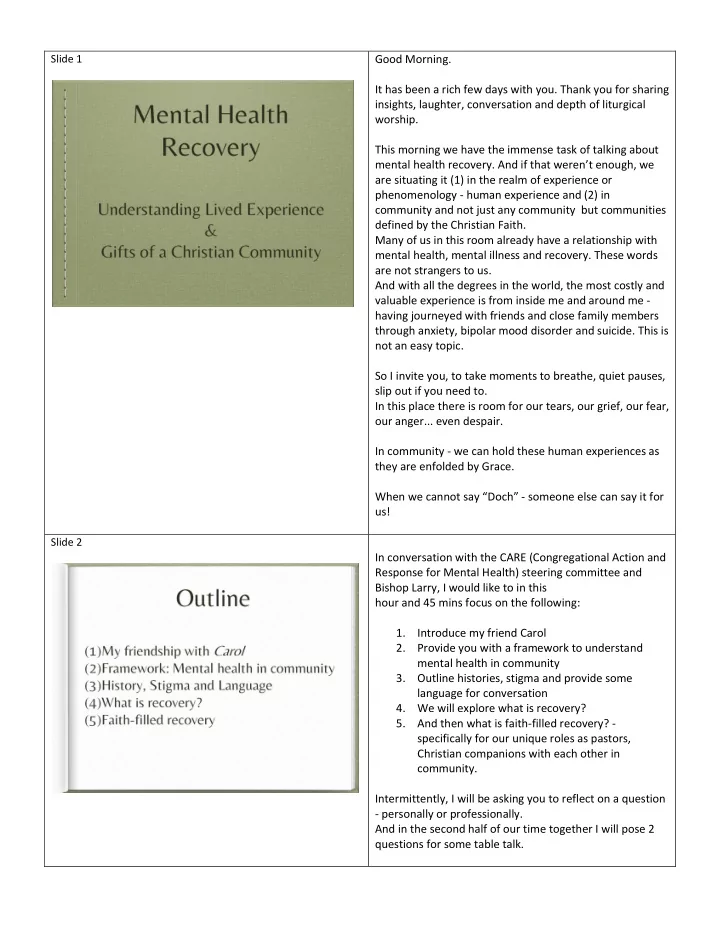
In conversation with the CARE (Congregational Action and Response for Mental Health) steering committee and Bishop Larry, I would like to in this hour and 45 mins focus on the following:
- 1. Introduce my friend Carol
- 2. Provide you with a framework to understand
mental health in community
- 3. Outline histories, stigma and provide some
language for conversation
- 4. We will explore what is recovery?
- 5. And then what is faith-filled recovery? -
specifically for our unique roles as pastors, Christian companions with each other in community. Intermittently, I will be asking you to reflect on a question
- personally or professionally.