Grammars and Lexicons: 11-721 (2007) HW solutions - - PDF document

grammars and lexicons 11 721 2007 hw solutions
SMART_READER_LITE
LIVE PREVIEW

Grammars and Lexicons: 11-721 (2007) HW solutions - - PDF document

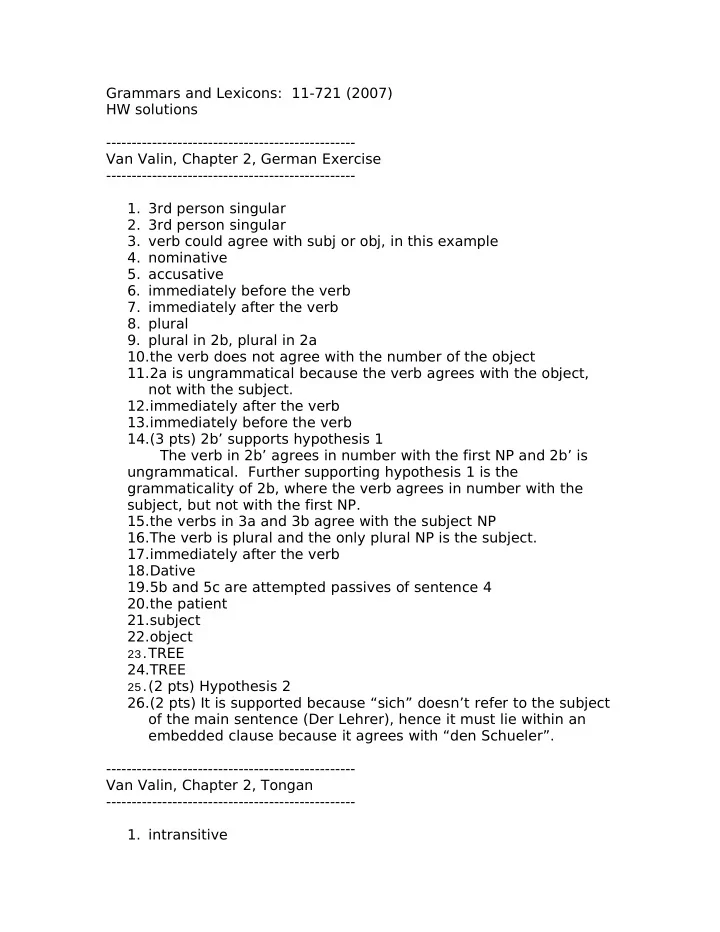
Grammars and Lexicons: 11-721 (2007) HW solutions ------------------------------------------------- Van Valin, Chapter 2, German Exercise ------------------------------------------------- 1. 3rd person singular 2. 3rd person singular 3. verb


slide-1
SLIDE 1

Grammars and Lexicons: 11-721 (2007) HW solutions

  • Van Valin, Chapter 2, German Exercise
  • 1. 3rd person singular
  • 2. 3rd person singular
  • 3. verb could agree with subj or obj, in this example
  • 4. nominative
  • 5. accusative
  • 6. immediately before the verb
  • 7. immediately after the verb
  • 8. plural
  • 9. plural in 2b, plural in 2a

10.the verb does not agree with the number of the object 11.2a is ungrammatical because the verb agrees with the object, not with the subject. 12.immediately after the verb 13.immediately before the verb 14.(3 pts) 2b’ supports hypothesis 1 The verb in 2b’ agrees in number with the first NP and 2b’ is

  • ungrammatical. Further supporting hypothesis 1 is the

grammaticality of 2b, where the verb agrees in number with the subject, but not with the first NP. 15.the verbs in 3a and 3b agree with the subject NP 16.The verb is plural and the only plural NP is the subject. 17.immediately after the verb 18.Dative 19.5b and 5c are attempted passives of sentence 4 20.the patient 21.subject 22.object

23.TREE

24.TREE

25.(2 pts) Hypothesis 2

26.(2 pts) It is supported because “sich” doesn’t refer to the subject

  • f the main sentence (Der Lehrer), hence it must lie within an

embedded clause because it agrees with “den Schueler”.

  • Van Valin, Chapter 2, Tongan
  • 1. intransitive
slide-2
SLIDE 2
  • 2. ‘a
  • 3. intransitive
  • 4. ‘a
  • 5. transitive
  • 6. ‘e
  • 7. ‘a
  • 8. ‘i
  • 9. ‘a

10.‘i 11.intransitive 12.ki 13.ki 14.intransitive 15.ergative-absolutive 16.S 17.S 18.O 19.S 20.S,O 21.S 22.A 23.S 24.O 25.Other 26.A,S

  • Van Valin, Chapter 2, Malayalam Exercise
  • Task 1:

Subj Obj Loc Instr Recip Ben Agent pass Exp hungry desid Child Kutti (1) Kuttiye (3) kuttikk ə (29) kuttikk ə (16) kuttiya al (27) kuttikk ə (7) Childre n kuttikal (12) mother amma (9) ammay e (4) ammak kə (1) ammay aal (30) ammak kə (25) Elepha nt aana (3) aanaye (24) aanakk ə (28) Elepha nts aanaka le (2) Stick Wati (13) Wati kontuh

slide-3
SLIDE 3

(4) Watiya al (9) Bird paksi (19) paksiye (10) Bread rotti (14) rotti (19) Shirt sarttə (15) Book pustak am (17) pustak am (29) Rice coorə (21) coorə (20) Bed kattil (12) kattilil (5)

  • subj. = subject
  • bj. = object
  • loc. = locative
  • instr. = instrument
  • recip. = recipient
  • ben. = benefactive

agent pass. = agent of passive

  • exp. hungry desid. = experiencer of "be hungry" and desideratives

("desiderative" is the word that linguists use for "want") Task 2: (7 pts)

  • a. null affix, no morpheme
  • b. subjects and inanimate objects (in transitive, intransitive and

passives) except experiencers – agent, theme

  • c. –ye
  • d. (2 pts) Animate objects (inanimate objects remain in nominative

form) – patient

  • e. Recipients – obj, beneficiaries – obl, experiencers - subj

Task 3: (2 pts)

  • a. How do you form a desiderative (want) sentence in Malayalam?
  • Put the experiencer in dative case, the object in accusative

case (if it is animate and a patient) and make the verb non- finite by adding -anam. (25) Ammakkə nullanam kuttiye.

mother(DAT) want-to-pinch child(ACC)

slide-4
SLIDE 4
  • b. How do you form a passive sentence in Malayalam?
  • Put the object in nominative case, the subject in instrumental

case (now it’s oblique), and add a passive suffix - appett to the verb (and change the stem a little bit). (26) Kutti aanaye aaraadhiccu. (27) Aana kuttiyaal aaraadhikkappettu. Task 4: Reflexive Pronouns (8 pts)

  • a. In sentences 32 and 35, what is the grammatical relation of the

antecedent of "swantam"?

  • The antecedent of swantam must be the subject.
  • b. What grammatical relation cannot be the antecedent of

"swantam"?

  • The object cannot be the antecedent of swantam.
  • c. In sentences 33 and 36, what is the grammatical relation of the

antececent of "awante"?

  • In 36 the object is the antecedent of awalute and in 33 the

antecedent is some outside NP that is not the subject.

  • d. What grammatical relation cannot be the antecedent of

"awante"?

  • The subject cannot be the antecedent of awante.
  • e. (2 pts) Hypothesis 1: The experiencer of a desiderative is a

subject. Hypothesis 2: The experiencer of a desiderative is not a subject. Which hypothesis is supported by example 34?

  • hypothesis 1
  • f. (2 pts) Why?
  • The experiencer of a desiderative (want, in this case) is a

subject because 34 shows that it can be the antecedent of swantam. Taks 5: Controllers and Controllees of Adjunct Clauses (21 pts)

  • a. In sentence 37, what is the grammatical relation of the

controller?

  • The controller is the subject of the matrix clause (amma).
  • b. In sentence 37, what is the grammatical relation of the

controllee?

  • The controllee is the subject of the adjunct clause.
  • c. In sentence 38, can a recipient with dative case be the

controller?

  • No.
  • d. In sentence 43, can a recipient with dative case be the

controllee?

slide-5
SLIDE 5
  • No.
  • e. In sentences 39 and 40, can a direct object be the controller?
  • No.
  • f. (2 pts) Hypothesis 1: A dative experiencer is a subject.

Hypothesis 2: A dative experiencer is not a subject. It is like

  • ther datives, for example, dative recipients.

Which hypothesis is supported by sentence 41?

  • g. (2 pts) Why?
  • Hypothesis 1: A dative experiencer is a subject

because, like other nominative subjects, it can be the controller.

  • h. (2 pts) Which hypothesis is supported by sentence 42?
  • i. (2 pts) Why?
  • Hypothesis 1: A dative experiencer is a subject

because a dative experiencer, unlike a dative recipient, can be the controllee and the controllee is a subject.

  • j. (2 pts) Hypothesis 1: Dative and nominative NPs can be

controllers and controllees of adjunct clauses. Hypothesis 2: Subjects can be controllers and controllees of adjunct clauses. Which hypothesis is disproven by example 43?

  • k. (2 pts) Why?
  • Hypothesis 1 is disproven because 43 has a dative

recipient (non-subject) which is ungrammatical as the controllee.

  • l. (2 pts) Hypothesis 1: Agents and experiencers can be controllers

and controllees of adjunct clauses, even if they are not subjects. Hypothesis 2: Subjects can be controllers and controllees of adjunct clauses, even if they are not agents or experiencers. Which hypothesis is supported by sentences 44 and 45?

  • m. (2 pts) Why?
  • Hypothesis 2: all subjects can be controllers and
  • controllees. 45 shows and example of a non-agent subject of

a passive that is a controller. 44 shows a patient subject that is a controllee.