SLIDE 1 Graph Algorithms
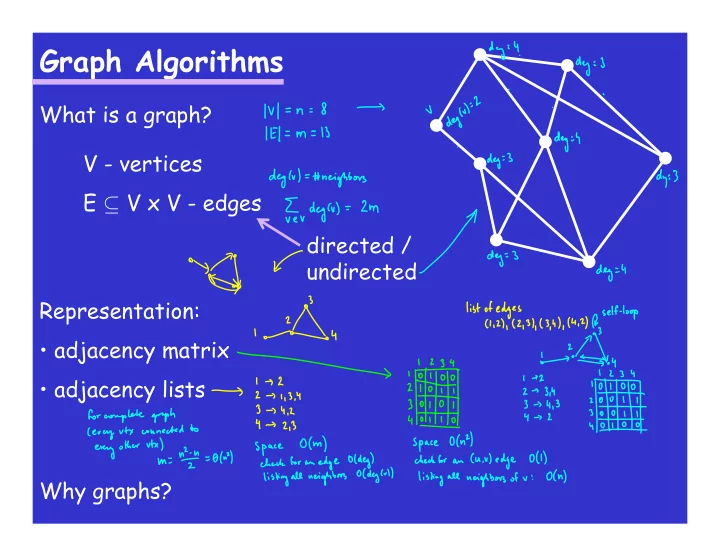
What is a graph? V - vertices E ⊆ V x V - edges directed / undirected Why graphs? Representation:
- adjacency matrix
- adjacency lists
SLIDE 2 Graph Algorithms
Graph properties: Tree – a connected acyclic (undirected) graph
SLIDE 3
Graph Traversals
Objective: list all vertices reachable from a given vertex s
SLIDE 4 BFS ( G=(V,E), s )
- 1. seen[v]=false, dist[v]=∞ for every vertex v
- 2. beg=1; end=2; Q[1]=s; seen[s]=true; dist[s]=0;
- 3. while (beg<end) do
4. head=Q[beg]; 5. for every u s.t. (head,u) is an edge and 6. not seen[u] do 7. Q[end]=u; dist[u]=dist[head]+1; 8. seen[u]=true; end++; 9. beg++;
Breadth-first search (BFS)
Finds all vertices “reachable” from a starting vertex. Byproduct: computes distances from the starting vertex to every vertex
SLIDE 5 DFS-RUN ( G=(V,E), s )
- 1. seen[v]=false for every vertex v
- 2. DFS(s)
DFS(v)
- 1. seen[v]=true
- 2. for every neighbor u of v
3. if not seen[u] then DFS(u)
Depth-first search (DFS)
Finds all vertices “reachable” from a starting vertex, in a different
SLIDE 6
Applications of DFS: topological sort
Def: A topological sort of a directed graph is an order of vertices such that every edge goes from “left to right.”
SLIDE 7
Applications of DFS: topological sort
Def: A topological sort of a directed graph is an order of vertices such that every edge goes from “left to right.”
SLIDE 8
Applications of DFS: topological sort
Def: A topological sort of a directed graph is an order of vertices such that every edge goes from “left to right.”
SLIDE 9
Applications of DFS: topological sort
Def: A topological sort of a directed graph is an order of vertices such that every edge goes from “left to right.”
SLIDE 10 TopSort ( G=(V,E) )
2. seen[v]=false 3. fin[v]=∞
- 4. time=0
- 5. for every vertex s
6. if not seen[s] then 7. DFS(s) DFS(v)
- 1. seen[v]=true
- 2. for every neighbor u of v
3. if not seen[u] then 4. DFS(u)
- 5. time++
- 6. fin[v]=time (and output v)
Applications of DFS: topological sort
SLIDE 11 TopSort ( G=(V,E) )
2. seen[v]=false 3. fin[v]=∞
- 4. time=0
- 5. for every vertex s
6. if not seen[s] then 7. DFS(s) DFS(v)
- 1. seen[v]=true
- 2. for every neighbor u of v
3. if not seen[u] then 4. DFS(u)
- 5. time++
- 6. fin[v]=time (and output v)
Applications of DFS: topological sort
What if the graph contains a cycle?
SLIDE 12
Appl.DFS: strongly connected components
Vertices u,v are in the same strongly connected component if there is a (directed) path from u to v and from v to u.
SLIDE 13
Appl.DFS: strongly connected components
Vertices u,v are in the same strongly connected component if there is a (directed) path from u to v and from v to u. How to find strongly connected components ?
SLIDE 14 STRONGLY-CONNECTED COMPONENTS ( G=(V,E) )
2. seen[v]=false 3. fin[v]=1
- 4. time=0
- 5. for every vertex s
6. if not seen[s] then 7. DFS(G,s) (the finished-time version) 8. compute G^T by reversing all arcs of G 9. sort vertices by decreasing finished time
- 10. seen[v]=false for every vertex v
- 11. for every vertex v do
12. if not seen[v] then 13.
- utput vertices seen by DFS(v)
Appl.DFS: strongly connected components
SLIDE 15 STRONGLY-CONNECTED COMPONENTS ( G=(V,E) )
2. seen[v]=false 3. fin[v]=1
- 4. time=0
- 5. for every vertex s
6. if not seen[s] then 7. DFS(G,s) (the finished-time version) 8. compute G^T by reversing all arcs of G 9. sort vertices by decreasing finished time
- 10. seen[v]=false for every vertex v
- 11. for every vertex v do
12. if not seen[v] then 13.
- utput vertices seen by DFS(v)
Appl.DFS: strongly connected components
SLIDE 16 Many other applications of D/BFS
DFS
- find articulation points
- find bridges
BFS
SLIDE 17 Many other applications of D/BFS
BFS