GRAPHIC MEDICINE: THE ART OF STORYTELLING WITH COMICS MICHAEL - - PowerPoint PPT Presentation

graphic medicine the art of storytelling with comics
SMART_READER_LITE
LIVE PREVIEW

GRAPHIC MEDICINE: THE ART OF STORYTELLING WITH COMICS MICHAEL - - PowerPoint PPT Presentation

GRAPHIC MEDICINE: THE ART OF STORYTELLING WITH COMICS MICHAEL GREEN, MD, MS PENN STATE COLLEGE OF MEDICINE mjg15@psu.edu What to Call These Things? In the context of Graphic Medicine, the vocabulary is imperfect Comics, graphic


slide-1
SLIDE 1

MICHAEL GREEN, MD, MS

PENN STATE COLLEGE OF MEDICINE mjg15@psu.edu
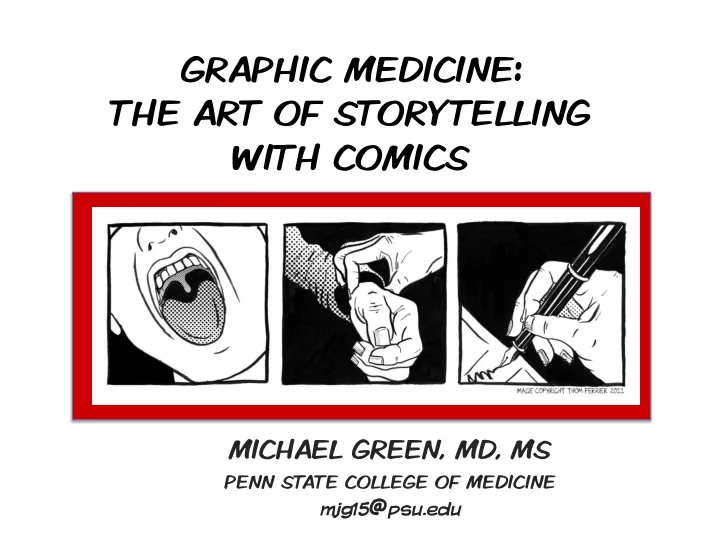
GRAPHIC MEDICINE: THE ART OF STORYTELLING WITH COMICS

slide-2
SLIDE 2

What to Call These Things?

  • In the context of Graphic

Medicine, the vocabulary is imperfect

– Comics, graphic memoir, graphica, graphic narrative, illness narrative, graphic pathography, comic memoir

  • For every definition, there

are counter examples and arguments

slide-3
SLIDE 3
slide-4
SLIDE 4

“What to call these things is one of the most nettlesome questions in the field. “Graphic” conjures for many the idea of sexually explicit; “novel” is usually a reference to fiction; ‘‘comic” suggests to some that these are supposed to be funny, or that they occupy the same terrain as “Batman.” Any of which could be true, but are not generally descriptive of the scope or ambition of these works.”

Peter Dunlap-Shohl, 2018

slide-5
SLIDE 5
slide-6
SLIDE 6

Important Features of Comics

  • A form of literature that includes….

– Pictures – Words – In sequence – To tell a story – Words complement and enhance pictures to produce greater meaning than either alone

slide-7
SLIDE 7

Graphic Medicine

  • Coined by Dr. Ian Williams
  • Speaks to interconnection between the medium of

comics and the field of medicine

  • Not one thing; includes:

– Stories by patients about illness experience – Stories by clinicians about being a health care provider – Materials to educate patients or clinicians – Tools aimed at changing health behavior – Scholarship about comics – It’s also about community

slide-8
SLIDE 8

Storytelling

  • At it’s core, Graphic

Medicine is about stories

  • The power of comics to

show us something about health, illness and the medical context

slide-9
SLIDE 9

Storytelling

  • In particular, stories that give voice to

perspectives that are not often told

  • Comics have a long history of being a

subversive medium

slide-10
SLIDE 10
  • R. Crumb

Underground Comics

slide-11
SLIDE 11

Taboo Topics

  • Suicide
  • Mental illness
  • AIDS
  • Sex
  • Abortion
  • Death and Dying
  • Herpes
slide-12
SLIDE 12

12

Monsters, by Ken Dahl

slide-13
SLIDE 13

Giving Voice to Those at the Margins

  • Transgender
  • Cancer patients
  • People with eating

disorders

  • Those with chronic

illness

  • People with

disabilities

  • Mutism
slide-14
SLIDE 14

14

Dumb, by Georgia Webber

slide-15
SLIDE 15

Offering Uncommon Perspectives

  • The inner thoughts of a

doctor

  • The experience of

being a front line nurse during the AIDS crisis

  • Being a family member
  • f patient with cancer
  • Life as a medical

student

slide-16
SLIDE 16

Challenging the Status Quo

  • Myths about pregnancy

Slightly Plural, by Marnie Galloway

slide-17
SLIDE 17

Challenging the Status Quo

  • Doctors don’t bring personal feelings to work

Tom Ferrier, Disrepute

slide-18
SLIDE 18
slide-19
SLIDE 19
slide-20
SLIDE 20

20

slide-21
SLIDE 21

Creation of “Missed It”

  • Began as a narrative essay about a mistake I made during

my internal medicine residency

  • Written as part of “Physician’s Writers Group”
slide-22
SLIDE 22

Evolved into a short and intense work of flash fiction

Routine ER page. He says it’s a COPDer. This will be easy -- nebs, steroids, 02. Home in a day. “What about the murmur?” I ask, “No worries, it’s innocent.” Just what I wanted to hear. Admit to floor; return to bed. 3 a.m. nurse is calling. Looks worse. “I can’t breathe.” Smell of fear. Lunge for my arm. Dead. Autopsy: pinpoint aortic stenosis. Fixable.

Creation of “Missed It”

slide-23
SLIDE 23
  • Wanted to tell this story visually
  • Collaborated with Ray Reich, a talented illustrator
  • How to “show” rather than “tell” this story

Creation of “Missed It”

slide-24
SLIDE 24
slide-25
SLIDE 25
slide-26
SLIDE 26
slide-27
SLIDE 27
slide-28
SLIDE 28
slide-29
SLIDE 29

JAMA 2015. Vol. 314, No. 22: 2345-2346

slide-30
SLIDE 30
slide-31
SLIDE 31
slide-32
SLIDE 32
slide-33
SLIDE 33

Zombie Themes

  • Fear of dehumanization
  • Isolation and loneliness
  • Mindless consumption
  • Being led by ruthless authority figures
  • Devaluing human beings
  • Erosion of empathy
slide-34
SLIDE 34

Zombies serve as powerful metaphors for our deepest fears and preoccupations

slide-35
SLIDE 35

Not About Zombies

  • Backdrops for stories about

– Survivors – Relationships

  • Emerge in response to

challenging times

George Romero

slide-36
SLIDE 36

Zombie Questions

  • How do people react to danger?

– Band together, or is everyone out for self? – Help the least advantaged, or survival of the fittest?

  • How do survivors cope with stress?

– Calmly or panicked?

  • How are power relationships negotiated?

– Smartest and most egalitarian as leaders, or rule by strong & ruthless?

slide-37
SLIDE 37
slide-38
SLIDE 38
slide-39
SLIDE 39

A Mixed-Methods Study Using “My Degeneration”

slide-40
SLIDE 40

Study Team

  • Daniel George, M.S., Ph.D.
  • Mike Goldenberg, M.A., MSIII
  • Michael Green, M.D.
  • Erik Lehman, M.S.
  • Kimberly R. Myers, M.A., Ph.D.
  • Xuemei Huang, M.D., Ph.D.
  • L.J. Van Scoy, M.D.
slide-41
SLIDE 41

Study Questions

  • Does reading My Degeneration help health care

providers (HCPs) better understand the lived experience of patients with Parkinson’s Disease?

  • Specifically, does it:

– ↑ confidence in understanding patients’ experience? – Change attitudes?

slide-42
SLIDE 42

Mixed Methods Approach

  • Participants:
  • 12 health care providers who treat patients

with Parkinson’s Disease

§ Mean age = 42 years § 83% female

  • All participants provided copy of the book
  • Pre/post intervention surveys
  • Qualitative assessment of small group discussion
slide-43
SLIDE 43

Mean Self-Efficacy (n=12)

scale 0-100; 0=low confidence, 100=high confidence

72 83 10 20 30 40 50 60 70 80 90 100 Self-Efficacy

Pre Post

P=0.001

slide-44
SLIDE 44

Smart Interesting Innovative Complex Active Mature Valuable Good Bad Worthless Juvenile Passive Simple Unimaginative Dull Stupid Pre Post

1 2 3 4 5 6 7

Semantic Differential Scale

Comics Are . . .

Mean score 4.8 à 5.3 (p=0.029)

slide-45
SLIDE 45

Net Promoter Score

  • 100 = would not recommend book to family or friends

+100 = would highly recommend book

  • 50

38 77

  • 50
  • 30
  • 10

10 30 50 70 90

Before Reading Book After Reading Book After Discussion

slide-46
SLIDE 46

No Change in Knowledge or Attitudes About PD

Measure Pre Mean Post Mean P value Knowledge About PD (0-100) 85 86 0.56 Attitudes about Parkinson’s * 52 54 0.166

*scale 15-60; 60 = patients worry a great deal

slide-47
SLIDE 47

Qualitative Results

  • 1. “My Degeneration” provided a meaningful way for

healthcare providers to learn about the lived experience of patients with PD

  • 2. The comic form engaged the healthcare providers in

ways that were different from other other mediums

  • 3. The benefits of the book may extend past the

healthcare team

slide-48
SLIDE 48

Graphic Medicine is a dynamic new field with many potential applications:

  • For teaching
  • For research
  • For patient care
  • For public health
slide-49
SLIDE 49
slide-50
SLIDE 50

MICHAEL GREEN mjg15@psu.edu