Graphs () Graphs () Graphs Graphs Graphs are collections of - - PowerPoint PPT Presentation

graphs graphs
SMART_READER_LITE
LIVE PREVIEW

Graphs () Graphs () Graphs Graphs Graphs are collections of - - PowerPoint PPT Presentation

Graphs () Graphs () Graphs Graphs Graphs are collections of nodes in which various pairs are connected by K08 line segments. The


slide-1
SLIDE 1

/

Graphs (Γράφοι) Graphs (Γράφοι)

K08 Δομές Δεδομένων και Τεχνικές Προγραμματισμού Κώστας Χατζηκοκολάκης

1

/

Graphs Graphs

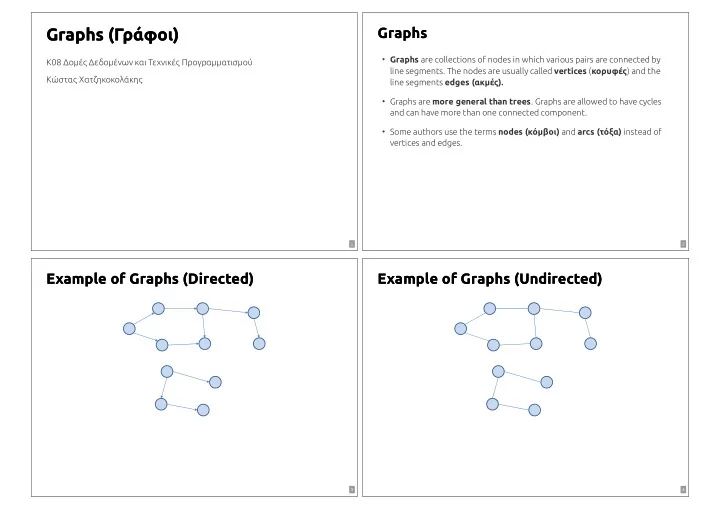
Graphs are collections of nodes in which various pairs are connected by line segments. The nodes are usually called vertices (κορυφές) and the line segments edges (ακμές).

  • Graphs are more general than trees. Graphs are allowed to have cycles

and can have more than one connected component.

  • Some authors use the terms nodes (κόμβοι) and arcs (τόξα) instead of

vertices and edges.

  • 2

/

Example of Graphs (Directed) Example of Graphs (Directed)

3

/

Example of Graphs (Undirected) Example of Graphs (Undirected)

4

slide-2
SLIDE 2

/

Examples of Graphs Examples of Graphs

Transportation networks

  • Interesting problem: What is the path with one or more stops of shortest
  • verall distance connecting a starting city and a destination city?
  • 5

/

Examples Examples

A network of oil pipelines

  • Interesting problem: What is the maximum possible overall ow of oil

from the source to the destination?

  • 6

/

Examples Examples

The Internet

  • Interesting problem: Deliver an e-mail from user A to user B
  • 7

/

Examples Examples

The Web

  • Interesting problem: What is the PageRank of a Web site?
  • 8
slide-3
SLIDE 3

/

Examples Examples

The Facebook social network

  • Interesting problem: Are John and Mary connected? What interesting

clusters exist?

  • 9

/

Formal Denitions Formal Denitions

A graph consists of a set of vertices and a set of edges , where the edges in are formed from pairs of distinct vertices in .

  • G = (V , E)

V E E V

If the edges have directions then we have a directed graph (κατευθυνόμενο γράφο) or digraph. In this case edges are ordered pairs

  • f vertices e.g.,

and are called directed. If is a directed edge then is called its origin and is called its destination.

  • (u, v)

(u, v) u v

If the edges do not have directions then we have an undirected graph (μη-κατευθυνόμενος γράφο). In this case edges are unordered pairs of vertices e.g., { } and are called undirected.

  • u, v

For simplicity, we will use the directed pair notation noting that in the undirected case is the same as .

  • (u, v)

(v, u)

When we say simply graph, we will mean an undirected graph.

  • 10

/

Example of a Directed Graph Example of a Directed Graph

1 2 3 4 5 6 7 8 9 10 11

G = (V , E) V = 1, 2, 3, 4, 5, 6, 7, 8, 9, 10, 11 E = (1, 2), (1, 3), (2, 5), (3, 4), (5, 4), (5, 6), (6, 70, (8, 9), (8, 10), (10, 11)

11

/

Example of an Undirected Graph Example of an Undirected Graph

1 2 3 4 5 6 7 8 9 10 11

G = (V , E) V = 1, 2, 3, 4, 5, 6, 7, 8, 9, 10, 11 E = (1, 2), (1, 3), (2, 5), (3, 4), (5, 4), (5, 6), (6, 70, (8, 9), (8, 10), (10, 11)

12

slide-4
SLIDE 4

/

More Denitions More Denitions

Two dierent vertices in a graph are said to be adjacent (γειτονικές) if there exists an edge .

  • v , v

i j

G = (V , E) (v , v ) ∈

i j

E

An edge is said to be incident (προσπίπτουσα) on a vertex if the vertex is

  • ne of the edge's endpoints.
  • A path (μονοπάτι) in a graph

, is a sequence of vertices of

  • f the form

in which each vertex , is adjacent to the next one (for ).

  • p

G = (V , E) V p = v v … v , (n ≥

1 2 n

2) vi vi+1 1 ≤ i ≤ n − 1

The length of a path is the number of edges in it.

  • A path is simple if each vertex in the path is distinct.
  • A cycle is a path
  • f length greater than one that begins

and ends at the same vertex (i.e., ).

  • p = v v … v

1 2 n

v =

1

vn

13

/

Denitions Denitions

A directed path is a path such that all edges are directed and are traversed along their direction.

  • A directed cycle is similarly dened.
  • 14

/

Denitions Denitions

A simple cycle is a path that travels through three or more distinct vertices and connects them into a loop.

  • 15

/

Example Example

1 2 5 4 6 7 8 3

Four simple cycles: (1,2,3,1) (4,5,6,7,4) (4,5,6,4) (4,6,7,4)

16

slide-5
SLIDE 5

/

Example Example

1 2 5 4 6 7 8 3

Two non-simple cycles: (1,2,1) (4,5,6,4,7,6,4)

17

/

Example Example

1 2 5 4 6 7 8 3

A path that is not a cycle: (1,2,4,6,8)

18

/

Connectivity and Components Connectivity and Components

Two vertices in a graph are said to be connected (συνδεδεμένες) if there is a path from the rst to the second in

  • G = (V , E)

G

Formally, if , then and are connected if there exists a path in such that and

  • x ∈ V and y ∈ V , where x =

 y x y p = v v … v ∈

1 2 n

G x = v1 y = vn

19

/

Connectivity and Components Connectivity and Components

In the graph , a connected component (συνεκτική συνιστώσα) is a subset of the vertices that are all connected to one another.

  • G = (V , E)

S V

A connected component of is a maximal connected component (μέγιστη συνεκτική συνιστώσα) provided there is no bigger subset

  • f

vertices in such that properly contains and such that itself is a connected component of .

  • S

G T V T S T G

An undirected graph can always be separated into maximal connected components such that whenever .

  • G

S , S , … ; , S

1 2 n

S ∩

i

S =

j

∅ i =  j

20

slide-6
SLIDE 6

/

Example of Undirected Graph and its Example of Undirected Graph and its Separation into Two Maximal Connected Separation into Two Maximal Connected Components Components

21

/

Connectivity and Components in Directed Connectivity and Components in Directed Graphs Graphs

A subset of vertices in a directed graph is strongly connected (ισχυρά συνεκτικό) if for each pair of distinct vertices in , is connected to and is connected to .

  • S

G (v , v )

i j

S vi vj vj vi

A subset of vertices in a directed graph is weakly connected (ασθενώς συνεκτικό) if for each pair of distinct vertices in , is connected to

  • r

is connected to .

  • S

G (v , v )

i j

S vi vj vj vi

22

/

Example: A Strongly Connected Digraph Example: A Strongly Connected Digraph

23

/

Example: A Weakly Connected Digraph Example: A Weakly Connected Digraph

24

slide-7
SLIDE 7

/

Degree in Undirected Graphs Degree in Undirected Graphs

In an undirected graph the degree (βαθμός) of vertex is the number

  • f edges in which is one of the endpoints of .
  • G

x e x e

The degree of a vertex is denoted by .

  • x

deg(x)

25

/

Example Example

1 2 5 4 6 7 8 3 .

The degree of node 1 is 2. The degree of node 4 is 4. The degree of node 8 is 1.

26

/

Predecessors and Successors in Directed Graphs Predecessors and Successors in Directed Graphs

If is a vertex in a directed graph then the set of predecessors (προηγούμενων) of denoted by is the set of all vertices such that .

  • x

G = (V , E) x Pred(x) y ∈ V (y, x) ∈ E

Similarly the set of successors (επόμενων) of denoted by is the set of all vertices such that .

  • x

Succ(x) y ∈ V (x, y) ∈ E

27

/

In-Degree and Out-Degree in Directed Graphs In-Degree and Out-Degree in Directed Graphs

The in-degree of a vertex is the number of predecessors of

  • x

x

The out-degree of a vertex is the number of successors of

  • x

x

We can also dene the in-degree and the out-degree by referring to the incoming and outgoing edges of a vertex.

  • The in-degree and out-degree of a vertex are denoted by

and respectively.

  • x

indeg(x)

  • utdeg(x)

28

slide-8
SLIDE 8

/

Example Example

1 2 3 4 5

The in-degree of node 4 is 2. The out-degree of node 4 is 1.

29

/

Proposition Proposition

If is an undirected graph with edges, then .

  • G

m deg(v) =

v∈G

Proof?

  • Each edge is counted twice
  • 30

/

Proposition Proposition

If is a directed graph with edges, then

  • indeg(v) =

v∈G

  • utdeg(v) =

v∈G

∑ m

Proof?

  • Each edge is counted once
  • 31

/

Proposition Proposition

Let be a graph with vertices and

  • edges. If

is undirected, then and if is directed, then .

  • G

n m G m ≤

2 n(n−1)

G m ≤ n(n − 1)

Proof?

  • If

is undirected then the maximum degree of a vertex is . Therefore, from the previous proposition about the sum of the degrees, we have

  • G

n − 1 2m ≤ n(n − 1).

If is directed then the maximum in-degree of a vertex is . Therefore, from the previous proposition about the sum of the in- degrees, we have .

  • G

n − 1 m ≤ n(n − 1)

32

slide-9
SLIDE 9

/

More denitions More denitions

A subgraph (υπογράφος) of a graph is a graph whose vertices and edges are subsets of the vertices and edges of respectively.

  • G

H G

A spanning subgraph (υπογράφος επικάλυψης) of is a subgraph of that contains all the vertices of .

  • G

G G

A forest (δάσος) is a graph without cycles.

  • A free tree (ελεύθερο δένδρο) is a connected forest i.e., a connected

graph without cycles. The trees that we studied in earlier lectures are rooted trees (δένδρα με ρίζα) and they are dierent than free trees.

  • A spanning tree (δένδρο επικάλυψης) of a graph is a spanning subgraph

that is a free tree.

  • 33

/

Example Example

1 2 5 4 6 7 8 3

The thick green lines dene a spanning tree of the graph.

34

/

Example Example

The thick green lines dene a forest which consists of two free trees.

35

/

Graph Representations: Adjacency Matrices Graph Representations: Adjacency Matrices

Let be a graph. Suppose we number the vertices in as

  • G = (V , E)

V v , v … v

1 2 n

The adjacency matrix (πίνακας γειτνίασης) corresponding to is an matrix such that if there is an edge , and if there is no such edge in .

  • G

n × n T[i, j] = 1 (v , v ) ∈

i j

E T[i, j] = 0 E

36

slide-10
SLIDE 10

/

Example Example

1 1 1 1 1 1 1 2 3 4 A graph G The adjacency matrix for graph G 1 2 3 4 1 2 3 4

37

/

Adjacency Matrices Adjacency Matrices

The adjacency matrix of an undirected graph is a symmetric matrix i.e., for all and in the range

  • G

T[i, j] = T[j, i] 1 ≤ i, j ≤ n

The adjacency matrix for a directed graph need not be symmetric.

  • 38

/

Adjacency Matrices Adjacency Matrices

The diagonal entries in an adjacency matrix (of a directed or undirected graph) are zero, since graphs as we have dened them are not permitted to have looping self-referential edges that connect a vertex to itself.

  • 39

/

Example Example

1 1 1 1 1 1 1 1 1 1 1 1 1 2 3 4 An undirected graph G The adjacency matrix for graph G 1 2 3 4 1 2 3 4

40

slide-11
SLIDE 11

/

Adjacency Sets Adjacency Sets

Another way to dene a graph is to specify adjacency sets (σύνολα γειτνίασης) for each vertex in .

  • G = (V , E)

V

Let stand for the set of all vertices adjacent to in an undirected graph

  • r the set of all vertices that are successors of in a directed graph

.

  • Vx

x G x G

If we give both the vertex set and the collection

  • f

adjacency sets for each vertex in then we have given enough information to dene the graph .

  • v

A = {V ∣x ∈

x

V } G

41

/

Graph Representations: Adjacency Lists Graph Representations: Adjacency Lists

Another family of representations for a graph uses adjacency lists (λίστες γειτνίασης) to represent the adjacency set for each vertex in the graph.

  • Vx

x

42

/

Example Directed Graph Example Directed Graph

1 2 2 3 2 3 3 4 5 3 1 4 4 5 1 1 1 3 5 4 A directed graph G The sequential adjacency lists for graph

  • G. Notice that vertices are listed in their

natural order. 2 Adjacency list Out Degree V ertex Number

43

/

Example Directed Graph Example Directed Graph

1 3 5 4 A directed graph G The linked adjacency lists for graph G. Notice that vertices in a list are organized according to their natural order . 2 2 3 . 3 4 5 . 4 1 .

. .

1: 2: 3: 4: 5:

44

slide-12
SLIDE 12

/

Example Undirected Graph Example Undirected Graph

1 3 2 3 5 2 4 1 3 4 5 3 3 1 2 4 4 2 2 4 5 2 1 2 1 3 5 4 An undirected graph G The sequential adjacency lists for graph G 2 Adjacency list Degree V ertex Number

45

/

Graph Searching Graph Searching

To search a graph , we need to visit all vertices of in some systematic

  • rder.
  • G

G

Each vertex can be a structure with a bool valued member . Visited which is initially false for all vertices of . When we visit , we will set it to true.

  • v

v G v

46

/

An Algorithm for Graph Searching An Algorithm for Graph Searching

// Ψευδοκώδικας, επίσκεψη όλων των κόμβων του γράφου void graph_search(G) { Let G = (V,E) be a graph Let C be an empty container for (each vertex x in V) { x.visited = false; } Insert v into C; while (C is non-empty) { Remove a vertex x from container C; if (!x.visited) { visit(x); x.visited = true; for (each vertex w adjacent to x) { if (!w.visited)) Insert w into C; } } } }

47

/

Graph Searching Graph Searching

Interesting case: the container is a stack.

1 2 3 4 5 6 7 8

In what order vertices are visited?

C

48

slide-13
SLIDE 13

/

Graph Searching Graph Searching

  • Eg. the container

is a stack.

1 2 3 4 5 6 7 8

The vertices are visited in the order 1, 4, 8, 7, 3, 2, 6, 5.

C

49

/

Depth-First Search (DFS) Depth-First Search (DFS)

When is a stack, the tree in the previous example is searched in depth- rst order.

  • C

Depth-rst search (αναζήτηση πρώτα κατά βάθος) at a vertex always goes down (by visiting unvisited children) before going across (by visiting unvisited brothers and sisters).

  • Depth-rst search of a graph is analogous to a pre-order traversal of an
  • rdered tree.
  • 50

/

Graph Searching Graph Searching

Another interestg case: the container is a queue.

1 2 3 4 5 6 7 8

What is the order vertices are visited?

C

51

/

Graph Searching Graph Searching

Another interestg case: the container is a queue.

1 2 3 4 5 6 7 8

The vertices are visited in the order 1, 2, 3, 4, 5, 6, 7 and 8.

C

52

slide-14
SLIDE 14

/

Breadth-First Search (BFS) Breadth-First Search (BFS)

When is a queue, the tree in the previous example is searched in breadth-rst order.

  • C

Breadth-rst search (αναζήτηση πρώτα κατά πλάτος) at a vertex always goes broad before going deep.

  • Breadth-rst traversal of a graph is analogous to a traversal of an ordered

tree that visits the nodes of the tree in level-order.

  • BFS subdivides the vertices of a graph in levels. The starting vertex is at

level 0, then we have the vertices adjacent to the starting vertex at level 1, then the vertices adjacent to these vertices at level 2 etc.

  • 53

/

Example Example

1 2 3 4 5 6 7 8

What is the order of visiting vertices for DFS?

54

/

Example Example

1 2 3 4 5 6 7 8

Depth-rst search visits the vertices in the order 1, 4, 8, 6, 5, 7, 3 and 2

55

/

Example Example

1 2 3 4 5 6 7 8

What is the order of visit for BFS?

56

slide-15
SLIDE 15

/

Example Example

1 2 3 4 5 6 7 8

Breadth-rst search visits the vertices in the order 1, 2, 3, 4, 5, 6, 7 and 8.

57

/

Exhaustive Search Exhaustive Search

Either the stack version or the queue version of the algorithm GraphSearch will visit every vertex in a graph provided that consists

  • f a single strongly connected component.
  • G

G

If this is not the case, then we can enumerate all the vertices of and run GraphSearch starting from each one of them in order to visit all the vertices of .

  • G

G

58

/

Exhaustive Search Exhaustive Search

void graph_exhaustive_search(G) { Let G = (V,E) be a graph. for (each vertex v in G) { graph_search(G, v) } }

59

/

Recursive DFS Recursive DFS

DFS can be also written recursively

  • The stack is essentially replaced by the function call stack
  • 60
slide-16
SLIDE 16

/

Recursive DFS Recursive DFS

// Ψευδοκώδικας, επίσκεψη όλων των κόμβων του γράφου void graph_dfs(G) { for (each vertex x in V) { x.visited = false; } for (each vertex x in V) { if (!x.visited)) traverse(G, x); } } void traverse(G, x) { visit(x); x.visited = true; for (each vertex w adjacent to v) { if (!w.visited)) traverse(G, w); } }

61

/

Example of Recursive DFS Example of Recursive DFS

What is the order vertices are visited?

1 2 3 4 5 6 7 8

62

/

Example Example

The vertices are visited in the order 1, 2, 5, 6, 3, 4, 7 and 8. This is dierent than the order we got when using a stack!

1 2 3 4 5 6 7 8

63

/

Complexity of DFS Complexity of DFS

DFS as implemented above (with adjacency lists) on a graph with edges and vertices has complexity .

  • e

n O(n + e)

To see why observe that on no vertex is traverse called more than once, because as soon as we call traverse with parameter , we mark visited and we never call traverse on a vertex that has previously been marked as visited.

  • x

x

Thus, the total time spent going down the adjacency lists is proportional to the lengths of those lists, that is

  • O(e)

The initialization steps in graph_dfs have complexity

  • O(n)

Thus, the total complexity is

  • O(n + e)

64

slide-17
SLIDE 17

/

Complexity of DFS Complexity of DFS

If DFS is implemented using an adjacency matrix, then its complexity will be .

  • O(n )

2

If the graph is dense (πυκνός), that is, it has close to edges the dierence of the two implementations is minor as they would both run in time.

  • O(n )

2

O(n )

2

If the graph is sparse (αραιός), that is, it has close to edges, then the adjacency matrix approach would be much slower than the adjacency list approach.

  • O(n)

65

/

Complexity of BFS Complexity of BFS

BFS with adjacency lists has the same complexity as DFS i.e., .

  • O(n + e)

66

/

Readings Readings

  • T. A. Standish. Data Structures , Algorithms and Software Principles in C.

Chapter 10

  • R. Kruse and C.L. Tondo and B. Leung. Data Structures and Program Design

in C. 2nd edition. Chapter 11

  • A. V. Aho, J. E. Hopcroft and J. D. Ullman. Data Structures and Algorithms.

Chapters 6 and 7

  • M. T. Goodrich, R. Tamassia and D. Mount. Data Structures and Algorithms

in C++. 2nd edition. Chapter 13

  • 67

/

68