Greedy algorithms: greed is good? Greedy algorithms Greed, for lack - - PowerPoint PPT Presentation

greedy algorithms greed is good greedy algorithms
SMART_READER_LITE
LIVE PREVIEW

Greedy algorithms: greed is good? Greedy algorithms Greed, for lack - - PowerPoint PPT Presentation

Greedy algorithms: greed is good? Greedy algorithms Greed, for lack of a better word, Coin Changing, Interval Scheduling, Interval Partitioning is good. Greed is right. Greed works. Greed clarifies, cuts through, and captures, the Tyler Moore


slide-1
SLIDE 1

Greedy algorithms

Coin Changing, Interval Scheduling, Interval Partitioning Tyler Moore

CS 2123, The University of Tulsa

Some slides created by or adapted from Dr. Kevin Wayne. For more information see http://www.cs.princeton.edu/~wayne/kleinberg-tardos. Some code reused from Python Algorithms by Magnus Lie Hetland.

Greedy algorithms: greed is good?

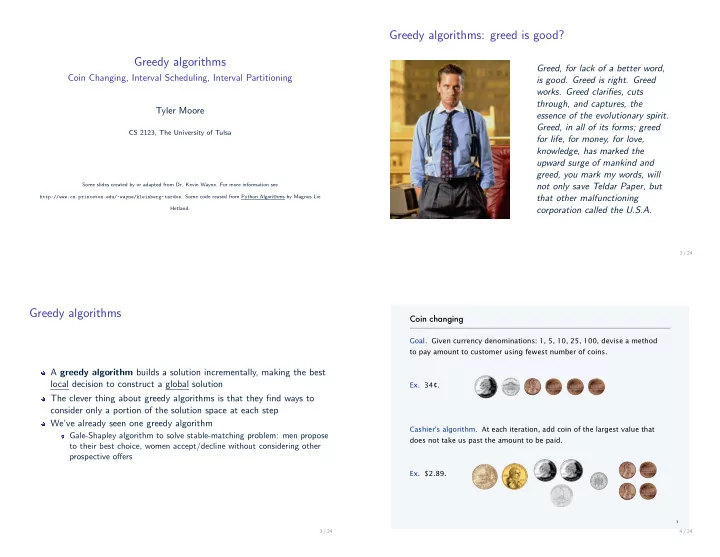
Greed, for lack of a better word, is good. Greed is right. Greed

  • works. Greed clarifies, cuts

through, and captures, the essence of the evolutionary spirit. Greed, in all of its forms; greed for life, for money, for love, knowledge, has marked the upward surge of mankind and greed, you mark my words, will not only save Teldar Paper, but that other malfunctioning corporation called the U.S.A.

2 / 24

Greedy algorithms

A greedy algorithm builds a solution incrementally, making the best local decision to construct a global solution The clever thing about greedy algorithms is that they find ways to consider only a portion of the solution space at each step We’ve already seen one greedy algorithm

Gale-Shapley algorithm to solve stable-matching problem: men propose to their best choice, women accept/decline without considering other prospective offers

3 / 24

  • Goal. Given currency denominations: 1, 5, 10, 25, 100, devise a method

to pay amount to customer using fewest number of coins.

  • Ex. 34¢.

Cashier's algorithm. At each iteration, add coin of the largest value that does not take us past the amount to be paid.

  • Ex. $2.89.

3

Coin changing

4 / 24

slide-2
SLIDE 2

4

Cashier's algorithm

At each iteration, add coin of the largest value that does not take us past the amount to be paid.

  • Q. Is cashier's algorithm optimal?

CASHIERS-ALGORITHM (x, c1, c2, …, cn)

_________________________________________________________________________________________________________________________________________________________________________________________________________________________________________________________________________________________________________________________________________________________________________________________________________________________________________________________________________________________________________________________________________________________________________________________________________________________________________________________________________________________________________________________________________________________________________________________________________________________________________________________________________________________________________________________________________________________________________________________________________________________________________________________________________________

SORT n coin denominations so that c1 < c2 < … < cn

S ← φ

WHILE x > 0

k ← largest coin denomination ck such that ck ≤ x IF no such k, RETURN "no solution" ELSE x ← x – ck S ← S ∪ { k }

RETURN S

_________________________________________________________________________________________________________________________________________________________________________________________________________________________________________________________________________________________________________________________________________________________________________________________________________________________________________________________________________________________________________________________________________________________________________________________________________________________________________________________________________________________________________________________________________________________________________________________________________________________________________________________________________________________________________________________________________________________________________________________________________________________________________________________________________________

set of coins selected

5 / 24

  • Property. Number of pennies ≤ 4.
  • Pf. Replace 5 pennies with 1 nickel.
  • Property. Number of nickels ≤ 1.
  • Property. Number of quarters ≤ 3.
  • Property. Number of nickels + number of dimes ≤ 2.

Pf.

・Replace 3 dimes and 0 nickels with 1 quarter and 1 nickel; ・Replace 2 dimes and 1 nickel with 1 quarter. ・Recall: at most 1 nickel.

5

Properties of optimal solution

6 / 24

  • Theorem. Cashier's algorithm is optimal for U.S. coins: 1, 5, 10, 25, 100.
  • Pf. [by induction on x]

・Consider optimal way to change ck ≤ x < ck+1 : greedy takes coin k. ・We claim that any optimal solution must also take coin k.

  • if not, it needs enough coins of type c1, …, ck–1 to add up to x
  • table below indicates no optimal solution can do this

・Problem reduces to coin-changing x – ck cents, which, by induction,

is optimally solved by cashier's algorithm. ▪

k ck all optimal solutions must satisfy 1 1

P ≤ 4

2 5

N ≤ 1

3 10

N + D ≤ 2

4 25

Q ≤ 3

5 100

no limit

6

Analysis of cashier's algorithm

max value of coins c1, c2, …, ck–1 in any OPT – 4 4 + 5 = 9 20 + 4 = 24 75 + 24 = 99 7 / 24

  • Q. Is cashier's algorithm for any set of denominations?
  • A. No. Consider U.S. postage: 1, 10, 21, 34, 70, 100, 350, 1225, 1500.

・Cashier's algorithm: 140¢ = 100 + 34 + 1 + 1 + 1 + 1 + 1 + 1. ・Optimal: 140¢ = 70 + 70.

  • A. No. It may not even lead to a feasible solution if c1 > 1: 7, 8, 9.

・Cashier's algorithm: 15¢ = 9 + ???. ・Optimal: 15¢ = 7 + 8.

7

Cashier's algorithm for other denominations

8 / 24

slide-3
SLIDE 3

9

Interval scheduling

・Job j starts at sj and finishes at fj. ・Two jobs compatible if they don't overlap. ・Goal: find maximum subset of mutually compatible jobs.

time

1 2 3 4 5 6 7 8 9 10 11

f g h e a b c d h e b

jobs d and g are incompatible

9 / 24

10

Interval scheduling: greedy algorithms

Greedy template. Consider jobs in some natural order. Take each job provided it's compatible with the ones already taken.

・[Earliest start time] Consider jobs in ascending order of sj. ・[Earliest finish time] Consider jobs in ascending order of fj. ・[Shortest interval] Consider jobs in ascending order of fj – sj. ・[Fewest conflicts] For each job j, count the number of

conflicting jobs cj. Schedule in ascending order of cj.

10 / 24

11

Interval scheduling: greedy algorithms

Greedy template. Consider jobs in some natural order. Take each job provided it's compatible with the ones already taken.

counterexample for earliest start time counterexample for shortest interval counterexample for fewest conflicts

11 / 24

12

  • Proposition. Can implement earliest-finish-time first in O(n log n) time.

・Keep track of job j* that was added last to A. ・Job j is compatible with A iff sj ≥ fj* . ・Sorting by finish time takes O(n log n) time.

Interval scheduling: earliest-finish-time-first algorithm

EARLIEST-FINISH-TIME-FIRST (n, s1, s2, …, sn , f1, f2, …, fn)

_________________________________________________________________________________________________________________________________________________________________________________________________________________________________________________________________________________________________________________________________________________________________________________________________________________________________________________________________________________________________________________________________________________________________________________________________________________________________________________________________________________________________________________________________________________________________________________________________________________________________________________________________________________________________________________________________________________________________________________________________________________________________________________________________________________________________________________________________________________________________________________

SORT jobs by finish time so that f1 ≤ f2 ≤ … ≤ fn A ← φ FOR j = 1 TO n IF job j is compatible with A A ← A ∪ { j } RETURN A

_________________________________________________________________________________________________________________________________________________________________________________________________________________________________________________________________________________________________________________________________________________________________________________________________________________________________________________________________________________________________________________________________________________________________________________________________________________________________________________________________________________________________________________________________________________________________________________________________________________________________________________________________________________________________________________________________________________________________________________________________________________________________________________________________________________________________________________________________________________________________________________

set of jobs selected

12 / 24

slide-4
SLIDE 4

20

Earliest-finish-time-first algorithm demo

time

C

E

1 2 3 4 5 6 7 8 9 10 11

H G D F

1 2 3 4 5 6 7 8 9 10 11

B B A E H

done (optimal set of jobs) 13 / 24

13

Interval scheduling: analysis of earliest-finish-time-first algorithm

  • Theorem. The earliest-finish-time-first algorithm is optimal.
  • Pf. [by contradiction]

・Assume greedy is not optimal, and let's see what happens. ・Let i1, i2, ... ik denote set of jobs selected by greedy. ・Let j1, j2, ... jm denote set of jobs in an optimal solution with

i1 = j1, i2 = j2, ..., ir = jr for the largest possible value of r.

why not replace job jr+1 with job ir+1? job ir+1 exists and finishes before jr+1

i1 i2 ir ir+1

Greedy:

ik

. . .

j1 j2 jr jm

OPT:

jr+1

. . .

14 / 24

i2 i1 ir ik jm jr j1 j2 ir+1

  • Theorem. The earliest-finish-time-first algorithm is optimal.
  • Pf. [by contradiction]

・Assume greedy is not optimal, and let's see what happens. ・Let i1, i2, ... ik denote set of jobs selected by greedy. ・Let j1, j2, ... jm denote set of jobs in an optimal solution with

i1 = j1, i2 = j2, ..., ir = jr for the largest possible value of r.

14

Interval scheduling: analysis of earliest-finish-time-first algorithm

solution still feasible and optimal (but contradicts maximality of r)

ir+1

Greedy: OPT:

. . . . . .

job ir+1 exists and finishes before jr+1

15 / 24

Interval partitioning.

・Lecture j starts at sj and finishes at fj. ・Goal: find minimum number of classrooms to schedule all lectures

so that no two lectures occur at the same time in the same room.

  • Ex. This schedule uses 4 classrooms to schedule 10 lectures.

15

Interval partitioning

time

9 9:30 10 10:30 11 11:30 12 12:30 1 1:30 2 2:30

h c b a e d g f i j

3 3:30 4 4:30

1 2 3 4

16 / 24

slide-5
SLIDE 5

16

Interval partitioning

Interval partitioning.

・Lecture j starts at sj and finishes at fj. ・Goal: find minimum number of classrooms to schedule all lectures

so that no two lectures occur at the same time in the same room.

  • Ex. This schedule uses 3 classrooms to schedule 10 lectures.

h c a e f g i j d b

time

9 9:30 10 10:30 11 11:30 12 12:30 1 1:30 2 2:30 3 3:30 4 4:30

1 2 3

17 / 24

17

Interval partitioning: greedy algorithms

Greedy template. Consider lectures in some natural order. Assign each lecture to an available classroom (which one?); allocate a new classroom if none are available.

・[Earliest start time] Consider lectures in ascending order of sj. ・[Earliest finish time] Consider lectures in ascending order of fj. ・[Shortest interval] Consider lectures in ascending order of fj – sj. ・[Fewest conflicts] For each lecture j, count the number of

conflicting lectures cj. Schedule in ascending order of cj.

18 / 24

18

Interval partitioning: greedy algorithms

Greedy template. Consider lectures in some natural order. Assign each lecture to an available classroom (which one?); allocate a new classroom if none are available.

counterexample for earliest finish time counterexample for fewest conflicts 1 2 3 counterexample for shortest interval 1 2 3 1 2 3

19 / 24

19

Interval partitioning: earliest-start-time-first algorithm

EARLIEST-START-TIME-FIRST (n, s1, s2, …, sn , f1, f2, …, fn)

_________________________________________________________________________________________________________________________________________________________________________________________________________________________________________________________________________________________________________________________________________________________________________________________________________________________________________________________________________________________________________________________________________________________________________________________________________________________________________________________________________________________________________________________________________________________________________________________________________________________________________________________________________________________________________________________________________________________________________________________________________________________________________________________________________________________________________________________________________________________

SORT lectures by start time so that s1 ≤ s2 ≤ … ≤ sn. d ← 0 FOR j = 1 TO n IF lecture j is compatible with some classroom Schedule lecture j in any such classroom k. ELSE Allocate a new classroom d + 1. Schedule lecture j in classroom d + 1. d ← d + 1 RETURN schedule.

_________________________________________________________________________________________________________________________________________________________________________________________________________________________________________________________________________________________________________________________________________________________________________________________________________________________________________________________________________________________________________________________________________________________________________________________________________________________________________________________________________________________________________________________________________________________________________________________________________________________________________________________________________________________________________________________________________________________________________________________________________________________________________________________________________________________________________________________________________________________

number of allocated classrooms

20 / 24

slide-6
SLIDE 6

13

Earliest-start-time-first algorithm demo

Consider lectures in order of start time:

・Assign next lecture to any available classroom (if one exists). ・Otherwise, open up a new classroom.

time

9 9:30 10 10:30 11 11:30 12 12:30 1 1:30 2 2:30 3 3:30 4 4:30

done

1

a

2

b

3

c d e f g h j i 21 / 24

20

Interval partitioning: earliest-start-time-first algorithm

  • Proposition. The earliest-start-time-first algorithm can be implemented in

O(n log n) time.

  • Pf. Store classrooms in a priority queue (key = finish time of its last lecture).

・To determine whether lecture j is compatible with some classroom,

compare sj to key of min classroom k in priority queue.

・To add lecture j to classroom k, increase key of classroom k to fj. ・Total number of priority queue operations is O(n). ・Sorting by start time takes O(n log n) time. ▪

  • Remark. This implementation chooses the classroom k whose finish time
  • f its last lecture is the earliest.

22 / 24

21

Interval partitioning: lower bound on optimal solution

  • Def. The depth of a set of open intervals is the maximum number that

contain any given time. Key observation. Number of classrooms needed ≥ depth.

  • Q. Does number of classrooms needed always equal depth?
  • A. Yes! Moreover, earliest-start-time-first algorithm finds one.

h c a e f g i j d b

1 2 3 time

9 9:30 10 10:30 11 11:30 12 12:30 1 1:30 2 2:30 3 3:30 4 4:30

depth = 3

23 / 24

22

Interval partitioning: analysis of earliest-start-time-first algorithm

  • Observation. The earliest-start-time first algorithm never schedules two

incompatible lectures in the same classroom.

  • Theorem. Earliest-start-time-first algorithm is optimal.

Pf.

・Let d = number of classrooms that the algorithm allocates. ・Classroom d is opened because we needed to schedule a lecture, say j,

that is incompatible with all d – 1 other classrooms.

・These d lectures each end after sj. ・Since we sorted by start time, all these incompatibilities are caused by

lectures that start no later than sj.

・Thus, we have d lectures overlapping at time sj + ε. ・Key observation ⇒ all schedules use ≥ d classrooms. ▪

24 / 24