
SLIDE 1
Greek Art from E l Cl l Early Classical to Hellenistic Period Hellenistic Period
- Mrs. Cook
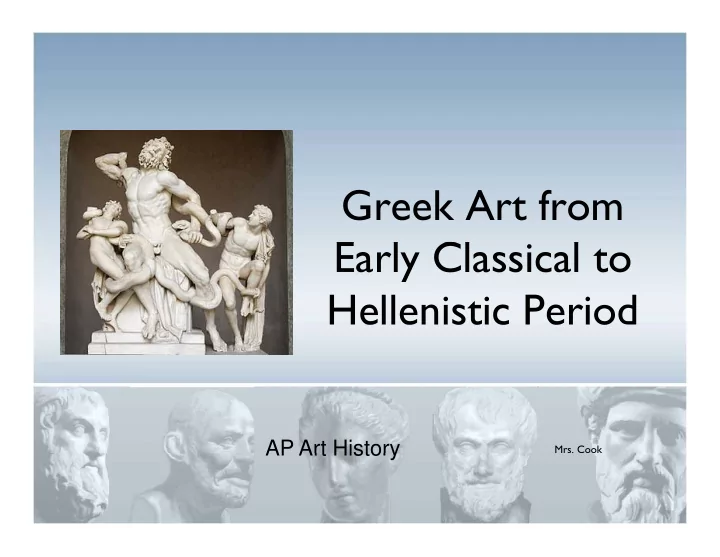
Greek Art from E Early Classical to l Cl l Hellenistic Period - - PowerPoint PPT Presentation
Greek Art from E Early Classical to l Cl l Hellenistic Period Hellenistic Period AP Art History AP Art History Mrs. Cook Greek Classical Art Greek Classical Art Scholars have characterized Greek Classical art as being based on
The first great monument of Classical architecture at Olympia, the site of the y p , Olympic games, architect was Libon of Elis The temple was made of stone, it was decorated with sculpture of imported 5-29: Temple of Hera II decorated with sculpture of imported marble, the themes demonstrated the power of the gods Zeus, Apollo, and Athena.
5-30: East Pediment, Temple of Zeus The subject of the east The subject of the east pediment is the chariot race
Seer, east pediment Temple of Zeus p p
Seer is a rare depiction of old age, balding, wrinkled head, sagging musculature- shocking expression on his face - We have moved away from the archaic smile, not a regular feature until the Hellenistic age
Athena, Herakles, and Atlas with Apples of the Hesperides
Severe Style – The Early Classical style of Greek sculpture – 480-450 BCE
Herakles cleaning Augean Stables: Labor #5 Labor #5
5-34: Kritios Boy Marble, 2’10” Cue Card Transitional piece from Archaic to Classical art - Under life-size, art historians Transitional piece from Archaic to Classical art Under life size, art historians thought it was the work of sculpture Kritios, they believe this is one of the most important statues in the history of art. – Never before had a sculptore been concerned with portraying a human being as he truly stands. K iti B th fi t t thi t i l f t th b d hift i ht h it Kritios Boy was the first to grasp this anatomical fact – the body shifts weight when it moves – This weight shift is called “contrapposto” (counterbalance) This separates Archaic Greek period from the Classical periods,
CONTRAPPOSTO (or COUNTERPOISE), ( ), an Italian word, describes the stance of the human body in which one leg bears the weight while the other is relaxed. An asymmetry is created in the shoulder hip asymmetry is created in the shoulder-hip
Early sculptures of human figures, while anatomically correct, appeared stiff and unnatural
If we look at the early Greek sculpture, the
CONTRAPPOSTO CONTRAPPOSTO
Anavysos Kouros (c 525 BCE), the unnatural stiffness is still present. ...the shoulders are level ...the hips are level ...both fists are level ...even the knees are level b t th l ft l i th t f d ...but the left leg is thrust forward. The left leg is forward and would have to be six inches longer!
CONTRAPPOSTO CONTRAPPOSTO
Contrapposto first appeared in classical Greek sculpture.
...the left shoulder is higher than the right shoulder ...an angle from the right shoulder to the left hip. The leg is relaxed and the hip bone is lower. ...the right leg bears all the body’s weight. Also notice how the knees are not level and at an
If the hips and shoulders were parallel, we could not balance and would fall over!
CONTRAPPOSTO CONTRAPPOSTO
The classical Greeks progressed to where they were able to model the human in a nonsymmetrical, relaxed stance that appears much more realistic. This was lost during the Middle Ages and was rediscovered by artists like Donatello during the Renaissance
5-35: Warrior, from the sea off Riace
Cue Card
carried the innovation f th K iti B i t
bronze statue.
shield, spear, and s e d, spea , a d helmet.
pronounced, It is a masterpiece of masterpiece of hollow-casting method.
space has replaced Archaic frontality and rigidity!
Charioteer Thi d h Ri i i h i l li
feet in opposite directions as well as the slight twist at the waist is keeping with the Severe style, originally part of a waist is keeping with the Severe style, originally part of a group representing a team of horse pulling a chariot driven by this charioteer
ld d t th soldered together
5-38: Zeus (or Poseidon?)
held in his right hand, probably a thunderbolt
right heel off the ground right heel off the ground
5-39: MYRON, Diskobolos (Discus Thrower)
Cue Card
demand so far exceeded the supply of Greek statues, the industry met the call by producing in marble, which presented a very different appearance from shiny bronze – without them we would not be able to reconstruct the history of Greek sculpture)
and limbs to form to intersecting arcs – (one from the and limbs to form to intersecting arcs (one from the discus to the left hand, one from the head to the right knee)
impossible to throw the discus this way but optically the pose k i i t i l f th f t works, viewpoint mainly form the front
embodiment of Polykleitos’s vision of the ideal statue of a nude male athlete or warrior nude male athlete or warrior.
to accompany a treatise on the subject – Canon, the contrapposto j pp is more pronounced than ever, his aim was to render a figure that stands naturally, His aim was to impose order on human impose order on human movement to make it beautiful and perfect.
5-40: POLYKLEITOS, Doryphoros cross balance, (right arm and left leg are relaxed, the tensed supporting leg opposes the flexed arm with the spear head turns to the right while Doryphoros (Spear Bearer)
Roman copy, marble, spear, head turns to the right while the hips twist to the left) He appears to step forward but doesn't move, dynamic asymmetrical balance, this ti hil t t d lti 6’11” Cue Card motion while at rest, and resulting harmony of opposites are the essence of Polykleitian style, closed stance, movement restrain,
Chiastic (cross balance) Chiastic (cross balance) is asymmetrical balance asymmetrical balance …right arm and leg rigid & stiff creating columnar stability and h i anchoring …the bent left arm and leg …head turns right, hips twist left, back foot turns outward creating a twist in the body
5-41; KRESILAS, Pericles Roman herm copy, c 429 BCE, Marble, 4’6” Marble, 4 6
head only in the form of a herm (a bust y (
was a general, unblemished features, his body’s perfect physique noble and his body s perfect physique, noble and important men to appear even more noble in their portraits -
but idealized images in which humans appeared godlike – Classical beauty Herm – Bust
5-42 to 5-44: Aerial View & Model of the Acropolis, Iktinos and Kallikrates, 447-438 BCE, Cue Card
Athenians undertook the costly project of reconstructing the Acropolis after the Persian sac
Kalikrates,
Iktinos believed harmonic proportions produced beautiful buildings, In the Parthenon, the ratio of larger and smaller parts is x=2y +1 (8 columns on the façade, 17 on the side
IKTINOS and KALLIKRATES, Parthenon Cue Card
IKTINOS and KALLIKRATES, Parthenon The Parthenon may be viewed as the ideal solution to the Greek architect’s quest for the perfect proportions in Doric temple design – Its well-spaced columns, with slender shafts, and capitals – ultimate refinement – the architects believed that beautiful proportions resulted from strict adherence to harmonic numerical ratios, whether in a temple of 200 feet long or a statue of a nude man the ratio was 9:4 Although the in a temple of 200 feet long or a statue of a nude man, the ratio was 9:4, Although the harmonious design, it is really irregular in shape, the building are deviations from strict horizontal and vertical lines of Greek post-and-lintel structures, these deviations meant that virtually every block had to be carved according to special set of instructions, Some modern observers say that the curving horizontal lines and tilting vertical ones create a dynamic balance in the building-kind of architectural contrapposto-giving it a greater sense of life One of the ironies is that the Doric temple had Ionic elements, inner frieze was Ionic, One of the ironies is that the Doric temple had Ionic elements, inner frieze was Ionic, maybe it was suggesting that they were the leader of all the Greeks – ionic/Doric
5-46: PHIDIAS, Athena Parthenos, c. 438 BCE, 38’
Marble copy
project,
designed the Parthenon around her, Athena was fully armed with shield, spear, helmet, and she held a Nike (the winged personification of she held a Nike (the winged personification of Victory – this referred to the victory in 479 BCE)
Acropolis was still vivid, the Athenians were intensely conscious that by driving back the Persians, they had save their civilization from the Eastern “barbarians”, sandals represented
centaurs)- over chaos, civilization over barbarism a metaphor for triumph of order d Athens over Persia
5-47: Lapith versus centaur centauromacy
vibrant living centaur form the lifeless Greek corpse vibrant living centaur form the lifeless Greek corpse
Three Goddess (Hestia, Dione, and A h dit ?) Helios and his horses, and Dionysis
5-48 & 5-49: Phidias, Pediments of the Parthenon Cue Card
Aphrodite?) Dionysis
Three Goddess (Hestia, Dione, and A h dit ?) Helios and his horses, and Dionysis
5-48 & 5-49: Phidias, Pediments of the Parthenon Cue Card
Aphrodite?) Dionysis
anatomy, both male and female, but also the mechanics of how muscles and ones make th b d the body move,
interconnected meaning, clinging, wet drapery reveals the voluptuous bodies beneath, deeply cut draper, figures sit naturally within the framework of the pediment, Phidias deeply cut draper, figures sit naturally within the framework of the pediment, Phidias designed this – his assistant might have executed it
Parthenon, West Pediment: Athena vs. Poseidon Cue Card
become the city’s patron deity.
g g p
line and the charioteers and their horse move through it effortlessly, figures and animals are brilliantly characterized, reclining figures fill the space,
Details of the Panathenaic Festival procession frieze
procession began at the Dipylon Gate, passed through the agora (central square) and ended on the Acropolis, where the Athenians placed the wooden statue of Athena. The procession begins on the west, the upper part of the relief is higher than the lower part, so more of the frieze is legible from the bottom – Another example of how Parthenon’s so more of the frieze is legible from the bottom Another example of how Parthenon s designers took optical effects into consideration, The Olympian deities do not take part in the festival but are spectators, The Parthenon celebrated the greatness of Athens and the Athenians as much as it honored Athena
5-52: Erechtheion and Plan
Erechtheion from the west
Cue Card
Ionic temple, it has some of he finest decorative details of any ancient Greek building,
host of other gods and demigods who were important in the city’s past.
place Poseidon striker the rock with this trident and producing a salt-water spring place, Poseidon striker the rock with this trident and producing a salt-water spring, Athena had cause an olive tree to grow, constant reminder of the victory over Poseidon.
leveled because it would disturb the ancient sacred sites, result four sides with very different character, each side rest on a different ground level,
Caryatid from south porch
Caryatid from south porch
Most striking and famous feature is the architect replaced Ionic columns replaced Ionic columns with caryatids, flutelike drapery folds concealing their stiff weight-bearing l d th legs underscore the architectural supports, small degree of flexibility to suggest the living gg g body.
KALLIKRATES, Temple of Athena Nike
5-56: Nike adjusting her sandal South side of the parapet
Persians
the decisive battle at Marathon, which turned the tide against the Persian, human events like the procession frieze, dozens of images of winged Victory adorned the parapet on three sides of the Athena Nike temple the sculptor carved this Nike with Parapet: a low protective wall along the edge
Nike temple, the sculptor carved this Nike with garments that appear almost transparent, drapery folds form intricate linear patterns , supple beauty of the young female body, modeled in high relief
Grave stele of Hegeso
The Athena Nike parapet reliefs was set up in memory of a woman named Hegeso- subject young woman in her home young woman in her home, attended y her main, the composition has parallels to Classical vase painting,
5:58: ACHILLES PAINTER, Warrior taking leave of his ife wife Lekythos (flask to hold f d il) perfumed oil) White-ground Foreshortening
g White-ground technique (painter covered the pot with a slip of fine white clay, then applied black glaze to outline figures, diluted brown, purple, red, and white to color them) they could add more colors but they had to be added after the firing, This technique was almost exclusively use on a technique was almost exclusively use on a scene: husband is preparing to go to war- helmet, shield, and spear- who will depart, never to return, the woman is the survivor The artist attempted to render the eyes in profile, foreshortening used,
5-59: NIOBID PAINTER,
Krater
, Artemis and Apollo slaying the children of Niobe
3-Quarter Profile Red-figure krater, placement of figures on different levels in a landscape depicting the f th Ni bid fl t th massacre of the Niobids reflects the compositional influence of panel painters, they actively interact with their setting,
5-61: Youth Diving
This type of scene often occurs in Greek vases
next
have been seen by someone peeking through columns; voyeuristic view, The original lost carved from marble
work of Praxitelses, one of the great masters of the 4th century. y
worldly sensuousness, see a new humanizing spirit, goddess of love completely nude
confined almost exclusively on paintings on vases for household use, considered “superior to all works in the whole world”
Praxiteles took the unprecedented step of representing the goddesses of love nude, No one had dared place inside a temple a statue of a goddess wearing no clothes inside a temple a statue of a goddess wearing no clothes
bathing, she has removed her garment, draped it over a large hydria (water pitcher) and is about to step in the b th 5-62: PRAXITELES Aphrodite of Knidos bath,
quite sensuous
5-62: Hermes and the infant Dionysos
is an integral part of the compositions)
hallmark of Praxiteles’ statues
dangles a bunch of grapes (missing) as a temptation for the infant, who is to become the Greek god of the vine.
child – one encounters often in real life child
is new
modeling is smooth and subtle, soft h d h ll S h d shadow, shallow S-shaped curve, subtle modeling of musculature, soft shadows play on body surface
5-65: LYSIPPOS, Apoxyomenos, (Th S )
proportions in which the bodies were (The Scraper) Roman copy of bronze, c. 330 BCE, 6’9” p p more slender than those of Polykleitos and head roughly one-eighth the height of the body rather than one-seventh , as in the previous century p y
statue (only marble left) - an athlete scraping
proportions, new change in physique, nervous g y energy,
right arm and at any moment the switch other hand to scrape his left arm
legs, began to break down the dominance of the frontal view and encourage to observe the view of his athlete form multiple angles, right
Great Late
arm boldly thrust forward
define early statues, the observer must move to the side and view the work at three-quarter
Classical sculpture
renown that Alexander the
angle or in full profile, head is one-eighth of body, far away look on the face
Alexander the Great selected him to create his official portrait,
Spear Bearer Hermes and the infant Dionysos Scaper Comparing with the Spear Bearer - This reveals the sweeping change in artistic attitude and intent, the deities still posses a beauty mortals can aspire to but not achieve but they are no long a aloof, they have entered the world of human experience,
5-66: LYSIPPOS, Farnese Herakles Roman copy, c. 320 BCE, 10’5” Cue Card Colossal statue viewer must walk around it original is nearly twice life size Colossal statue, viewer must walk around it, original is nearly twice life-size, exaggerated muscular development, depicted the hero so weary he must lean on his club for support or he will topple over, rejecting stability and balance, holds golden apples in his right hand behind his back, unseen unless you walk around it, we see pain and weariness, eloquent testimony to Late Classical sculptors interest in humanizing the Greek gods and heroes,
5-67: LYSIPPOS: Alexander the Great He was the official sculpture of Alexander the Greek, it provides insight into his lit personality
5-68: Stag hunt Pebble mosaic: the floors consist of small stones of various colors collect from beaches and riverbanks and set into a thick coat of cement It was the into a thick coat of cement, It was the scene of a Stag hunt, the artist signed the work like the ceramic vase painters. This is the earliest mosaicist’s signature known Pebble mosaic
5-70: Battle of Issus, (AKA Battle of Alexander the Great and Darius)
floor of a room in a appointed Roman house at Pompeii, The mosaicists employed tesserae mosaicists employed tesserae (cubical pieces of glass or tiny stones cut to the desire size and shape) instead of pebbles p ) p
Great and the Persian King Darius III. Artist depiction of the rearing horse seen in three the rearing horse seen in three quarter rear view, reflection of a man’s terrified face, Persian to the right of the rearing horse has fallen to the ground and raises backward, dropped shield to protect himself from being trampled being trampled,
shiny surface and the absence
h l i l i t it f th psychological intensity of the drama unfolding before the viewer,
5-71: Theater, Epidauros
5-71: Polykleitos the Younger Theater, Epidauros
closel associate ith religio s rites and as not p re entertainment closely associate with religious rites and was not pure entertainment.
circular hard and level surface was the orchestra (means dancing place” the spectators ( g p p sat on the slope overlook the orchestra – the theatron means “place of seeing” The Greeks always situated the auditorium on a hillside, acoustics were excellent
the auditorium 387 feet in diameter and 55 rows of seats that accommodate about the auditorium 387 feet in diameter and 55 rows of seats that accommodate about 12,000 spectators (everyone could hear perfectly), the entered the theater via a passageway between the seating area and the scene building which house dressing rooms for the actors, it also formed the backdrop for the plays, The plan was simple but perfectly suited for its function.
5-72: THOLOS, SANCTUARY OF ATHENA PRONAIA at Delphi Th l Thi i h b d
example of a round temple of the Classical period,
It had Doric columns on the exterior and Corinthian columns inside.
Greek temple design, architects did not dil b th C i thi it l readily embrace the Corinthian capital, they used them for the interiors of sacred buildings
5-74: Choragic Monument The earliest instance of a Corinthian capital on the exterior of a Greek building which is not really a b ildi it i t t building, it is a monument to commemorate the victory of a theatrical contest in 334 BCE, Engaged Corinthian columns adorn g g the drum of this monument, huge Corinthian capital sits atop the roof
Gardner’s 11th ed., p. 147 rules of Greek temple design
to the area, Paionios and Daphnis, the work of the temple continued on and off for to the area, Paionios and Daphnis, the work of the temple continued on and off for 500 years - and it was never completed.
5-78: Altar of Zeus, Pergamon This is the most famous Hellenistic l t l bl Alt l d sculptural ensemble. Altar placed on an elevated platform up a dramatic fight of stairs, contains an altar dedicated to Zeus, Ionic colonnade with projecting wings on p j g g each side, All around the altar platform was a sculpted frieze almost 400 feet long, populated about 100 life-size figures,
the gods against the g g giants
intensity without parallel in earlier sculpture violent earlier sculpture, violent movement, battle of the gods and the giants, the giants as helpless gigantomachy
giants which parallel to Alexander the Great’s defeat of the Persians 5-79: Athena battling Alkyoneos, defeat of the Persians
another (masterful handling of spatial illusion) Altar of Zeus
5-79: Athena battling Alkyoneos, Altar of Zeus gigantomachy
Parthenon Parthenon Athena
Siphnian Treasury at Delphi
5-80: Gallic chieftain
g after taking his wife’s life (if captured, would be sold as a slave) He preferred death to surrender
woman’s limp, lifeless body, twisting posture, almost theatrical gestures, emotional intensity of the suicidal act,
5-81: Dying Gaul Trumpeter
Trumpeter who collapses upon his large oval shield as blood pours from the gash in his chest, he stares at the ground in a pained expression.
very pronounced – very emotional, seen as a hero to the Greeks, figure meant t b i th d t ti th f to be seen in the round, great emotion on the face,
the drama of this dying and suffering Gaul are very pronounced – very emotional are very pronounced very emotional
5-82: Nike alighting on a warship (Nike of Samothrace) c 190 BCE Marble 8’1”
Masterpieces of the Hellenistic baroque sculpture, wind sweeps her drapery, thick folds around her right leg, chiton is pulled tightly across her abdomen and left leg, theatrical effect, Art and nature combined here to create one of the most successful sculptured Hellenistic statues interact with their environment and appear living, breathing, and intensely emotional human (or divine) presence. probably built to commemorate a naval victory in 191 BCE a dramatic twist and contrapposto of the torso Monumentality of the victory in 191 BCE, a dramatic twist and contrapposto of the torso, Monumentality of the figure, Her missing right arm may have raised a victory crown or held and open hand in greeting,
5-83: Venus de Milo c.150-125 BCE, Marble, 6’7” 6’7” They explored the eroticism of the nude y p female form. Larger-than-life marble statue, the goddess of love is overtly sexual, left hand holds the apple Paris awarded her when he judge her the most awarded her when he judge her the most beautiful goddess, right hand is lightly grasped the edge of drapery near left hip – halfhearted attempt to keep it from slipping father down her body, May of the Hellenistic sculptors especially those for private patrons, went even further depicting goddess of love as and object of depicting goddess of love as and object of sexual desire. Elegance of pose, long S- shaped curve, softly modeled forms; light and shadow softly play on surface,
H ll i ti l t ft t d l Hellenistic sculptors often portrayed sleep, suspension of consciousness and entrance into the fantasy world of dreams, drunken, restlessly sleeping satyr, eroticism comes y p g y , in this statue, 5-84: Sleeping Satyr (Barberini Faun)
marble 85 in. high
They didn’t leave all themes especially the themes especially the Greek athlete but they treated in new ways, he isn’t the victorious boxer with perfect face but a heavily battered, defeated veteran whose upward gaze maybe directed to gaze maybe directed to the man that beat him, his nose and teeth broken, smashed ears, Using emotion to show the one-mighty fighter
5-87: Old market woman Roman copy, 4’1”
p g g social order, we only saw this on vase painting but not in sculpture, haggard old woman, brining fruits and vegetables to sell in the market face is wrinkled her body in the market, face is wrinkled, her body bent with age, her spirit broken by a lifetime of poverty, interest in social realism absent before, art reflect this different social climate, wider variety of physical types,
interest in old age interest in old age
5-89: Athanadoros, Hagesandros, and Polydoros
C.E., marble 94 1/2 in. high
Unearthed in Rome in 1506 by the artist Michelangelo, Story: the Trojan priest who tried to warn his people of the dangers lurking warn his people of the dangers lurking inside the hose given to Troy by the Greeks; snakes were sent by the gods to prevent him form speaking The gods p p g g who favored the Greeks in the war against Troy had sent the serpents to punish Laocoon, High Drama! in terrible agony the High Drama! in terrible agony, the three Trojans writhe in pain as they struggle to free themselves from the death grip of the serpents, One bits into his hip and lets out a cry, twisting, curving forms; the eye cannot rest, wanders around the composition, viewing the composition form many viewing the composition form many angles is encourage, Heightened musculature
Laocoon and his sons
Compare with 5-79 Alkyoneos