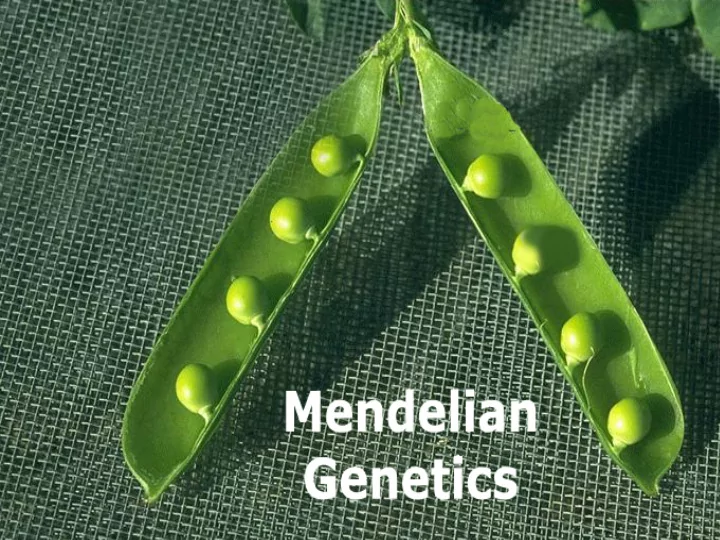
Gregor Johann Mendel 1822- 1884 Austrian monk Experimented with - - PowerPoint PPT Presentation

gregor johann mendel
SMART_READER_LITE
LIVE PREVIEW

Gregor Johann Mendel 1822- 1884 Austrian monk Experimented with - - PowerPoint PPT Presentation

Gregor Johann Mendel 1822- 1884 Austrian monk Experimented with pea plants He thought that heritable factors (genes) retained their individuality generation after generation Sadava, D., D. Hillis, H. Heller, and M.


slide-1
SLIDE 1
slide-2
SLIDE 2

Gregor Johann Mendel

  • 1822- 1884
  • Austrian monk
  • Experimented with pea

plants

  • He thought that

‘heritable factors’ (genes) retained their individuality generation after generation

Sadava, D., D. Hillis, H. Heller, and M. Berenbaum. 2009. Life: The Science of Biology. 9th, e-book. W.H. Freeman.

slide-3
SLIDE 3

Meiosis I

One diploid sex cell divides……

Sadava, D., D. Hillis, H. Heller, and M. Berenbaum. 2009. Life: The Science of Biology. 9th, e-book. W.H. Freeman.

slide-4
SLIDE 4

Result: One diploid cell = four haploid cells Although Mendel had no knowledge of chromosomes or meiosis, we know that a pair of alleles reside on homologous chromosomes, and that those alleles segregate during meiosis

Sadava, D., D. Hillis, H. Heller, and M. Berenbaum. 2009. Life: The Science of Biology. 9th, e-book. W.H. Freeman.

slide-5
SLIDE 5

Terms to Know and Use

  • Gene – A DNA blueprint controlling synthesis of a

protein

  • Trait - variant for a gene: i.e. a purple flower,

determined by alleles

  • Heritable trait – trait passed from parent to
  • ffspring
  • Dominant trait - expressed over recessive trait

when both are present

  • Recessive trait - not expressed when the dominant

trait is present

  • Co-Dominant – expressed as blended traits
slide-6
SLIDE 6
  • Allele - a variation of a gene responsible for

different traits, often represented as A or a

  • Locus - location of a gene,or allele, on a

chromosome

  • Chromosome - strand of DNA containing

the genes

  • Haploid - one copy of a chromosome
  • Diploid - two copies of a chromosome
  • Gamete - a spermatozoa or oocyte (egg)

cell, they are haploid

slide-7
SLIDE 7
  • Zygote - cell resulting from the fusion of two gametes,

they are diploid

  • Genotype - the type of alleles on a chromosome:

genetic makeup

  • Phenotype - The physical appearance of an organisms
  • way a genotype is expressed: i.e. the color of a flower
  • True breeding line - organisms that always pass the

same genotype to their offspring

  • Hybrid - offspring resulting from crossbreeding two

true breeding lines: F1

  • Homozygous - same alleles for a trait (AA or aa)
  • Heterozygous - different alleles for a trait (Aa)
slide-8
SLIDE 8

Pea Characteristics

Trait on the left is dominant. Trait on the right is recessive.

slide-9
SLIDE 9

Mendel’s Hypotheses

  • There are alternate forms
  • f ‘genes’(alleles)
  • For each trait, organisms

have 2 genes, one from mom & one from dad

  • Pollen and egg each carry

1 allele/trait because alleles segregate

  • When only one allele is

expressed & other has no noticeable effect, it is dominant

  • http://www.sumanasinc.com/webcontent/anisamples/

nonmajorsbiology/independentassortment.html

slide-10
SLIDE 10

Mendel’s Experiments

  • 1. Plants must possess constant

differentiating characteristics.

  • 2. The hybrids of such plants

must, during the flowering period, be protected from the influence of all foreign pollen,

  • r be easily capable of such

protection.

  • 3. The hybrids and their offspring

should suffer no marked disturbance in their fertility in the successive generations.

http://www.missouribotanicalgarden.org/Portals/0/PlantFinder/low/ A682-0901021.jpg

slide-11
SLIDE 11

Law of Segregation

When any individual produces gametes, the two copies

  • f a gene separate, so that each gamete receives only
  • ne copy.

Sadava, D., D. Hillis, H. Heller, and M. Berenbaum. 2009. Life: The Science of Biology. 9th, e-book. W.H. Freeman.

slide-12
SLIDE 12

A A a a

a a M

  • t

h e r c

  • n

t r i b u t e s : AA Father contributes:

  • r
  • r

True Breeding

P generation produces F1 generation

Aa Aa Aa Aa

Results in 100% offspring being:

  • Genotype: Aa
  • Phenotype: round-seeded
  • heterozygotes
slide-13
SLIDE 13

Individuals from F1 generation

Sadava, D., D. Hillis, H. Heller, and M. Berenbaum. 2009. Life: The Science of Biology. 9th, e-book. W.H. Freeman.

slide-14
SLIDE 14

A a A a

A a M

  • t

h e r c

  • n

t r i b u t e s : Aa Father contributes:

  • r
  • r

AA Aa Aa aa

Cross Breeding

F1 generation produces F2 generation

Results in an average of offspring being:

  • Genotype: 25% AA, 50% Aa, & 25% aa
  • Phenotype: 75% round-seeded & 25%

wrinkled

slide-15
SLIDE 15

Probablity

Using Probability Calculations in Genetics Like the results

  • f a coin toss, the

probability of any given combination of alleles appearing in the offspring

  • f a cross can be
  • btained by multiplying

the probabilities of each

  • event. Since a

heterozygote can be formed in two ways, these two probabilities are added together

Sadava, D., D. Hillis, H. Heller, and M. Berenbaum. 2009. Life: The Science of Biology. 9th, e-book. W.H. Freeman.

slide-16
SLIDE 16

Chi Squared (X2) Test

  • Measure of ‘how different’ the data
  • bserved and recorded differs from the

data expected

  • 1. Determine expected results
  • 2. Complete a goodness of fit table
  • Larger X2 means more different
  • Theory and experiment agree less

Exp (E) Obs (O) O-E (O-E)2 (O-E)2 E

Lab manual pg. 49

slide-17
SLIDE 17

Using X2

  • If the value is larger than a

predetermined level (critical value) then we say that the experimental results were significantly different