Groundwater Dependent Heraklion, Crete Island, Greece Ecosystems - - PowerPoint PPT Presentation

groundwater dependent
SMART_READER_LITE
LIVE PREVIEW

Groundwater Dependent Heraklion, Crete Island, Greece Ecosystems - - PowerPoint PPT Presentation

2 nd International Conference ADAPTtoCLIMATE 24-25 June 2019 Groundwater Dependent Heraklion, Crete Island, Greece Ecosystems (GDEs) and climate change: A vulnerability assessment D. CHARCHOUSI AND M.P. PAPADOPOULOU LABORATORY OF PHYSICAL


slide-1
SLIDE 1

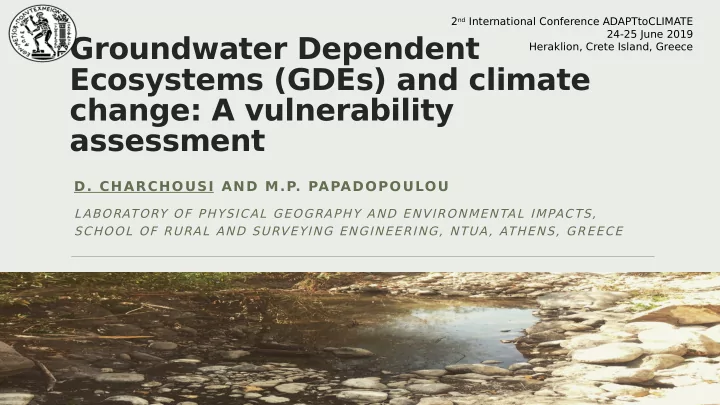
Groundwater Dependent Ecosystems (GDEs) and climate change: A vulnerability assessment

  • D. CHARCHOUSI AND M.P. PAPADOPOULOU

LABORATORY OF PHYSICAL GEOGRAPHY AND ENVIRONMENTAL IMPACTS, SCHOOL OF RURAL AND SURVEYING ENGINEERING, NTUA, ATHENS, GREECE

2nd International Conference ADAPTtoCLIMATE 24-25 June 2019 Heraklion, Crete Island, Greece

slide-2
SLIDE 2

Introduction

Groundwater Dependent Ecosystems (GDEs) Ecosystems rely on groundwater to fulfjl all or part of their water requirements Types of GDE: a) freshwater ecosystems, near-shore marine, estuarine ecosystems such as springs, wetlands, rivers, cave and aquifer ecosystems b) terrestrial ecosystems (vegetation ecosystems)

Source: https://wetlandinfo.des.qld.gov.au

slide-3
SLIDE 3

Introduction

GDEs value Ecosystems services: benefjts that people obtain from ecosystems and the direct and indirect contribution of ecosystems to human well-being such as:

  • water source (e.g. spring water)
  • food supply
  • cultural/recreational services

Factors of GDEs vulnerability:

  • groundwater depletion (over-exploitation)
  • groundwater quality degradation (saltwater intrusion, nitrate pollution, etc)
  • climate change (foreseen additional pressure on groundwater availability and

quality)

slide-4
SLIDE 4

GDEs related legislation and policy

European legislation and policy

  • European Directive 2006/118/EC: protection of groundwater against pollution

and deterioration

  • European Directive 2000/60/EC: framework for Community action in the fjeld of

water policy

  • Emphasize the need for ensuring GDEs protection
  • State that quantitative and qualitative status of groundwater systems have

efgects on GDEs sustainability

  • Threshold values for pollutants should be established by the Member States

based on interactions between groundwater and associated aquatic and dependent terrestrial ecosystems.

slide-5
SLIDE 5

GDEs related legislation and policy

Australian legislation and policy

  • National Water Initiative (2004), Council of Australian Governments (COAG):

 specify that surface water, groundwater systems and their dependent ecosystems should be incorporated in states water frameworks

  • Groundwater Dependent Ecosystems Atlas (GDE Atlas): National Dataset of

Australian GDEs:  expresses the potential for groundwater interaction/use for river/spring/wetland and vegetation ecosystems across Australia  categorize GDEs depending on their interaction status with groundwater: high, moderate or low potential for groundwater interaction Scope:  to regularly update groundwater planning and management practices  to ensure that all the GDEs are included in the water management decisions

slide-6
SLIDE 6

GDEs related legislation and policy

United States legislation and policy  Water resources management strategies in the United States are generally designed and implemented by each state  GDEs protection policies vary greatly among the states  Some states provide indirectly and/or direct protection to GDEs by:

  • Recognizing water rights for citizens (drinking, agriculture use, etc)
  • Providing protection for surface fmows afgected by groundwater fmows
  • Adopting integrated surface and groundwater management practices
  • Supporting the maintenance of fjsh population
  • Assessing changes in vegetation and wetlands
  • Setting minimum groundwater levels to support dependent fmora and

fauna

slide-7
SLIDE 7

GDEs and climate change

Climate change impacts on GDEs and related services:

  • Direct and indirect consequences
  • Imposed by changes in precipitation and temperature
  • Vary among the difgerent types of the GDEs and services

Indicative expected impacts:

  • Springs, streams, riparian areas, wetlands: altered hydrology, decrease in size over time
  • Groundwater-dependent terrestrial vegetation: negatively afgected by foreseen piezometric

decrease

  • Drinking and irrigation water (GDEs services): vulnerable to salinization imposed by foreseen

sea level rise

  • Groundwater and GDEs quality: afgected by altered groundwater temperatures due to rising

air and river temperatures

slide-8
SLIDE 8

GDEs monitoring and evaluation

Monitoring groundwater and GDEs response to climatic variables changes - Examples

Water availability monitoring

Abstraction/recharge Groundwater levels Water balance

Physico-chemical characteristics

T emperature Dissolved oxygen NO3

Biological characteristics

abundance of species % tolerant plant species to salinity communities composition

slide-9
SLIDE 9

GDEs and climate change adaptation

  • Optimize use of water resources & also ensuring resilience of GDEs and related

services

  • Examples of adaptation measures already proposed and assessed:
  • changes in cropping patterns
  • water transferring
  • recycling and reuse
  • water pricing
  • Main mechanisms of adaptation: research, education, monitoring, legislation
  • Combined use of monitoring and modeling to understand how and to what

extent GDEs are afgected by climate change

slide-10
SLIDE 10

Discussion and conclusions

  • Groundwater and GDEs have a signifjcant role in humans prosperity

and ecosystems sustainability

  • GDEs are vulnerable to changes in climate, particularly in temperature

and precipitation variations

  • Climate change impacts on GDEs vary according the type of the

ecosystem and over time and space

  • As changes in groundwater due to climatic variables alteration is

generally slow, long-term monitoring is recommended for GDEs vulnerability assessment.

  • Due to the uniqueness of each GDE ecosystem, case-based

measures should be assessed and adopted

slide-11
SLIDE 11

Thank you for your attention !!