Growth of microorganisms in culture: example of the phytoplancton - - PowerPoint PPT Presentation
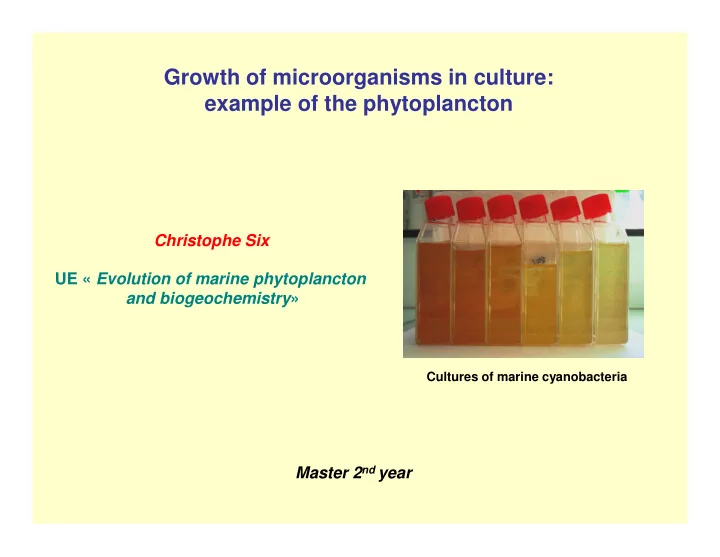
Growth of microorganisms in culture: example of the phytoplancton Christophe Six UE Evolution of marine phytoplancton UE Evolution of marine phytoplancton and biogeochemistry Cultures of marine cyanobacteria Master 2 nd year What is
What is growth?
Higher organisms
Any increase of the biomass of an organism
Microorganisms
Why should we measure growth?
. Ecology: Prey/predator, adaptation… . Evolution: The key of the Natural Selection of Species . Physiology: Integration of the efficiency of all cell processes Can also be the increase of the size of the population of an organism
How to measure the growth of a phytoplankton culture ?
Monitor the number of cells in the culture function of time
- Counting slides (Malassez, Thoma, etc…)
250 µm 250 µm 50 µm 200 µm
= 0,01 mm3 = 0,01 µL = 10-5 mL
200 µm
- Cell counter (type Wallace H. Coulter)
Detection of conductance
- f the electrolyte
- Flow cytometry
Monitoring a parameter that varies proportionally to the cell density
- Photosynthetic pigments
- Concentration of elements (C, N)
- Absorption of non-pigmented material (OD 750 nm)
But be careful to acclimation !
How to measure the growth of a phytoplankton culture ?
0,1 0,2 0,3 0,4 0,5 0,6 0,7 0,8 0,9 1 400 450 500 550 600 650 700 750 800 Longueur d'onde (nm) Absorbance (UA)
Non pigmented material Chl a
Growth in continuous culture: Turbidostat
Sampling
Culture medium
Peristaltic pump
The culture is constantly diluted Culture Trash
- Constant volume of culture
- Constant cell density
- Constant growth rate
- No limitation
Growth in closed medium ‘batch cultures)
Cell density
Growth is limited by the capacities of the culture medium
Time
Latence phase Exponentielle phase Transition phase Stationnary phase Decreasing phase
Latence phase
- Abrupt medium change = stress
- ajustment of the physiology to the new medium
- All transferred cells are not viables
- The duration and dynamics of the latence phase is often dependent on the mother culture
Temps Cellules
Culture mère Cultures filles
Temps Cellules
The exponential phase of growth 2 1 4
t 1 t 2 t 3 Binary division
Temps Cellules
8
Cells Time t 4
Time
1 2 4 8
cells
1 2 3 4
N = N0 . ekT
N0 K : growth constant (= growth rate µ
µ µ µ)
Time Cell density
The exponential phase of growth
ln(N2) – ln (N1) K = t2 – t1 N1 N2 t2 t1
Time Cell density
. Generation / doubling time tg or td : The time necessary for a cell to divide tg = ln(2) / k
Generation 0 1 2 3
The exponential phase of growth
. Number of divisions per day n :
Generation time tg = 1 day n = 1 division per day Growth rate K = 0,69 jour-1
!
n = 1/ tg => n = k / ln(2)
The stationnary and decreasing phases
- Change of the physiology of the cells in response to the limitation
Resistance
Time Cells
- Dynamics of these phases mal connue
Time Cells Time Cells
k
k
Measuring a growth rate experimentally
. Estimation from two time points ln(N2) – ln (N1) K =
30 000 000 35 000 000
ion
Time (day) 1 2 3 4 5 6 7 8 9 10 11 12 cell/mL 1 849 596 960 232 1 235 454 2 001 565 2 945 654 5 621 245 10 236 458 20 804 561 26126876 29463189 30109473 30533249 28112286
K = t2 – t1 ln(26126876) – ln (5621245) K = 8 – 5
5 000 000 10 000 000 15 000 000 20 000 000 25 000 000
5 10 15
Time
Cell concentratio N2 N1 t1 t2
K = 0.5121
Time (day) 1 2 3 4 5 6 7 8 9 10 11 12 cell/mL 1 849 596 960 232 1 235 454 2 001 565 2 945 654 5 621 245 10 236 458 20 804 561 26126876 29463189 30109473 30533249 28112286 Ln (Cell/mL) 14,4305 13,7749 14,02695 14,50944 14,89584 15,54206 16,14147 16,85068 17,07848 17,19865 17,22035 17,23433 17,151717
. Estimation from a natural logarithm regression ln(N) – ln (N0) K = t ln(N) = kt + lnN0
=>
Slope of the regression
Measuring a growth rate experimentally
Ln (Cell/mL) 14,4305 13,7749 14,02695 14,50944 14,89584 15,54206 16,14147 16,85068 17,07848 17,19865 17,22035 17,23433 17,151717
5 000 000 10 000 000 15 000 000 20 000 000 25 000 000 30 000 000 35 000 000
5 10 15
Time
Cell concentration 10 12 14 16 18 20 5 10 15 Ln (Cell concentration)
y = 0,5617x + 12,8 R
2 = 0,9904
10 12 14 16 18 20 2 4 6 8 Ln (Cell concentration)
Time (day)
Exercise: The influence of light on the growth of a cyanobacterium
Synechococcus sp. WH8102 15 25 50 85 200 700
µmol photons . m-2 . s-1
Strain isolated from oligotrophic waters
What is the impact of light irradiance on the growth of Synechococcus sp. WH8102 ? Experimental protocole :
- The cultures were transferred at low cell density
- The number of cells was determined by flowr cytometry for several days