Guams coral reef fisheries provide food for Guams families, jobs - - PDF document

guam s coral reef fisheries provide food for guam s
SMART_READER_LITE
LIVE PREVIEW

Guams coral reef fisheries provide food for Guams families, jobs - - PDF document

Ecosystem Threats: What the fishing community can do to ensure a sustainable future Presentation to the Regional Ecosystem Advisory Committee of the Western Pacific Regional Fisheries Management Council March 18, 2010 Guams coral reef


slide-1
SLIDE 1

Ecosystem Threats: What the fishing community can do to ensure a sustainable future

Presentation to the Regional Ecosystem Advisory Committee of the Western Pacific Regional Fisheries Management Council March 18, 2010

  • V. Brown

1 NMFS PIRO

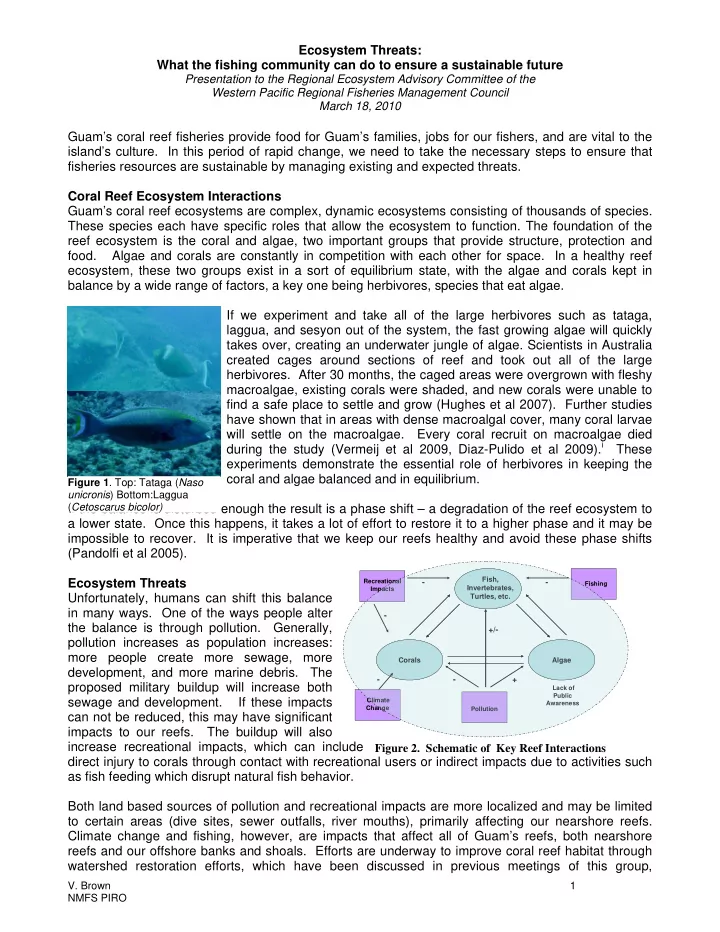
Fish, Invertebrates, Turtles, etc. Corals Algae Fish, Invertebrates, Turtles, etc. Corals Algae

Fishing Recreational Impacts Climate Change Pollution Lack of Public Awareness

+ +

  • +/

+/-

  • Guam’s coral reef fisheries provide food for Guam’s families, jobs for our fishers, and are vital to the

island’s culture. In this period of rapid change, we need to take the necessary steps to ensure that fisheries resources are sustainable by managing existing and expected threats. Coral Reef Ecosystem Interactions Guam’s coral reef ecosystems are complex, dynamic ecosystems consisting of thousands of species. These species each have specific roles that allow the ecosystem to function. The foundation of the reef ecosystem is the coral and algae, two important groups that provide structure, protection and

  • food. Algae and corals are constantly in competition with each other for space. In a healthy reef

ecosystem, these two groups exist in a sort of equilibrium state, with the algae and corals kept in balance by a wide range of factors, a key one being herbivores, species that eat algae. If we experiment and take all of the large herbivores such as tataga, laggua, and sesyon out of the system, the fast growing algae will quickly takes over, creating an underwater jungle of algae. Scientists in Australia created cages around sections of reef and took out all of the large

  • herbivores. After 30 months, the caged areas were overgrown with fleshy

macroalgae, existing corals were shaded, and new corals were unable to find a safe place to settle and grow (Hughes et al 2007). Further studies have shown that in areas with dense macroalgal cover, many coral larvae will settle on the macroalgae. Every coral recruit on macroalgae died during the study (Vermeij et al 2009, Diaz-Pulido et al 2009).i These experiments demonstrate the essential role of herbivores in keeping the coral and algae balanced and in equilibrium. If the balance is disturbed enough the result is a phase shift – a degradation of the reef ecosystem to a lower state. Once this happens, it takes a lot of effort to restore it to a higher phase and it may be impossible to recover. It is imperative that we keep our reefs healthy and avoid these phase shifts (Pandolfi et al 2005). Ecosystem Threats Unfortunately, humans can shift this balance in many ways. One of the ways people alter the balance is through pollution. Generally, pollution increases as population increases: more people create more sewage, more development, and more marine debris. The proposed military buildup will increase both sewage and development. If these impacts can not be reduced, this may have significant impacts to our reefs. The buildup will also increase recreational impacts, which can include direct injury to corals through contact with recreational users or indirect impacts due to activities such as fish feeding which disrupt natural fish behavior. Both land based sources of pollution and recreational impacts are more localized and may be limited to certain areas (dive sites, sewer outfalls, river mouths), primarily affecting our nearshore reefs. Climate change and fishing, however, are impacts that affect all of Guam’s reefs, both nearshore reefs and our offshore banks and shoals. Efforts are underway to improve coral reef habitat through watershed restoration efforts, which have been discussed in previous meetings of this group,

Figure 1. Top: Tataga (Naso unicronis) Bottom:Laggua (Cetoscarus bicolor)

Figure 2. Schematic of Key Reef Interactions

slide-2
SLIDE 2
  • V. Brown

2 NMFS PIRO

however, the success of these efforts may be impacted by the two threats that will be discussed here: climate change and fishing. Climate Change Humans have adapted to live in a changing world by creating new technologies and advancements. But climate change is a change on a much larger scale than most human populations have ever had to cope with. It will affect many aspects of our environment including the temperature of our seas, the level of our seas, and as we are now starting to observe, the pH levels of our sea. What does this mean for Guam’s reefs? Due to temperature increases we could see incidents of increased coral bleaching and shifts in species distribution. Ocean acidification may impact growth rates of corals and

  • ther organisms that calcify. Sea level rise may lead to increased erosion in our coastal areas.

Severe bleaching can lead to mass coral mortality. If macroalgae takes over after such an event, it could prevent coral recovery and result in a much less productive reef (Pandolfi et al 2005). However, if there are enough herbivores to keep the macroalgae in check, coral larvae can settle on the dead corals and start rebuilding the reef. A key is to have enough herbivores to keep the algae in check. Ocean Acidification Climate change is caused by increases in carbon dioxide and other greenhouse gases in the

  • atmosphere. The oceans provide a huge storage facility for carbon dioxide. This might sound like a

good thing, that the oceans will hold all of our extra carbon dioxide. But it is actually a very serious problem as it makes the ocean more acidic and threatens a number of key reactions in coral

  • rganisms. As oceans become more acidic organisms that use carbonate for their shells and

structures will not be able to build these structures as quickly or as efficiently. This means that corals will grow slower. It may impact the calcifying algae that build our algal ridges on the northern and eastern reefs, as well as the tiny organisms that provide the basis of the pelagic food webs. Scientists are still studying the potential impacts, but we do know that this will impair corals ability to grow and thus will affect the ecosystem balance we discussed earlier. This will affect all reefs – both nearshore and offshore. If nothing else it will negatively affect reefs ability to recover or maintain existing populations due to reduced growth rates. (Eakin 2009) Fishing Fishing is important – it provides food for our families, jobs for our community, and it is important to Guam’s culture. However, we as a fishing community need to be aware of how our fishing activities affect the larger ecosystem and we need to be smart about our harvesting – now more than ever. Fishing is one of the activities that directly affect our reef ecosystems. When we fish we are physically removing organisms that play a role in the ecosystem balancing act. Herbivores such as the tataga, hangon, sesyon are necessary to keep the algae in check. Laggua and atuhong and also play a vital role in clearing the substrate so that new corals can settle on the reefs and grow. Predators such as mamulan and halu’u keep those fish populations healthy and fit. When we catch fish, we remove them from their roles on the reef. And this is okay, the fish communities are a renewable resource. But we need to be smarter about how we harvest and how much we harvest. We as a community need to make sure that we aren’t taking too many fish and that we leave enough fish to keep our reefs healthy, so that we have fish far into the future. Pathways to Resilience How do we keep our fish stocks, our reefs, and our community healthy? We need to focus our management efforts on building resiliency into our coral reef ecosystems. What is resiliency? It is the reefs ability to recover from these ecosystem threats. Reefs have tremendous regenerative capability (Connell et al 1997). The reefs in Palau are a great example of this – many areas have already recovered from the massive 1997-1998 bleaching. However, in order for the reefs to be resilient we have to preserve the balance in the ecosystem. This requires us to do two key things: 1.) reduce land based sources of pollution and 2.) manage our

slide-3
SLIDE 3
  • V. Brown

3 NMFS PIRO

fisheries for resilience. Let’s focus on the second one, since this is a fisheries council meeting. One

  • f the most important things we can do to protect the ecosystem balance and protect the future of our

reefs, is to take steps to keep our herbivorous fish and invertebrate communities healthy and robust. This means that we need to have all the parts of the fish community– the manahak, hangon, tataga, sesyon, laggua, all the way up to the halu’u. And we need to make sure that we have enough of those fish to keep the ecosystem balance. NOAA PIRO in collaboration with the local resource agencies are currently developing a poster showing fish size at first reproduction of the most commonly landed reef fish. We’re also developing a companion measuring guide for the Mariana Islands that will have the same information but in a smaller format that will fit in a pocket or tackle

  • box. This poster illustrates the L50, the size at which half of the fish in

a particular cohort or generation reach reproductive maturity. So if we have 100 fish that were all spawned at the same time – 50 of them have started reproducing when they are the size on the poster. Some fish will re produce at a smaller size, some will reproduce at a larger

  • size. We can use this information to make better decisions about which

fish we target. Ideally, if we target fish a little bit larger than this L50 size we increase the chance that each fish reproduces before we take it out of the

  • ecosystem. So very simply, as fishers we should target fish that have

had a chance to reproduce. This will increase the total reproductive capacity of our fish stocks. We can complement this by also sparing the largest fish that have the highest individual reproductive capacity. We can also help impacted reefs recover, by choosing to take fewer herbivores in those areas. This would also be appropriate in areas such as Cetti Bay where watershed restoration efforts are

  • underway. By leaving the herbivores on the reef, they can further reduce the algae and give the

corals a chance to re-establish themselves. This will require a change in how we think about fishing. We may have to make the hard decision to throw the small fish back or to not take the big laggua that just swam in front of us. Hopefully, with tools like this we as fishers can help restore our reefs and improve our fish stocks. Key Points

  • There are big threats to our reefs on the horizon – military buildup, climate change, and ocean

acidification

  • Watershed restoration and other habitat restoration efforts are important, but they can be

improved by enhanced herbivory

  • Herbivores are essential to maintain the equilibrium between algae and corals
  • Fishers can help improve resiliency by making choices about their target fish
  • We can enhance herbivory in restoration areas to help restore the balance by not

taking herbivores in these areas.

  • We can increase reproduction by targeting fish above the L50 and also leaving the

really big fish with increased reproductive potential

Diaz-Pulido et al. 2009. Doom and boom on a resilient reef: climate change, algal overgrowth and coral recovery. PLoS ONE 4:e5239 Hughes et al 2007. Phase Shifts, Herbiovry, and the Resilience of Coral Reefs to Climate Change. Current Biology: 17:360-365 Padolfi et al 2005. Are US Coral Reefs on the Slippery Slope to Slime? Science 18 March 2005: Vol. 307. no. 5716, pp. 1725 - 1726 Vermeij et al. 2009. Survival and settlement success of coral planulae: independent and synergistic effects of macroalgae and microbes. Oecologia. 159:325-336.

Figure 3. L50 Poster