H = E The FHI-aims Group at Duke Volker Blum Tong Zhu Group - PowerPoint PPT Presentation
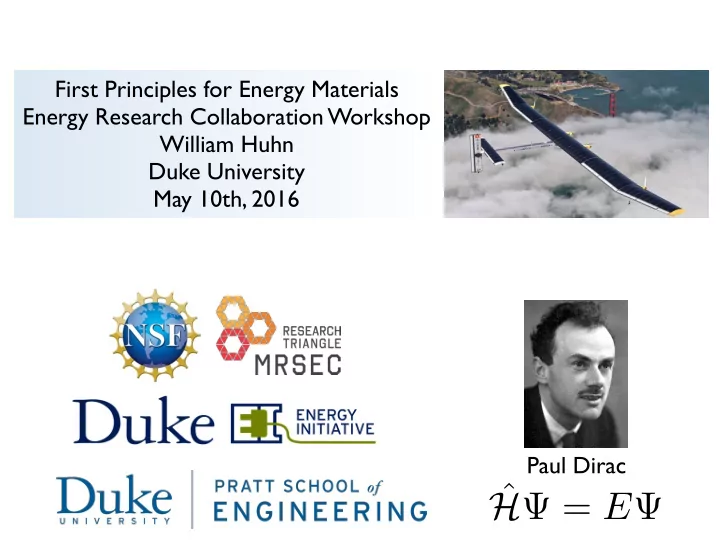
First Principles for Energy Materials Energy Research Collaboration Workshop William Huhn Duke University May 10th, 2016 Paul Dirac H = E The FHI-aims Group at Duke Volker Blum Tong Zhu Group Leader PV Materials Lead, FHI-aims
First Principles for Energy Materials Energy Research Collaboration Workshop William Huhn Duke University May 10th, 2016 Paul Dirac ˆ H Ψ = E Ψ
The FHI-aims Group at Duke Volker Blum Tong Zhu Group Leader PV Materials Lead, FHI-aims Project William Huhn Garnett Liu Spin-Orbit Coupling Perovskites “Photovoltaics Lead” Ab Initio Materials Simulations Group Hudson Hall, Duke University Formerly: Björn Lange Raul Laasner Victor Yu Jan Kloppenburg Nuclear Spin States Electronic Structure Tiago Botari NMR Infrastructure (NSF)
Photovoltaic Materials Si 25% efficiency Standard material for PV
Photovoltaic Materials III-V Si Al P Ga As In Sb 25% efficiency 48% efficiency! Standard material Expensive and for PV difficult to grow
Photovoltaic Materials III-V Si CdTe Al P Ga As In Sb 25% efficiency 48% efficiency! 23% efficiency Standard material Expensive and Contains toxic for PV difficult to grow elements
Photovoltaic Materials Can we find non-toxic, (relatively) cheap new materials in this class? III-V Si CdTe Al P Ga As In Sb 25% efficiency 48% efficiency! 23% efficiency Standard material Expensive and Contains toxic for PV difficult to grow elements
Earth-Abundant, Non-Toxic Photovoltaics David Mitzi Cu-Zn-Sn-S (12%) Non-toxic and (relatively) cheap!
Earth-Abundant, Non-Toxic Photovoltaics David Mitzi Bayram Saparov Cu-Ba-Sn-S Cu-Zn-Sn-S (12%) Non-toxic and (relatively) cheap!
Earth-Abundant, Non-Toxic Photovoltaics David Mitzi Bayram Saparov Tong Zhu Cu-Ba-Sn-S Cu-Zn-Sn-S (12%) Non-toxic and (relatively) cheap!
Earth-Abundant, Non-Toxic Photovoltaics David Mitzi Bayram Saparov Tong Zhu Cu-Ba-Sn-S Cu-Zn-Sn-S (12%) Non-toxic and Cu-Ba-Sn-Se (relatively) cheap!
Hybrid Organic-Inorganic Perovskites Eames et al., Nature Comm. 2015 CH 3 NH 3 PbI 3 Efficiency increased from 12% to 20.1% in only 2 years!
Hybrid Organic-Inorganic Perovskites David Mitzi Yosuke Kanai (UNC) Eames et al., Nature Comm. 2015 CH 3 NH 3 PbI 3 AEQTPbBr 4 Efficiency increased from Garnett Liu Moving to a 2D layered material 12% to 20.1% in only 2 years! allows for much larger molecules, improved tunability
Prediction of Design Parameters with First Principles AEQT -PbBr 4 - no SOC
Prediction of Design Parameters with First Principles AEQT -PbBr 4 - no SOC AEQT -PbBr 4 - SOC
Prediction of Design Parameters with First Principles AEQT -PbBr 4 - no SOC AEQT -PbBr 4 - SOC Holes on organic component, electrons on inorganic component? ... good principle for PV (carrier separation)
Prediction of Design Parameters with First Principles AEQT -PbBr 4 - no SOC AEQT -PbBr 4 - SOC Holes on organic component, electrons on inorganic component? ... good principle for PV (carrier separation) First principles reveals spin-orbit coupling is an important design choice to consider
First Principles for Energy Materials
Photovoltaic Efficiency Over Time
Recommend
More recommend
Explore More Topics
Stay informed with curated content and fresh updates.