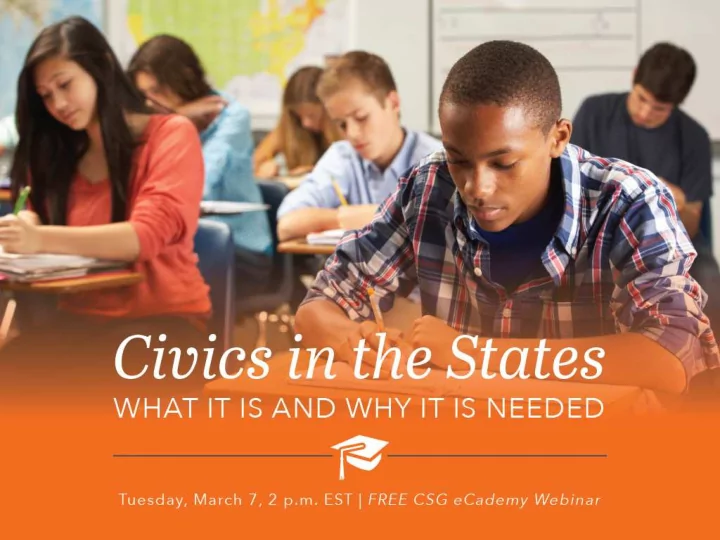
SLIDE 1
SLIDE 2
h"p://knowledgecenter.csg.org/kc/ system/files/civic_report.pdf
SLIDE 3
Abby Kiesa , Director of Impact at CIRCLE
SLIDE 4 Maryam Judar, ExecuEve Director, the CiEzen Advocacy Center
SLIDE 5 Marshall Croddy, president of ConsEtuEonal Rights FoundaEon
SLIDE 6 Jan Brennan a Project Leader at EducaEon Commission of the States’ NaEonal Center for Learning and Civic Engagement
SLIDE 7 www.civicyouth.org
All Together Now: Collaboration and Innovation for Youth Engagement
Abby Kiesa CIRCLE Tisch College of Civic Life at Tufts University
SLIDE 8 What do we mean by civic educa<on?
- Civic knowledge is deep, complex, applied
- Pedagogy should involve framing quesEons,
deliberaEng soluEons, experiencing acEons
- Goal is to prepare for involvement in civic life,
which includes:
Analysis Discussion Strategies & Planning
CollaboraEon
Working
Problems ReflecEon Taking Concrete AcEon Working Across Difference
Building & Maintaining Civic RelaEonship
SLIDE 9 A bit about the current context
Youth Civic Engagement
Demographics PolarizaEon of parEes, processes & media Inequality Civic Life TransiEons to On & Offline Trends within EducaEon
SLIDE 10 OpportuniEes & Challenges
Deep polarizaEon and ideological conflict Growing inequality of civic
An increasingly diverse youth populaEon A powerful role for social media
SLIDE 11 www.civicyouth.org
Commission on Youth Voting and Civic Knowledge
- Distinguished, interdisciplinary group
- Funded by S.D. Bechtel, Jr. Foundation,
the W.T. Grant Foundation, the Robert R. McCormick Foundation, the Spencer Foundation, and the Youth Engagement Fund
SLIDE 12 www.civicyouth.org
Commission on Youth Voting and Civic Knowledge
- Data on 6,913 people in total
- Including teachers (720), stakeholders, and
young people
- Scan of state policies relevant to voting,
voter registration, social studies, civics, teacher certification and school performance indices
SLIDE 13 Some of our findings:
« Some of the standard reform proposals are actually misconceived « But educaEng and engaging young people has long term effects « EffecEve pracEces develop skills as well as knowledge « Yet there are major gaps in exposure and quality « Strengthening civic educaEon requires more support
SLIDE 14 www.civicyouth.org
We know more about what works…
Discussing current issues Service-learning addressing “root causes” Extracurricular participation Being told to and taught to vote by a teacher
SLIDE 15 www.civicyouth.org
There continue to be unequal
« Civics well-taught in some advantaged communities, but much less so in schools that serve low-income and minority youth « White, wealthy students are 4-6 times more likely to exceed “proficient” in civics « 7% of low-SES students reached “proficient.”
SLIDE 16 www.civicyouth.org
Support teachers…
24.8% of teachers thought that parents or
if politics was discussed in their government course
SLIDE 17 www.civicyouth.org
Exciting Civic Education Trends
AP Civics as a deeper civics C3 Standards – preparation for informed engagement Gamified & Simulated civic learning experiences Learning by taking civic action; “Action Civics” Extracurricular & Out-
State policy
- Integration of civic learning
in elementary grade reading
- Project-based assessments
- Application of knowledge to
real-world problem
SLIDE 18 www.civicyouth.org
Innovation
« Better state standards « Support teachers’ obligation to include discussions of current issues « Lower the voting age to 17 « Badges for excellence in civics
SLIDE 19
Collabora<on
« Focus on quality implementaEon processes « Statewide coaliEons, as in CA, FL, IL « Align civics and voEng laws « Assign students to discuss news at home « Badges awarded by schools and others
SLIDE 20 www.civicyouth.org
To break this pattern, we need innovation and collaboration…
SLIDE 21
Civics is Back in Illinois
Maryam Judar ExecuEve Director/Community Lawyer CiEzen Advocacy Center Elmhurst, Illinois
SLIDE 22 Poor Civic Health in Illinois
- Decades without civics requirement in public
schools
- Fewer social studies requirements than any other
state in the naEon
– Illinois Civic Health Index 2010 – Illinois Civic Blueprint 2nd ediEon Public Policy Chapter – Le"ers to the Editor – early and oaen and seize the moment
SLIDE 23 Strategy
– Two decades providing assistance to individuals seeking to be civically engaged but without the knowledge or skills to do so – BenedicEne University Public Policy students and local government survey – Former Illinois A"orney General and gubernatorial candidate – Collaborated on idea of the Task Force on Civic EducaEon – Sought General Assembly Leadership buy-in
- Draaed Task Force legislaEon to include different stakeholders as
members (17 members culled to 13 in legislaEve process, cugng out student appointments)
- Reviewed case studies from other states (Florida, Tennessee)
- Meanwhile, convened Public Policy Commi"ee meeEngs at Illinois Civic
Mission CoaliEon events
SLIDE 24 Bringing Back Civics
- Task Force legislaEon passed in 2013
- Task Force meets during 2014 and holds
public hearings
- Final report released December 2014
SLIDE 25 Task Force RecommendaEons
- 1. Require a civic educaEon course in high school
(completed)
- 2. Revise Illinois Social Studies Standards (completed)
- 3. Require a service learning project in middle and high
schools
- 4. Align licensure and cerEficaEon requirements for pre-
service teachers with best pracEces
- 5. Involve students in the elecEon process
- 6. Extend the Task Force to gather public input through
public hearings (completed)
SLIDE 26 Bringing Back Civics, cont.
- Legislators sponsored legislaEon mandaEng
civics course in public high schools in 2015
- Bill passed with separate bill amending
implementaEon date for school year 2016-2017 for the incoming class
- Signed by Governor Rauner August 2015
- Requires simulaEon of government processes,
discussion of current and controversial issues, and service learning
SLIDE 27 Public-Private Partnership
- Robert R. McCormick FoundaEon organized
foundaEons to allocate money to the effort to train social studies teachers over a 3-year period
– Recruited and retained public affairs firm with extensive relaEonships in Illinois capitol
- Shawn Healy, civic learning scholar, chaired Social
Studies Standards Revision Task Force during 2016, worked in collaboraEon with Illinois State Board of EducaEon
– Comprised primarily of classroom pracEEoners representaEve of the various social studies disciplines, grade bands, and geographic regions
SLIDE 28 Illinois Learning Standards
- Previous standards knowledge heavy
- Current standards focused on knowledge, agtudes
(disposiEons), and pracEce (skills)
- Civic mindedness, historical thinking, economic decision-
making, geographic reasoning, and psychological and sociological intellect across all disciplines and grade levels
- Two complementary categories: inquiry skills and
disciplinary concepts
– Inquiry skills involve quesEoning, invesEgaEng, reasoning, and responsible acEon – Disciplinary concepts make use of social science ideas, principles, and content to pursue answers to the quesEons generated by student inquiries
SLIDE 29 Active Civics
Presented by Marshall Croddy President of Constitutional Rights Foundation
SLIDE 30 Trends
§ Low rates of knowledge about government. § Low rates of trust in government:
- national ranging 20%
- state, 37%.
§ Low rates of trust in media.
The Challenges for Civic Education
SLIDE 31 q High levels of partisanship/lack of opportunity and capacity to constructively discuss issues. q Disinformation, Fake News q Student inability to evaluate
media sources
Election 2016 Implications
Library of Congress. Chicago : Illinois WPA Art Project, [between 1936 and 1940]
SLIDE 32 q High Quality Civic/Social Studies Frameworks and Standards at the State Level
- Civic learning across the grade spans
- More coverage of state and local government
- Opportunities for Participation
q Adequate teacher professional development and curriculum to support best practices and methods
Addressing the Challenges
SLIDE 33 New Framework and Standards Models
The College, Career, and Civic Life (C3) Framework for the Social Studies
- Inquiry-based
- Integration of the four core social studies disciplines—
civics, economics, geography and history.
- A strong focus on concepts and skill development
- Strongly linked to evaluating sources and utilizing
evidence in drawing conclusions and taking action
Research-based Proven Practices…
Promising Developments
SLIDE 34 Active learning classroom strategies that can be utilized at all grade levels that emphasize knowledge development, critical thinking and presentation skills, and real world issues. Motivation. Relevance. Practice and development of skills and behaviors needed for effective and engaged adult citizen participation. Active Civics (Not just civic content, but how it is taught)
SLIDE 35 q Academic discussions promoting deep reading of sources, multiple perspectives on issues, critical thinking, and inquiry. q Engaging all students. q Models include:
- Structured Academic Controversy (SAC)
- Civil Conversation.
Structured Classroom Discussion of Controversial and Public Policy Issues
SLIDE 36 Examples include moot courts, mock trials, legislative hearings, executive decision making. Put students in the roles of participants and decision- makers; must apply knowledge, critical thinking to decision-making and advocacy.
Simulations of Democratic Processes and Procedures
SLIDE 37 Students learn civics by doing civics.
q Analyze problems and issues and public policy relating to them. q Design projects or actions to address the problems; work together; interact with policy makers and processes. q Evaluate and document results. Project-based Civic Learning (Action Civics, Civics- based Service Learning) Constitutional Rights Foundation www.crf-usa.org
SLIDE 38
The essential, indispensable member of any team addressing education policy.
Education Commission of the States
We believe in the power of learning from experience and we know informed policymakers create better education policy.
SLIDE 39
REPORT RESEARCH COUNSEL CONVENE
How we do it
SLIDE 40
SLIDE 41
SLIDE 42
Key Civic Education Policy Elements
Policy 1: PreparaEon for civic life is the co-equal purpose of educaEon at the state, district and insEtuEonal level. Policy 2: Civic learning standards and curricula at each grade level, preschool through postsecondary. Policy 3: Civic learning standards include inquiry- based instrucEon that results in informed acEon and demonstraEon of learning.
SLIDE 43
Key Civic Education Policy Elements
Policy 4: IntegraEon of civic learning across all academic disciplines. Policy 5: Pre-service licensure/accreditaEon supports teachers as civic educators. Policy 6: Professional development supports teachers as civic educators.
SLIDE 44
Key Civic Education Policy Elements
Policy 7: Assessments of student progress toward civic learning outcomes is used to measure student performance and inform instrucEonal efforts. Policy 8: Accountability indicators of teacher, district and school/insEtuEon performance supports civic learning. Policy 9: Measures of civic learning community impact.
SLIDE 45
SLIDE 46
SLIDE 47
Education Commission of the States www.ecs.org | @Edcommission National Center for Learning and Civic Engagement Jbrennan@ecs.org | @NCLCEatECS
Contact Us
SLIDE 48 Questions?
Please submit them in the question box
- f the GoToWebinar taskbar.