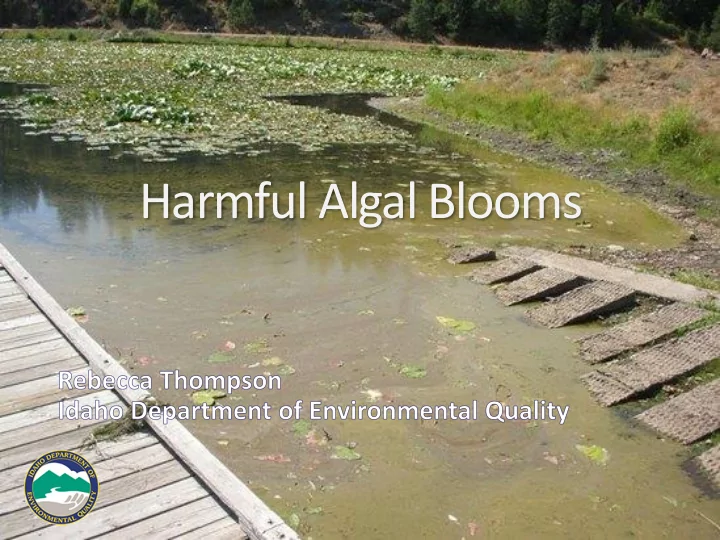
Harmful Algal Blooms Harmful Algal Blooms = HABs Photo credit: - - PowerPoint PPT Presentation

harmful algal blooms harmful algal blooms habs photo
SMART_READER_LITE
LIVE PREVIEW

Harmful Algal Blooms Harmful Algal Blooms = HABs Photo credit: - - PowerPoint PPT Presentation

Harmful Algal Blooms Harmful Algal Blooms = HABs Photo credit: Darren Brandt Foam Scum Paint Mats on the surface of water Anabaena Microcystis 80+ types of microcystins including microcystin L-R Microcystin LR is generally considered


slide-1
SLIDE 1

Harmful Algal Blooms

slide-2
SLIDE 2

Harmful Algal Blooms = HABs

slide-3
SLIDE 3

Photo credit: Darren Brandt

slide-4
SLIDE 4
slide-5
SLIDE 5

Foam Scum Paint Mats on the surface of water

slide-6
SLIDE 6
slide-7
SLIDE 7
slide-8
SLIDE 8
slide-9
SLIDE 9
slide-10
SLIDE 10
slide-11
SLIDE 11
slide-12
SLIDE 12
slide-13
SLIDE 13
slide-14
SLIDE 14
slide-15
SLIDE 15
slide-16
SLIDE 16

Anabaena Microcystis

slide-17
SLIDE 17

80+ types of microcystins including microcystin L-R Microcystin LR is generally considered among the most toxic, and is frequently present in HABs world-wide

slide-18
SLIDE 18

Oral ingestion of drinking water and during recreation Dermal contact during recreation Inhalation (incidental) during recreation Ingesting contaminated fish, or shellfish Gastroinstestinal (GI), skin irritation, respiratory Liver or kidney damage Nervous system

slide-19
SLIDE 19
slide-20
SLIDE 20

Drinking water under the Safe Drinking Water Act Ambient waters under the Clean Water Act (CWA) Provide informal technical guidance Not legally enforceable

http://www.epa.gov/nutrient-policy-data/guidelines-and-recommendations

slide-21
SLIDE 21

Toxin Health Advisory Values < 6 yrs > 6 yrs Microcystins 0.3 μg/L 1.6 μg/L Cylindrospermopsin 0.7 μg/L 3.0 μg/L Source: http://www.epa.gov/nutrient-policy-data/guidelines-and-recommendations

slide-22
SLIDE 22

For primary contact recreation For children Developing for the toxins microcystins and cylindrospermopsin

slide-23
SLIDE 23

Excess nutrients (IDAPA 58.01.02.200.06) Floating, suspended, or submerged matter (58.01.02.200.05) Toxic substances (IDAPA 58.01.02.200.02) Indirectly address HABs through control of nutrients (phosphorous)

slide-24
SLIDE 24

Risk Measurement Decision Action: Posting Action: News Release

  • 1. Is surface scum

visible and associated with toxigenic* species? Yes Recommend posting by public health district (PHD) in conjunction with water body management agency DEQ and PHD make determination No Proceed to 2

  • 2. Is the sum of all

potentially toxigenic* taxa ≥100,000 cells/mL? Yes Recommend posting by PHD in conjunction with water body operator DEQ and PHD make determination No Proceed to 3

  • 3. Is the density of

Microcystis or Planktothrix ≥40,000 cells/mL? Yes Recommend posting by PHD in conjunction with water body operator DEQ and PHD make determination No Do not recommend posting * Toxigenic taxa include Anabaena, Microcystis, Planktothrix, Nostoc, Coelosphaerium, Anabaenopsis, Aphanizomenom, Gloeotrichia, Woronichinia, Oscillatoria, and Lyngbya. Additional taxa are known to be potentially toxic and may be added to the list in the future.

Adapted from ODHS 2015

slide-25
SLIDE 25
slide-26
SLIDE 26
slide-27
SLIDE 27

Black Lake (1985 and 1986) – death of dogs, cattle, and deer Cascade Reservoir (1993 to 1996) – 23 cattle died

slide-28
SLIDE 28

Lake Lowell Avondale Lake Black Lake Cocolalla Lake Fernan Lake Hayden Lake Hauser Lake Henry’s Lake Dworshawk Res. American Falls Res. Blackfoot Res. Salmon Falls Creek Res.

slide-29
SLIDE 29
slide-30
SLIDE 30

DEQ Region June July August Sept. Oct. Nov. Coeur d’Alene Fernan Fernan Avondale Hayden Fernan Avondale Hayden Fernan Avondale Hayden Fernan Avondale Hayden Black Fernan Black Idaho Falls Henry’s Pocatello Blackfoot R. Lewiston Dworshawk Dworshawk Boise Lake Lowell

slide-31
SLIDE 31
slide-32
SLIDE 32
slide-33
SLIDE 33

Response associated with recreational waters

slide-34
SLIDE 34
slide-35
SLIDE 35

Bloom presence Collect and preserve grab samples Send for lab analysis (identify and enumerate species; measure toxicity)

slide-36
SLIDE 36

Based on public reports of blooms Concurrent with other field efforts (e.g., invasive species monitoring)

slide-37
SLIDE 37
slide-38
SLIDE 38
slide-39
SLIDE 39

Determine presence/absence of blue-green algae bloom Identify species present Enumerate number of cells or colonies When public health advisories/postings warranted When public communication necessary

slide-40
SLIDE 40
slide-41
SLIDE 41

FAQ Advisories

slide-42
SLIDE 42
slide-43
SLIDE 43

http://www.deq.idaho.gov/water-quality/surface-water/ http://www.healthandwelfare.idaho.gov/Health/Environ mentalHealth/HarmfulAlgalBlooms/

slide-44
SLIDE 44
slide-45
SLIDE 45