SLIDE 1
HARRIERS IN THE [Tasmanian] HARVEST
A synopsis by Peter Tonelli TasNature Latrobe –Tasmania Photography mainly by the Author or other credited images
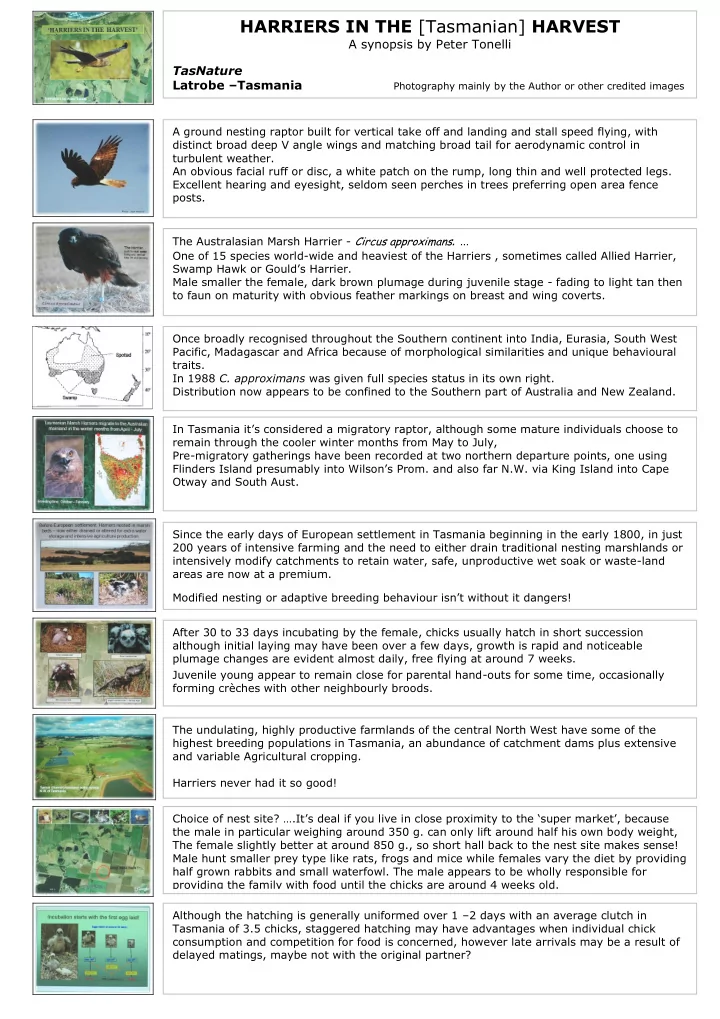
The Australasian Marsh Harrier - Circus approximans. … One of 15 species world-wide and heaviest of the Harriers , sometimes called Allied Harrier, Swamp Hawk or Gould’s Harrier. Male smaller the female, dark brown plumage during juvenile stage - fading to light tan then to faun on maturity with obvious feather markings on breast and wing coverts. A ground nesting raptor built for vertical take off and landing and stall speed flying, with distinct broad deep V angle wings and matching broad tail for aerodynamic control in turbulent weather. An obvious facial ruff or disc, a white patch on the rump, long thin and well protected legs. Excellent hearing and eyesight, seldom seen perches in trees preferring open area fence posts. Once broadly recognised throughout the Southern continent into India, Eurasia, South West Pacific, Madagascar and Africa because of morphological similarities and unique behavioural traits. In 1988 C. approximans was given full species status in its own right. Distribution now appears to be confined to the Southern part of Australia and New Zealand. In Tasmania it’s considered a migratory raptor, although some mature individuals choose to remain through the cooler winter months from May to July, Pre-migratory gatherings have been recorded at two northern departure points, one using Flinders Island presumably into Wilson’s Prom. and also far N.W. via King Island into Cape Otway and South Aust. Since the early days of European settlement in Tasmania beginning in the early 1800, in just 200 years of intensive farming and the need to either drain traditional nesting marshlands or intensively modify catchments to retain water, safe, unproductive wet soak or waste-land areas are now at a premium. Modified nesting or adaptive breeding behaviour isn’t without it dangers! After 30 to 33 days incubating by the female, chicks usually hatch in short succession although initial laying may have been over a few days, growth is rapid and noticeable plumage changes are evident almost daily, free flying at around 7 weeks. Juvenile young appear to remain close for parental hand-outs for some time, occasionally forming crèches with other neighbourly broods. The undulating, highly productive farmlands of the central North West have some of the highest breeding populations in Tasmania, an abundance of catchment dams plus extensive and variable Agricultural cropping. Harriers never had it so good! Choice of nest site? ….It’s deal if you live in close proximity to the ‘super market’, because the male in particular weighing around 350 g. can only lift around half his own body weight, The female slightly better at around 850 g., so short hall back to the nest site makes sense! Male hunt smaller prey type like rats, frogs and mice while females vary the diet by providing half grown rabbits and small waterfowl. The male appears to be wholly responsible for providing the family with food until the chicks are around 4 weeks old. Although the hatching is generally uniformed over 1 –2 days with an average clutch in Tasmania of 3.5 chicks, staggered hatching may have advantages when individual chick consumption and competition for food is concerned, however late arrivals may be a result of delayed matings, maybe not with the original partner?
SLIDE 2 Polygamy occasionally occurs within the Genus Circus, although males supporting two incubating hens and later his double clutch offspring must expect to be in for a torrid time! Distances of around 100 meters apart are encountered in this type of relationship, however in the case illustrated only a few meters separated both nests …with a well beaten connecting path created by demanding pseudo siblings when food arrives.
After the poppy heads have been headed at approx. 30 CM from ground, the standing stubble is slashed and pulped before being ploughed back into the soil for another rotational crop, Had these chicks been any larger when the initial header unknowingly straddled them some time earlier….then they would have most likely been beheaded!
An all too familiar sight, young advanced chicks having avoided being chopped up in the mower, then the raking into rows - inevitably fell victim to the bailing machine. If only the initial discovery of the nest had been adequately flagged, as would be normal for
- ie. Irrigation outlets or hazardous natural obstacles!
Communication between farm owner and farm contractors is crucial.
Tasmanian climate and geology has proven to ideal for many high value commercial crops, approximately forty-percent of the worlds legal opiate is grown in Tasmania. Occasional Harrier nests are located in poppies which presents special Federal and State crop protection laws and limits access for raptor banders when entering these restricted zones!
So how do you find that needle in the haystack nest - be it in meter high broad beans, standing fodder, cereals or any other high value crops?
- 1. Accidental disturbance pre harvest during crop spraying, weed rouging
- 2. Discovery during harvest (usually resulting in casualties or desertion.)
- 3. Behavioural (field) observations leading to nest direction and follow-up locations.
- 4. Trial methods – (fluoro) food marking and flagging, ariel fly-overs,
Another recently introduced (3 - 5 year) perennial crop that appears to be attracting Harriers to nest is Pyrethrum - probably because of its immediate post winter recovery and advanced standing when site selection begins early Oct. White chicks in a thick blanket of white flowers aren’t easily spotted. A basic profile of a nest site appears to be a round a 5 ha or 12 acre paddock with a northerly aspect , 2 or 3 permeant catchment dams within 1 Km of the nest site, Although not always the case, nests tend to be located close to the center of the
- crop. Standing grass left around the nest provides critical shade in hot summer sun
is often minimal. It’s recommended to farmers that if possible leave a minium of 5 X 5 meters or two tractor lengths around the nest. This stand of strawberry clover fodder crop attracted honey bees during daylight hours irritating the chicks, normally it’s flies attracted to the nest litter! The Agricultural Contractors Assn. throughout the NW in particular are keen to promote ‘due care and protection of Harriers’ as their Mission statement and see these birds as the ‘farmers friend’ especially when it comes to vermin control. Crops management of commercial broad beans involves a reasonably high volume
- f irrigation and broad applications of selective herbicide, fungicide and insecticide.
The regular pass-over however and the parental brooding disturbance allows a greater chance of locating and important flagging of nest sites before harvest begins.
SLIDE 3 Exposing a nest during harvest that appears to be finished may be deceiving, as well fledged chicks may have vacated the open platform in the direct heat of the day - for the cooler shade of the standing crop in this case, barley. Post harvest stubble grazing can quickly undo all the best efforts of the farmer, if nests with chicks aren’t fully protected until free flying. Cattle are not only eager to consume what standing cover remains around the nest site, their inquisitive nature and mob mentality invariable leads to the young harriers being trampled, so temporary electric fencing or similar is the recommended action. Bands are placed on the legs of chicks when at least half grown (5 weeks +). Recognised as a migratory raptor annually crossing Bass Strait, overall distance a bird effectively travels in a 4-5 year band recovery is highly underestimated! Morphological measurements are mandatory for the Australian Bird and Bat Banding Scheme, site data is also collected for personal comparative references If a suspected nest is ‘hidden’ in a standing crop, polite encouragement is requested
- f the farmer that he traverse the parameter of the field. Speedy short cuts can
have dia consequences. In this case the land owner was total unaware of how close he came to wiping out the nest and immediately felt he owed them a 50 meter surround temporary fence! On rare occasions when nest sites have been totally demolished during harvest, well-meaning landowners hand young chicks into wildlife rescue groups. Ideally if possible the brood is returned to the original paddock site after reconstruction of a pseudo nest. Failing this, fostering into a know clutch of similar age is found to be highly successful. Disturbance leading to nest desertion ….other predatory wildlife, farm machinery, irrigation and pesticide applications, migratory hazards. Foxes? Climate change? Opportunities exist for ‘getting the message out’’ to the farming fraternity, mainly through the Primary Producer feature of N.W. Coast print media - A.B.C.– Northern Tas. Country Hour reporters are always keen to promote pre harvesting Harrier awareness. Agricultural company newsletters are always welcome - usually specific to their cropping type. After twenty years gathering and collating nest data in the field, banding ungrateful feisty chicks, formatting behavioural attitudes between raptor and landowner, multiple presentations in respect to ecological and environmental education, scenarios won situations lost. The Harriers in the Harvest project has now found a wonderful new recruit. Alison Dugand, Cradle Coast – N.R.M, biodiversity officer for farms ….an enthusiastic (Ornithology) student from Chas. Sturt University. Data is handed annually to the ABBBS - Canberra (Birdlife Australia), although few band recoveries occur, it is generally noted that mature migratory birds returning annually to the central N/W have been collected within 2-6 kilometres from their
Recovered band are mostly removed from road kill (carrion feeding). I trust you have enjoyed my Harrier’s in the Harvest synopsis - formulated in the Central North-West area of Tasmania. I will be pleased to answer any questions! Thank you.