Hawaii Health Care Innovation Models Project Delivery and Payment - - PDF document

hawai i health care innovation models project delivery
SMART_READER_LITE
LIVE PREVIEW

Hawaii Health Care Innovation Models Project Delivery and Payment - - PDF document

EXECUTIVE CHAMBERS HONOLULU DAVID Y. IGE GOVERNOR Hawaii Health Care Innovation Models Project Delivery and Payment Committee Meeting September 10, 2015 Committee Members Present: Committee Members Excused: Judy Mohr Peterson (Co-chair)


slide-1
SLIDE 1

Health Care Innovation Office | 1

EXECUTIVE CHAMBERS HONOLULU DAVID Y. IGE

GOVERNOR

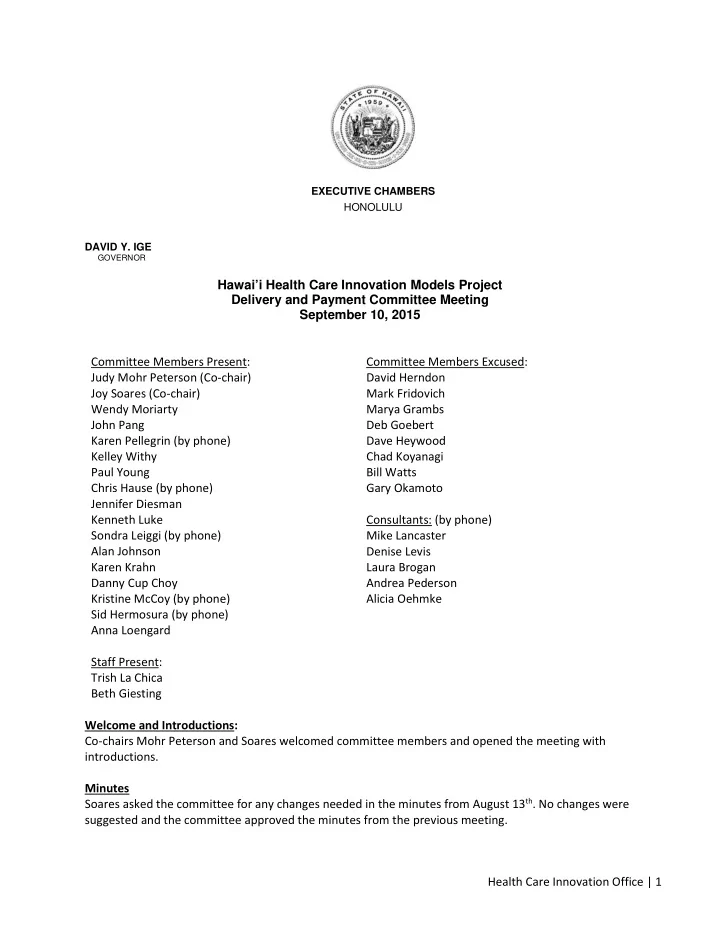
Hawai’i Health Care Innovation Models Project Delivery and Payment Committee Meeting September 10, 2015 Committee Members Present: Judy Mohr Peterson (Co-chair) Joy Soares (Co-chair) Wendy Moriarty John Pang Karen Pellegrin (by phone) Kelley Withy Paul Young Chris Hause (by phone) Jennifer Diesman Kenneth Luke Sondra Leiggi (by phone) Alan Johnson Karen Krahn Danny Cup Choy Kristine McCoy (by phone) Sid Hermosura (by phone) Anna Loengard Staff Present: Trish La Chica Beth Giesting Committee Members Excused: David Herndon Mark Fridovich Marya Grambs Deb Goebert Dave Heywood Chad Koyanagi Bill Watts Gary Okamoto Consultants: (by phone) Mike Lancaster Denise Levis Laura Brogan Andrea Pederson Alicia Oehmke Welcome and Introductions: Co-chairs Mohr Peterson and Soares welcomed committee members and opened the meeting with introductions. Minutes Soares asked the committee for any changes needed in the minutes from August 13th. No changes were suggested and the committee approved the minutes from the previous meeting.

slide-2
SLIDE 2

Hawaii Health Care Innovation Models Project Delivery and Payment Committee Meeting September 10, 2015 Health Care Innovation Office | 2 SIM 2 Goals and Focus Areas (Slides 4 to 11). Beth Giesting reviewed the SIM goals, priorities, and rationale. This meeting will focus on the behavioral health integration for adults. The next meeting will focus on children. (Please see slides) Adult Behavioral Health Integration Models (Slides 12 to 39)

  • Dr. Michael Lancaster continued the discussion of evidence based practice (EBP) models for behavioral

health integration. Some key points:

  • The BHI models give everyone the opportunity to decide which model to implement. It is also

important to understand the cultural needs and social determinants of health that are prominent among the Medicaid population.

  • We recognize that any change in the system is difficult. But the priority is to identify and treat

people who are already in primary care. We need available and sustainable training models that we can provide to primary care physicians.

  • We want to build upon expertise and leverage relationships with different agencies.
  • A matrix of the options for EBP by Target Population (mild to moderate) is on slide 18.
  • The proposed EBPs for adults are: SBIRT, Screening and treatment for Depression and Anxiety,

and Motivational Interviewing.

  • SBIRT Discussion
  • Stakeholder feedback from focus group discussions:
  • Recommendations: provide consultation services, develop a list of resources,

provide referral service or a number for primary care to call, have psychiatrists available to provide consultation

  • We are challenged by having no step down units, no beds. SMI are taking up all beds

and there are none available mild to moderate

  • Other issues: no post-discharge follow up
  • MI received positive responses from providers , PHQ9 is also being practiced
  • Multi-disciplinary team could really help with mild to moderate.
  • Motivational interviewing is really helpful in working with BH and chronic conditions
  • ACT teams were mentioned in the past – for SMI/SPMI
  • Community health centers are ready to do screening
  • The MI model was developed around tobacco and substance abuse and is also helpful for

those with chronic conditions, and for adolescents

  • State funding has forced us to look at most critical, high risk, but this model really focuses on

the front end of this

  • SIM is also looking at: privacy and security issues, care coordination issues, access issues
  • QCIPN (Queen’s Clinically Integrated Physician Network): We are working on behavioral

health integration as well. We are beginning to implement screening and have put together programs that support physicians in helping them manage their patients. In the next year we will put together a mental health model.

  • Now only a physician network, but needs to be inter-disciplinary
  • Queen’s contracts with UH Psychiatry department, which has a lot of experience in

telepsychiatry
slide-3
SLIDE 3

Hawaii Health Care Innovation Models Project Delivery and Payment Committee Meeting September 10, 2015 Health Care Innovation Office | 3

  • How do we get our PCPs accustomed to using technology or using curbside consult

model services?

  • 3 good programs: KP on Maui, Queen’s, PCA telepsych in Hawai‘i Island
  • David Roth can be a resource on telepsychiatry
  • Building a referral platform on top of HHIE
  • Targeting pregnant women will work
  • Using SBIRT on those with chronic conditions will work
  • Physicians may not want to screen all patients
  • PCPs in focus groups have lamented that programs like service coordination offered through

health plans can’t be offered to all their patients and would like to see something they can use with their entire patient population.

  • Could the PC clinics do the screening and, if warranted, have a regional or centralized

service provide the brief intervention?

  • PCPs have said that health plans should pay for this service if they are requiring them to

include it in their metrics.

  • SBIRT can also be administered by other paraprofessionals that patients interact with during

the visit.

  • Could be similar to flu vaccine program where an external office does the screening and

communicates with PCP

  • There’s a lot of wrap around services for those going to CHCs, but not for private PCPs
  • Pharmacists are among the most trusted; there’s a lot of data showing how we can leverage

pharmacists to strengthen the current workforce without adding burden to PCPs

  • SBIRT target population can focus on:
  • Pregnant women
  • Adults with chronic conditions
  • Everybody – population determined by PCP

Screening for Depression and Anxiety Discussion:

  • Project ECHO – no payment structure available
  • 1.5 hour every week on case-based consultation
  • QCIPN - providers earn points, which translate to incentives for getting training
  • SA – when you leave the facility for treatment, sometimes the patient’s mild to moderate SA

may go away but depression or other conditions do not

  • Under PCMH recognition to get to level 1 depression screening is required
  • We should focus on small provider offices since larger organizations are more likely to be

doing it already

  • How can we incentivize 1-2 person PCP offices?
  • What’s the clinical imperative? What will get them to achieve better outcomes?
  • Depression target population can focus on:
  • Pregnant women
  • Adults with chronic conditions
  • Anybody as determined by PCP
slide-4
SLIDE 4

Hawaii Health Care Innovation Models Project Delivery and Payment Committee Meeting September 10, 2015 Health Care Innovation Office | 4 Motivational Interviewing (MI) – Discussion:

  • Training is needed for broad implementation
  • MI can be part of same roll out as SBIRT or depression screening; it can be a component of

each of these approaches.

  • MI uses messaging that frames BH models as a means to better manage chronic disease
  • There’s value in focusing on building community supports and services to empower patients

and families to manage their own health

  • MI target population can focus on:
  • Everybody – population determined by PCP
  • As part of MI or Depression screening

Operational and Other Issues (Slides 40-44) Soares provided brief updates on SIM:

  • Privacy and Security Issues – SIM continues to work with key stakeholders and providers on

how to capture best practices and develop use case examples in sharing behavioral health information.

  • Workforce/Care Coordination – the Workforce committee is focused on opportunities with

CHWs and clinical pharmacists as staff who can support the BH care team.

  • Payment Models and Quality Incentives – SIM continues to work with Judy Mohr Peterson

and Navigant in developing measures that would evaluate the BH delivery and payment model. Next Meeting The next Delivery and Payment Committee meeting will be on September 30th from 12-1:30pm in the State Capitol, Room 309. Adjournment The meeting was adjourned at 1:40pm.

slide-5
SLIDE 5

State Innovation Model Design 2

DELIVERY AND PA PAYMENT COMMITTEE SEPTEMBER 10, 2015

slide-6
SLIDE 6

Welcome and Introductions

  • 1. Judy Mohr Peterson, Dept of Human Services, Co-

Chair

  • 2. Joy Soares, Office of the Governor, Co-Chair
  • 3. Mark Fridovich, Dept of Health
  • 4. Deborah Goebert, National Center on Indigenous

Hawaiian Behavioral Health

  • 5. Marya Grambs, Mental Health America
  • 6. Chris Hause, Kaiser Permanente
  • 7. Sid Hermosura, Waimanalo Health Center
  • 8. David Herndon, HMSA
  • 9. Dave Heywood, UnitedHealth Care
  • 10. Robert Hirokawa, Hawaii Primary Care Association
  • 11. Alan Johnson, Hina Mauka
  • 12. Chad Koyanagi, Institute for Human Services
  • 13. Karen Krahn, Dept of Health
  • 14. Sondra Leiggi, Castle Medical Center
  • 15. Anna Loengard, Queen’s CIPN
  • 16. Kristine McCoy, Hilo Family Practice Residency
  • 17. Wendy Moriarty, `Ohana Health Plan
  • 18. Gary Okamoto, AlohaCare
  • 19. John Pang, Pharmacist
  • 20. Karen Pellegrin, UH Hilo College of Pharmacy
  • 21. Bill Watts, Queen’s Medical Center
  • 22. Kelley Withy, AHEC
  • 23. Paul Young, HAH

SIM Staff: Trish LaChica and Abby Smith

slide-7
SLIDE 7

Agenda

 Welcome and Introductions Judy Mohr Peterson  Review of Minutes Joy Soares  SIM 2 Goals and Focus Areas Beth Giesting  Adult Behavioral Health Integration Models

  • Dr. Michael Lancaster

 Operational and Other Issues Joy Soares

  • Privacy and Security Issues
  • Workforce/Care Coordination
  • Payment Models and Quality Incentives

 Other Business Joy Soares  Adjourn

slide-8
SLIDE 8

SIM Goals

Triple Aim + 1

  • Better health
  • Reliably good quality care
  • Cost-effective care
  • + Reducing disparities in health status and access to care
slide-9
SLIDE 9

SIM Goals

Nurturing healthy families – whole-family approach

  • Investing early in keiki and their young parents for future generations.
  • Coordinating systems, programs, and services.
slide-10
SLIDE 10

SIM2 Focus Areas

Two health care delivery areas that can focus us on ‘Ohana:

Behavioral health integration with primary care – effective awareness, diagnosis and treatment

 Adults and children in the primary care settings with mild to moderate behavioral health conditions

Oral health improvement via increased access to timely and preventive services

 Access for children and increase dental sealants and fluoride varnishes  Strategies to increase coverage for low-income adults

FOCUS IS ON MEDICAID

slide-11
SLIDE 11

Rationale for BH focus

Feedback from stakeholders, providers, community BH conditions disproportionately affect the most vulnerable populations. Access to behavioral health services is challenging, particularly for the Medicaid population. While transformation is progressing, BH has largely been left out of innovations. Stakeholder feedback from the SIM first round identified behavioral health services need to be strengthened, and that the lack of BH training and resources was an obstacle to offering those services at the primary care level. Synergy with other initiatives: Community Health Needs Assessment (CHNA) identified behavioral health as a priority.

slide-12
SLIDE 12

Data on BH

 Community Health Needs Assessment identified mental illness as number one preventable cause of hospitalization in 2012.  SIM Round 1 actuarial analysis showed the average total cost for individuals with a BH diagnosis was three times the average total cost for individuals without a BH diagnosis.  In 2013, >1 in every 4 adults (27.5%) in Hawai’i reported having poor mental health.i  Asian Americans, Native Hawaiians, and Pacific Islanders (AA/NHPIs) represent 82.5% of the population in Hawai’i, yet have the lowest utilization rates for mental services among all populations, regardless of gender, age, and geographical location.ii  The number of suicides for youth ages 15 to 24 more than doubled from 2007 to 2011.iii

slide-13
SLIDE 13

Rationale for Focusing on Mild-Moderate BH Conditions

Data and stakeholder feedback revealed there is an opportunity…

Behavioral health integration with primary care – effective awareness, diagnosis and treatment of mild to moderate behavioral health conditions –

could improve outcomes and lower costs.

slide-14
SLIDE 14

Rationale for Focusing on Mild-Moderate BH Conditions

 PCPs provide 60-70% of BH care for mild to moderate conditions.  Feedback from Hawaii stakeholders suggest that many PCPs are not screening because of the lack of BH training and resources needed to provide those services at the primary care level.  Potential return on investment: co-morbidity costs in Hawaii

  • SIM HHIC analysis revealed there was a co-existing mental health condition in 34% of

hospitalizations (CY2012 - $483 million).  National behavioral health integration initiatives have demonstrated improved outcomes and a strong return on investment for patients with mild to moderate behavioral health conditions.  Data on behavioral health integration pilots in Hawaii are not available yet, but anecdotally providers report they think their patients are receiving better care.

slide-15
SLIDE 15

Focus Today is on Adults

WE’LL FOCUS ON CHILDREN DURING OUR NEXT MEETING

slide-16
SLIDE 16

Whole Person Care

Integration of Primary and Behavioral Health Care Presentation to the Delivery & Payment Committee – 9/10/2015 State of Hawaii Health Care Innovation Office

  • Dr. Mike Lancaster
slide-17
SLIDE 17

BHI models will take into consideration:

  • The need to develop a blueprint that can be supported by

health plans, providers and patients and their families.

  • The desire to build these models with engaged providers.
  • The need to be flexible and to meet providers / practices

where they are in the process of BHI and with the model that makes the sense for their patient population.

slide-18
SLIDE 18
  • Cont. BHI models will take into consideration:
  • The desire to offer two to three different BHI models with

applicability to different populations.

  • The models must be sensitive and understand the social

determinants of health and issues of cultural diversity that are prevalent in the Medicaid population.

  • Build models on existing infrastructure to leverage

resources.

  • Other considerations from the D & P Committee?
slide-19
SLIDE 19

Focus on two to three EBP models:

  • Provides a choice for providers – meeting them where they

are

  • Keeps it simple
  • Sustainable in a PCP model of care
  • Recognizes that any change at the practice will present

challenges

  • Focuses on early adopters
slide-20
SLIDE 20

Build on Existing Infrastructure:

  • Build on / develop relationships

– CAMHD – CCS – JABSOM – MCOs – IPAs – Provider Groups – Schools, DHS, DOH – Etc.

slide-21
SLIDE 21

Need Available and Sustainable Training Models:

  • Academic Medical Centers
  • Area Health Education Centers
  • Managed Care Organizations
  • CME online/webinar – proven models available
  • Telepych / telemedicine
  • Others?
slide-22
SLIDE 22

Choices for EBP by Target Population (mild – moderate):

Depression and Anxiety Substance Abuse Motivational Interviewing 12 – 18 years    > 18 years   

Pregnant Women

  

Women of Child Bearing Age

  

slide-23
SLIDE 23

Proposed EBP for PHP/BH Integration 1) SBIRT- Screening, Brief Intervention, Referral for Treatment; to help address the hidden issues with substance misuse in a PCP population 2) Screening and Treatment of Depression and Anxiety - based on IMPACT model to identify and treat depression in a PCP population 3) Motivational Interviewing- educate, engage, empower consumers we serve to be part of their health workforce

Note: We will discuss anxiety during our next meeting.

slide-24
SLIDE 24

Priority Populations for SBIRT Pregnant women

  • Substance use during pregnancy will have a negative impact on birth outcomes

and is detrimental to the mother and the baby

  • Studies indicate that prenatal care greatly reduces the negative effects of SA

during pregnancy, including decreased risks of low birth weight and prematurity

  • ACOG has an official opinion on the value and importance to screen for SA

during pregnancy

  • Current Activities in Hawaii:
  • Dr. Ira Chasnoff has worked with 16 clinics on Oahu and the Big Island for

about 10 years

  • Alignment with other initiatives: The Hawaii Maternal and Infant Health

Collaborative is working to make SBIRT the standard of care for all prenatal providers

slide-25
SLIDE 25
  • Cont. Priority Populations for SBIRT

Adults with chronic conditions

  • Individuals with comorbid physical and behavioral conditions are at greater risk

for poor health outcomes and unless the behavioral health issues are addressed, they will have a difficult time managing their chronic illness(es)

  • SAMHSA supports SBIRT for adults with chronic conditions
  • 2006 eight state report by Colton et al documented that individuals with

comorbid behavioral health conditions will have a much shorter life expectancy

slide-26
SLIDE 26
  • Cont. Priority Populations for SBIRT

Adults with chronic conditions

Hawaii-specific data: 2012 HHIC SIM Report

  • A mental health condition was a co-existing diagnosis in 34% of

hospitalizations

  • Diabetes was a co-existing condition for 28% of potentially preventable

hospitalizations and 10% of hospital readmissions

  • Health disparities:
  • High blood pressure and diabetes are more prevalent among native

Hawaiians, Filipinos and Japanese1

  • The prevalence of asthma is highest among the Native Hawaiian

population1

  • One in five Native Hawaiian/Pacific Islander had a diagnoses depressive

disorder – the highest percentage of all racial groups in the US2

slide-27
SLIDE 27
  • Cont. Priority Populations for SBIRT

Additional Groups to Consider

  • Women of Child Bearing Age

Discussion: What populations should we prioritize?

slide-28
SLIDE 28

Which Clinical Settings Should be Prioritized for SBIRT models?

  • OB/GYNs
  • Primary Care Integration to occur:

– Private Practices – Community Health Centers – Others?

slide-29
SLIDE 29

Major Supports Providers Will Need for SBIRT:

  • Training program – train the trainer
  • Champions in the practice
  • Learning collaboratives for champions to share best

practices

  • Tools, workflows and toolkits
  • Clearly defined system transformation expectations and

guidelines

  • Incentives – payment reform
  • Effective workforce to support the initiative
slide-30
SLIDE 30

Priority Populations for Screening for Depression Pregnant women

  • Perinatal and postpartum depression are some of the most common medical

complications during pregnancy and the postpartum period. And, if untreated can have very negative effects on women, infants and families.

  • ACOG recommends screening for depression with validated screening

tools, such as the Edinburgh, PHQ-9 and Beck.

slide-31
SLIDE 31

Priority Populations for Screening for Depression Pregnant women – Hawaii-specific data1

  • About 1 out of 7 women (14.5% ) with a recent live birth reported Self Reported Postpartum

Depressive Symptoms (SRPPD)

  • Other Pacific Islander, Other Asian, Samoan, Hawaiian, Filipino, and Korean had the highest

SRPPD estimates

  • Women more likely to report SRPPD were younger, less educated, not married, were

Medicaid/QUEST insured, had an unintended pregnancy, smoked and used illicit drugs in pregnancy, and reported intimate partner violence

  • Women that report SRPPD were more likely to use drugs during pregnancy, smoke in the last 3

months of pregnancy, experience intimate partner violence, have a premature delivery Alignment with other initiatives: Hawaii Maternal and Infant Health Collaborative also interested in addressing perinatal and postpartum depression

slide-32
SLIDE 32
  • Cont. Priority Populations for Screening for Depression

Adults with chronic conditions

  • Prevalence of co-morbid physical and behavioral conditions is high in the Medicaid

population and both need to be treated and addressed for optimal health outcomes – whole person care.

  • The U.S. Preventive Services Task Force recommends screening for depression as it

is among the leading causes of disability in person 15 years and older and individuals with chronic conditions are considered “at risk”.

slide-33
SLIDE 33
  • Cont. Priority Populations for Depression

Adults with chronic conditions

Hawaii-specific data: 2012 HHIC SIM Report

  • A mental health condition was a co-existing diagnosis in 34% of

hospitalizations

  • Diabetes was a co-existing condition for 28% of potentially preventable

hospitalizations and 10% of hospital readmissions

  • Health disparities:
  • High blood pressure and diabetes are more prevalent among native

Hawaiians, Filipinos and Japanese1

  • The prevalence of asthma is highest among the Native Hawaiian

population1

  • One in five Native Hawaiian/Pacific Islander had a diagnoses depressive

disorder – the highest percentage of all racial groups in the US2

slide-34
SLIDE 34
  • Cont. Priority Populations for Screening for Depression

Members with complex needs (aka high utilizers)

  • Prevalence of co-morbid physical and behavioral conditions is high in the Medicaid population and both need to be

treated and addressed for optimal health outcomes – whole person care.

  • The U.S. Preventive Services Task Force recommends screening for depression as it is among the leading causes of

disability in person 15 years and older and individuals with chronic conditions are considered “at risk”. Hawaii-specific data: 2012 HHIC SIM Report

  • Approximately one in every 10 hospitalizations and ER visits are potentially preventable.
  • Total annual costs associated with potentially avoidable stays/visits:
  • To ER: $93 Million (charges)
  • To hospital: $159 million (estimated cost)
  • For hospital readmissions: $103 million (estimated cost)
  • Differences in potentially preventable ER utilization and hospital readmission exist by race/ethnicity and by County of

patient residence.

  • Disparities: Highest among Other Pacific Islander and Hawaiians, and highest on Kauai

Discussion: What populations should we prioritize?

slide-35
SLIDE 35

Which Clinical Settings Should be Prioritized for Screening for Depression?

– Private Practices – Community Health Centers – Others?

slide-36
SLIDE 36

Major Supports Providers Will Need to Support Screening for Depression:

  • Training program – train the trainer
  • Champions in the practice
  • Learning collaboratives for champions to share best

practices

  • Tools, workflows and toolkits
  • Clearly defined system transformation expectations and

guidelines

  • Incentives – payment reform
  • Effective workforce to support the initiative
slide-37
SLIDE 37

Motivational Interviewing

  • An EBP that will be a component of practice change, and will

be incorporated into most of the previous described elements.

  • MI as a practice change model in itself will focus on entire

practices to integrate this EBP model of care for care of all patients

  • MI is culturally appropriate for most clients
slide-38
SLIDE 38

Priority Populations for Motivational Interviewing

Pregnant women

  • Motivational Interviewing is an evidence based practice (person-centered form of talking) that will

enable trained providers to better engage with their patients. MI educates, engages and empowers consumers to elicit and strengthen their motivation for change

  • Proven model to increase patient engagement

Adults with chronic conditions

  • Same rational as above

Members with complex needs (aka high utilizers)

  • Same rational as above

Discussion: What populations should we prioritize?

slide-39
SLIDE 39

Which Clinical Settings for Motivational Interviewing: – High Volume Practices – Small Private Practices – Community Health Centers – Health Departments – Others?

slide-40
SLIDE 40

Major Supports Providers Will Need to Support Motivational Interviewing:

  • Training program – train the trainer
  • Champions in the practice
  • Learning collaboratives for champions to share best

practices

  • Tools, workflows and toolkits
  • Clearly defined system transformation expectations and

guidelines

  • Incentives – payment reform
  • Effective workforce to support the initiative
slide-41
SLIDE 41

What Will We Need to Succeed?

  • Engaged providers and engaged consumers
  • Support and endorsement from stakeholders
  • Potential alignment of payment / reimbursement
  • Potential policy revisions
  • Other thoughts from Delivery and Payment Committee

members on what will be needed to make this work in Hawaii?

slide-42
SLIDE 42

Discussion and Recommendations:

  • Based on elements noted above discuss recommended EBP

and target group to address

  • Factors to consider:

– Clinical need/ importance – Keep it simple to implement (no change is easy) – Fits into PCP model of practice with minimal disruption – ROI – clinical and fiscal – Will resonate with PCPs

slide-43
SLIDE 43

Drum roll……Committee recommends …….

slide-44
SLIDE 44

Operational and Other Issues

Privacy and Security Issues

Real or perceived issues related to not being able to share behavioral health data

  • Related SIM Strategy:
  • Request technical assistance from federal agencies to provide information on when

information can be shared for specific use cases (e.g. OB/GYN to pediatrician)

  • Circulate draft document providing information on when information can be shared

for feedback

  • Post and share final document in many settings
slide-45
SLIDE 45

Operational and Other Issues

Privacy and Security Issues Continued

  • Information sharing is inefficient
  • Related SIM Strategy:
  • Collect specific use case information and determine if there are ways to make

the process easier for providers.

  • Determine if the ways should be included in plan
  • Develop template PCPs and BH providers can use to share information
  • Other issues related to privacy and security?
slide-46
SLIDE 46

Workforce and Care Coordination

Primary care practices need support and team to help screen and treat

  • Explore how Community Health Workers (CHW) can support practices
  • Explore how clinical pharmacist can support practices
  • Decrease practice barriers for psychologists
  • Provider to provider consults
  • Other strategies?
slide-47
SLIDE 47

Workforce and Care Coordination

Primary care practices need care coordination support

  • Explore how Community Health Workers (CHW) can support practices
  • Explore how health plans can support practices
  • Provider to provider consults
  • Other strategies?
slide-48
SLIDE 48

Other Business

  • SIM will schedule additional Delivery and Payment

Committee meetings

  • Navigant site visit in October
slide-49
SLIDE 49

Next Meeting

Tuesday, October 14th, 12:00-2:00 pm

State Office Tower, Leiopapa a Kamehameha, Room 1403