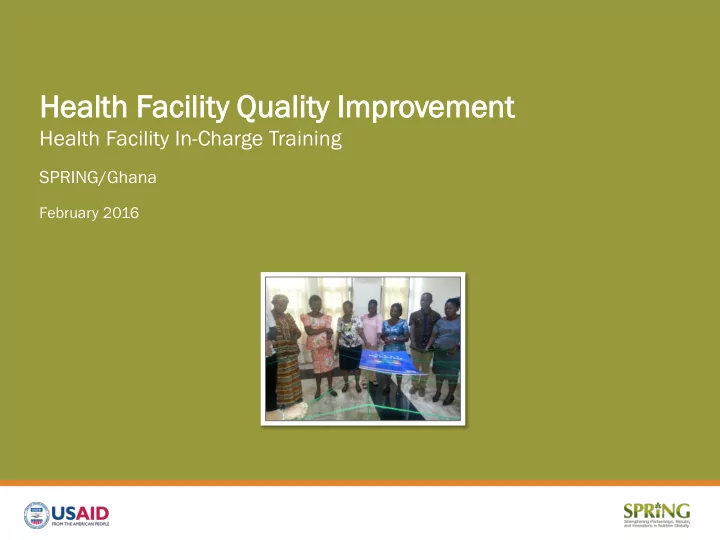
SLIDE 1 Hea ealth lth Fac acility ility Qu Qual ality ty Improveme ement nt
Health Facility In-Charge Training
SPRING/Ghana
February 2016
SLIDE 2 Cour
se Goals als
- 1. Provide technical support to QI team.
- 2. Improve the quality of GMP services at the CWC
(at both static and out-of-reach points).
- 3. Improve the optimal growth of all children under
2 years of age.
- 4. For coaches: To develop a pool of coaches at the
district to assist the health facility QI team to improve the quality of health services.
SLIDE 3 Ob Objectiv ctive e of Health alth Fac acility ility In-Char Charge ge Trai aining ning
To improve the knowledge and skills of HF managers/in-charges in implementing quality improvement approaches at the health facility, which will improve the quality of health services.
Specif ific ic objectiv ives: Assist health facility to—
- Form QI team:
- Select appropriate team members.
- Establish well-functioning QI team:
- Manage stages of team development.
- Develop well-functioning QI meeting:
- Find gap/problem, cause of problem, root cause of problem, brainstorm
possible solutions (change ideas), prepare action plan, test change idea, measure improvement.
- Conduct continuous implementation (PDSA cycle) of testing change
idea and measure improvement.
- Document lesson learned from testing change ideas and measure
improvement.
SLIDE 4 Cour
se Ob Objectiv ctives s II
For QI team members: Support the health facility to—
- 1. Attend QI team meetings regularly.
- 2. Support a well-functioning QI team.
- 3. Participate in well-functioning QI meeting:
- Find gap/problem, cause of problem, root cause of problem,
brainstorm possible solutions (change ideas), prepare action plan, test change idea, measure improvement.
- 4. Conduct continuous implementation (PDSA cycle) of
testing change idea and measure improvement.
- 5. Document lesson learned from testing change ideas
and measure improvement.
SLIDE 5
What at Is Qu Qual ality? ty? What at Is Impr provement? ment?
Quality: In pairs—
Think of a time when you bought something of high quality—what made it high quality? Think of a time you had a high quality service—what made it high quality?
SLIDE 6 Scena cenario io 1: Qu Qual ality ty of Car are? e?
- Being one of the model families in her village,
Fatima went to Kumbungu HC for her ANC
- checkup. The midwife did not speak Fatima’s
language; she held Fatima until she could find a
- translator. Fatima waited for two hours.
- Did Fatima receive quality care from the midwife?
- Explain why or why not.
SLIDE 7 Scena cenario io 2: Qu Qual ality ty of ca care? e?
- Last Saturday, Rafia gave birth to a beautiful baby,
with a TBA’s assistance. However, the TBA could not expel the placenta from Rafia’s womb. Rafia was rushed to a nearby health center when the bleeding did not stop. The midwife at the health center had no sterile gloves. After keeping Rafia for one hour, the midwife realized that she needed to send Rafia to a district hospital.
- Did the midwife give Rafia quality care?
- Explain why or why not.
SLIDE 8
Qu Qual ality ty from m Which ch Perspec spectiv tive?
SLIDE 9
What at is Qu Qual ality? ty?
SLIDE 10 Dimen mensions sions of Qu Qual ality ty
- Care must be safe.
- Care must be effective and reliable.
- Care must be patient centered.
- Care must be timely.
- Care must be efficient.
- Care must be equitable.
SLIDE 11 Qu Qual ality ty from m a a Syst stems ems Vi View
Inputs (Resources) Processes (Activities) Outcomes (Results)
- People
- Equipment
- Supplies
- Infrastructure
- Information
- Technology
- What is done?
- How is it done?
- Health services
delivered
behaviour
status
SLIDE 12 Ma Main Points nts
- Definition of quality of services is different for different
people.
- People become dissatisfied with the health services
they receive at a health facility because it is not their standard of quality.
- It is important for patients to be aware of the quality of
health care services, when defining quality of services.
- If you want to improve the quality of service you have to
look at the system (inputs, processes, and outputs) of health services.
- Patients should understand the different levels of
health care services provided at different health facility levels (hospital, health center, and CHPS compound).
SLIDE 13 What at Do We Me Mean an by Improvement? ement?
- Faster?
- Better?
- Safer?
- Less expensive?
- More efficient?
Think of a time when you changed a way of doing something that led to an
this improvement happen?
SLIDE 14
What at Would uld Be Be an an Impr provement ment at at a CW a CWC? C?
Think about this: What would be an improvement in services at the CWC?
SLIDE 15 What at Is an and Shoul
d Be Be th the Situ tuation ation at at th the e Fac acility? ility?
20% of pre regnant nt women en receivi iving ng ANC services ces Current nt Perfor
mance nce What is the current situation at the facility? Gap Reducing gap = Improvement 90% of pregnan ant t women en receivi iving ng ANC services ces Desired ired Performa mance nce What is the desired situation at the facility?
SLIDE 16 Cas ase e Stu tudy dy 1
Scenario: Joyce is the in-charge at an RCH unit in Karaga
- district. She was just transferred from Bongo district.
She has worked in the RCH clinic in Karaga for more than four months. According to the CHV’s records, there are more than 200 pregnant women in the community. But, the ANC register shows only 15 pregnant women received ANC services last month. Joyce does not know what to do. Her colleagues are fine with providing ANC services to only 15 pregnant women.
- Answer the following questions:
- What do you think the staff should do?
- Why should they do that?
- How can they do that?
- Can you show this using an improvement diagram?
SLIDE 17 Cas ase e Stu tudy dy 2
Scenario: Robert learned that no growth charts were filled
- ut completely and correctly. He trained and assigned a
volunteer to help the nurse fill out the charts. The following month, he found 20% of growth charts filled out completely and correctly. He shared this result with staff and discussed how they could increase to having 50% of growth charts filled
- ut correctly. Staff promised to do their best. After three
months, Robert found that the 20% of correctly filled growth charts had increased to 70%.
- Use an improvement diagram to show the percentage of
growth charts correctly filled out.
- What change idea could have been used for the first
improvement?
- Propose a change idea staff might have used for the
second improvement.
SLIDE 18 Cas ase e Stu tudy dy 2 (c (cont
inued)
- Robert planned to fix the problem of filling out growth chart
completely and correctly.
st month
- He found 1% of growth charts filled out completely:
- He pointed out this problem to the nurse and asked to fix this problem.
- Second
d month
- He found 1% of growth charts were filled out completely:
- He called a staff meeting and asked all staff to fix this problem.
- Third
d month
- He found that 3% of growth charts were filled out completely.
- Fourth
h month
- He found that 50% of growth chart filled out completely.
SLIDE 19 Ex Exercises: cises: What at Is Improvement? ment? How w Does es It t Hap appe pen? n?
Goal: To pass the ball around the whole group in the fastest time.
- First attempt: No talking. Last
person starts passing ball. Each person will pass the ball to another person.
- Timekeeper records the time.
- After first attempt, the group
discuss and use four different ent approac
hes to pass the ball in the least time.
- Record time taken each time.
- Plot a run chart of number of
attempts vs. time taken to pass the ball.
Did your time improve? How?
SLIDE 20
- First attempt: Follow the rule:
Baseline.
Brainstorm ideas with the team and allow different ideas to come out.
- Test four different strategies
(attempts); try to improve on each attempt.
- Measure time taken to pass
the ball, so that they know which one was the most effective.
- Draw a run chart and present
improvement.
Attempt Initial/Change Idea Time 1st 2nd 3rd 4th
SLIDE 21 How w to Ma Make e Improvements ements
Improvement requires the following steps:
- Determine the gap: Between your coverage now
and the coverage you would like to achieve.
- Brainstorm interventions (change ideas).
- Select one intervention or change idea to test.
- Test the change ideas for a period of time.
- Measure the improvement.
- Plot improvement.
SLIDE 22 If you
canno not t me measure ure it, you
canno not t improve e it. “The first step toward getting somewhere is to decide cide that you u are not
ng to stay where re you are.” – Anon
ymous
SLIDE 23
Mo Model del for Improvement ment
SLIDE 24 Mo Model del for Qu Qual ality ty of Improvement ment
Asks three questions before testing change ideas:
1. What are we trying to accomplish?
2. How will we know that a change is an improvement?
- Measure improvement (to identify appropriate measur
ures es that track imp mprovement ment).
3. What change can we make that will result in an improvement?
- Change Idea to test (identify key change ideas to test).
- Plan: Plan how to test change ideas.
- Do: Implement change idea.
- Study: Measure improvement (collect data).
- Act: Make a decision: Based on improvement result: adopt, adapt,
- r abandon the change idea.
- Use the process of the ball game, change idea tested and data
measured to explain modern model for improvement.
SLIDE 25 The “PDSA” Cycle
Plan:
- Objectives.
- Questions and predictions
(why?).
where?, when?).
- Plan for data collection.
- Communicate the change,
engage stakeholders. Do:
- Carry out the plan.
- Document problems and
unexpected observations.
Study:
- Complete the analysis
- f the data (impact of
intervention?).
predictions.
learned. Act:
results.
be made?
SLIDE 26
Qu Quali lity ty Improvement ent Must Be Data Driven. en.
SLIDE 27 Pr Principles ciples of QI QI
Robert visited a QI health facility in Karaga district. The first thing Robert did was ask the health facility manager to draw the process/steps a client goes through when attending CWC. The manager, Latifa, told him that she would like to improve the filling out of growth charts completely and correctly during the GMP services. She found that most of the growth charts were not filled completely and correctly. Robert asked Latifa how she knew the charts were not filled completely and
- correctly. Did she have any data? Latifa showed him the record of growth charts
filled out completely; it showed that only 20 growth charts were completely and correctly filled out. Using the process map she had recently made, Robert asked which staff were directly involved in filling out the growth chart, and who kept the record of filled growth chart. After writing down the names Latifa mentioned, Robert told her to establish a team with these people. Robert also told the manager to educate caregivers about why filling out the chart correctly and completely was important; that being able to see the growth curve
- n the chart will tell mothers if their child is growing well.
- What
t was the main infor
mati tion
ert t needed ded to help Latifa imp mplemen ement t qua qualit ity imp mproveme ement nt and imp mprove e the qua qualit ity y of GMP services ces?
SLIDE 28 Pr Principles ciples of QI QI - 2
- 1. Understanding systems and processes
- 2. Teamwork
- 3. Focus on patients
- 4. Use of data
SLIDE 29
QI QI Team eam Me Meeting eting
Have you ever conducted a meeting before? What were the steps?
SLIDE 30 Role le Pl Play – How w to Condu
ct a QI a QI Team am Me Meeting ting
At Voggu CHPS facility, the QI team identified that staff were not plotting the growth charts completely and correctly. Data was collected during the month, showing that only 60 growth charts out of 100 were filled completely and correctly.
SLIDE 31 Act ction ion Pl Plan an
Gap/Problem? Purpose? How? Who? When? Remarks Only 60% of growth charts are filled out completely and correctly. To increase the filling
charts completely and correctly from 60% to 70%. Continue working with CHV to support the CHN filling out the charts complete ly and correctly. CHN By the end
Continue to collect data.
SLIDE 32 QI QI Team eam Me Meeting eting Steps ps
- 1. Determine the gaps.
- 2. Ask, why are these gaps happening?
- List the reasons why this gap is happening.
- Select ONE—where can your facility make an impact?
- 3. Find the root cause of that gap:
- List the root causes.
- Select ONE.
- 4. What are solutions to that cause?
- List the solutions.
- Select ONE—this is your change idea.
- 5. Create an action plan.
SLIDE 33 Cas ase e Stu tudy dy to Pr Prac actice tice in a a Sma mall ll Group up
Scenario ario 1: Attendance at Kumbungu HF RCH has been low, compared to previous months. The QI team discussed expanding the number of outreach points and selected this as the chief change idea to implement. Conduct a QI team meeting where this change idea is examined for the next course of action. Scenario ario 2: Attendance at Kumbungu HF RCH has been low compared to previous months. The QI team discussed expanding the number of outreach points and they selected this as the chief change idea to implement. In the team’s action plan, it was decided that two of the community health nurses would lead this change; however, one CHN did not attend any outreach clinic that months. Conduct a QI team meeting where the team responds to this challenge. Scenario rio 3: Attendance at the Kumbungu HF RCH has been low, compared to previous
- months. The QI team identified this problem. Act out the QI team as it discussed
this problem, brainstorm possible change ideas, and develop an action plan.
SLIDE 34 Cas ase e Stu tudy dy – Mi Midwif wife e Ma Mary
Mary is a midwife who has worked in Sakogu Health Center for 10 years. Last month, she attended a five-day IYCF training in Tamale. She was impressed with the training, which taught her how simple activities can solve most of the IYCF problems that she was unable to do before. During the training, she practiced filling out growth charts correctly and completely and conducting targeted counselling. Now, she is confident in filling out growth charts and conducting
- counselling. After returning from the training, she tried to
improve the quality of the above services in her health facility, but she has not been successful. She realized that she needs a team to improve quality of services. She went to meet her coach to get advice on how she can form a QI team.
SLIDE 35
Cas ase e Stu tudy dy – Hazia’s Story
Hazia attended a three-day HF in-charge QI training in Kumbungu. After returning from training, she wanted to form a QI team. She has 9 staff in her health facility. She was advised to form a QI team of 5 to 7 members, but not wanting to upset her staff, she decided to include all 9 staff as QI team members.
SLIDE 36 Stages ges Team formation Storming Norm acceptance Performance
Meaning
- Identify the members.
- Assign roles.
- Prepare workplan.
Conflict of all types.
working norm.
Team productivity. Member Reaction
- Enthusiasm
- Optimism
- Politeness
- Effort to identify tasks.
- Resistance
- Changing attitude
- Disputes
- Defensive behavior
- Competition
- Doubts about the goals
- Acceptance
- Relief
- Commitment to overcome
differences
- Happy interactions
- Satisfaction
- Trust
- Commitment to continue
SLIDE 37 Summ mmar ary y of Es Esta tablishing blishing QI QI Team am --
- - 1
- Every team goes through the stages of development:
- Forming
- Storming
- Norming
- Performing
- Each stage is a critical part of ensuring the team is well
functioning and reaching its goals.
- Coach and QI team leader should understand these stages
and the team development process. The QI team should assess the stages of their team and be prepared to tackle the problems of that stage.
- Coach and team leader should also remind team members
- f the stages of team development.
SLIDE 38 Summ mmar ary y of Es Esta tablishing blishing QI QI Team am – 2 2
- Health care consists of interdependent steps that
different people execute.
- Quality gaps occur in services when information does
not communicate clearly in hand-over between people.
- Staff knows system and process of health facility
services well, so they are right people to find out the problems and generate ideas for local solutions that will be doable and affordable.
- Each team member’s confidence increases when they
achieve results working together.
SLIDE 39 Fishbone hbone (C (Cau ause se–Ef Effect ect Diag agram am)
- A tool used to collect and
- rganize all the possible
causes for a particular problem.
- A first step in problem solving
by generating a comprehensive list of possible causes.
understanding of the problem.
The fishbone analysis answers the question “Why?”
Why is there a problem?
SLIDE 40 Fish head = problem Poor quality services Resources Personnel Processes Clients Lack of adequate infrastructure Inadequate supplies No money Poor referral system Lack of communication with HC level
Lack of community involvement and feedback
Lack of knowledge, skills, and experience High workload Poor supervision Uninformed Limited access Not empowered
SLIDE 41 Br Brief f Ex Exercise: cise: Fishbone hbone Diag agram am
Identify a problem. What are the different possible causes? (30 min.) Problem Reasons for the problem for that aspect (e.g., shortage
workers) Each ‘bone’ is a different aspect of the cause (e.g., health workers) USAID Health Care Improvement Project
SLIDE 42 Coach aches es Roles les an and Responsi sponsibili bilites es
Demonstration:
- An interactive learning technique in which the facilitator
explains and shows the stages and their sequence for carrying out a procedure or activity. Steps: 1. Demonstrate the entire procedure from beginning to end. 2. Divide the procedure into parts and allow the participants to work on the individual stages of the procedure. 3. Demonstrate the entire procedure again and allow the providers to practice the entire procedure from beginning to end.
SLIDE 43 Coaches’ Role
- Facilitator
- Trainer
- QI expert
- Commu
mmuni nicat cation ion skills
- Encouraging all team members to
share relevant information.
ilitati tion
- n skills
- Promoting decision making by
consensus.
ing g skills
- Coaching is not synonymous with
- training. Training can be one
component of a larger coaching initiative.
ity y imp mprovemen ement t skills
- Increase the performance for the
task for which they receive coaching or mentoring.
SLIDE 44 Coaches’ Responsibilities – 1 1
e QI QI princi nciples. s.
n how to give positiv tive feedback ck and respect ct the opinio nions ns of oth
s.
ide coaching/ ing/ment mentoring ring session n after observing ing QI QI team meeting eting.
ide coaching ing on technical nical and problem m solving ng skills ls.
ide feedback k to the team. m.
port the team leader.
in objectiv ive e and neutral. ral.
- Enable the team and the team
leader to m make their ir own decisio sions. ns.
ish a climat mate e of cooperatio ation n and d openness ss
e the problem m solving ng process. s.
rage team work rk.
energy on the common n tasks. ks.
SLIDE 45 Coaches’ Responsibilities – 2 2
Assist to—
m QI team:
- Understand current system and processes.
- Conduct orientation to QI team.
- Establi
blish sh we well ll-function ionin ing g QI team:
- Understand stages of developing well performing team:
- Team forming
- Team storming
- Team norming
- Team performing
- Develop
lop we well-functioni tioning g QI team meet etin ing: g:
- Understand (draw) processes of health delivery system (at CWC).
- Find out the gap in steps—from documents (register, note book, tally sheet, forms, etc.); comparing denominator and
numerator.
- Develop indicator.
- Steps to follow during the QI meeting:
- Member present data (numerator and denominator)
- Determine gap/problem (difference in denominator and numerator)
- Determine the root cause of the problem
- Brainstorm possible solution/change idea of the root cause
- Select one change idea
- Test selected change idea (at CWC)
- Study/measure improvement (at CWC)
- Conduc
duct contin inuou
s PDSA cycle ycle to test chang ange idea.
ent lesson son learned ed from m testin ing g change ge ideas s and measurin ing g imp mprovem emen ent.
SLIDE 46 Process of Decision Making: Margaret’s Deci ecision sion
Margaret graduated from the University for Development Studies (UDS) this year. Now, she would like to join a master’s program in nutrition, but she does not know which university offers a good international nutrition
- program. She has collected information about the university from the
following sources: 1. university website 2. students who graduated from the nutrition department 3. faculty who teach in the nutrition department She decided to go to the university in South Africa because— 1. It offers courses of her interest. 2. It is not expensive. 3. One of her relatives is now studying there so she can share living cost.
SLIDE 47
Decision cision-Makin Making g Pr Process cess
Information Discussion Decision Making
SLIDE 48 QI QI Me Meetings etings
First QI Team Meeting Second QI Team Meeting Third QI Team Meeting Identify gap + look at problems contributing to gap + analyze root causes of problems + brainstorm solutions to that problem + develop action plan + meeting adjourned.
Study improvement data + discuss and make decision; continue testing the same change idea; modify change idea and continue testing or reject change idea. ACT. If change idea is rejected, then conduct root cause analysis (using problem tree or fishbone diagram, or barrier analysis, etc.) to find the main root cause of the gap/problem (which may have been missed last time). Then, either select another change idea from the previous list or prepare a new change idea list by brainstorming + analyze root cause + develop action plan. PLAN. Study improvement data + discuss and make decision, continue testing the same change idea, modify change idea and continue testing or reject change idea. If change idea is rejected, then conduct root cause analysis (using problem tree or fishbone diagram or barrier analysis, etc.) to find out the main root cause of the gap/problem (which may have been missed last time). Then, either select another change idea from the previous list or prepare a new change idea list by brainstorming + analyze root cause + develop action plan.
DO DO DO
SLIDE 49
Principle: “Do not reinvent the wheel—st steal eal shamelessly, share senselessly.”
SLIDE 50
Un Unde derst standing anding th the Current rent Syst stem em
Inputs + Processes = Outcomes
People What is done? Behaviour Change Infrastructure Patient Satisfaction Materials How is it done? Services Delivered Change in Health Status Information
SLIDE 51
Un Unde derst standing anding Work k as as Pr Proce cesses sses an and Syst stems ems
Process: A sequence of steps through which inputs from supplies are converted into outputs for customers. System: The sum of all the total elements (including processes) that interact to produce a common goal.
SLIDE 52
Ex Examples amples of Pr Processe cesses
Child Welfare Clinic
SLIDE 53
Steps ps an and Par Participa ticipants nts
Patient arrives Registration Take temperature Doctor’s exam Collect tests Specialist’s exam Patient leaves Patient Receptionist Nurse Physician Lab technician Specialist Patient
SLIDE 54 Work k as as a Pr a Process cess
Need for blood analysis determined Paperwork printed Paperwork delivered to lab Blood analyzed Blood drawn Blood draw scheduled Results put in computer Reports printed Reports delivered to floor
Adapted from Langley, et al., The Improvement Guide: A Practical Approach to Enhancing Organizational Performance. Jossey Bass, 1996.
SLIDE 55 Draw w a p a proce cess ss flo low w ma map of th the e CWC C or AN ANC C at at y your
acility lity.
SLIDE 56 Drawing wing Flo low w Char hart
Weighing place What are the steps? Growth card filling place Triage step Counselling room Interactive education place What happens at this step? What are the possible
SLIDE 57
Principle: “Most problems are found in processes and systems, not in people.” Ma Manag aged ed ca care me mean ans s ma manag aging ing th the proce cesses sses of ca care, e, not t ma manag aging ng physi ysicians cians an and nurse ses. s.
SLIDE 58
Child ild Welf lfare are Cli linic nic
SLIDE 59 “Every system is perfectly designed to achieve the results it gets.” – Pau Paul l Ba Bata talden lden “Insanity: doing the same thing over and
- ver again and expecting different results.” –
Al Alber bert t Ei Einst stein ein
SLIDE 60 Indi dicat cator
Purpose of indicators:
- Indicator is a measurement of level of
performance/achievements/outcome.
- Indicator indicates the position/state/level of
program achievement (position where you are— indicated in number).
- Indicator also helps to show measurement of
progress/improvement.
SLIDE 61 Cas ase e Stu tudy dy
Margaret is a midwife working in a health center that has a very low attendance of pregnant women for ANC services. The record from home visits by CHVs shows there are 100 pregnant women in the community, but only 20 attended ANC services. She plans to increase the number of pregnant women attending her clinic— from 20 to 50. She started collecting data on pregnant women attending the ANC clinic every month.
- What is the indicator?
- What is the numerator?
- What is the denominator?
- What is the percentage of women attending the ANC clinic?
- What is the frequency of data collection?
SLIDE 62 Act ctivities ivities at at a CW a CWC
What main GMP activities happen at the CWC?
- Register child.
- Weigh child.
- Plot weight of child on the growth chart.
- Triage caregivers for counselling.
- Provide targeted counselling to caregivers.
- Measure growth of child.
SLIDE 63 Key y Infor
mation Abo bout ut Indicat dicator
- rs
- Numerator
- Denominator
- Source of data
- Frequency
SLIDE 64
Creating eating Indicat icator from m GMP MP Pr Processe cesses/St s/Steps/A eps/Act ctiviti vities es
Main GMP activities during the CWC: 1. Register child. 2. Weigh child. 3. Plot weight of child on the growth chart. 4. Triage caregivers for counselling. 5. Provide targeted counselling to caregivers. 6. Measure growth of child. Indicators: 1. Percentage of children registered for GMP. 2. Percentage of children weighed. 3. Percentage of children’s weight plotted on the growth chart. 4. Percentage of caregivers triaging for counselling. 5. Percentage of caregivers received targeted counselling. 6. Percentage of children with improved growth.
SLIDE 65 Indi dicat cator
s of ANC NC Service vices
weeks) registered.
ANC services.
iron tablet.
folic acid tablet.
counseling.
- Percentage of pregnant women
(<14 weeks) registered.
- Percentage of pregnant women
received ANC services.
- Percentage of pregnant women
received iron tablet.
- Percentage of pregnant women
received folic acid tablet.
- Percentage of pregnant women
received counselling.
SLIDE 66 Sour urce ce of Dat ata
- Total number of children <2 years old.
- Total number of children weighed.
- Total number of children with growth chart completely filled out.
- Total number of children with weight plotted.
- Total number of children with weight plotted and joined.
- Total number of caregivers counselled.
- Total number of caregivers triaged.
- Total number of caregivers given interactive education.
- Total number of children with growth not faltering.
SLIDE 67
Perce cent ntage age of Women men Att ttending ending ANC NC Ser ervic vices es
Month Numerator Denominator Percentage Change Idea J 8 M A M F 5 30 50 20 48 12 45 25 50
SLIDE 68
Perce cent ntage age of Children ildren Correctly rrectly Weighe ghed
Month Numerator Denominator Percentage Change Idea J 25 M A M F 6 120 130 91 140 56 125 127 150
SLIDE 69 Perce cent ntage age of Growth wth Char hart t Com
pletely ely an and Correc rrectly tly Filled lled Ou Out
Month Numerator Denominator Percentage Change Idea J 8 M A M F 3 30 50 20 40 6 60 25 50
SLIDE 70 Perce cent ntage age of Car aregiv egiver ers s Receiv ceiving ing Tar argeted ed Counselling
Month Numerator Denominator Percentage Change Idea J 44 M A M F 13 130 180 126 140 70 220 168 210
SLIDE 71 Including cluding Change ange Ideas eas on Your r Grap aph
10 % of pregnant women participate in HIV test. 100% of pregnant women should participate in HIV test. QI team met and discussed— Change idea proposed- Awareness- Radio Spots One Month Later: Measured—10% women tested No Improvement. QI team met and discussed— Change idea proposed—Awareness—TV spots one month later: Measured—20% women tested improvement but not 100%. QI team met and discussed— Change idea proposed—Awareness—TV Spots and religious groups One month later: Measured—50% women tested improvement but not 100%. QI team met and discussed— Change idea proposed—Awareness—radio spots, religious and women group one month later: Measured—80% women tested improvement but not 100%. QI team met and discussed— Change idea proposed—Awareness—TV spots and religious and religious group one month later: Measured—80% women tested improvement but not 100%.
Graph this data, and include the change idea implemented for each point on the graph.
SLIDE 72 “Quality improvement is a journey of many small steps.” Pr Principl ciple: e: Achie chieve e co continual tinual improvement ment th through
mall ll, , incr cremental emental ch chan anges. ges.
SLIDE 73 QI QI Implem lementation entation Activities ctivities Timeline meline
Coaches’ training Health facility in- charge training Form QI team.
QI Meeting QI Meeting QI Meeting QI Meeting QI Meeting QI Meeting QI Meeting QI Meeting Coaching Coaching Coaching Coaching Coaching Coaching Coaching Coaching
Learning Session LS LS Harvest Meeting Train QI team.
SLIDE 74 Impor portant tant QI QI T Team eam Ne Next xt Steps ps
- Go back to facility and debrief the facility.
- On which day will this happen?
- Date:
- Form the QI team. Who are the members? Send the
names of the members to your sub-district head.
- On which day will this happen?
- Date:
- Only after the QI team members’ names have been
submitted to the sub-district, can the date for the QI team orientation be set.
- This training is ONLY for QI team members.
SLIDE 75 El Elements ments of QI QI
- QI teams
- Coaches
- Monthly QI team meetings
- Testing improvements (PDSA cycle)
- Participate in learning sessions
- Documentation
- Develop change idea package
SLIDE 76 “Every system is perfectly designed to achieve exactly the results that it achieves.”
nce is a ch charact racteris eristi tic c of a system. em.
chie ieve e a differe erent nt level el of performance, it is essential to make e ch changes nges to that system em in ways that permit it to pr produ
ce bett etter r results.
- Poorly designed systems lend themselves to ine
nefficiency ciency and po poor
quality ality.
ntify unn nnecessar ecessary, , redu edundant, dant, or missing pa parts s of pr processe
s and attempt to impro prove e qua uali lity ty by clarifyi ifying ng and/or simpl plify fying ng pr proce
dures.
ery y ch change ge is necessarily an im n impr provement, ment, changes must be test sted ed and stud udied ied to determine whe hether ther the change impr proves es the quality of care.
SLIDE 77 PL PLHIV IV Flo low w Ma Mapping ing Be Before
QI Inter ervention ention
Reception Clinician (ht., wt. MUAC) Pharmacy FBP Community Counselling Laboratory
SLIDE 78
PL PLHIV IV Pat Patients ents Flo low w af after QI QI Inter erven ention tion
Reception (ht., wt., MUAC) Clinician Pharmacy FBP Community Triage Counselling Laboratory
SLIDE 79 This presentation was made possible by the American people through the U.S. Agency for International Development (USAID) under Cooperative Agreement No. AID-OAA-A-11-00031, the Strengthening Partnerships, Results, and Innovations in Nutrition Globally (SPRING) project.
Thank you! For more information, please contact: