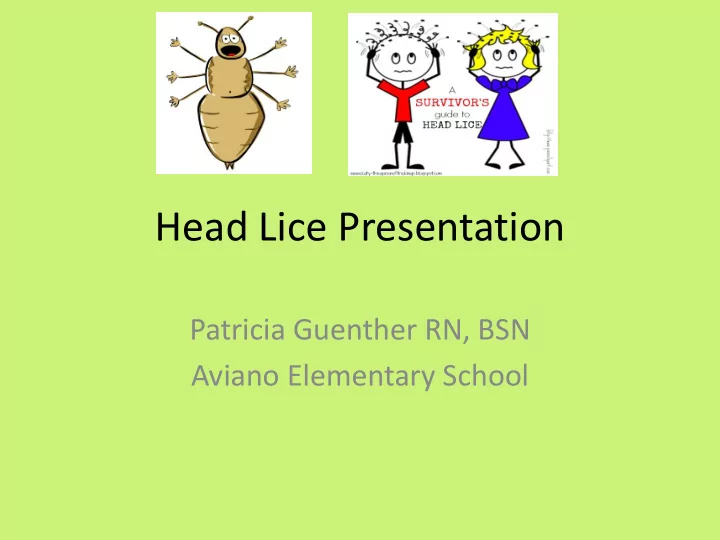
Head Lice Presentation Patricia Guenther RN, BSN Aviano Elementary - - PowerPoint PPT Presentation

head lice presentation
SMART_READER_LITE
LIVE PREVIEW

Head Lice Presentation Patricia Guenther RN, BSN Aviano Elementary - - PowerPoint PPT Presentation

Head Lice Presentation Patricia Guenther RN, BSN Aviano Elementary School What are Head Lice? Head Lice are a tiny, wingless parasitic insect that live among human hair and feeds on tiny amounts of blood drawn from the scalp. Life Cycle


slide-1
SLIDE 1

Head Lice Presentation

Patricia Guenther RN, BSN Aviano Elementary School

slide-2
SLIDE 2

What are Head Lice?

  • Head Lice are a tiny,

wingless parasitic insect that live among human hair and feeds on tiny amounts of blood drawn from the scalp.

slide-3
SLIDE 3

Life Cycle of Head Lice

slide-4
SLIDE 4

Signs of Head Lice

  • Lice eggs (called nits) – these look like tiny

yellow, tan, or brown dots before they hatch.

  • You will find them on the hair shafts close to

the scalp where it is warm. The warmth is need for their survival.

  • They will be difficult to remove. **You can’t

brush or shake them off.**

  • The lice eggs (nits) hatch in 1-2 weeks after

they are laid.

slide-5
SLIDE 5

Picture of Nits (Lice eggs)

slide-6
SLIDE 6

Signs of Head Lice

  • Adult lice and nymphs (baby lice) - the adult

louse is no bigger than a sesame seed and is greyish-white or tan.

  • The adult louse can survive up to 2 days off

the scalp. They feed on blood several times a day.

  • Nymphs are smaller and become adult lice in

about 1-2 weeks after they hatch.

slide-7
SLIDE 7

Picture of Adult Lice (Louse)

slide-8
SLIDE 8

Signs of Head Lice

  • Scratching- With lice bites come itching and
  • scratching. However, this might not start right
  • away. It will depend on the child’s sensitivity

to the bites.

  • It might take weeks for kids with lice to start

to scratch.

  • They may complain of things moving around
  • n or tickling their heads.
slide-9
SLIDE 9

How to check for Head Lice

  • You may be able to see lice or nits by parting your

child’s hair into small sections and checking for lice or nits with a fine tooth comb on the scalp, behind the ears, and around the nap the neck.

  • It is rare to find them on the eye lashes or

eyebrows.

  • A magnifying glass and bright light may help.
  • Lice can be seen on dry or wet hair, but many

people have an easier time spotting lice if the hair is wet.

slide-10
SLIDE 10

Divide the wet or dry hair into sections

slide-11
SLIDE 11

Comb through the wet or dry hair

slide-12
SLIDE 12

Look Closely at the comb

Tips

  • You may want to place a

white towel over the child’s shoulders too.

  • Use a flash light and a

magnifying glass to examine the comb each time you pass through the hair.

  • Identify dandruff, seed-like

casings, nits or lice etc. Look closely at the comb

slide-13
SLIDE 13
slide-14
SLIDE 14
slide-15
SLIDE 15
slide-16
SLIDE 16

How to treat Head Lice

  • Dodea requires one treatment of a pediculocide shampoo.
  • Examples: Pyrethrins combined with piperonly butoxide-

Brand Names: A-200*, R&C*, RID*, Triple X*.

  • Pyrethrins are naturally occurring pyrethroid extracts from

the chrysanthemum flower. Pyrethrins are safe and effective when used as directed. Pyrethrins can only kill live lice, not unhatched eggs (nits). A second treatment is recommended 9 to 10 days after the first treatment to kill any newly hatched lice before they can produce new eggs. Pyrethrins generally should not be used by persons who are allergic to chrysanthemums or ragweed. Pyrethrin is approved for use on children 2 years of age and older. CDC website: http://www.cdc.gov/parasites/lice/head/index.html

slide-17
SLIDE 17
slide-18
SLIDE 18

Remember…

  • Step 1- TREAT with a pediculocide shampoo
  • Step 2- REMOVE comb out all nits by using a

fine tooth comb

  • Step 3- CONTROL by cleaning the child’s

clothes and Surroundings

slide-19
SLIDE 19

CONTROL Tips…

  • Clean the Child’s Clothes and Surrounding- Remember Lice can live up to

48 hours off the human body and nits can survive for up to 10 days. To avoid re-infestation, it is important to clean your child’s home environment. Carefully clean clothing, sheets, blankets and pillowcases, as well as

  • ther personal belongings that could harbor head lice, by washing

them in very hot water and leaving them in the dryer set at high heat for at least 20 minutes. Dry clean items that cannot take washing and drying at high temperatures.

  • Items that can’t be cleaned such as stuffed animals should be placed in a

sealed plastic bag for 14 days.

  • Vacuum carpets, upholstery and mattresses thoroughly.
  • Clean and then soak combs and brushes in pediculocide shampoo for one

hour.

  • Animals do not carry human head lice, so there is no need to treat them

your family pets.

slide-20
SLIDE 20

Prevention is the KEY!

  • The key to prevention is avoiding contact with infested human hair
  • r on an object that harbors head lice. Therefore parents should try

to: Avoid head-to-head (hair-to-hair) contact during play and

  • ther activities at home or school and elsewhere (sport

activities, playground, slumber parties, and camp). Do not share clothing such as hats, scarves, coats, sport uniforms, hair ribbons, barrettes and headgear. Do not lie on beds, couches, pillows, carpets or stuffed animals that have recently been in contact with an infested person. Do not share combs, brushes or towels. Check your child’s hair frequently. Keep long hair up in a ponytail, bun or braided.

slide-21
SLIDE 21

Message from the AES Nurse

Head lice are troublesome pests but rarely cause serious illness. Parents, students and school staff are encouraged to focus their energies on education and treatment to help prevent head lice transmissions in their community, school or extra-curricular activities. Children can be taught to avoid activities that may spread head lice. Sincerely, Patricia Guenther, RN, BSN

AES School Nurse

DSN:632/5620 Email: patricia.guenther@eu.dodea.edu