Healt Health a h and Nutrition nd Nutrition Lesson content and - - PowerPoint PPT Presentation

healt health a h and nutrition nd nutrition
SMART_READER_LITE
LIVE PREVIEW

Healt Health a h and Nutrition nd Nutrition Lesson content and - - PowerPoint PPT Presentation

Healt Health a h and Nutrition nd Nutrition Lesson content and ide esson content and ideas as Ideas for starters and plenaries Potato dishes Hot potato Spot the potato Building blocks Potato quiz Just a minute


slide-1
SLIDE 1

Lesson content and ide esson content and ideas as

Healt Health a h and Nutrition nd Nutrition

Ideas for starters and plenaries

  • Potato dishes
  • Hot potato
  • Spot the potato
  • Building blocks
  • Potato quiz
  • Just a minute
slide-2
SLIDE 2
  • Preparation

– Set up a potato on the desk before students arrive – Hand out a cocktail flag to every student

  • Activity

– Write the name of a potato dish on the flag. – Stick the completed flag into the potato. – Read through them as a class. – Discuss the variety of dishes. Discussion ideas

  • The different ways in

which potatoes are prepared to make the dishes.

  • Which dishes use

healthier cooking

  • methods. Could others

be made more healthy?

  • Can the dishes be eaten

by people with special dietary needs such as diabetic or coeliac?

Learning Outcomes:

  • Know that there are many different potato dishes
  • Understand cooking techniques to create dishes

Potat ato dis

  • dishes

hes

slide-3
SLIDE 3
  • Preparation

– Give a potato to one student to hold

  • Activity

– Whoever is holding the potato must name a potato dish, describe it, then pass the potato – Continue for 2 minutes. No repeats – Record all the dishes that are named. – Revisit the list and discus anything particularly unusual or unfamiliar Discussion ideas – The different ways in which potatoes are prepared to make the dishes. – Which dishes use healthier cooking

  • methods. Could
  • thers be made more

healthy? – Can the dishes be eaten by people with special dietary needs such as diabetic or coeliac?

Learning Outcomes:

  • Know that potatoes are used in many dishes
  • Know that potatoes can be cooked in different ways

Ho Hot po t potat ato

slide-4
SLIDE 4
  • Preparation

– Purchase different potatoes (different colours, shapes and sizes) and other similar vegetables, E.g. Turnip, swede, sweet potato, parsnip

  • Activity

– Spot the potatoes amongst a selection of vegetables?

  • Discussion ideas

– The number of different varieties – Healthiest ways to cook different types of potato? (fluffy, smooth and salad potatoes are all suited to different cooking methods) – Best types of potatoes for special diets such as diabetics?

Learning Outcomes:

  • Understand that potatoes have different

properties

Spo Spot t t the po he potat ato

slide-5
SLIDE 5
  • Preparation

– Write the names and functions of different nutrients on pieces of paper E.g. Carbohydrate, Protein, Fats, Milk and dairy products, Fibre, Free sugars, Salt, Vitamins, Iron, Potassium

  • Activity

– Visit each ‘nutrient’ poster – Write on a post-it note the name of a food that contains that nutrient and stick it onto the paper – no repeats. – Discuss each food group/nutrient and the suggestions provided. – Identify where potatoes have been suggested and discuss.

  • Discussion ideas

– What type of food are potatoes? – Which other nutrients do they contain? – Should they have featured on every sheet of paper?

Learning Outcomes:

  • Know that potatoes contain many health benefits
  • Know that potatoes contain lots of nutrients

Building bloc Building blocks ks

slide-6
SLIDE 6
  • Carbohydrates: for energy, providing power for muscles, brain and organs
  • Free sugars are a form of carbohydrate but may be added to foods
  • Salt helps the body retain water, helps muscle contraction and digestion
  • Protein for growth and repair of the human body, particularly muscles
  • Fats help protect our vital organs and provide insulation
  • Milk and dairy products contain calcium to strengthen bones
  • Fibre keeps the digestive system working well
  • Potassium supports muscles, the nervous system, and blood pressure.
  • Folate helps normal blood formation, the immune system, and reduces

tiredness.

  • Thiamin (Vitamin B1) keeps the heart and nervous system healthy
  • Magnesium helps turn carbohydrates into energy, important for bone health.
  • Vitamin B6 contributes to health blood and helps the body use and store

energy

  • Vitamin C protects cells and keeps them healthy.
  • Iron helps make red blood cells, which carry oxygen around the body.

Building bloc Building blocks: INFORMA ks: INFORMATION TION

slide-7
SLIDE 7

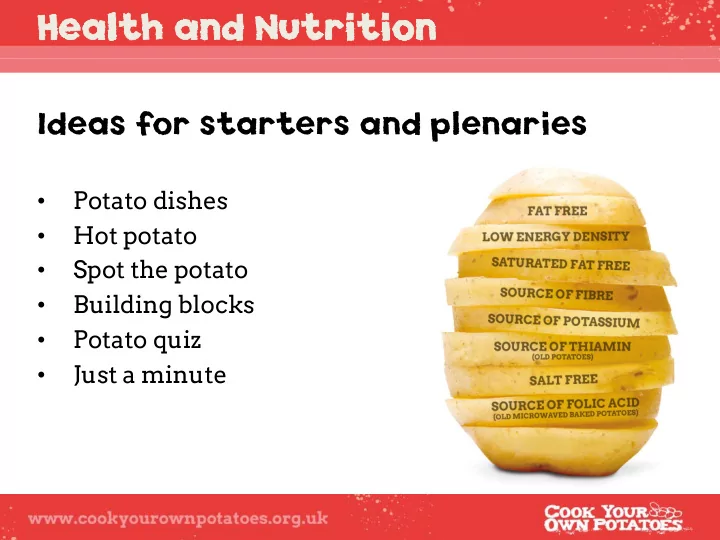
Potatoes contain: ü Carbohydrates ü Protein ü Fibre X No Fat X No Salt X No Sugar ü Potassium ü Folate ü Thiamin (Vitamin B1) ü Magnesium ü Vitamin B6 ü Vitamin C ü Iron

  • Sliced potato image

Building bloc Building blocks: INFORMA ks: INFORMATION TION

slide-8
SLIDE 8

Potato Quiz Potat ato Quiz

  • Quiz

1) Potatoes belong to which food group?

A) Starchy foods B )Protein C) Fruit and vegetables D) Dairy 2) Potatoes contain high amounts of which of these vitamins? A C D E 3) In which part of the potato can the majority of its vitamins and minerals be found? A) The flesh B) The skin C) The eyes D) The centre 4) Which of the following nutrients are NOT found in potatoes? A) Carbohydrates B) Fat C) Protein D) Fibre 5) How does your body use carbohydrates? A) Strengthen bones B) Repair and growth C) InsulaGon D) Energy 6) Which of these techniques is NOT used for mashed potato? A) Mashing B) Boiling C) RoasGng D) Peeling 7) Which of the following cooking methods is healthiest? A) Chips B) Dauphinoise C) Roast potatoes D) Baked 8) Which type of potato is best for a diabeOc? A) Fluffy B) Salad C) Smooth 9) Which of these potato dishes is suitable for a vegetarian? A) CoJage pie B) Fishcakes C) Potato and spring onion cake D) Prawn potato salad 10) Which of these are common allergens? A) Celery B) Egg C) Fish D) Nuts

slide-9
SLIDE 9

Potato Quiz

1) Potatoes belong to which food group?

A) Starchy foods B )Protein C) Fruit and vegetables D) Dairy 2) Potatoes contain high amounts of which of these vitamins? A C D E 3) In which part of the potato can the majority of its vitamins and minerals be found? A) The flesh B) The skin C) The eyes D) The centre 4) Which of the following nutrients are NOT found in potatoes? A) Carbohydrates B) Fat C) Protein D) Fibre 5) How does your body use carbohydrates? A) Strengthen bones B) Repair and growth C) InsulaGon D) Energy 6) Which of these techniques is NOT used for mashed potato? A) Mashing B) Boiling C) RoasGng D) Peeling 7) Which of the following cooking methods is healthiest? A) Chips B) Dauphinoise C) Roast potatoes D) Baked 8) Which type of potato is best for a diabeOc? A) Fluffy B) Salad C) Smooth 9) Which of these potato dishes is suitable for a vegetarian? A) CoJage pie B) Fishcakes C) Potato and spring onion cake D) Prawn potato salad 10) Which of these are common allergens? THEY ALL ARE A) Celery B) Egg C) Fish D) Nuts

Potat ato Quiz: ANSWERS

  • Quiz: ANSWERS
slide-10
SLIDE 10

Learning Outcomes:

  • Recap on learnings of a particular lesson

Jus ust a Minut t a Minute e

  • Activity (Option 1)

– Ask students to write down what they have learnt in the lesson in one minute. – Then reduce this to five key words. – Then distill the lesson to one word. – Share the final word with the class.

  • Activity (Option 2)

– Each group to talk for one minute about the lesson – Choose a number and a letter so that (say) 3 words beginning with ‘s’ must be included in their talk.