HEALTH OF MIGRANTS for SOCIO-ECONOMIC DEVELOPMENT Dr Davide Mosca, - - PowerPoint PPT Presentation

health of migrants for socio economic development
SMART_READER_LITE
LIVE PREVIEW

HEALTH OF MIGRANTS for SOCIO-ECONOMIC DEVELOPMENT Dr Davide Mosca, - - PowerPoint PPT Presentation

Intersessional Workshop 25 March 2014 IOMs EXPERIENCE AND PROGRAMMING SOUTH-SOUTH MIGRATION: PARTNERING STRATEGICALLY FOR DEVELOPMENT HEALTH OF MIGRANTS for SOCIO-ECONOMIC DEVELOPMENT Dr Davide Mosca, Director-Migration Health


slide-1
SLIDE 1

SOUTH-SOUTH MIGRATION: PARTNERING STRATEGICALLY FOR DEVELOPMENT

HEALTH OF MIGRANTS for SOCIO-ECONOMIC DEVELOPMENT

Dr Davide Mosca, Director-Migration Health Division-IOM

Intersessional Workshop – 25 March 2014
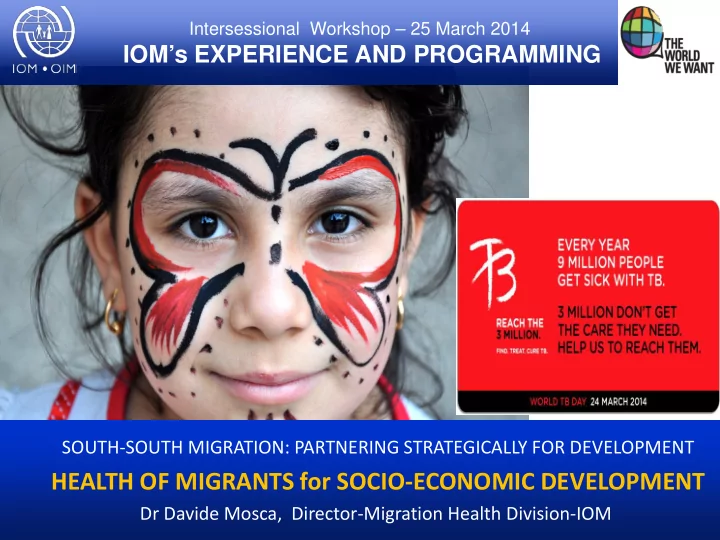
IOM’s EXPERIENCE AND PROGRAMMING

slide-2
SLIDE 2

1) Health of migrants 2) South-South migration and partnership: the case of TB in Southern Africa 3) Making migration work for development

slide-3
SLIDE 3

1) Health of migrants, bridging rights, public health, and development

slide-4
SLIDE 4

‘’ The wealth of poor people lies in their capabilities and their assets. Of these, health is the most important. Health allows poor people to work. A sick, weak and disabled body is a liability both to the person affected and to those who must support them. Thus, if health is an asset and ill health a liability, protecting and promoting health care is central to the entire process of poverty reduction and human development ’’

Zambia’s, Poverty Reduction Strategy Paper, 2002

slide-5
SLIDE 5
  • Conditions surrounding the migration

process can make migrants vulnerable > Need to address Social Determinants of Health

  • Inequalities in accessing health services

> Need to achieve Universal Health Coverage

  • Negative outcomes for migrants and

communities (i.e. health costs of migration) > on Individual health, Public Health, and Development

What the health and migration problem is?

  • Limited monitoring systems, limited knowledge,

limited inter-sector and inter-country debate, and collaboration limited share of good practices, > Research and evidence, dialogues, partneship,

slide-6
SLIDE 6

« Health and development are inextricably linked! »

  • Health is central to sustainable development : health is a beneficiary of

development, a contributor to development, and a key indicator of what people-centered right-based, inclusive, and equitable developement seeks to achieve

  • Health is important as an end in itself , and as an integral part of ‘human

well-being’, (which includes interrelated and interdependent material, psychological, social, cultural, educational, work, environmental, political, and security dimensions).

  • The achievement of health goals requires policy coherence and shared

solutions across multiple sectors: that is a ‘‘whole-of-government’’ or ‘‘health-in-all-policies’’ approaches

(Health in the post-2015 Agenda : Report of the Global Thematic Consultation on Health, April 2013)

slide-7
SLIDE 7

Challenges in promoting migrants’ health rights

National level: health of migrants not often safeguarded:

  • Migrants still seen as burden on health system and carriers of disease
  • ‘Generous’ social rights seen as a potential pull factor
  • Migrants too often remain invisible, marginalized and excluded
  • Lack of policy coherence, and multi-sectoral collaboration

International level: health of migrants absent in global debates:

  • Often absent in global health debates (SDH, NCD, Disease Controll programmes, etc.)
  • Often absent in debates on migration & development (HLD M&D, GFMD, GMG, etc.)
slide-8
SLIDE 8

Challenges II: Discrimination, exclusion, unethical treatment of migrant workers

  • Limitations to travel, work and reside

abroad based on medical ground (HIV, TB)

  • Pre-departure forced contraception;
  • Unethical medical screenings for

prospective migrant workers

  • Deportation of migrants with treatable

conditions and pregnant

  • Refusal of visa to dependents for

temporary labour migrants

  • Impact on families left behind
  • Often lack of equitable occupational

health and social protection

  • Evidence-based good practices exist.
  • Dialogue can help in advancing an

equity agenda for the benefit of all

slide-9
SLIDE 9

World Health Assembly Resolution on Health

  • f Migrants (WHA 61.17)(2008)

Calls upon Member States, i.a.:

  • “to promote equitable

access to health promotion and care for migrants”

  • “to promote bilateral and

multilateral cooperation on migrants’ health among countries involved in the whole migration process”

slide-10
SLIDE 10

Reduce excess mortality & morbidity Minimize negative health impacts of migration process

Migration Health Goals

Ensure migrants' health rights Avoid disparaties in health status & access

WHA Resolution 61.17: Public health and development approach to migrants’ health:

slide-11
SLIDE 11

WHO-IOM Operational Framework

  • n Health of Migrants (WHA 61.17)

Monitoring Migrant Health Partnerships, Networks and Multi country Frameworks Policy and Legal Frameworks Migrant-Sensitive Health Systems

Operational Framework on Migrants’ Health:

slide-12
SLIDE 12

IOM’s Health Programmatic Areas

Health Promotion & Assistance for Migrants Migration Health Assistance for Crisis Affected Populations Migration Health Assessment & Travel Health Assistance IOM conduct health assessments for various categories of migrants, including resettling refugees, immigrants, temporary migrants, labour migrants and displaced persons, either before departure or upon arrival

IOM assists crisis- affected populations, especially in natural

  • disasters. Assists

governments and host communities to strengthen and re- establish primary health care systems IOM promotes and advocates for migrant sensitive health systems and policies (focus especially on labour and irregular migrants and host communities). Provides technical assistance to enhancing capacities

slide-13
SLIDE 13

2) Focus on TB : find, treat and cure

slide-14
SLIDE 14

16

Focus on TB: facts

Global burden has stabilised, but very high in 2012:

  • 8.6 million people fell ill with TB (1.1 million

people living with HIV).

  • 1.3 million people died from TB
  • about 3 million people with TB were “missed”
  • Estimated 450 000 people developed MDR-TB

(est. 170,000 deaths)

  • The number diagnosed with MDR-TB nearly

doubled between 2011 and 2012

  • Less than 25% of those estimated to have MDR-

TB in 2012 were detected

slide-15
SLIDE 15

The case of Tuberculosis (TB)

Africa region: most severe burden of

TB per capita

– Highest rates of cases (10% of world population; 24% of the notified 5.8 M TB cases world-wide) – Highest number of death rates (40% of all global TB-deaths = 600,000 people died from TB in 2011- 64,000 children) – Highest rates TB/HIV co-infection (80% of TB cases in PLHA reside in Africa) – Only region not on track to achieve MDG-related TB target to halt and reverse TB epidemic by 2015 reducing TB mortality by 50%

If status quo prevails, more than 5 million people in Africa will die in the next decade from TB and TB/HIV.

slide-16
SLIDE 16

TB in the mines:

  • High HIV prevalence & vulnerability

among mineworkers (PLWHA estimated 30% of workforce > 20-30 times more likely to develop TB)

  • TB risk enhanced by exposure to silica

dust (particularly in gold mines)

  • Mining sector in Southern Africa has the

highest concentration of TB in the world (more than 3,000-7,000/100.000 population)

  • 33% of new cases of TB in sub-Saharan

Africa are consequences of mining

  • 30% of mine-workforce international

migrants; 60% internal migrants

  • Estimated cost : 880M USD/year

TB in the Mines

slide-17
SLIDE 17

South-South Migration, TB and partnership Southern Africa

“If TB and HIV are a snake in Southern Africa, the head of the snake is here in South Africa. People come from all over the Southern Africa development community to work in our mines and export TB and HIV, along with their earnings. If we want to kill the snake, we need to hit it on its head.”

19

  • Dr. Aaron Motsoaledi, Minister of Health
  • f South Africa
slide-18
SLIDE 18

Partnership on Health and Mobility in East and Southern Africa (PHAMESA)

– aims to improve health of labour migrants and communities in commercial, agriculture, mining, fisheries, transport sectors – research, strengthened health services, strengthened policies, increased coordination and collaboration of different partners within and across borders

The importance of multi-sectoral/ multi- country dialogue and partnerships

slide-19
SLIDE 19
  • Funded by Sida, US Govt, Netherlands since 2003
  • Multi-year partnership aimed at strengthening capacity of partners (Govt, non-

govt, CSOs) in ESA region to address migration–related health challenges

  • For example: IOM provides technical and financial support to:

 Develop the “SADC Declaration on TB and mines” (adopted by Heads of States in Aug 2012) by facilitating dialogue of key stakeholders within and between countries  Implement key research such as ‘financing migrant’s health’  Facilitate south-south exchange of information and good practices on migrants health  Improve TB case detection among mobile and migrant populations (TB- Reach, i.e. border Zimbabwe with Botswana and RSA)  Strengthened partnerships with WHO, Stop TB Partnership, WB, Global Fund to fight AIDS, TB and Malaria, SADC, MOHs, CSOs

slide-20
SLIDE 20

TB in the Mines

SADC TB in the Mining Industry Initiative

  • Declaration on TB in the Mining Sector

adopted by Heads of State (2012)

– culmination of regional and multi-sectoral collaboration facilitated by IOM and partners (health, labour, minerals and energy, employers, employees, civil society, academia, UN agencies, IOM.) – outlines priority areas for urgent action; recognizes vulnerability of migrants and communities – recognized key role of employers to manage

  • ccupational TB, including TB associated with

silicosis post-employment and organizations of employees – Commits to zero new infections, zero stigma and discrimination, and zero deaths resulting from TB, HIV, silicosis and other occupational health

slide-21
SLIDE 21

3) Making Migration work for development: key issues

slide-22
SLIDE 22

Linking ‘migration health’ and ‘migration and development’

Manage migration in crisis situations Protect the human rights of all migrants

Factor Migration into development planning

Promote policy coherence and institutional development

Enhance evidence building and knowledge-based policy-making on migration

Improve public perceptions

  • f migrants

Migrants’ health and well-being

Enhanced access to health Social Determiants of Health of migrants are addressed

slide-23
SLIDE 23

 Implement the WHA Resolution 61.17 and its action framework (Madrid 2010)  Maintain the health of migrants in global migration and development debates  Address discriminatory practices  Produce evidence and share good practices  Enhance advocacy  Include migrant-health indicators in the post-2015 development framework  Forge a large partnership cross- sector and cross-countries

Way Forward

slide-24
SLIDE 24

Migration Health Division

slide-25
SLIDE 25

Healthy Migrants in Healthy Communities! www.iom.int

Thank you