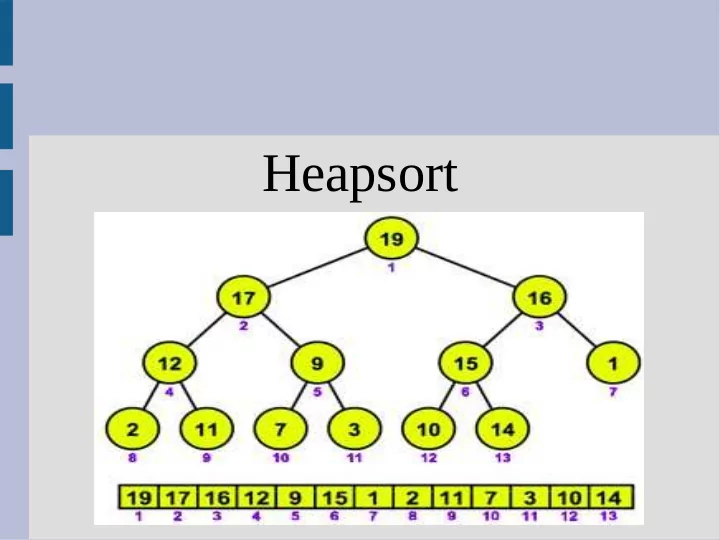
SLIDE 1
Heapsort
SLIDE 2
Build-Max-Heap
Next we build a full heap from an unsorted sequence Build-Max-Heap(A) for i = floor( A.length/2 ) to 1 Max-Heapify(A, i)
SLIDE 3
Build-Max-Heap
Red part is already Heapified
SLIDE 4
Build-Max-Heap
Correctness: Base: Each alone leaf is a max-heap Step: if A[i] to A[n] are in a heap, then Heapify(A, i-1) will make i-1 a heap as well Termination: loop ends at i=1, which is the root (so all heap)
SLIDE 5
Build-Max-Heap
Runtime?
SLIDE 6
Build-Max-Heap
Runtime? O(n lg n) is obvious, but we can get a better bound... Show ceiling(n/2h+1) nodes at any level 'h', with h=0 as bottom
SLIDE 7
Build-Max-Heap
Heapify from height 'h' takes O(h)
SLIDE 8
Heapsort
Heapsort(A): Build-Max-Heap(A) for i = A.length to 2 Swap A[ 1 ], A[ i ] A.heapsize = A.heapsize – 1 Max-Heapify(A, 1)
SLIDE 9
Heapsort
You try it! Sort: A = [1, 6, 8, 4, 7, 3, 4]
SLIDE 10
Heapsort
First, build the heap starting here A = [1, 6, 8, 4, 7, 3, 4] A = [1, 6, 8, 4, 7, 3, 4] A = [1, 7, 8, 4, 6, 3, 4] A = [8, 7, 1, 4, 6, 3, 4] - recursive A = [8, 7, 4, 4, 6, 3, 1] - done
SLIDE 11
Heapsort
Move first to end, then re-heapify A = [8, 7, 4, 4, 6, 3, 1], move end A = [1, 7, 4, 4, 6, 3, 8], heapify A = [7, 1, 4, 4, 6, 3, 8], rec. heap A = [7, 6, 4, 4, 1, 3, 8], move end A = [3, 6, 4, 4, 1, 7, 8], heapify A = [6, 3, 4, 4, 1, 7, 8], rec. heap A = [6, 4, 4, 3, 1, 7, 8], next slide..
SLIDE 12
Heapsort
A = [6, 4, 4, 3, 1, 7, 8], move end A = [1, 4, 4, 3, 6, 7, 8], heapify A = [4, 4, 1, 3, 6, 7, 8], move end A = [3, 4, 1, 4, 6, 7, 8], heapify A = [4, 3, 1, 4, 6, 7, 8], move end A = [1, 3, 4, 4, 6, 7, 8], heapify A = [3, 1, 4, 4, 6, 7, 8], move end A = [1, 3, 4, 4, 6, 7, 8], done
SLIDE 13
Heapsort
SLIDE 14
Heapsort
Runtime?
SLIDE 15
Heapsort
Runtime? Run Max-Heapify O(n) times So... O(n lg n)
SLIDE 16
Priority queues
Heaps can also be used to implement priority queues (i.e. airplane boarding lines) Operations supported are: Insert, Maximum, Extract-Max and Increase-key
SLIDE 17
Priority queues
Maximum(A): return A[ 1 ] Extract-Max(A): max = A[1] A[1] = A.heapsize A.heapsize = A.heapsize – 1 Max-Heapify(A, 1), return max
SLIDE 18
Priority queues
Increase-key(A, i, key): A[ i ] = key while ( i>1 and A [floor(i/2)] < A[i]) swap A[ i ], A [floor(i/2)] i = floor(i/2) Opposite of Max-Heapify... move high keys up instead of low down
SLIDE 19
Priority queues
Insert(A, key): A.heapsize = A.heapsize + 1 A [ A.heapsize] = -∞ Increase-key(A, A.heapsize, key)
SLIDE 20
Priority queues
Runtime? Maximum = Extract-Max = Increase-Key = Insert =
SLIDE 21
Priority queues
Runtime? Maximum = O(1) Extract-Max = O(lg n) Increase-Key = O(lg n) Insert = O(lg n)
SLIDE 22
Sorting comparisons:
Name Average Worst-case Insertion[s,i] O(n2) O(n2) Merge[s,p] O(n lg n) O(n lg n) Heap[i] O(n lg n) O(n lg n) Quick[p] O(n lg n) O(n2) Counting[s] O(n + k) O(n + k) Radix[s] O(d(n+k)) O(d(n+k)) Bucket[s,p] O(n) O(n2)
s=stable, p=parallelizable, i=in-place
SLIDE 23
Sorting comparisons:
https://www.youtube.com/watch?v=kPRA0W1kECg