Heart and Kidney Interactions: what are the challenges for - - PowerPoint PPT Presentation

heart and kidney interactions what are the
SMART_READER_LITE
LIVE PREVIEW

Heart and Kidney Interactions: what are the challenges for - - PowerPoint PPT Presentation

Heart and Kidney Interactions: what are the challenges for prevention and progression Christoph Wanner, Wrzburg, Germany Wrzburg Daniel Meisner Heart & 1586-1626 Kidney interactions: What are the England challenges Thomas


slide-1
SLIDE 1

Heart and Kidney Interactions: what are the challenges for prevention and progression

Heart & Kidney interactions: What are the challenges for prevention and protection?

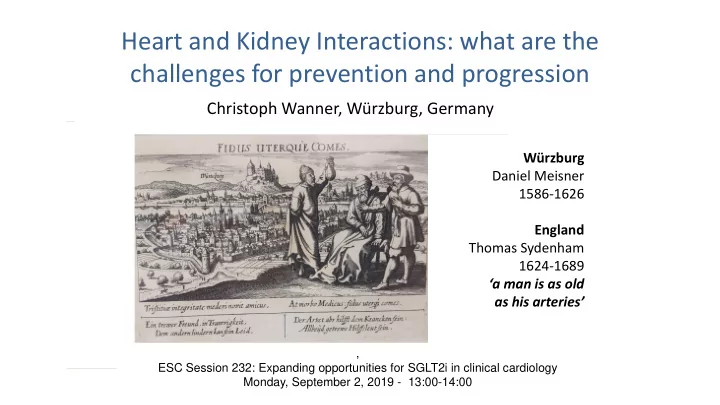
Würzburg Daniel Meisner 1586-1626 England Thomas Sydenham 1624-1689 ‘a man is as old as his arteries’

, ESC Session 232: Expanding opportunities for SGLT2i in clinical cardiology Monday, September 2, 2019 - 13:00-14:00

Christoph Wanner, Würzburg, Germany

slide-2
SLIDE 2

EBAC Disclosures

  • C. Wanner

I. Institution grants: Boehringer-Ingelheim (BI) II. Speaker honoraria: AstraZ, Bayer, BI, Lilly, MSD, Sanofi

  • III. Advisory Board:

Bayer, BI, MSD

  • IV. Shares/stock:

None

slide-3
SLIDE 3

Water Salt Glucose

Cardio-Renal Syndrome

HF and CKD Chronic Kidney Disease Cardio Kidney Diabetes

slide-4
SLIDE 4

~ 40-50% of all HF patients have concomitant CKD

EJHF 2014;16:103-11

~ 40-50% of all CKD patients have HF*

PLoS One 2015;10:e0131034 *T2DM CKD patients have a preponderance for HeFpEF

Of all the common diseases, CKD imposes the most dramatic divergence between biological age and chronological age Declining renal function, independent of a patient’s age, is the main driver

  • f cardiovascular ageing

…. underlying pathophysiologic pathways, originating in the kidney and involving the cardiac and vascular system, are dominated by progressive fibrosis and degeneration, associated with altered telomerase activity ….

Facts & Challenges

Wanner et al, Lancet 2016;388:276-288, Review

slide-5
SLIDE 5

Resistance to diuretics in CKD and HF (altered dose response curve) A recent shift in thought process regarding the interplay of cardiac and renal dysfunction suggest that renal congestion may be the primary driver of worsening renal function Once discharged after acute decompensated HF it is advisable to transition the patients into an outpatient dcompression clinic for further Decongestive therapy and follow-up

Challenges

slide-6
SLIDE 6

6

Packer et al, Lancet Diabetes Endocrinol 2018;6:547-554

Renal function in T2D patients in the PARADIGM-HF trial

HFrEF <40/35%, symptomatic

Change in eGFR (ml/min/1.73m2)

slide-7
SLIDE 7

Wanner et al, JASN 2018;29:2755-2769

EMPA-REG Outcome: Long-term – chronic - eGFR slope

week 4 to last value on treatment

slide-8
SLIDE 8

EMPA-REG Outcome: eGFR over 3 years

Wanner et al, NEJM 2016; 375:323-334

4 W after stop

slide-9
SLIDE 9

EMPA-REG Outcome: Kidney outcomes by baseline HF

Butler J et al, in press 2019

slide-10
SLIDE 10

Effects of Empagliflozin vs placebo on %HbA1c, by eGFR

10

Cherney et al. Kidney International 2018; 93: 231-244

10

  • 1.0%
  • 0.5%

+0.5% Number of measurements Empagliflozin Placebo %HbA1c difference (95% CI) p value for interaction

%HbA1c

eGFR (mL/min/1.73m2) ≥90 348 343

  • 0.84 (-0.95, -0.72)

<0.001 ≥60 to <90 518 516

  • 0.60 (-0.70, -0.51)

≥30 to <60 234 239

  • 0.38 (-0.52, -0.24)

<30 42 46

  • 0.04 (-0.37, 0.29)
slide-11
SLIDE 11

Kidney function over time by baseline HF

Butler J et al, in press 2019

slide-12
SLIDE 12

Renal MOA +/- Diabetes: Increased renal sodium reabsorption

SGLT2

Loop of Henle Blockade of SGLT2

Afferent arteriole Efferent arteriole

RAAS SNS Renal sodium reabsorption

v

Glomerular pressure

Key drivers for RAAS and SNS activation

  • 2. Obesity
  • 3. Hypertension
  • 4. Heart failure
  • 5. Diabetes

Activation Increase

Renal sodium reabsorption

v

Glomerular pressure

  • 1. CKD

Adapted from: Cherney D et al. Circulation 2014;129:587

slide-13
SLIDE 13

Where to go from here ?

Zoccali & Mallamaci, CJASN 2018;13:1432-1434

  • Managing volume overload in CKD by chronically restrict dietary

sodium (no sustained success), but should include a “personal salt manager” (point of care technology) even in asymptomatic lung congestion!?

  • Use technology i.e. diagnostic measures such as bioimpedance

spectroscopy, lung ultrasound to manage hypervolemia

  • We need more data in CKD & HF: trial design with a composite of

MACE and MAKE (Major Adverse Kidney Event) ?

  • ‘New’ endpoints, such as HHF, eGFR slopes (and albuminuria)!?

Parfrey et al, CJASN 2016;11:539-46

slide-14
SLIDE 14

GFR >90 ml/min GFR >135 ml/min Hyperfiltration GFR <60 ml/min GFR <30 ml/min

Normal Glomerular Hypertension CKD Stage 3 CKD Stage 4

Glomerular Hypertension & Single Nephron Hyperfiltration

slide-15
SLIDE 15

CV death

Kidney disease progression

„Hard“ kidney endpoints

ESKD defined as:

  • Initiation of chronic dialysis
  • Kidney transplant

Renal death*

Surrogate kidney endpoints

Kidney function loss defined as:

  • Sustained ≥40% eGFR decline
  • Sustained kidney failure

(i.e. eGFR <10ml/min/1.73m2)

Primary cardio-renal composite outcome

more non-diabetic kidney disease than DKD ! ?

Herrington et al, CKJ 2018;11:749-761

slide-16
SLIDE 16

16

Wanner & Brenner, NRN 2019;15:459-460

slide-17
SLIDE 17

17

Glucose Salt Water

Thank you

”This is not the end. It is not even the beginning of the end. But it is, perhaps, the end of the beginning” Winston Churchill 1942

slide-18
SLIDE 18

Wanner C, Marx N 2018, Diabetologia

DOI 10.1007/s00125-018-4678-z