high N , steady-state scenarios 5 W.W. (Bill) Heidbrink 1 - - PowerPoint PPT Presentation

high n steady state scenarios
SMART_READER_LITE
LIVE PREVIEW

high N , steady-state scenarios 5 W.W. (Bill) Heidbrink 1 - - PowerPoint PPT Presentation

Alfvn eigenmodes (AE) degrade fast-ion confinement in high N , steady-state scenarios 5 W.W. (Bill) Heidbrink 1 Amplitude with J. Ferron, 2 C. Holcomb, 3 M. Van Zeeland 2 , E. Bass 4 , X. Chen 2 , C. Collins 1 , A. Garofalo 2 , X. Gong 5 ,


slide-1
SLIDE 1

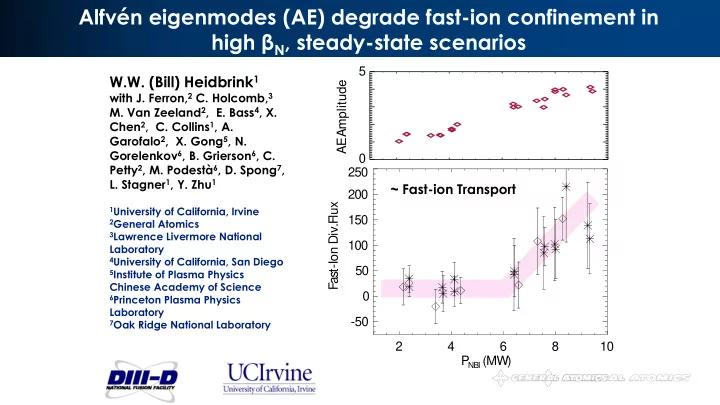
Alfvén eigenmodes (AE) degrade fast-ion confinement in high βN, steady-state scenarios

W.W. (Bill) Heidbrink1

with J. Ferron,2 C. Holcomb,3

  • M. Van Zeeland2, E. Bass4, X.

Chen2, C. Collins1, A. Garofalo2, X. Gong5, N. Gorelenkov6, B. Grierson6, C. Petty2, M. Podestà6, D. Spong7,

  • L. Stagner1, Y. Zhu1

1University of California, Irvine 2General Atomics 3Lawrence Livermore National

Laboratory

4University of California, San Diego 5Institute of Plasma Physics

Chinese Academy of Science

6Princeton Plasma Physics

Laboratory

7Oak Ridge National Laboratory

2 4 6 8 10 P

NBI (MW)

  • 50

50 100 150 200 250 Fast-Ion Div.Flux AE Amplitude 5

~ Fast-ion Transport

slide-2
SLIDE 2

Steady-state Advanced Tokamak (AT) scenarios

  • ften have elevated values of safety factor q

1) Poli, NF 54 (2014) 2) Garofalo, NF 54 (2014) 3) Kessel, FED 80 (2006) J.M. Park, APS (2013)

  • Projections predict a stable

βN=5 steady-state scenario in DIII-D with increased ECCD and off-axis NBI

slide-3
SLIDE 3

Ferron, PoP 20 (2013) 092504

Many DIII-D discharges with qmin>2 have poor global confinement Is degraded fast- ion confinement the culprit?

qmin (2.7 <

N < 3.9, 4.5 < q95 < 6.8)

Typical H- mode level H89 =

E 89

1.0 1.5 2.0 2.5 2.6 2.4 2.2 2.0 1.8 1.6

Uses Thermal + Fast Ion Stored Energy

slide-4
SLIDE 4

Outline

  • 1. AEs degrade fast-ion confinement in many

steady-state scenario discharges

  • 2. Degradation of fast-ion confinement can

account for the overall degradation in global confinement

  • 3. Physical mechanism of fast-ion transport:

critical gradient behavior due to many wave- particle resonances

  • 4. Outlook
slide-5
SLIDE 5

Use TRANSP to quantify the degradation in fast-ion signals

  • Use spatially uniform

ad hoc fast-ion diffusion Df in TRANSP as an empirical measure of degraded fast-ion confinement

  • Alternatively, use

ratio of signal to “classical” prediction

  • Global confinement

varies with fast-ion confinement

0.0 0.4 0.8 1.2

1 2 3 2 3 4 5 6

1.2 1.6 2.0 2.4

0.33 0.67 1.0

NE UTR ONS (1015n/s) S

ignal /C lassical

TIME (s)

#154406

C

lassical P rediction

Measured S

ignal

Variable Df P rediction Variable Df (m2/s) G

lobal C

  • nfinement “H89”

(b) (c)

slide-6
SLIDE 6

The qmin~2 discharge has more AEs and worse confinement than the qmin~1 discharge

slide-7
SLIDE 7

Many Alfvén Eigenmodes are Observed & Expected

0.2 0.4 0.6 0.8 1.0 MINOR R ADIUS

#152932 @ 2.962 s

(a) 113 k Hz (b) 137 kHz (c) 153 kHz

2 4 6 8 10 5 10 15 20 2 4 6 8 10

Amp (eV) Amp (eV) Amp (eV)

Measured Simultaneous Modes Calculated Unstable TAE Typical toroidal mode numbers: 2-5

(ECE)

GYRO

slide-8
SLIDE 8

qmin~1 data agree with predicted fast-ion signals

Ratio of signal to calculated predictions Classical Neutrons 89% Wf ast 100%

FIDA (1016ph/s-sr-m2)

180 200 220

MAJORR ADIUS (cm)

qmin ~ 1

1.0 2.0

Classical

slide-9
SLIDE 9

qmin~1 data agree with predicted fast-ion signals but qmin~2 data do not

Ratio of signal to calculated predictions Classical Classical Neutrons 89% 61% Wf ast 100% 72%

FIDA (1016ph/s-sr-m2)

180 200 220

MAJORR ADIUS (cm)

qmin ~ 1 qmin ~ 2

1.0 2.0

*

slide-10
SLIDE 10

Assuming fast-ion diffusion of 1.3 m2/s gives approximate agreement with qmin~2 data Ratio of signal to calculated predictions Classical Classical Df Neutrons 89% 61% 91% Wf ast 100% 72% 108% *

slide-11
SLIDE 11

Degraded fast-ion signals correlate with increasing Alfvén eigenmode activity

  • Every diagnostic that is

sensitive to co-passing fast ions measures reductions

  • The “AE Amplitude” is

the average amplitude of coherent modes in the TAE band (from interferometer signals)

  • Data from quasi-

stationary portion of steady-state scenario discharges

slide-12
SLIDE 12

Outline

  • 1. AEs degrade fast-ion confinement in steady-

state scenario discharges

  • 2. Degradation of fast-ion confinement can

account for the overall degradation in global confinement

  • 3. Physical mechanism of fast-ion transport:

critical gradient behavior due to many wave- particle resonances

  • 4. Outlook
slide-13
SLIDE 13
  • Compare two

matched discharges: qmin ~ 1 & qmin ~ 2

1.0 1.5 2.0 2.5 3.0 1.2 1.4 1.6 1.8 2.0 2.2 2.4 2.6

qmin

H89 C

  • nfinement F

actor

qmin~1 qmin~2

Enhanced fast-ion transport can explain the apparent reduction in thermal confinement at high qmin

slide-14
SLIDE 14
  • Compare

power balance in qmin ~ 2 shot: Classical vs. Df=1.3 m2/s

  • Reduced fast-

ion stored energy

  • Less power

delivered to thermal plasma

1.0 1.5 2.0 2.5 3.0 1.2 1.4 1.6 1.8 2.0 2.2 2.4 2.6

qmin

H89 C

  • nfinement F

actor

AE E ffect qmin~1 qmin~2

 Thermal diffusivities like qmin ~1 discharge

Enhanced fast-ion transport can explain the apparent reduction in thermal confinement at high qmin

slide-15
SLIDE 15

Outline

  • 1. AEs degrade fast-ion confinement in many

steady-state scenario discharges

  • 2. Degradation of fast-ion confinement can

account for the overall degradation in global confinement

  • 3. Physical mechanism of fast-ion transport:

critical gradient behavior due to many wave- particle resonances

  • 4. Outlook
slide-16
SLIDE 16

Different combinations of on-axis & off-axis beams vary the fast-ion gradient that drives AEs

On-axis injection

Use L-mode plasma in current ramp:

  • Low AE threshold
  • Well diagnosed

0.2 0.4 0.6 0.8 0.0 1 2 3 4 5

F AS T-ION DE NS I TY (1012 cm-3) NOR MALIZE D MINORR ADIUS

Beam Mix=0.0 0.22 0.45 0.72 1.0

#146102 @ 550 ms

CLAS S ICAL BE AM PR OFILE S

(On-axis) (Off-axis)

slide-17
SLIDE 17

As predicted by linear AE stability theory, a steeper gradient drives more AE activity

  • Growth rate from

TAEFL gyrofluid code

  • GYRO gyrokinetic

code gives similar results

0.0 0.2 0.4 0.6 0.8 1.0 0.0 0.5 1.0 1.5 2.0 0.0 0.5 1.0

BE AM MIX

On axis Off axis

AEAmplitude n=2 Growth rate n=3 Growth rate

0.2 0.4 0.6 0.8 0.0 1 2 3 4 5

F AS T-ION DE NS I TY (1012 cm-3) NOR MALIZE D MINORR ADIUS

Beam Mix=0.0 0.22 0.45 0.72 1.0

#146102 @ 550 ms

CLAS S ICAL BE AM PR OFILE S

slide-18
SLIDE 18

Stronger AE activity causes a larger fast-ion deficit

  • The measured

neutron rate approaches the classical prediction for off- axis injection

0.0 0.2 0.4 0.6 0.8 1.0 0.0 0.5 1.0 1.5 2.0 0.0 0.5 1.0

BE AM MIX

On axis Off axis

AEAmplitude Neutron/Classical

0.2 0.4 0.6 0.8 0.0 1 2 3 4 5

F AS T-ION DE NS I TY (1012 cm-3) NOR MALIZE D MINORR ADIUS

Beam Mix=0.0 0.22 0.45 0.72 1.0

#146102 @ 550 ms

CLAS S ICAL BE AM PR OFILE S

slide-19
SLIDE 19

The measured fast-ion profile is nearly the same for all angles of injection!

  • Suggests the fast-ion

transport is “stiff”

  • The linear stability

threshold acts (approximately) as a “critical gradient”

1 2 3 FIDA Density Beam mix = 0.0 0.45 0.72 1.0 1.7 1.8 1.9 2.0 2.1 2.2 Major R adius (m)

Of course, in quiet plasmas, the profiles differ.

0.2 0.4 0.6 0.8 0.0 1 2 3 4 5

F AS T-ION DE NS I TY (1012 cm-3) NOR MALIZE D MINORR ADIUS

Beam Mix=0.0 0.22 0.45 0.72 1.0

#146102 @ 550 ms

CLAS S ICAL BE AM PR OFILE S

slide-20
SLIDE 20

A critical gradient model* reproduces the

  • bserved trend

0.0 0.2 0.4 0.6 0.8 1.0 0.4 0.5 0.6 0.7 0.8

BE AM MIX NOR MALIZE D NE UTR ONR ATE E xperiment Theory

*Ghantous, Phys. Pl. 19 (2012) 092511. Gorelenkov TH/P1-2

0.2 0.4 0.6 0.8 0.0 1 2 3 4 5

F AS T-ION DE NS I TY (1012 cm-3) NOR MALIZE D MINORR ADIUS

Beam Mix=0.0 0.22 0.45 0.72 1.0

#146102 @ 550 ms

CLAS S ICAL BE AM PR OFILE S

On-axis Off-axis

slide-21
SLIDE 21

Recent Data Supports Critical Gradient Model of Alfven Eigenmode (AE) Induced Fast Ion Transport

  • Beam power scan varies AE

amplitude

  • Modulated off-axis beam allows

measurement of incremental fast- ion flux

  • Local fast-ion density ceases to rise

above certain input power/ AE amplitudes

– SSNPA Neutral particle analyzer -> fast- ion density localized in phase space

AE Power (a.u.) SSNPA ~ Fast-ion Density

PNBI-mod

slide-22
SLIDE 22

Above threshold, the modulated signal is strongly distorted by AE transport

  • Conditionally average the

modulated signal

  • At low power, the signal agrees

well with a classical model

  • Classically, the amplitude of the

modulated signal should increase at high power

10 20 30 40 50

  • 0.05

0.00 0.05

2.1 MW(T

  • tal P
  • wer)

9.3 MW

Classical TIME (ms) Modulated S ignal (a.u.) PNBI-mod

slide-23
SLIDE 23

Infer the fast-ion transport from a continuity equation for the measured “density”

  • When the AEs are absent, the transport

term is negligible  measure source in a low-power shot

  • With AEs, use the measured n to infer

the divergence of the fast-ion flux

  • Linearize. Obtain a continuity equation

for 1st order (modulated) quantities

Distribution Function Weight Function “Flux”

  • Define a “density” that incorporates the

phase-space sensitivity W in its definition

slide-24
SLIDE 24

Divergence of fast-ion flux abruptly increases above an AE threshold  critical gradient behavior

2 4 6 8 10 P

NBI (MW)

  • 50

50 100 150 200 250 Fast-Ion Div.Flux AE Amplitude 5

AE Power (a.u.) SSNPA ~ Fast-ion Density

slide-25
SLIDE 25

Many small-amplitude resonances  “stiff” transport

  • Use

constants-

  • f-motion to

describe complex Energetic Particle

  • rbits
  • 1.5
  • 1.0
  • 0.5

0.0 0.5 0.0 0.5 1.0 1.5

Toroidal Canonical Angular Momentum (P

f / Ywall)

Magnetic Moment (m*B/E

)

COUNT PAS S ING COUNT PAS S ING CO-PAS S ING CO-PAS S ING LOS T(LOS T) TR APPE D

slide-26
SLIDE 26

Many small-amplitude resonances  “stiff” transport

  • Injected

beams populate the co-passing & trapped portions of phase space

slide-27
SLIDE 27

Many small-amplitude resonances  “stiff” transport

  • Use measured

modes to compute orbits that satisfy a resonance condition

  • Many

resonances cause stochastic

  • verlap in phase

space* *White, PPCF 52 (2010) 045012

slide-28
SLIDE 28

The high qmin steady-state scenario plasmas also have many resonances

qmin ~ 2 qmin ~ 1 Resonance Deposition

slide-29
SLIDE 29

Outline

  • 1. AEs degrade fast-ion confinement in many

steady-state scenario discharges

  • 2. Degradation of fast-ion confinement can

account for the overall degradation in global confinement

  • 3. Physical mechanism of fast-ion transport:

critical gradient behavior due to many wave- particle resonances

  • 4. Outlook
slide-30
SLIDE 30

New strategies are needed to overcome critical gradient behavior

Above AE stability threshold, additional

  • n-axis beam power is ineffective
  • More off-axis beam power (broader beam profile)
  • Nucl. Fusion 53 (2013) 093006
  • Better thermal confinement (less auxiliary power for

same βN) PPC/P2-31, EX/P2-39

  • Replace beam-driven current with RF TH/P2-38
  • Modify AE stability Nucl. Fusion 49 (2009) 065003
slide-31
SLIDE 31

Conclusions

  • 1. AEs degrade fast-ion confinement in many

steady-state scenario discharges

  • 2. Degradation of fast-ion confinement can

account for the overall degradation in global confinement

  • 3. Physical mechanism of fast-ion transport:

critical gradient behavior due to many wave- particle resonances

slide-32
SLIDE 32

Backup Slides

slide-33
SLIDE 33

Implications for ITER

  • ITER steady-state scenario is predicted to have unstable AEs
  • Multiple modes with many resonances are likely  critical

gradient fast-ion transport regime

  • Not strongly driven past threshold
  • Critical gradient calculation predicts modest effect
slide-34
SLIDE 34

High βN, high qmin discharges with good fast-ion confinement are observed

Transport barrier near r=0.7

0.0 0.4 0.8 1.2

2 3 4 5 6

1.2 1.6 2.0 2.4

NE UTR ONS (1015n/s) TIME (s)

#154406

C

lassical

S

ignal

G

lobal C

  • nfinement “H89”
  • Less Beam Power
  • Higher Density

 Weaker AE Drive