High-Precision Measurements of g A and g V in Neutron and Nuclear - - - PowerPoint PPT Presentation

high precision measurements of g a and g v in neutron and
SMART_READER_LITE
LIVE PREVIEW

High-Precision Measurements of g A and g V in Neutron and Nuclear - - - PowerPoint PPT Presentation

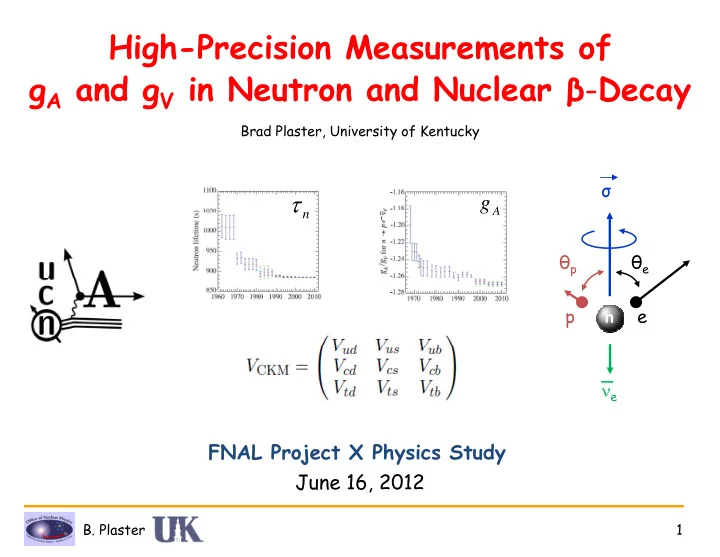
High-Precision Measurements of g A and g V in Neutron and Nuclear - Decay d d l Brad Plaster, University of Kentucky g g A A n p e p e n e FNAL Project X Physics Study June 16 2012 June 16, 2012 B. Plaster


slide-1
SLIDE 1

High-Precision Measurements of d d l

Brad Plaster, University of Kentucky

gA and gV in Neutron and Nuclear β-Decay

σ

A

g

θe θp

n

A

g

n e p e

FNAL Project X Physics Study June 16 2012

  • B. Plaster

1

June 16, 2012

slide-2
SLIDE 2

Neutron β-decay form factors

u W― d e― W

e

gV = gV(0) = 1 (0) gP negligible SCC Experiments probe : G G V [CVC] gA = gA(0) gWM(0) = κp – κn SCC gS, gT = 0 under G-parity

[but broken in SM by isospin-symmetry breaking]

GV = GF Vud gV GA = GF Vud gA [CVC]

  • B. Plaster

2

isospin symmetry breaking]

slide-3
SLIDE 3

Neutron β-decay observables

Lifetime :

  

RC 1 3 1 1

2 2 3 5 2

   f V m G

d e F

A A

g G   

  

RC 1 3 1 2

3

  f Vud

n

   

V V

g G

= 1 0390(4)

[Czarnecki et al. (2004)]

= 1.0390(4)

[Marciano and Sirlin (2006)]

Correlation coefficients :

[Jackson, Treiman, Wyld (1957)]

                               

      

E E p p D E p B E p A J J E m b E E p p a E E E p dE d d dW

e e e e n n e e e e e e e e e

       1 ) (

2

2 2

) 1 ( 3 1 1         a

A greatest

b, D sensitive

2 2

3 1 ) 1 ( 2 3 1 ) 1 ( 2              B A

[and most straightforward to measure]

A0 greatest sensitivity to 

T0 = 782 keV

, to beyond SM physics

[beyond recoil-order]

  • B. Plaster

3

3 1  

to measure] Tp ~ 750 eV Recoil-order terms : Holstein (1974) Harrington (1960) Gardner and Zhang (2001) Bhattacharya et al. (2012) Gudkov et al. (2006)

slide-4
SLIDE 4

Nuclear β-decay observables

Superallowed 0+ -> 0+ ft values : Experimental observables : half-life branching ratio branching ratio Q-value

) δ δ 1 )( δ 1 (

C NS R

     ft t F ) 1 ( 1 2 ln

2 2 2 5 3 V R ud V F e

V g G m    

CVC: gV = 1,

29 . /

2

   /

2

[Saxon-Woods]

CVC

  • B. Plaster

4

independent of medium

93 . /

2

  

[Hartree-Fock]

Hardy and Towner (2009) Towner and Hardy (2010)

CVC

slide-5
SLIDE 5

Vud from nuclear β-decay

Assuming CVC, gV = 1 : |Vud|2 = 0.94916 ± 0.00016 ± 0.00035 ± 0.00020 ± 0.00004

exp’t ∆R

V

δC, δNS δ’R

Experimental error below theoretical error Significant effort on testing validity of δC, δNS corrections

[e.g., Melconian (2011, 2012)] [ g , ( , )]

CKM unitarity satisfied at present, using gV = 1 nuclear β-decay Vud d V 0 9999 0 0004 0 0004 Experimentalist question to theorists : Are there and Vus : 0.9999 ± 0.0004 ± 0.0004 Experimentalist question to theorists : Are there prospects for reducing the error on ∆R

V ?

  • B. Plaster

5

Hardy and Towner (2009) Towner and Hardy (2010)

slide-6
SLIDE 6

Status of neutron β-decay: gA

Decay of polarized neutrons :         p p p p J m p p dW                                   

      

E E p p D E p B E p A J J E m b E E p p a E E E p dE d d dW

e e e e n n e e e e e e e e e

1 ) (

2

[Results for  from a and B not [ competitive at present]

/ 1 2 26(24)

0.2% determination

gA/gV = gA = –1.2726(24)

[from A0 values and one combined A0/B0 result included in PDG]

Error subject to large 2/ = 5.1

  • B. Plaster

6

g 

  • H. Abele et al. (2002)

R.W. Pattie et al. (2009)

  • J. Liu et al. (2010)
  • D. Mund et al. (2012)
slide-7
SLIDE 7

Status of neutron β-decay: τn

PDG A Pre-2011 : 2011 – : 885.7 ± 0.8 s 881 5 ± 1 5 s PDG Average

7 2 /

2

* 2011 : 881.5 ± 1.5 s

7 . 2 /

2

  

  

RC 1 3 1 1

2 2 5 2

   f V m G

e F

  

RC 1 3 1 2

3

   f Vud

n

   

Compare τn with gA treating 0+  0+ Vud as input

  • B. Plaster

7

ud

p

* New self-corrected result : Arzumanov et al., JETP Lett. 95, 224 (2012) : 881.6 ± 0.8 ± 1.9 s

slide-8
SLIDE 8

Experimental techniques for gA

PERKEO II: Cold Neutron Beam

Cold Neutron Beam

~50 μeV – 25 meV l i l

J  

glancing angles

High Statistics

B 8 1 B 8 1

e e n n

E p A J J  S:B ~ 8:1 S:B ~ 8:1

A P N N N N E A

e i i i i e

  cos ) (

meas

   

   

  • B. Plaster

8

  • H. Abele et al. (2002)
  • H. Abele (2008)
  • D. Mund et al. (2012)
slide-9
SLIDE 9

Experimental techniques for gA

UCNA: Stored Ultracold Neutrons (UCN) L

UCN storage  7 m/s  350 neV

Low Backgrounds

[esp. n-induced]

High Polarization S:B ~ 40:1

  • B. Plaster

9

R.W. Pattie et al. (2009)

  • J. Liu et al. (2010)
  • B. Plaster et al. (2012)
slide-10
SLIDE 10

Future neutron β-decay prospects

Current published precision on A0 : PERKEO II : 0.42% UCNA : 1.3% [later this summer: ~0.75%] Near-term projected precision : p j p PERKEO III : ~ 0.2% UCNA :  0.5% [data in hand] Precision on gA could approach ~0.05% in next several years PERC :  0 1% on A a Longer-term projected precision : y PERC :  0.1% on A, a Nab : 0.1% on a, 0.3% on b abBA : 0.1% on a, 0.08% on A

also aCORN, aSPECT, etc.

abBA 0.1% on a, 0.08% on A Neutron lifetime : Many world wide experiments aimed at  ±1 0 s precision

, ,

  • B. Plaster

10

Many world-wide experiments aimed at  ±1.0 s precision

slide-11
SLIDE 11

Future neutron β-decay prospects

Tests of CVC / Search for second-class currents in neutron β-decay

[Holstein (1974), Gardner and Zhang (2001)]

Recoil-order energy-dependence of the asymmetries (a, A)

) ( θ ) ( E A P E A  ) ( θ cos ) (

bin meas

E A P E A

n 

all 6 form factors

s

  • rder term

recoil ) (

0 

 A E A

CVC Hypothesis Test SCC Test A: best for 

examples

OR

CVC Hypothesis Test [assume SCC = 0] SCC Test [assume CVC] 0.1% on a : 2.5% on gWM ; δgT ~ 0 22/2

OR

  • B. Plaster

11

δgT 0.22/2

slide-12
SLIDE 12

Future neutron β-decay prospects

Extractions of gV*Vud in 0+  0+ nuclear β-decay limited by theoretical errors What will it take for neutron β-decay to challenge nuclear β-decay ? Need δA/A  0.11% Need δτn  0.4 s AND

  • B. Plaster

12

slide-13
SLIDE 13

Final notes

Also recent theoretical work on searches for new physics (S, T) in neutron β-decay: b, B. [Bhattacharya et al. (2012)] Apologies for lack of time to discuss this, as focus was on gA, gV. Comment : FNAL source of UCN for β-decay studies would be very interesting UCNA limited by statistics at present Max ~60 Hz of β-decay rate from ~2/cm3 in decay volume If could achieve, say, extracted UCN density of ~10/cm3 -> 300 Hz

A

7 . 2 

~500M counts for 0 1% statistics on A

A N A

A

7 . 2  

500M counts for 0.1% statistics on A @ 300 Hz -> ~20 days of 100% running

  • > ~0.025% on gA [Vud extraction]
  • B. Plaster

13

@ y f g

slide-14
SLIDE 14

UCNA Collaboration

H.O. Back, T.J. Bowles, L.J. Broussard, R. Carr, S. Clayton, S. Currie, B W Filippone A Garcia P Geltenbort S Hasan K P Hickerson J Hoagland B.W. Filippone, A. Garcia, P. Geltenbort, S. Hasan, K.P. Hickerson, J. Hoagland, G.E. Hogan, A.T. Holley, T.M. Ito, C.-Y. Liu, J. Liu, M. Makela, R.R. Mammei, J.W. Martin, D. Melconian, M.P. Mendenhall, C.L. Morris, R.W. Pattie, A Perez Galvan M L Pitt B Plaster J C Ramsey R Rios R Russell

  • A. Perez Galvan, M.L. Pitt, B. Plaster, J.C. Ramsey, R. Rios, R. Russell,
  • A. Saunders, S. Seestrom, W.E. Sondheim, E. Tatar, R.B. Vogelaar,
  • B. VornDick, C. Wrede, A.R. Young, B. Zeck
  • B. Plaster

14

slide-15
SLIDE 15

The End

  • B. Plaster

15

slide-16
SLIDE 16

Why measure A with UCN ?

Systematic Corrections [ % ] P l i ti / Polarization / Spin-Flip Backgrounds Others PERKEO I (1986) ILL (1997) 2.6 ~ 3 2 9 ~13

magnetic mirroring

~ 3

strong cos θ

ILL (1997) PNPI (1997) ~ 3 2.9 23 small ~3

 cos θ 

g variation

 cos θ 

PERKEO II (2002) 1.4 0.5 ~0.1

 cos θ 

UCNA (2008–2009) 0.0 0.015 ~0.5 – ~1.0

 cos θ 

  • B. Plaster

16 backscattering + cos θ

slide-17
SLIDE 17

Neutron lifetime experiments

In-Beam Technique Cold neutron beam

 / N N  

Cold neutron beam C nt N nd d p d t(s)

e.g.,, NIST Experiment Nico et al., PRC 71, 055502 (2005)

Count N0 and decay product(s) Detector efficiencies, volume !

Dewey et al., PRL 91, 152302 (2003)

Storage Technique Stored UCN: walls gravity B

 /

) (

t

e N t N

Stored UCN: walls, gravity, B Load then count “surviving” UCN

e.g., NIST Experiment

Load, then count surviving UCN Losses other than β-decay ! and/or decay products in “real time”

Ioffe Trap: Superposition of 2x solenoid with quadrupole Brome et al., PRC 63, 055502 (2001)

  • B. Plaster

17

β y

O’Shaughnessy et al., arXiv: 0903.5509

slide-18
SLIDE 18

Most recent lifetime result

trap

1 1 1  

trap

loss storage

  

measured extract must account

(absorption, upscattering)

measured extract must account for these t l t d extrapolated to zero loss

detector previous smallest t l ti 105 UCN from source

Serebrov et al PLB 605 72 (2005)

  • B. Plaster

18

extrapolation ~ 105 s

Serebrov et al., PLB 605, 72 (2005)

slide-19
SLIDE 19

Spin and Momentum Analysis

[ assuming the electron and anti neutrino are massless ]

  • B. Plaster

[ assuming the electron and anti-neutrino are massless ] From D. McKinsey Ph.D. Thesis, Harvard University (2002) 19

slide-20
SLIDE 20

Ultracold neutrons (UCN)

1980’s – … Neutron EDM searches performed with UCN Ki i E i 350 V S d 8 / Kinetic Energies  350 nano-eV Speeds  8 m/s

E Ψ R = 1 for E < V Energy, Ψ Ψ = eikx + Re-ikx ћ2k 2 R = 1 for E < VF

VFermi

x E = ћ kx 2m Ψ = Te-κx VFermi

L h ti

CN “ b l ”

335 neV 210 neV 123 V

58Ni

Fe T fl

Long coherence times Small E  v fields

  • B. Plaster

20

UCN “storage bottle”

123 neV Teflon

slide-21
SLIDE 21