Highgate BO 1448(43) Bridge 25 on TH 4 (Machia Road) over the - - PowerPoint PPT Presentation

highgate bo 1448 43
SMART_READER_LITE
LIVE PREVIEW

Highgate BO 1448(43) Bridge 25 on TH 4 (Machia Road) over the - - PowerPoint PPT Presentation

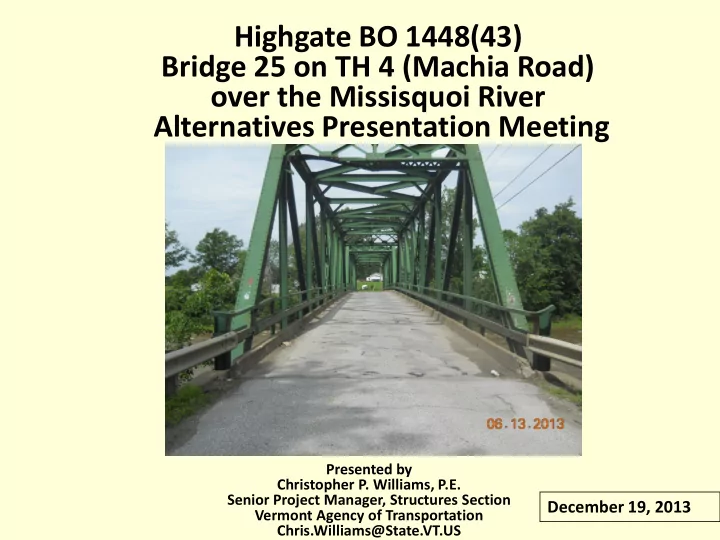
Highgate BO 1448(43) Bridge 25 on TH 4 (Machia Road) over the Missisquoi River Alternatives Presentation Meeting Presented by Christopher P. Williams, P.E. Senior Project Manager, Structures Section December 19, 2013 Vermont Agency of


slide-1
SLIDE 1

Highgate BO 1448(43) Bridge 25 on TH 4 (Machia Road)

  • ver the Missisquoi River

Alternatives Presentation Meeting

Presented by Christopher P. Williams, P.E. Senior Project Manager, Structures Section Vermont Agency of Transportation Chris.Williams@State.VT.US

December 19, 2013

slide-2
SLIDE 2

PROJECT LOCATION

slide-3
SLIDE 3

Meeting Outline

  • Purpose of the Meeting
  • Structures Section Re-organization
  • Existing bridge deficiencies
  • Alternatives considered
  • Summary and recommendation
  • Next Steps
slide-4
SLIDE 4

Purpose of Meeting

  • Present the alternatives that we have considered
  • Explain the constraints to the project
  • Help you understand our approach to the project
  • Provide you with the chance to ask questions
  • Provide you with the chance to voice concerns
  • Build consensus for the recommended alternative-
slide-5
SLIDE 5

Accelerated Bridge Program

  • Began in January 2012
  • Bridges are deteriorating faster than we can fix them
  • Short-term closures are key
  • Impacts to property owners and resources is minimized
  • Less impacts = less process = less money = faster delivery
  • Accelerated Bridge Construction (ABC) is very efficient
  • Accelerated Project Delivery is the result
  • Shift from individual projects to programmatic approach
  • Goal of 25% of projects into Accelerated Bridge Program
  • Goal of 2 year design phase for ABP (5 years conventional)
slide-6
SLIDE 6

Project Initiation & Innovation Team

  • Part of re-organization in January 2012
  • All Structures projects will begin in the PIIT
  • Very efficient process
  • Look for innovative solutions whenever possible
  • Involved until Project Scope is defined
  • Hand off to PM to continue Project Design phase
slide-7
SLIDE 7

Phases of Development

Project Definition Project Design Construction Project Funded Project Defined Contract Award

Identify resources & constraints Evaluate alternatives Public Participation Build Consensus

  • Quantify areas of

impact

  • Environmental

permits

  • Develop plans,

estimate and specifications

slide-8
SLIDE 8

Project Background

  • The structure is owned and maintained by the Town
  • Machia road is a class 2 local road
  • Funding will be 80 Federal funds
  • State/Local shares will be determined based on

alternative selected

  • Functionally labeled as a Rural local road
  • Posted Speed = 35 mph (Design Speed)
  • Existing bridge is a two span Thru Truss
  • Bridge length = 292 feet (2 equal spans @ 143 feet)
  • Bridge Width = 16 feet +/-
  • The bridge was built in 1928 (85 years old)
slide-9
SLIDE 9

Historic Considerations

  • The bridge is listed on or is eligible for the National

Register of Historic Places

  • The Historic Metal Truss Bridge Preservation plan in

1998 concluded that it is feasible and prudent to rehabilitate this bridge for limited highway use

  • If the bridge is rehabilitated, the Agency will offer the

Town a preservation easement to “…assist in preserving and maintaining the Bridge, its historic engineering and architectural features…and its value and significance to the people of Vermont.”

  • This agreement reduces the local share to $0
  • Provided that the town meets their obligations in the

agreement, and subject to availability of funds, the Agency also agrees to be responsible for all necessary rehabilitation and restoration costs as long as the bridge remains in highway use

slide-10
SLIDE 10

Traffic Data

“Current Year” 2016 “Design Year” 2036 Average Annual Daily Traffic 750 790 Design Hourly Volume 95 100 Average Daily Truck Traffic 30 45 %Trucks 4.4 6.1

slide-11
SLIDE 11

EXISTING BRIDGE DEFICIENCIES

Deficiencies

  • The bridge is structurally deficient and unable to carry design loads
  • The bridge is too narrow for the roadway classification and design speed
  • The bridge and approach railing are substandard
  • The vertical and horizontal alignments are substandard

Inspection Rating Information (Based on a scale of 9) Bridge Deck Rating 5 Fair Superstructure Rating 4 Poor Substructure Rating 4 Poor

Rating Definitions 9 Excellent 8 Very Good 7 Good 6 Satisfactory 5 Fair 4 Poor 3 Serious 2 Critical 1 Imminent Failure

slide-12
SLIDE 12

Looking east at Bridge approach

slide-13
SLIDE 13

Looking west on Bridge approach

slide-14
SLIDE 14

Looking west on bridge deck

slide-15
SLIDE 15

East Abutment showing signs of movement

slide-16
SLIDE 16

West Abutment showing undermining

slide-17
SLIDE 17

Layout Showing Constraints

Constraints present

  • Right of Way
  • Buildings
  • Historic Bridge
  • Archeological
  • Utilities –Overhead
slide-18
SLIDE 18

Alternatives Overview

  • Rehabilitation of truss – 20 year fix
  • Rehabilitation of truss – 40 year fix
  • Rehabilitation of truss – Widen truss
  • Rehabilitation of truss and add new bridge
  • Replacement on existing alignment (State Typical)
  • Replacement on new alignment (State Typical)
  • Replacement on new alignment (Town Typical)

Note: The method to maintain traffic during construction will be considered separately later in the presentation

slide-19
SLIDE 19

Rehabilitation of truss – 20 year fix

  • Maintain truss in existing location and configuration
  • Load capacity of HS-15 (27 tons) maximum
  • Replace east abutment
  • Patch/repair west abutment and pier
  • Patch or overlay existing deck
  • Replace damaged or deteriorated truss members
  • Clean and paint truss
  • Short term (20 year) solution
slide-20
SLIDE 20

Bridge Typical – Rehabilitations

slide-21
SLIDE 21

Layout – Rehabilitation (20 & 40 year fix)

slide-22
SLIDE 22

Profile – Rehabilitation (20 & 40 year fix)

slide-23
SLIDE 23

Rehabilitation of truss – 40 year fix

  • Same features as 20 year fix but add the following:
  • More extensive repairs to west abutment
  • More extensive truss member replacement
  • Replace deck and pier
  • Mid-term (40 year) solution
slide-24
SLIDE 24

Rehabilitation - Widen Truss

  • Similar to 40 year fix but add the following:
  • West abutment would remain but be extended
  • More truss member replacement
  • Entire floor system and deck would be replaced
  • Overhead members would be replaced or lengthened
  • Mid-term (40 year) solution
slide-25
SLIDE 25

Bridge Typical – Widen Truss

slide-26
SLIDE 26

Layout – Widen Truss

slide-27
SLIDE 27

Rehabilitation Truss + New Bridge

  • Similar to 40 year fix but add the following:
  • Construct new (13’ wide) bridge adjacent to truss
  • Mid-term (40 year) solution (based on existing truss)
slide-28
SLIDE 28

Bridge Typical – Rehab + New Bridge

slide-29
SLIDE 29

Layout – Rehab + Second Bridge

slide-30
SLIDE 30

Replacement on existing alignment (State Typical)

  • Construct new 2 span bridge 280’ long (2 spans @ 140’)
  • Conventional steel beams and concrete deck bridge type
  • 22 feet wide rail to rail (2’ shoulders, 9’ travel lanes)
  • Vertical alignment will be improved
  • Horizontal alignment will be improved
  • Long-term (80 year) solution
slide-31
SLIDE 31

Bridge Typical – State Typical

slide-32
SLIDE 32

Layout – New Bridge on Existing Alignment

slide-33
SLIDE 33

Profile – Replacement on Existing Alignment

slide-34
SLIDE 34

Replacement on new alignment (State Typical)

  • Construct new 2 span bridge 290’ long (2 spans @ 145’)
  • Conventional steel beams and concrete deck bridge type
  • Entire bridge will be on curve
  • 22 feet wide rail to rail (2’ shoulders, 9’ travel lanes)
  • Vertical alignment will be improved
  • Horizontal alignment will be improved
  • Long-term (80 year) solution
slide-35
SLIDE 35

Layout – New Bridge On New Alignment State Typical

slide-36
SLIDE 36

Profile – New Bridge On New Alignment

slide-37
SLIDE 37

Replacement on new alignment (Town Typical)

  • Same as previous replacement option except as follows:
  • Town policy requires wider typical section than State requires
  • 32 feet wide rail to rail (5’ shoulders, 11’ travel lanes)
slide-38
SLIDE 38

Bridge Typical – Town Typical

slide-39
SLIDE 39

Layout – New Bridge Off Alignment Town Typical

slide-40
SLIDE 40

Methods to Maintain Traffic

Three general methods available:

  • Phased Construction
  • Temporary Bridge
  • Bridge closure w/ off-site detour
slide-41
SLIDE 41

Phased Construction Option

  • Ruled out since not possible for truss bridges
  • Build half new bridge while traffic is on half of old bridge
  • Switch traffic on new bridge portion
  • Build remainder of new bridge
  • One-Way alternating traffic with lights
  • Queue lengths and queue times can be inconvenient
  • Access to side drives/buildings needs to be considered
  • Relatively long construction duration
  • Workers & motorists in close proximity – safety concerns
  • Can usually be done without ROW acquisition
slide-42
SLIDE 42

Temporary Bridge Option

  • Construct temporary bridge to maintain traffic
  • One-Way alternating traffic with lights
  • Queue lengths and queue times can be inconvenient
  • Access to side drives/buildings needs to be considered
  • Very long construction duration
  • Right-Of-Way acquisition is necessary
  • Environmental impacts are increased
  • Property owner impacts are increased
  • Project Delivery time increased
  • Project Costs increased-
slide-43
SLIDE 43

Layout - Temporary Bridge Upstream

slide-44
SLIDE 44

Accelerated Bridge Construction with Bridge Closure Option

  • Close bridge (time dependent on alternative selected)
  • Allow 24/7 construction during bridge closure
  • Contract incentives/dis-incentives to encourage contractor
  • Contractor will receive more $ if closure is less than stated

in the contract

  • Community would have input on time of closure (between

June 1 and September 1)

  • Town will be responsible for detour route (location, signing,

installing, maintaining)

  • Local share will be cut in half
  • Public Outreach to provide advance notice for planning-
slide-45
SLIDE 45

Possible Detour Route

Closed Bridge

Machia Road to VT 78 to VT 207 to Brosseau Road to Morey Road End to end distance around detour is 8.1 miles (about 16 minutes) Town is responsible for determining the most appropriate route

slide-46
SLIDE 46

Concerned Stakeholders for Bridge Closures

A few groups we commonly hear concerns from:

  • Businesses who lose drive-by traffic during the closure
  • Schools who have a bus route over the closed bridge
  • Motorists who have to travel a longer distance on the detour
  • Emergency responders who have to respond quickly
  • Owners living near the construction who are concerned with noise
  • Owners living along a bypass route that will see increased traffic
  • Municipalities who have increased impact to their local roads
slide-47
SLIDE 47

Mitigation Strategies for Bridge Closures

Some ideas on how these impacts are often mitigated:

  • Allow municipality input on time of year for closure
  • Accelerated construction duration including:
  • Allowance for working 24 hours per day and 7 days per week
  • Incentive/Dis-incentive clause to encourage the contractor ($$)
  • Noise limits included in contract for night time work
  • Signing to notify motorists of business districts open for business
  • Grant assistance from Agency of Commerce & Community

Development

  • Many examples of creative solutions from people impacted-
slide-48
SLIDE 48

Alternatives Matrix - Rehabilitations

20 Year Detour 40 Year Detour Widen Truss Detour Widen Truss Temp Bridge Rehab & New Bridge Phased

Construction w/ CE and Contingencies

$2,684,500 $3,794,300 $5,751,200 $6,823,700 $6,475,300

Preliminary Engineering

$516,300 $729,800 $1,106,000 $1,312,300 $1,245,300

Right of Way

$0 $30,000 $40,000 $60,000 $80,000

Total Cost

$3,200,800 $4,554,500 $6,897,200 $8,196,000 $7,800,600

Local Share

$0 (0%) $0 (0%) $0 (0%) $0 (0%) $97,508 (1.25%)

Design Life (years)

20 40 40 40 40

Typical

0-8-8-0 0-8-8-0 2-9-9-2 2-9-9-2 2.5-9-2.5 2-9-2

Project Development Duration

2 years 4 years 4 years 4 years 4 years

Construction Duration

12 months 18 months 18 months 24 months 24 months

Closure Duration

2 weeks 2 weeks 24 weeks None None

slide-49
SLIDE 49

Alternatives Matrix – Replacements

Existing Alignment (State Typ) Detour Existing Alignment (State Typ) Temp Bridge New Alignment (State Typ) Detour New Alignment (State Typ) Temp Bridge New Alignment (Town Typ) Detour New Alignment (Town Typ) Temp Bridge

Construction w/ CE and Contingencies

$4,253,600 $5,326,100 $4,407,000 $5,479,500 $5,132,400 $6,204,900

Preliminary Engineering

$818,000 $1,024,300 $847,500 $1,053,800 $987,000 $1,193,300

Right of Way

$30,000 $60,000 $30,000 $60,000 $30,000 $60,000

Total Cost

$5,101,600 $6,410,400 $5,284,500 $6,593,300 $6,149,400 $7,458,200

Local Share

$255,080 (5%) $641,040 (10%) $264,225 (5%) $659,330 (10%) $307,470 (5%) $745,820 (10%)

Design Life (years)

80 80 80 80 80 80

Typical

2-9-9-2 2-9-9-2 2-9-9-2 2-9-9-2 5-11-11-5 5-11-11-5

Project Development Duration

4 years 4 years 4 years 4 years 4 years 4 years

Construction Duration

12 months 24 months 12 months 24 months 12 months 24 months

Closure Duration

12 weeks None 12 weeks None 12 weeks None
slide-50
SLIDE 50

Conclusion and Recommendation

Alternative Selection Complete Replacement on new alignment w/ State Typical

  • Load capacity meets current standards
  • No restrictions for width or height
  • Design standards are met
  • Long term (80 year) fix

Traffic Maintenance Method Bridge closure w/ off-site detour & ABC

  • Detour length, traffic volume and duration are reasonable
  • Minimal property owner and environmental impacts
  • Has best chance of being expedited
  • Reduced local share (5%)
slide-51
SLIDE 51

Next Steps

  • Wait for Town response to recommendation on

proposed project

  • Develop Conceptual plans and distribute for comment
  • Begin Environmental Permitting process
  • Hold Public Information meeting for proposed project
  • Process local agreements
  • Project Defined – MILESTONE
  • Transfer project to Design Project Manager
  • Develop Preliminary plans
  • Utility relocation coordination
  • Right-of-Way process

This is a list of a few important activities expected in the near future and is not a complete list of activities.

slide-52
SLIDE 52

Questions

Direct any questions to: Christopher P. Williams, P.E. Chris.Williams@State.VT.US

https://outside.vermont.gov/agency/vtrans/external/Projects/Structures/98J378

This presentation is available at the web address shown below