Historical Candidate Auroras in Comparison with Auroral Reports - - PowerPoint PPT Presentation

historical candidate auroras in comparison with auroral
SMART_READER_LITE
LIVE PREVIEW

Historical Candidate Auroras in Comparison with Auroral Reports - - PowerPoint PPT Presentation

Historical Candidate Auroras in Comparison with Auroral Reports during Known Extreme Events Hisashi Hayakawa*, Stephenson, F. R., Willis, D. M., Uchikawa, Y., Ebihara, Y., Wilkinson, J., Scott, C. J., and Wild, M. N. *Rutherford Appleton


slide-1
SLIDE 1

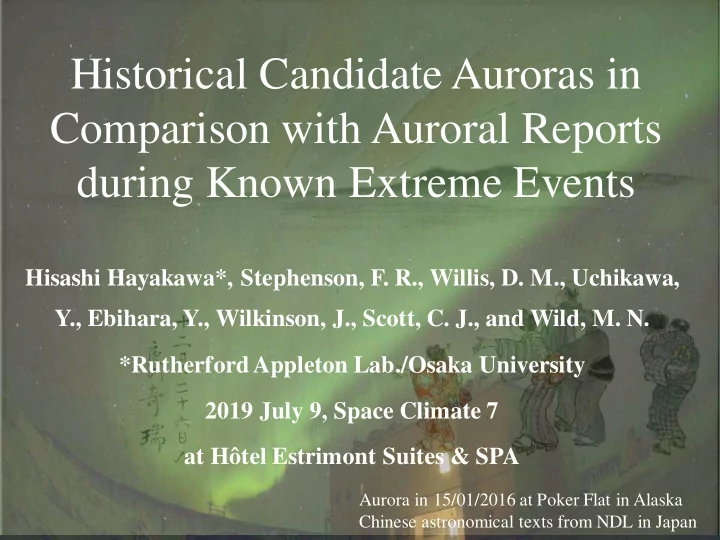
Historical Candidate Auroras in Comparison with Auroral Reports during Known Extreme Events

Hisashi Hayakawa*, Stephenson, F. R., Willis, D. M., Uchikawa, Y., Ebihara, Y., Wilkinson, J., Scott, C. J., and Wild, M. N. *Rutherford Appleton Lab./Osaka University 2019 July 9, Space Climate 7 at Hôtel Estrimont Suites & SPA

Aurora in 15/01/2016 at Poker Flat in Alaska Chinese astronomical texts from NDL in Japan

slide-2
SLIDE 2

Solar-Terrestrial Storms

Sunspot AR Flares ICMEs Aurora Space weather hazards Courtesy: NASA Magnetic Storms

slide-3
SLIDE 3

Carrington Event in 1859

Carrington 1859 vs Stewart 1861 via Bartels 1938 Sunspot drawing vs Kew Magnetogram Aurora Australis in Flagstaff (Melbourne) adopted from Neumeyer (1864) SFE -110 nT => X45±5 Magnetic Storm Dst ≈ −850 nT white light flare low latitude aurorae

slide-4
SLIDE 4

History of Instrumental Solar Observations

Clette and Lefevre 2016 Thomas Harriot, 1610 Dec. 18 Carrington event in 1859 (Hayakawa+2018)

slide-5
SLIDE 5

Even more extreme storms in 774 and 993

Anomalous cosmic ray events in 774 and 993 in worldwide tree rings (Buntgen+2018)

How was the Sun in 774 and 993 ?  Both occurred centuries before the onset

  • f instrumental observations !

 Worth consulting historical documents  Extending our knowledge back to BC 567 (Stephenson+2004; Hayakawa+2016)

slide-6
SLIDE 6

How can we use historical documents? Tutorial cases in the Carrington event

The historical documents complementarily let us reconstruct the auroral oval during the Carrington event (Tsurutani+2003; Siscoe+2006; c.f., Green+2006; Hayakawa+2018)

六日夜五ツ過ゟ北ゟ少東 秋葉金比 羅山之間火光天ニ耀終夜明かた迄火 光見ヘ候由。

Historical Documents Instrumental Measurements

slide-7
SLIDE 7

Hayakawa+2018d, ApJ

Reconstructed auroral ovals and their spatial extent

Empirical correlation between equatorward boundary of auroral ovals and intensity of magnetic storms in Dst value (Yokoyama+1998)

slide-8
SLIDE 8

What happened around 775?

  • Some historical reports have been found around 775 (Usoskin+2013)
  • 773/774/776 Anglo-Saxon Chronicle

– => with dating problems (773/774 in MS and 776 in CE)

  • 776 Jan. 12/13 in China
  • Discussions about their interpretations: auroras/halos(Usoskin+2013;

Stephenson 2015; Neuhauser+2015)

  • Zuqnin Chronicle’s drawings in 771/772 and 773 June (Hayakawa+2017b)
  • Enhanced solar activity (Usoskin+2013) vs solar minimum (NN15)
  • We need to reference modern observations to understand historical
  • bservations
slide-9
SLIDE 9

Aurora vs Atmospheric Optics

Aurorae Haloes: atmospheric optics

Skyscanner.com Earth Sky

slide-10
SLIDE 10

Zūqnīn Chronicle in 771/772 and 773

It was seen at harvest time (771/772),

  • ccupying the entire northern side from the

eastern corner to the western corner. Its form was as follows: a blood-red scepter, a green one, a black one, and a saffron- colored one. It was going from below to

  • above. When one scepter was extinguished,

another one went up. And when someone was looking at it, it was changed into seventy shapes. (MS V at.Sir.162, f.150v.) The sign which was seen a year ago in the northern region, was also seen in this year, in the month ḥzīrān (June 773), on a Friday. And equally in these three years, in which one (sign) after another was seen, each appeared on a Friday. And each equally stretched from eastern side to western side. And when someone rose up to watch it, it was changed to many different shapes in this way: when a blood-red ray was extinguished, a green one went up, and when the green one was extinguished, a saffron-colored

  • ne went up, and when this one was extinguished,

a black one went up. (MS V at.Sir.162, f.155v. )
slide-11
SLIDE 11

Vertical ray structure of Aurorae

Aurorae in NZ, 2017 March 28, 01:51 LT (c) T. Nakamura

Over head aurora at Amida (40.4 MLAT) is comparable to the auroral electron precipitation in 1989 March storm (Dst = −589 nT) down to 40.1 MLAT (c.f., Hayakawa+2017b, 2019d; Rich and Denig, 1992)

slide-12
SLIDE 12

776 Jan. 12 event

  • A report for white vapour at Chang’an was recorded in Xin Tangshu (v. 32,

p.836) etc. They are transcribed and translated:

  • 大曆十年…十二月丙子,月出東方,上有白氣十餘道,如匹練,貫五車及畢、

觜觿、參、東井、輿鬼、柳、軒轅,中夜散去。

  • “Dali reign period, 10th year, 12th lunar month, day bingzi (12) [= A.D. 776

Jan 12], the Moon appeared (= rose) in the eastern direction. Above it there were more than ten streaks (dao) of white vapour (baiqi). They were like unspun silk. They penetrated (guan) [the star groups] Wuche and Bi, Zuixi, Shen, Dongjing, Yugui, Liu, and Xuanyuan. After midnight they disappeared.”

  • Aurora (Usoskin+2013; Stephenson 2015) vs Halo (NN15);
  • South, white, near the moon ! Not aurora but lunar halo ! (NN15)
slide-13
SLIDE 13

A counter-example for the halo hypothesis

Capron 1883, see Love 2018 for the detailed discussions

South, above or near the moon, and glowing pearly white (Capron, 1883) => Then, should it be a lunar halo ? However, Capron’s spectroscopic results contradict the halo hypothesis for this parallel record

slide-14
SLIDE 14

Hall 1872

slide-15
SLIDE 15

Too widely extended for haloes

Anyways the distribution of these eight constellations cannot be explained by lunar halo => Reconstructing magnetic field line, the overhead aurora seemed to extend beyond 36.6 ILA T (c.f., Chang’an 37.0 MLA T)

Stephenson et al. (2019)

slide-16
SLIDE 16

Reconstruction of Magnetic Field Line

18.72 h LT on 12 January 776 1.50 h LT on 13 January 776

Stephenson et al. (2019)

slide-17
SLIDE 17

Anglo-Saxon Chronicle

  • MS A, f.10v.: [773] AN. dcclxxiii Her oþiewde read Cristesmel on hefenum æfter sunnan
  • setlgonge. (v.3, p.39)
  • In 773 [776], Here, a red sign of Christ appeared in the heavens after the sun’s setting.

(Swanton, 2000, p.50)

  • Re-dated to 776, in comparison with continental chronicles (e.g. Swanton 2000, as already

cited in Usoskin et al. 2013) (c) Corpus Christi College, Cambridge (MS 173, f.10v).

slide-18
SLIDE 18

After Sunset

  • What is the physical nature of the records of “red cross in the sky”
  • Timing of “post solis occubitum” or “æfter sunnan setlgange”.
  • Usoskin+13 and S15 => “after” sunset
  • NN15 => “during” sunset
  • If this is “during sunset”, this is too bright to be aurora and should be

solar halo (NN15), while the color would be favorable to the aurora if this is “after sunset” (U+13, S15)

  • This usage is not confirmed neither in state-of-the-art dictionaries for

Latin nor Old English (Hayakawa+2019b)

slide-19
SLIDE 19

We cannot see the cross after sunset

Horizon after sunset Neuhauser and Neuhauser 2015

NN15 considered the “red cross” should be a cross of horizontal arc and vertical pillar.  However, the horizontal arc is not visible after sunset  Halo hypothesis seems not very realistic

slide-20
SLIDE 20

A Cross-like Aurora after Sunset

Auroral reports during the 1872 storm, as described in Hall (1872);The Meteorological Magazine (1872)

Aurorae during twilight ! Aurorae like a cross !

slide-21
SLIDE 21

The Corona Aurora in 1872

The Corona Aurora at Barnstaple The Reconstructed Display

Hall (1872), see detail in Hayakawa+2019b

slide-22
SLIDE 22

“Crosses” back in Anglo-Saxon England

The Meteorological Magazine (1872)

So far, no scientific reason to reject auroral hypothesis in Usoskin+2013 The event is dated between 775 Mar. 25 and 777 Dec. 25  Too late to associate with the cosmic ray event in 774/775 (Hayakawa+2019b)  Supporting enhanced solar activity around 775 (Usoskin+2013; Hayakawa+2019b)

slide-23
SLIDE 23

Magnetic North Pole

Auroral Reports around 774/775

771/772, 773 June: Zuqnin ~ 40.4 MLA T 776 Jan. 12: China ~ 37.0 MLA T 775 Mar. – 777 Dec.: ASC ~ 50 – 55 MLA T

slide-24
SLIDE 24

“Open of Heaven’s Gate” in 992.12-993.01

Koryosa, Waseda University Library, MS ri06_02809, 47, f. 19a

天元玉暦祥異譜:日本国立文書館蔵

slide-25
SLIDE 25

Records in Saxonian Cities in 992 Dec 26

Annalista Saxo, f. 95b Chronik des Thietmar von Merseburg: f. 58a

slide-26
SLIDE 26

Description in Sachsen Chronicles

  • Original Text: DCCCCXCII. … In nocte natalis sancti protomartyris, id est VII.
  • Calend. Ianuarii, inauditum seculis miraculum ridimus, videlicet circa primum

gallicinium (gallicantum) tantam lucem subito ex aquiline effulsisse, ut plurimi dicerent diem oriri. Stetit autem unam plenam horam, postea rubente aliquantulum cœlo in solitum conversum est colorem.

  • Our translation:In the night of St. Promartyr, namely on 12.26 (VII days back

from 1, Jan.), we saw an unheard miracle. Around the first cockcrow, such a light shined that many people said that the sun had risen. And this continued one good

  • hour. Immediately after that, the sky got reddened and returned to the normal color.
  • Not 993.12.26 (Stephenson 2015) but 992.12.26(Hayakawa+2017a, Sol. Phys.)
slide-27
SLIDE 27

Irish Records in 992 Dec 26

Annals of Four Masters, f. 388r. Ulster Annals, f. 53r.

The unusual appearance on the St. Stephan’s Eve, so that the sky was blood-red. (Annals of Ulster) The fiery hue was on the sky till the morning. (Annals of the Four Masters) Simultaneous with Sachsen records

slide-28
SLIDE 28

Magnetic North Pole

Auroral Reports around 993/994

992 Dec. – 993 Jan.: Korea ~ 40.2 MLA T 992 Dec 26: Ulster, Ireland ~ 53.5 MLA T 992 Dec 26: Sachsen, Germany ~ 51.8 MLA T

slide-29
SLIDE 29

Candidate aurorae and their timing

Buntgen+2018

slide-30
SLIDE 30

Can we simply compare medieval events with modern events? – Yes and No

Hayakawa et al. 2019d

We need to consider the historical documents’ limit of geographical coverage => difficulties in simple comparisons

slide-31
SLIDE 31

Aurorae and Phase of Magnetic Storm

Hayakawa et al. 2019d

Onset of local astronomical twilight at Lisbon Local sunrise at Lisbon

slide-32
SLIDE 32

Magnetic North Pole

Auroral Reports around 774/775

771/772, 773 June: Zuqnin ~ 40.4 MLA T 776 Jan. 12: China ~ 37.0 MLA T 775 Mar. – 777 Dec.: ASC ~ 50 – 55 MLA T

slide-33
SLIDE 33

We are constantly recovering auroral records

Green and Boardsen 2006 Hayakawa+2019d Hayakawa+2018f

We are recovering ‘forgotten’ auroral records in historical documents even for the Carrington event => Why not for the medieval candidate auroral records?

slide-34
SLIDE 34

Conclusion

  • The historical documentsmay let us trace back the history of solar activity

beyond the onset of scientific instrumental observations in 1610.

  • The auroral records are of significant use as a proxy for ICMEs, due to the

known correlation between its equatorwardextension and storm intensity in Dst value (e.g., Carrington event)

  • The candidateaurorae around 775 have been subjected to scientific

considerations

  • Philological analyses and comparison with modern observations are

important to understand what these medieval historical documents mean.

slide-35
SLIDE 35

Conclusion

  • Historical documents show candidates of extreme magnetic storms in 776 and

in late 992, at least comparable to the 1989 March storm (Dst = −589 nT).

  • These events at least show that the solar activity should have been significantly

enhanced around 774/775 and 992/993.

  • Nevertheless, the relationship of these events with the anomalous cosmic ray are

not immediately clear: too early for the 774/775 event and unclear for the 993/994 event.

  • We can compare the equatorwardboundary of auroral oval throughout history
  • However, the geographical coverage in historic time is limited and make auroral

visibility apparently more decent.

slide-36
SLIDE 36

The relationship between CMEs and GLEs (of SEPs) are hardly straightforward (Gopalswamy+2012)  Carrington event? (Usoskin+2012; Cliver+2013)  CME ◯ / SEP × The solar event around 774/775 => CME × / SEP ◯ ??

slide-37
SLIDE 37

References

  • Cliver & Svalgaard 2004, Sol. Phys., 224, 407. (extreme events)
  • Gopalswamy+2012, SSR, 171, 23 (CME vs SEP)
  • Hayakawa+2018d, ApJ, 869, 57 (1859)
  • Hayakawa+2019b, Sol. Phys., 294, 42 (ASC)
  • Hayakawa+2019d, Space Weather, under review.
  • McCracken+2001, JGR, 106, A10 (nitrate)
  • Stephenson, Willis, Hayakawa+2019, Sol. Phys., 294, 36. (776)
  • Usoskin & Kovaltsov 2012, ApJ, 757, 92 (Be data)
  • Usoskin+2013, A&A, 552, L3
slide-38
SLIDE 38

Thank you for your attention !

slide-39
SLIDE 39
slide-40
SLIDE 40
slide-41
SLIDE 41
slide-42
SLIDE 42

Carrington Event and Extreme Events

Cliver and Svalgaard

slide-43
SLIDE 43

The Strongest SPE?: A Serious Doubt

Usoskin and Kovaltsov 2012 Wolff+2012

slide-44
SLIDE 44

The Strongest SPE?: A Serious Doubt

  • The Carrington event was considered the strongest SPE in history since

1561, based on the nitrate concentration (McCracken+2001).

  • This was however subjected to serious doubt upon the inconsistency

with nitrate signals in other ice cores and Be data (Usoskin+2012; Wolff+2013; Duderstadt+2016)

  • The nitrate spike seems to have been caused by forest fire at the time

(Wolff+2012)

  • The Carrington event is no longer the strongest SPE according to the
  • nitrate. => What about other elements?
slide-45
SLIDE 45

Carrington Event is no longer with the strongest SEP

Cliver and Svalgaard

slide-46
SLIDE 46

The Extreme Auroral Display

  • The other feature highlighting the

Carrington event is its extreme equatorward extension of the auroral oval.

  • Chapman (1957) picked this event

up as ONE of “Outstanding Tropical Auroras”, based on the auroral

  • bservation at Honolulu.
  • However, this was not the only

magnetic storm picked up in his paper.

Chapman 1957

slide-47
SLIDE 47

Discussion on the Dst value

Magnetogram Analysis by Siscoe+2006, modified from Tsurutani+2003

The punctual value (-1600 nT) vs the hourly average (-850 nT) at Bombay => However, the Dst value is by definition average of hourly value of four different magnetograms …

slide-48
SLIDE 48

Global Aurora Display on 1859 Sept. 1/2

Green & Boardsen 2006

Equatorward boundary of auroral VISIBILITY down to 22-23 deg MLA T (Kimball 1960; Tsurutani+2003) v.s. 18 deg MLA T (Green & Boardsen 2006)

slide-49
SLIDE 49

Auroral Visibility and Overhead Aurora

The report of the auroral visibility does not necessarily mean the observation of

  • verhead aurora
slide-50
SLIDE 50

Another Great Event on 28/29 August

Loomis 1860

slide-51
SLIDE 51

Aurora in the South

Warner 1872; Twining 1872

slide-52
SLIDE 52

Extreme Brightness

Loomis 1860

slide-53
SLIDE 53

Extreme Brightness

The Meteorological Magazine (1872)

slide-54
SLIDE 54

Hall 1872

slide-55
SLIDE 55

References

  • Cliver & Svalgaard 2004, Sol. Phys., 224, 407. (extreme events)
  • Gopalswamy+2012, SSR, 171, 23 (CME vs SEP)
  • Hayakawa+2018d, ApJ, 862, 15 (1872)
  • Hayakawa+2018f, ApJ, 869, 57 (1859)
  • Hayakawa+2019a, MNRAS in press (1909)
  • Hayakawa+2019b, Sol. Phys., under review (ASC)
  • Kappenman 2006, ASR, 38, 188 (1921)
  • McCracken+2001, JGR, 106, A10 (nitrate)
  • Silverman & Cliver 2001, JASTP, 63, 523 (1921)
  • Stephenson, Willis, Hayakawa+2019, Sol. Phys., under review. (776)
  • Usoskin & Kovaltsov 2012, ApJ, 757, 92 (Be data)
slide-56
SLIDE 56
slide-57
SLIDE 57