History of electric Types of systems Propulsion basics - - PowerPoint PPT Presentation

history of electric types of systems propulsion basics
SMART_READER_LITE
LIVE PREVIEW

History of electric Types of systems Propulsion basics - - PowerPoint PPT Presentation

History of electric Types of systems Propulsion basics Electronics basics Guemes Island ferry planned Crosscut.com The ICE is melting Internal Combustion Engine ICE Electric Steam 90 year gap 90 year gap


slide-1
SLIDE 1
  • History of electric
  • Types of systems
  • Propulsion basics
  • Electronics basics

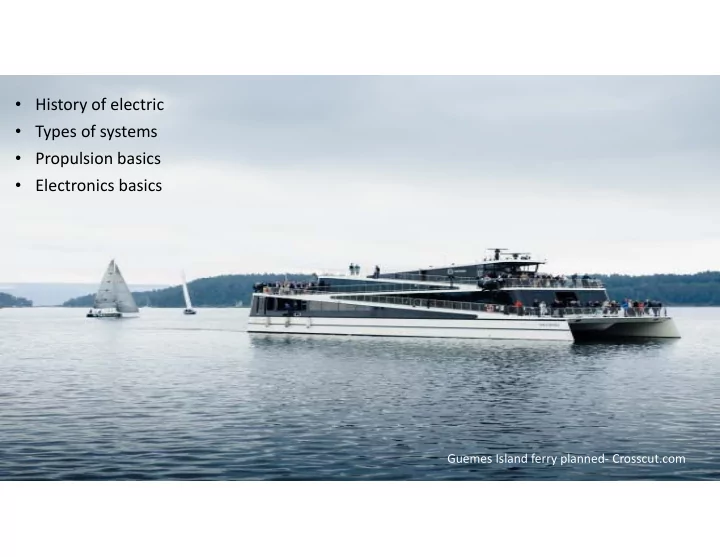
Guemes Island ferry planned‐ Crosscut.com
slide-2
SLIDE 2

The ICE is melting…

Steam Internal Combustion Engine ICE “90‐year gap” “90‐year gap” 1800 2000 1950 1900 1850 2050 Electric Electric 1800 2000 1950 1900 1850 2050

ELCO stops electric pleasure boats Popularization of E launches E‐boat English Channel crossing 8 hrs, both ways 8 charging stations on Thames ELCO Electric Launch Company p p Jacobi, Russia: 14 passenger –E‐boat‐ 3 mph Popularization of E‐ launches

Data from Wikipedia and Elco website

Photo: Tad Pfeffer/Extreme Ice Survey

slide-3
SLIDE 3

Electric promises lower impact to Electric promises lower impact to self and others:

  • No CO warning sticker

No CO warning sticker

  • No bilge buzzer
  • No plume of diesel smoke in the marina
  • Clean engine compartment and topsides

Clean engine compartment and topsides

  • Charging happens at your slip and under‐way
  • Great control‐ no stalling at low speeds
  • Simpler to use and maintain
  • Simpler to use and maintain
  • Quiet‐ low vibration
  • Odorless
  • Renewable energy
  • Renewable energy
slide-4
SLIDE 4

Integrated

  • utboards
  • utboards
  • Simple to use
  • Simple to use
  • Light weight‐ portable
  • Cost competitive with gasoline

p g

  • dinghies thru 2 ton boats
  • Range is expandable

S ll i t h

  • Small size = easy to charge
slide-5
SLIDE 5

Non‐integrated

  • utboards:
  • utboards:
  • More customized installation
  • More customizable range and
  • More customizable range and

power

  • Charge options more limited

by size by size

  • For applications where weight

not an issue.

  • Larger boats

g

  • Variable efficiency
  • Requires engineering and

installation

  • Range can be upgraded later.
slide-6
SLIDE 6

inboard all‐electric

  • Up to 60 miles range
  • Control, environmental and sensorial

benefits compared to ICE.

  • Charge options limited by size

Torqeedo.com

  • Charge options limited by size
  • Competitive purchase cost
  • Greater weight ‐balance trim
  • User‐friendly controls
  • Can be upgraded: more batteries,

generator or solar generator or solar.

Elco.com

slide-7
SLIDE 7

Inboard gas Inboard gas‐ electric hybrid

  • Extended cruising.
  • Don’t mind extra $ for a dual

system. system.

  • Power and range similar to ICE.
  • Looses some environmental

Torqeedo.com

Looses some environmental and operating cost benefits of EP

  • Weight +‐ depending.
slide-8
SLIDE 8

How to make sense of E propulsion? How to make sense of E propulsion?

Output power Input power thrust voltage Output power thrust Sh ft displacement Propulsion? Shaft power Propulsion?

slide-9
SLIDE 9

How to make sense of propulsion? How to make sense of propulsion?

The boat The system

Input power (efficiency) Voltage Current Capacity RPM (s) Output power (drag x speed) Speed / range Displacement Hull params Cost RPM (s) Pitch Diameter Hull params Loop until satisfied

slide-10
SLIDE 10

Thrust at speed…

Input power (efficiency) Voltage Current Capacity Output power (drag x speed) Speed / range Displacement Hull params Cost

  • Catalina 30,

Data thanks to

(efficiency) Capacity (drag x speed) Hull params lbf

Catalina 30, Data thanks to

James Lambden, www.electricboatdesign.com

quirement), l

POWER required = Drag (thrust) x speed

ag (thrust req

Drag (thrust) x speed

knots Dra

slide-11
SLIDE 11

Definitions and system types

Input power (efficiency) Voltage Current Capacity Output power (thrust x speed) Speed / range Displacement Hull params Cost

98% 99% 98%

Component efficiencies (efficiency) Capacity (thrust x speed) Hull params E overall = Eprop x Ebattery x Emotor x Egear x Ewiring x Echarging

60% 75% 85% 90% 98% 99% 98% 33% 60%

Typical gasoline or

Overall propeller battery motor gear reduction controller wiring charger

g diesel conversion

slide-12
SLIDE 12

Sizing

Input power Voltage C Output power Speed / range Di l C

g vs efficiency

watts input tons

(efficiency) Current Capacity (drag x speed) Displacement Hull params Cost

0.5 1 1.5 2 2.5 3 3.5 4 4.5 5 5.5 6 EP Carry 0.25 Torqeedo 0.5 66 Oceanvolt 3.5 8.5

… …

Electric Yacht 5 30 Elco 4 40

… … Efficiency Power (W)

slide-13
SLIDE 13

Propeller and motor matching

Propeller Diameter Effect on Thrust,

40 watts input

3 0 4.0 5.0 6.0 h r u s t

atts put

0.0 1.0 2.0 3.0 5 7 9 11 13 15 17 l b t h

  • All motors have their efficient RPM
  • peration range.

5 7 9 11 13 15 17 propeller diameter, inches

  • Larger diameters , higher pitch and

slower rotation lower blade area.

  • Gearing matches motor to propeller.
slide-14
SLIDE 14

Batteries

100 Ah lead acid battery

90 100 110

50 Ah battery

50 60 70 80 90 % battery capacity

  • A lead acid 100 AH battery will lose 50% of its capacity at 40 amps draw (when new)

30 40 10 20 30 40 50 60 Amp draw

  • A lead acid 100 AH battery will lose 50% of its capacity at 40 amps draw. (when new).
  • A 48Ah LiFePO4 will lose about 5‐8 % at 40 amp draw.
  • Choice of battery affects range, speed etc.

A Lead acid system can be upgraded to one of these in the future.

slide-15
SLIDE 15

Volts, Amps, Watts, Horsepower

  • Volts, V
  • Amps, A

Motor t Amps, A

  • Power = V x A, Watts, W
  • Amp capacity = A x time, Amp hours, Ah
  • Energy = V x A x time , Watt hours, Wh

system volts Amps 1kW motor system

  • Volts: 3 battery system = 12v x 3 = 36 Volts

battery battery battery

+ ‐ + ‐ + ‐

  • Amps: 0 to 28 Amps depending on throttle
  • Power: 0 to 36 x 28 = 1000 Watts depending on throttle
  • Amp capacity: Each battery (idealized) can provide 4 amps for 20 hours = 80 Ah
  • Energy: Ah x Volts = 80 Ah x 36V = 2880Wh
slide-16
SLIDE 16

Review

generator/ solar / wind… shore power charger throttle controller battery bank electric motor gear reduction

slide-17
SLIDE 17
  • Questions
  • Comments
  • Comments
  • Feedback