Ho ow w D Do o H Ho ou us se eh ho ol ld ds s C Co - - PowerPoint PPT Presentation

ho ow w d do o h ho ou us se eh ho ol ld ds s c co op pe
SMART_READER_LITE
LIVE PREVIEW

Ho ow w D Do o H Ho ou us se eh ho ol ld ds s C Co - - PowerPoint PPT Presentation

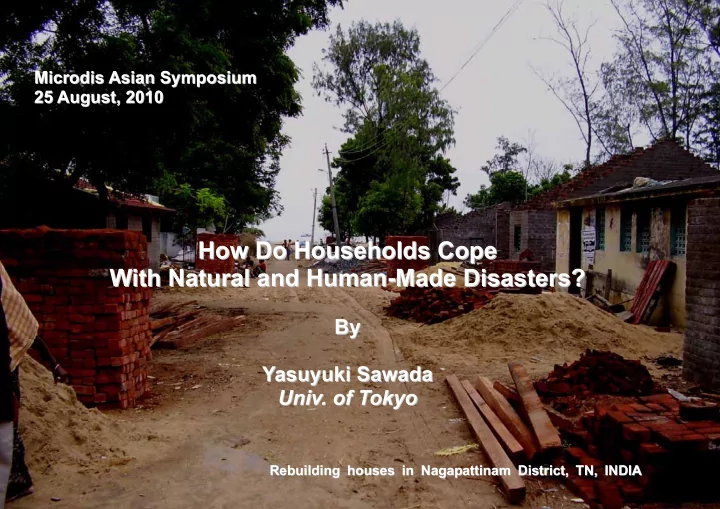
Mi ic cr ro od di is s A As si ia an n S Sy ym mp po os si iu um m M 25 5 A Au ug gu us st t, , 2 20 01 10 0 2 Ho ow w D Do o H Ho ou us se eh ho ol ld ds s C Co op pe e H Wi it th h


slide-1
SLIDE 1

1

H Ho

  • w

w D Do

  • H

Ho

  • u

us se eh ho

  • l

ld ds s C Co

  • p

pe e W Wi it th h N Na at tu ur ra al l a an nd d H Hu um ma an n-

  • M

Ma ad de e D Di is sa as st te er rs s? ?

B By y Y Ya as su uy yu uk ki i S Sa aw wa ad da a U Un ni iv v. .

  • f

f T To

  • k

ky yo

  • R

Re eb bu ui il ld di in ng g h ho

  • u

us se es s i in n N Na ag ga ap pa at tt ti in na am m D Di is st tr ri ic ct t, , T TN N, , I IN ND DI IA A

M Mi ic cr ro

  • d

di is s A As si ia an n S Sy ym mp po

  • s

si iu um m 2 25 5 A Au ug gu us st t, , 2 20 01 10

slide-2
SLIDE 2

2

Objectives of My Presentation ! To present the conceptual framework of the impact of disasters on individual and HH behavior: Risk management and coping ! To provide selective evidence ! To discuss innovative (policy) instruments: Index insurance

B

Be ef fo

  • r

re e t ts su un na am mi i A Af ft te er r t ts su un na am mi i

slide-3
SLIDE 3

3

1. Introduction: Definitions and Overview

slide-4
SLIDE 4

4

  • 1. Background

! Our life is full of risks! ! A disaster: An unforeseen large negative event which overwhelms local

  • capacity. There are three types:

" The natural disasters 1) Hydro-meteorological disasters: Floods, storms (typhoons), and droughts 2) Geophysical disasters: Earthquakes, tsunamis and volcanic eruptions 3) Biological disasters: Epidemics and insect infestations. " The technological disasters 1) Industrial accidents: Chemical spills, collapses of industrial infrastructures 2) Transport accidents: By air, rail, road or water means of transport. " Manmade disasters 1) Economic crises: Growth collapse, hyperinflation, and currency crisis 2) Violence: Terrorism, civil strife, riots, and war.

slide-5
SLIDE 5

5

! Feature 1: Increasing trend of natural disasters ! Feature 2: Natural disasters do not select location ! Feature 3: The number of complex economic crisis has been increasing

Table 2 Frequency of Economic Crises Over Time 1970-79 1980-1995 Type of crisis Total Average per year Total Average per year Balance-of-payments 26 2.6 50 3.13 Twin 1 0.10 18 1.13 Single 25 2.50 32 2.00 Banking 3 0.30 23 1.44 Source: Table 1 of Kaminsky and Reinhart (1999) AER

! Feature 4: The number of conflicts is not necessarily declining.

slide-6
SLIDE 6

6

  • 2. “Ex ante risk management” and “ex post risk-coping”:

Framework and evidence

slide-7
SLIDE 7

7

  • 2. Risk Management (Mitigation) and Risk Coping Strategies

! Household risk management strategies: Activities for mitigating risk and reducing income instability before the resolution of uncertainties (Walker and Jodha, 1986; Alderman and Paxson, 1992). " Ex ante management is cost effective against disasters: ! Investments in earthquake-proof house, insurance contracts, and access to the early-warning system " Yet, such strategies are often difficult by nature because (natural) disasters are typically unforeseen and rare events.

slide-8
SLIDE 8

8

  • 2. Risk Management and Risk Coping Strategies

! Household risk-coping strategies: Ex post strategies to maintain consumption (livelihood) [Alderman and Paxson (1992)]. !" To use market mechanisms: ! Credit markets to reallocate future resources to today’s consumption ! Insurance market transactions (need ex ante contract though) ! Ex post labor market participation o use returns to human capital #" Self-insurance mechanisms ! To reduce consumption expenditure with maintaining total calorie intakes. ! To use accumulated financial and physical assets (precautionary saving). $" Non-market insurance mechanisms ! To receive public and private transfers. ! Against unexpected natural disasters, ex post risk-coping will be indispensable

slide-9
SLIDE 9

9

Case Studies

  • I. Financial Crisis in Korea
  • II. Two Earthquakes in Japan (Chuetsu and Kobe)
  • III. Indian Ocean Tsunami Disaster (TN, India)

IV. Avian Influenza in Vietnam

  • V. Sichuan Earthquake

VI. Typhoon Milenyo in the Philippines

slide-10
SLIDE 10

10

  • 2. Risk Coping Strategies I: The Asian Financial Crisis

! During the currency crisis in Indonesia, Korea, Thailand and Mexico, consumption reallocation was an important coping strategy ! In Korea, extended credit was also important but not enough. The likelihood of facing credit constraints increased significantly [Kang and Sawada (2003); around 2,000 panel households]

Changes in per capital consumption in Korea Aug 1996 – July 97 Aug 1997 – July 98 Change rate (%) mean (std. error) mean (std. error) Expenditures for luxuries (cultural& activities, entertainment, dining out, and durable goods) 147.25 (333.75) 53.98 (86.36)

  • 63.3

Sales of assets (land, real estate, securities, and withdrawal of time deposits) 195.01 (1305.44) 203.62 (1089.94) 4.4 Outstanding debt (formal banks, informal banks, and personal) 842.02 (2177.78) 1074.34 (5252.27) 27.6 Source: Kang and Sawada (2008)

slide-11
SLIDE 11

11

  • 2. Risk Coping Strategies II: Chuetsu and Kobe Earthquakes
slide-12
SLIDE 12

12

  • 2. Risk Coping Strategies II: Chuetsu Earthquake

! The Chuetsu earthquake " October 23, 2004 " In April/May 2006, we conducted surveys with all the dwellers of Yamakoshi village. ! Data " Ichimura, Sawada, and Shimizutani (2008): A unique survey was completed by 597 HHs out

  • f the total of 663 registered households in the village (response rate = 90%)

" Carefully designed structured questionnaires

slide-13
SLIDE 13

13

Per Yen Effect of the House Damages on Different Coping Strategies by Different Groups

) ' | ( ) | ( ) ' | ( ) | ( z Z D E z Z D E z Z Y E z Z Y E ! " ! ! " !

Y

From Half-Collapsed (z) to Collapsed (z’) From Minor Damages (z) to Half-Collapsed (z’) Reallocated Amount of donation Total amount 0.3441 0.0484 Amount of the government’s livelihood recovery transfers received 70% 40% Total amount 0.2446 Insurance indemnity payments received Total amount 0.1096 0.3766

! Effective donations, government transfers, and insurance payments: " Large donations with relatively small number of victims " Well-designed public safety net program " Unusually high participation in earthquake insurance programs: effective market

slide-14
SLIDE 14

14

  • 2. Risk Coping Strategies II: Kobe Earthquake

! The Kobe earthquake " January 17, 1995 ! Sawada and Shimizutani (2008) JMCB: " Data: “Survey on Changes in Livelihood and Consumption Behavior After the Earthquake” conducted by Hyogo Prefecture " Respondents: 1,589 women aged above 30, randomly selected from the area. ! Importance of credit market; Ineffective private and public transfers; ineffective self-insurance. " Large donations with large number of victims " Lack of public safety net program " Low participation in earthquake insurance programs ! Contrasting results with the Chuetsu earthquake

slide-15
SLIDE 15

15

  • 2. Risk Coping Strategies III: Indian Ocean Tsunami Disaster

! UT-TNAU Survey (400 households in 8 villages in Jan-Apr 2006) ! In India, the number of deaths caused by tsunami was the highest in TN State, especially in the Nagapattinum district,

where 6,065 people perished.

slide-16
SLIDE 16

16

  • 2. Risk Coping Strategies IV: Highly Pathogenic Avian Influenza in Vietnam

! HPAI hit since Dec 2003. A unique household panel data from a commune in Yen Bai province [Tamura and Sawada (2009)]. " Randomly chosen two villages from a commune that was hit by AI. " The data covers 136 panel households in 2004, 2005, and 2006.

slide-17
SLIDE 17

17

slide-18
SLIDE 18

18

  • 2. Risk Coping Strategies V: Sichuan Earthquake

! On May 12, 2008, the Great Sichuan Earthquake occurred, with the epicenter Wenchuan County at Sichuan Province of China. " 69,197 people dead, 18,222 missing, and left about 4.8 million people homeless " In March 2009, we conducted a survey with 2,000 respondents out of around 30,000 people in a temporary housing district at Mianzhu County [Sawada and Li, 2010].

slide-19
SLIDE 19

19

slide-20
SLIDE 20

20

  • 2. Risk Coping Strategies VI: Super Tyhoon Milenyo

! On September 25, 2006, super typhoon Milenyo hit Luzon Island. " 496,325 homes were totally or partially destroyed. " 127 deaths, 323 injured, and 45 missing. " In January-April 2007, we conducted our own survey of 400 households in a village by the (East) Laguna Lake near Los Banos (Sawada et al., 2009)

slide-21
SLIDE 21

21

Summary of empirical results on ex post risk coping stragtegies

Study Disaster type Damages Risk Coping Strategies Reallocation of consumption Borrowing Dissaving Labor adjustments Income transfers Other Ichimura, Sawada, and Shimizutani (2006) Chuetsu earthquake Houses Ineffective (Effective) Ineffective ‐ Donation and public transfers very effective Formal insurance effective Sawada and Shimizutani (2005, 2008) Hanshin Awaji Earthquake Houses ‐ Effective Ineffective ‐ Limited Assets ‐ Ineffective Effective ‐ Ineffective Sawada (2009) Indian tsunami in Tamil Nadu, India Houses ‐ Effective Limited ‐ Ineffective Assets ‐ Effective Ineffective ‐ Ineffective Unemployment ‐ Ineffective Effective Emigration Ineffective Tamura and Sawada (2009) Avian influenza in Vietnam Livestock losses ‐ Informal credit effective Ineffective ‐ Ineffective Sawada and Li (2010) Sichuan Earthquake Productive assets, employment, health Effective Effective (if not constrained)

  • Emigration

Effective Sawada et al. (2009) Typhoon Milenyo Orchard trees Paddy Houses Effective Effective Ineffective Effective Effective

slide-22
SLIDE 22

22

  • 3. Role of Market and Non-Market Mechanisms

Against Disasters

slide-23
SLIDE 23

23

  • 3. Market and Non-Market Mechanisms

! Formal insurance against natural disasters are limited. " Insured losses arising from natural disasters: ! Sawada and Shimizutani (2007; 2008): the overall ineffectiveness of formal and informal insurance mechanisms against the Kobe earthquake. " Formal tests of consumption risk sharing hypothesis (RSH). " Sensitivity of consumption (livelihood) change systematically related to damages " Similar tests were conducted for other disasters (Korean crisis and Vietnamese AI)

Tests of risk sharing: Distribution of households by extent of change in consumption and extent of damage (%)

Damage degree Consumption (livelihood) changed substantially or slightly (%) No change (%) Major damage 80.22 19.78 Moderate damage 73.31 26.69 Minor damage 60.65 39.35 Home No damage 50.48 49.52

Data source) Sawada and Shimizutani, 2008

slide-24
SLIDE 24

24

  • 4. New Innovative Ideas?
  • A. How to handle aggregate risks?

! Microfinance and Index insurance (top down)

  • B. How to match aid inflows and demand without moral hazard?

! Community-based management (bottom up)

slide-25
SLIDE 25

25

  • 4. How to handle aggregate risks? Index Insurance

! Potentially, micro-credit programs can play a role of disaster insurance through a flexible repayment system [For Bangladesh, Shoji (2010) JDS] ! Index insurance contracts are written against specific aggregate events such as drought or flood defined and recorded at a regional level [Hazell (2003); Morduch (2004); Lilleor, Gine, Townsend, Vickery (2005); Skees, Varangis, Larson and Siegel (2006)]. " Can cover the aggregate events " Divisible, so affordable and accessible even to the poor " Easy to implement and privately managed " Free from moral hazard, adverse selection, and high transaction costs that have plagued traditional agricultural insurance contracts such as crop insurance schemes. ! Weather-based Index Insurance in LDCs " Rainfall insurance in India and Malawi [Gine and Yang (2009) JDE] " Famine index insurance [Chantarat, et al. (2007) AJAE] " Livestock based index insurance (ILRI, Nairobi) " WFP in Ethiopia

slide-26
SLIDE 26

26

  • 4. How to handle aggregate risks? Index Insurance

! Major constraints to design index type insurance against natural disasters. " A “rare” event; making it difficult to design actuarially fair insurance and to set appropriate premium because obtaining historical data on natural disasters pattern is hard [Morduch (2004)]. " The poor may find it difficult to recognize the value because natural disasters are

  • ften characterized by unforeseen contingencies and because the poor often are

myopic with high time discount rates [Pender (1996)]. Human beings tend to ignore rare bad events [Camerer and Kunreuther (1989)]. " The existence of the “basis risk” also deters demand [Morduch (2004); Hazell (2003)]. " The insurers need international reinsurance markets. Yet, reinsurance markets and trades of catastrophe (CAT) bonds are still thin.

slide-27
SLIDE 27

27

! Nakata, Sawada, and Tanaka (2009): In 2008, hypothetical questions on AI, flood (FL), and drought index insurance in Vietnam with 2,000 respondents of VHLSS 2006 " A past experience dramatically increases probability assessment of the event (10 and 100 times for AI and FL) and WTP for the insurance (30% and 50% for AI and FL)

slide-28
SLIDE 28

28

  • 4. How to handle aggregate risks?

Index Insurance as a Mitigation Device of Human-Made Disasters

! Miguel, Satyanath and Sergenti (2004) JPE: " 41 countries in Africa in 1981‐99 年 " Drought (natural disaster) ! Income decline ! Conflicts (human made disaster)

slide-29
SLIDE 29

29

  • 5. How to handle aggregate risks?

Index Insurance as a Mitigation Device of Human-Made Disasters

! Rapid Conflict Prevention Support (RCPS) by Ted Miguel (2009) " To target foreign aid to (drought) vulnerable countries beforehand " E.g.) Drought Relief Program (DRP) in Botswana: ! Botswana as Africa’s economic superstar for the past 40 years ! Former President Quett Masire: “The drought insurance played an important role in its success”

slide-30
SLIDE 30

30

  • 4. How to match aid inflows and demand without moral hazard?

! In matching of emergency demands and massive proliferations of aid supply under imperfect information and uncertainties may create moral hazard problems: " Targeting failure: wrong people are targeted or right targets are excluded " Moral hazard: Even under “tagged” targeting interventions, there are perverse incentives to change their characteristics to gain eligibility, e.g. “Tsunami marriages” " Transaction costs: Timely matching will be very costly. The July 2006 report of Tsunami Evaluation Coalition (TEC) found: 1) Tsunami victims received US$7,100 on average 2) Relief is not necessarily given on the basis of need 3) Relief is allocated in response to political pressure or to the donating public. ! The role of social capital or community-based management (CBM)? " CBM will ease the imperfect information problems and enable the beneficiaries to amplify their voice in policymaking and to strengthen the incentives for providers to serve effectively. " WB allocated $7 billion in 2003 to CBM related projects ($3 billion in 1996)

slide-31
SLIDE 31

31

Finally -

・ Against disasters as unforeseen contingencies, ex post risk coping strategies and effective market mechanisms (insurance, credit, labor etc.) are the key. ・ Yet, formal/informal insurance mechanisms are largely ineffective against disasters right now. ・ So, new innovative ideas such as index insurance and community-based management should be elaborated on. ・ Evidence-based policies are indispensable: Continued data collection and evaluation of the policies (before &) after each disaster will be important.