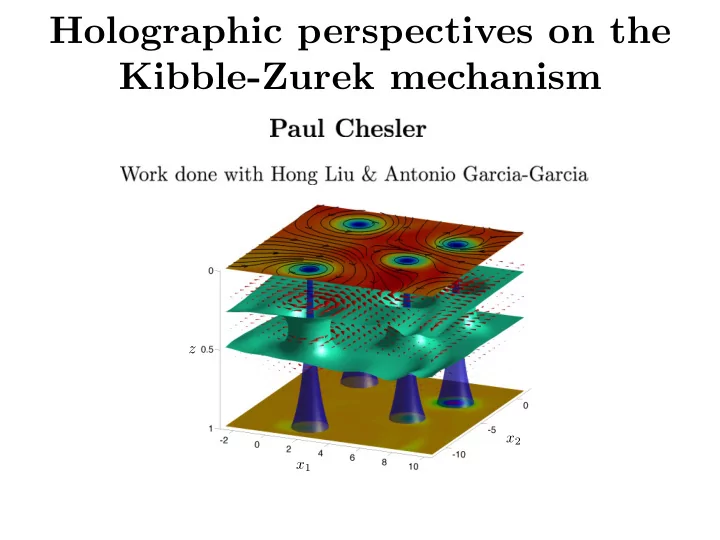
Holographic perspectives on the Kibble-Zurek mechanism z x 2 x 1 - - PowerPoint PPT Presentation

holographic perspectives on the kibble zurek mechanism
SMART_READER_LITE
LIVE PREVIEW

Holographic perspectives on the Kibble-Zurek mechanism z x 2 x 1 - - PowerPoint PPT Presentation

Holographic perspectives on the Kibble-Zurek mechanism z x 2 x 1 What is the Kibble-Zurek mechanism? QFT with 2 nd order phase transition: Example: superfluid Symmetry group U (1) broken for T < T c . broken unbroken Order


slide-1
SLIDE 1

x2 x1

z

Holographic perspectives on the Kibble-Zurek mechanism

slide-2
SLIDE 2

What is the Kibble-Zurek mechanism?

unbroken

broken

QFT with 2nd order phase transition:

  • Example: superfluid
  • Symmetry group U(1) broken for T < Tc.
  • Order parameter 6= 0 for T < Tc.
  • What happens when T is dynamic?

✏(t) ⌘ 1 T(t) Tc .

  • Density of defects after quench:

n ⇠ ⇠−(d−D).

slide-3
SLIDE 3

What is the Kibble-Zurek mechanism?

unbroken

broken

Box of superfluid at T > Tc

QFT with 2nd order phase transition:

  • Example: superfluid
  • Symmetry group U(1) broken for T < Tc.
  • Order parameter 6= 0 for T < Tc.
  • What happens when T is dynamic?

✏(t) ⌘ 1 T(t) Tc .

  • Density of defects after quench:

n ⇠ ⇠−(d−D).

slide-4
SLIDE 4

What is the Kibble-Zurek mechanism?

unbroken

broken

Box of superfluid at T > Tc

}

ξ

QFT with 2nd order phase transition:

  • Example: superfluid
  • Symmetry group U(1) broken for T < Tc.
  • Order parameter 6= 0 for T < Tc.
  • What happens when T is dynamic?

✏(t) ⌘ 1 T(t) Tc .

  • Density of defects after quench:

n ⇠ ⇠−(d−D).

slide-5
SLIDE 5

What is the Kibble-Zurek mechanism?

unbroken

broken

Box of superfluid at T > Tc

}

ξ

QFT with 2nd order phase transition:

  • Example: superfluid
  • Symmetry group U(1) broken for T < Tc.
  • Order parameter 6= 0 for T < Tc.
  • What happens when T is dynamic?

✏(t) ⌘ 1 T(t) Tc .

  • Density of defects after quench:

n ⇠ ⇠−(d−D).

slide-6
SLIDE 6

unbroken

broken

−tfreeze

+tfreeze

Critical slowing down

  • Critical exponents: ⇠eq = ⇠o|✏|−ν and ⌧eq = ⌧o|✏|−zν.
  • Inevitable ∃ tfreeze such that ∂τeq

∂t

  • t=tfreeze ∼ 1.
  • Characteristic scale: ⇠freeze ≡ ⇠eq(t = tfreeze).

Zurek’s estimate of correction length

slide-7
SLIDE 7
  • Assume linear quench: ✏(t) = t/⌧Q.

⇒tfreeze ∼ ⌧ νz/(1+νz)

Q

, ⇠freeze ∼ ⌧ ν/(1+νz)

Q

.

  • Density of topological defects when condensate first forms:

nKZ ∼ 1 ⇠d−D

freeze

∼ ⌧ −(d−D)ν/(1+νz)

Q

ψ

−tfreeze

+tfreeze

t

(t) ∼ ✏(t)β

frozen

adiabatic

The Kibble-Zurek scaling

slide-8
SLIDE 8

Motivational claims

  • 1. Dynamics after +tfreeze need not be adiabatic.
  • Adiabatic evolution only after teq tfreeze.
  • 2. No well-defined condensate until teq.
  • 3. Dynamics after T < Tc responsible for KZ scaling.
  • 4. ξ(teq) ξfreeze ) far fewer defects formed
slide-9
SLIDE 9

Motivational claims

  • 1. Dynamics after +tfreeze need not be adiabatic.
  • Adiabatic evolution only after teq tfreeze.
  • 2. No well-defined condensate until teq.
  • 3. Dynamics after T < Tc responsible for KZ scaling.
  • 4. ξ(teq) ξfreeze ) far fewer defects formed

magnitude prediction usually overestimates the real density of defects ob- served in numerics. A better estimate is obtained by using a factor f, to multiply ˆ ξ in the above equations, where f ≈ 5−10 depends on the specific model.29,31–35 Thus, while KZM provides an order-of-magnitude estimate

excerpt from [Del Campo & Zurek]

slide-10
SLIDE 10

Motivational claims Employ holographic duality

  • 1. Dynamics after +tfreeze need not be adiabatic.
  • Adiabatic evolution only after teq tfreeze.
  • 2. No well-defined condensate until teq.
  • 3. Dynamics after T < Tc responsible for KZ scaling.
  • 4. ξ(teq) ξfreeze ) far fewer defects formed

magnitude prediction usually overestimates the real density of defects ob- served in numerics. A better estimate is obtained by using a factor f, to multiply ˆ ξ in the above equations, where f ≈ 5−10 depends on the specific model.29,31–35 Thus, while KZM provides an order-of-magnitude estimate

excerpt from [Del Campo & Zurek]

slide-11
SLIDE 11

Motivational claims Employ holographic duality

First holographic study: [Sonner, del Campo, Zurek: two weeks ago]

  • 1. Dynamics after +tfreeze need not be adiabatic.
  • Adiabatic evolution only after teq tfreeze.
  • 2. No well-defined condensate until teq.
  • 3. Dynamics after T < Tc responsible for KZ scaling.
  • 4. ξ(teq) ξfreeze ) far fewer defects formed

magnitude prediction usually overestimates the real density of defects ob- served in numerics. A better estimate is obtained by using a factor f, to multiply ˆ ξ in the above equations, where f ≈ 5−10 depends on the specific model.29,31–35 Thus, while KZM provides an order-of-magnitude estimate

excerpt from [Del Campo & Zurek]

slide-12
SLIDE 12

A holographic model of a charged superfluid

Action:

[Hartnoll, Herzog & Horowitz: 0803.3295]

Sgrav = 1 16πGN Z d4x p G  R + Λ + 1 q2

  • F 2 |DΦ|2 m2|Φ|2

, where Λ = 3 and m2 = 2.

  • Near-boundary asymptotics of Φ encodes QFT condensate hψi.
  • Spontaneous symmetry breaking:

– Black-brane solutions with T > Tc have Φ = 0. – Black-brane solutions with T < Tc have Φ 6= 0.

slide-13
SLIDE 13

A holographic model of a charged superfluid

Action:

[Hartnoll, Herzog & Horowitz: 0803.3295]

Sgrav = 1 16πGN Z d4x p G  R + Λ + 1 q2

  • F 2 |DΦ|2 m2|Φ|2

, where Λ = 3 and m2 = 2.

  • Near-boundary asymptotics of Φ encodes QFT condensate hψi.
  • Spontaneous symmetry breaking:

– Black-brane solutions with T > Tc have Φ = 0. – Black-brane solutions with T < Tc have Φ 6= 0.

Game plan:

  • Start at T > Tc in distant past.
  • Cool black brane through Tc.
  • Watch Φ and hψi form.
slide-14
SLIDE 14

A holographic model of a charged superfluid

Action:

[Hartnoll, Herzog & Horowitz: 0803.3295]

Sgrav = 1 16πGN Z d4x p G  R + Λ + 1 q2

  • F 2 |DΦ|2 m2|Φ|2

, where Λ = 3 and m2 = 2.

  • Near-boundary asymptotics of Φ encodes QFT condensate hψi.
  • Spontaneous symmetry breaking:

– Black-brane solutions with T > Tc have Φ = 0. – Black-brane solutions with T < Tc have Φ 6= 0.

T > Tc

Game plan:

  • Start at T > Tc in distant past.
  • Cool black brane through Tc.
  • Watch Φ and hψi form.
slide-15
SLIDE 15

A holographic model of a charged superfluid

Action:

[Hartnoll, Herzog & Horowitz: 0803.3295]

Sgrav = 1 16πGN Z d4x p G  R + Λ + 1 q2

  • F 2 |DΦ|2 m2|Φ|2

, where Λ = 3 and m2 = 2.

  • Near-boundary asymptotics of Φ encodes QFT condensate hψi.
  • Spontaneous symmetry breaking:

– Black-brane solutions with T > Tc have Φ = 0. – Black-brane solutions with T < Tc have Φ 6= 0.

T < Tc

T > Tc

Game plan:

  • Start at T > Tc in distant past.
  • Cool black brane through Tc.
  • Watch Φ and hψi form.
slide-16
SLIDE 16

Stochastic driving

  • 1. Stochastic processes choose different vacua at different x.
  • 2. Boundary conditions limu!0 Aν = µδν0, limu!0 ∂uΦ = ϕ.
  • 3. Statistics hϕ⇤(t, x)ϕ(t0, x0)i = ζδ(t t0)δ2(x x0).
  • 4. Mimics backreaction of GN suppressed Hawking radiation.

ϕ

ζ ∼ 1/N 2

slide-17
SLIDE 17

Stochastic driving

  • 1. Stochastic processes choose different vacua at different x.
  • 2. Boundary conditions limu!0 Aν = µδν0, limu!0 ∂uΦ = ϕ.
  • 3. Statistics hϕ⇤(t, x)ϕ(t0, x0)i = ζδ(t t0)δ2(x x0).
  • 4. Mimics backreaction of GN suppressed Hawking radiation.

ϕ

ζ ∼ 1/N 2

slide-18
SLIDE 18

Movies show |hψ(t, x)i|2

Slow quench

Fast quench

slide-19
SLIDE 19

Movies show |hψ(t, x)i|2

Slow quench

Fast quench

slide-20
SLIDE 20

Movies show |hψ(t, x)i|2

Slow quench

Fast quench

slide-21
SLIDE 21

50 100 150 200 250 0.25 0.5 0.75 1

t

tfreeze

Condensate growth

Adiabatic growth |h i|2 ⇠ ✏(t)2β

avg

  • |hψi|2
slide-22
SLIDE 22

50 100 150 200 250 0.25 0.5 0.75 1

t

tfreeze

teq

Condensate growth

Adiabatic growth |h i|2 ⇠ ✏(t)2β

avg

  • |hψi|2
slide-23
SLIDE 23

50 100 150 200 250 0.25 0.5 0.75 1

t

tfreeze

teq

Condensate growth

Adiabatic growth |h i|2 ⇠ ✏(t)2β

avg

  • |hψi|2

non-adiabatic growth

slide-24
SLIDE 24

50 100 150 200 250 0.25 0.5 0.75 1

t

tfreeze

teq

Condensate growth

Adiabatic growth |h i|2 ⇠ ✏(t)2β

10

1

10

2

10

3

10 10

1

10

2

tfreeze teq √τQ

τQ

avg

  • |hψi|2

non-adiabatic growth

slide-25
SLIDE 25

Non-adiabatic condensate growth

  • Correlation function C(t, r) ⌘ h ⇤(t, x + r) (t, x)i.
  • Linear response

C(t, q) = ⇣ Z dt |GR(t, t0, q)|2.

  • Relation to black brane quasinormal modes

GR(t, t0, q) = ✓(t t0)H(q)ei

R 0t

t dt00!o(✏(t00),q)

where !o is ✏ < 0 quasinormal mode analytically continued to ✏ > 0

  • Instability for ✏ > 0

Im !o = b✏z⌫ a✏(z2)⌫q2 + O(q4) > 0.

  • Modes with q < qmax with qmax ⇠ ✏(t)⌫ form condensate.
slide-26
SLIDE 26

Non-adiabatic condensate growth (II)

At t > tfreeze, C(t, r) ∼ C0(t)e

r2 `co(t)2 ,

where C0(t) ∼ ⇣tfreeze `co(t)−d exp (✓ t tfreeze ◆1+νz) . and `co(t) = ⇠freeze ✓ t tfreeze ◆ 1+(z−2)⌫

2

. Linear response breaks down when C0(t) ∼ ✏(t)2β teq ∼ [log R]

1 1+⌫z tfreeze,

R ∼ ⇣−1⌧

(d−z)⌫−2 1+⌫z

Q

.

slide-27
SLIDE 27

Non-adiabatic condensate growth (II)

At t > tfreeze, C(t, r) ∼ C0(t)e

r2 `co(t)2 ,

where C0(t) ∼ ⇣tfreeze `co(t)−d exp (✓ t tfreeze ◆1+νz) . and `co(t) = ⇠freeze ✓ t tfreeze ◆ 1+(z−2)⌫

2

. Linear response breaks down when C0(t) ∼ ✏(t)2β teq ∼ [log R]

1 1+⌫z tfreeze,

R ∼ ⇣−1⌧

(d−z)⌫−2 1+⌫z

Q

.

slide-28
SLIDE 28

50 100 150 200 250 0.25 0.5 0.75 1 2 4 6 10

−5

10

−4

10

−3

10

−2

10

−1

10

t

(t/tfreeze)1+νz

avg

  • |hψi|2

Comparing to unstable mode analysis (I)

e(t/tfreeze)1+νz

slide-29
SLIDE 29

300 600 900 1200 1500 1 1.5 2 2.5 3 tfreeze/√τQ teq /√τQ const. c

  • log

c′ √τQ

10

1

10

2

10

3

10 10

1

10

2

tfreeze teq √τQ

τQ

Comparing to unstable mode analysis (II)

τQ

For holography (mean field exponents)

  • R ∼

1 ζ√τQ and tfreeze ∼ √τQ.

  • teq ∼ √log R tfreeze
slide-30
SLIDE 30

Consequences of extended non-adiabatic growth

×10−4

t = tfreeze

t = 0.7teq t = 0.85teq

t = teq

If teq tfreeze then

  • No well-defined vortices form until t ⇠ teq.
  • `co(teq) = ⇠freeze

teq tfreeze

⌘ 1+(z−2)ν

2

⇠freeze.

  • Far fewer defects formed than KZ predicts

n/nKZ ⇠ (teq/tfreeze)− (d−D)(1−(z−2)ν)

2

.

  • State at t = tfreeze is irrelevant.
slide-31
SLIDE 31

How natural is teq tfreeze?

  • 1. All holographic theories have teq tfreeze.
  • GN suppressed Hawking ) ζ ⇠ 1/N 2 and

teq ⇠ [log N]1/(1+νz)tfreeze.

  • 2. Universality classes (d z)ν 2β > 0 have teq tfreeze.
  • teq ⇠ [log τQ]1/(1+νz)tfreeze.
  • Example: superfluid 4He.

) Log correction to density of defects n nKZ ⇠ [log τQ]− (d−D)(1+(z−2)ν)

2(1+zν

nKZ.

slide-32
SLIDE 32

1 2 3 4 5 0.2 0.4 0.6 0.8 1

t

t/tfreeze

r

C(t, r)/C(t, r = 0)

  • Smear over scales ∼ ξfreeze.

ξFWHM/ξfreeze

IR coarsening before condensate formation

slide-33
SLIDE 33

1 2 3 4 5 0.2 0.4 0.6 0.8 1

t

t/tfreeze

r

C(t, r)/C(t, r = 0)

  • Smear over scales ∼ ξfreeze.

ξFWHM/ξfreeze

factor of 5!

IR coarsening before condensate formation

slide-34
SLIDE 34

1 2 3 4 5 0.2 0.4 0.6 0.8 1

t

t/tfreeze

r

C(t, r)/C(t, r = 0)

  • Smear over scales ∼ ξfreeze.

ξFWHM/ξfreeze

factor of 5!

Due to explosive growth of IR modes after +tfreeze.

IR coarsening before condensate formation

slide-35
SLIDE 35

Counting defects

×10−4

t = tfreeze

t = 0.7teq t = 0.85teq

t = teq

10

1

10

2

10

3

10

1

10

2

Nvortices

  • 1.92L

ξ FW HM

2 τ −1/2

Q

τQ

O(25) fewer vortices than KZ estimate

For holography, n ∼ 1 √log N τ −1/2

Q

.

slide-36
SLIDE 36

Summary

  • For wide class of theories there exists new scale teq.
  • Exposive growth of IR modes between tfreeze < t < teq.
  • If teq tfreeze

– Initial correlation ξfreeze not imprinted on final state. – Far fewer defects formed than KZ predicts. – Log corrections to KZ scaling law.

slide-37
SLIDE 37

Sudden quenches

0.05 0.1 20 40 60 80

Nvortices ϵf

✏final

`co ∼ 1/qmax ∼ ✏−ν

final