Homework for lecture slides 4a, 4b, and 4c. 1,0 1 L R Homework - - PowerPoint PPT Presentation

homework for lecture slides 4a 4b and 4c
SMART_READER_LITE
LIVE PREVIEW

Homework for lecture slides 4a, 4b, and 4c. 1,0 1 L R Homework - - PowerPoint PPT Presentation

Homework for lecture slides 4a, 4b, and 4c. 1,0 1 L R Homework 4.1. 0,2 1,0 2 L R Suppose each player pretends this is a zero-sum game, and 3,1 0,2 1 uses the minimax algorithm to L R compute a value for each node 3,1 2,4 2


slide-1
SLIDE 1

Nau: Game Theory 1 Updated 9/29/10
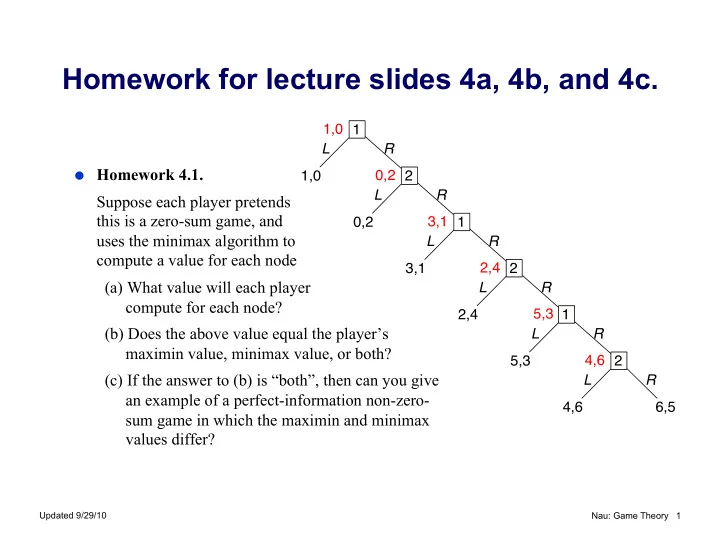
Homework for lecture slides 4a, 4b, and 4c.

1,0 0,2 3,1 2,4 5,3 4,6 6,5 1 2 1 2 1 2 R R R R R R L L L L L L 4,6 5,3 1,0 0,2 3,1 2,4  Homework 4.1.

Suppose each player pretends this is a zero-sum game, and uses the minimax algorithm to compute a value for each node (a) What value will each player compute for each node? (b) Does the above value equal the player’s maximin value, minimax value, or both? (c) If the answer to (b) is “both”, then can you give an example of a perfect-information non-zero- sum game in which the maximin and minimax values differ?

slide-2
SLIDE 2

Nau: Game Theory 2 Updated 9/29/10

 Homework 4.2. Above is a game tree for a perfect-information zero-sum game.

Run the alpha-beta algorithm on this game tree. At each node, write the intermediate and final values for alpha, beta, and v.

Max’s utility:

slide-3
SLIDE 3

Nau: Game Theory 3 Updated 9/29/10

Max’s utility:

 Homework 4.3. Let G be a perfect-information zero-sum game. At each node x of

the game tree, let negamax(x) be the payoff for the player to move to x if both players use their minimax strategies. (a) Give a recursive formula for negamax(x) (b) On the game tree above, put all of the negamax values (c) Modify the alpha-beta algorithm to return negamax values instead of minimax values.

slide-4
SLIDE 4

Nau: Game Theory 4 Updated 9/29/10

Max’s utility: 1 –1 –1 –1 1 –1 –1 1

 Homework 4.4. At each node x, of the tree shown below, let m(x) be x’s minimax

  • value. Suppose Max uses an evaluation function e(x) that returns m(x) with

probability 0.9, and –m(x) with probability 0.1. At the root node, what is Max’s probability of correct decision if Max searches (a) to depth 1? (b) to depth 2? (c) to depth 3?