
SLIDE 1
Horseshoe Crab Shorebird Education Project
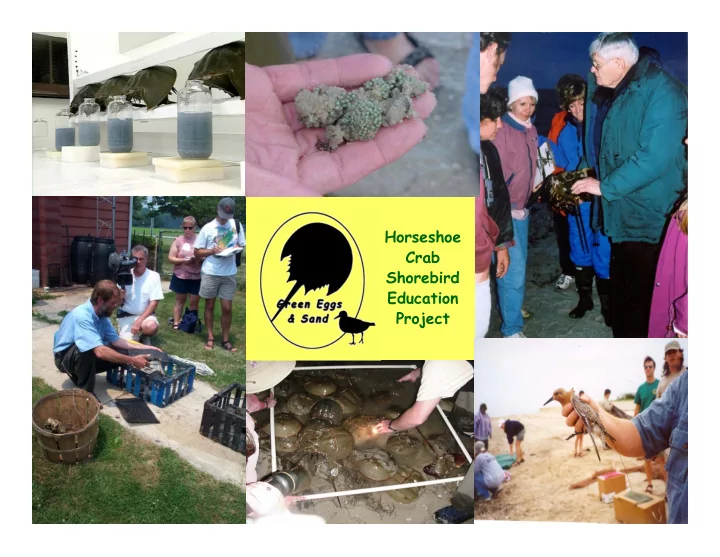
Horseshoe Crab Shorebird Education Project So, whats the big - - PowerPoint PPT Presentation
Horseshoe Crab Shorebird Education Project So, whats the big deal about horseshoe crabs? Kitts Hummock Beach, Delaware, early 1990s (courtesy Jim White) provides window on fascinating animals, globally-significant unique life
Horseshoe Crab Shorebird Education Project
Kitts Hummock Beach, Delaware, early 1990’s (courtesy Jim White)
constitutes a highly contentious natural resource management challenge and controversy provides window on globally-significant in-our-own-backyard natural phenomenon fascinating animals, unique life history, longevity on planet, “living fossils” example of an animal
“trash species” that now has all these uses and values
2000: Tri-state
steering committee convened to chart project directions teachers & experts recruited for inaugural workshop module teams form & curriculum work begins
2001: lessons for
draft four-module curriculum developed curriculum released for piloting to new group of educators at spring workshop
2002-3: video parts
workshops expanded to two each during spring lunar events on DelBay
2004: GE&S/HSC
poster produced curriculum/videos packaged to CD/DVD workshops expanded up and down coast (MA, NJ, VA & GA)
2005-7:
GE&S earns recognition
Conservation Communi- cator of Year (NEAFWA) Interpretive Media Best Curriculum (NAI) invited to present at 1st International HSC Conference (ISSCHC)
2008-14: workshops
expand to Long Island, Maine & Connecticut New team of educators complete major revision
(new curriculum DVD released in 2012)
2015 Workshops May 1-3: University of Georgia Marine
Education Center & Aquarium, Savannah
May 29-31: Wetlands Institute, Stone
Harbor, New Jersey
36 workshops in 8 states, involving: >100 experts & >1000 educators from 25 states & 4 foreign nations
http://tydb.mobiusnm.com/workshop
a memorable workshop experience
an engaging mix of: field experiences, expert seminars and hands-on activities.
an award-winning curriculum: “Conservation Communicator
a unique, effective collaboration: working across state lines,
scientists and educators, resource managers and stakeholders
your typical teacher workshop
heavy focus on hearing from the experts
curriculum/activities take a back-seat
about advocacy for any view
presents multiple points of view strives for accuracy and balance encourages critical thought & analysis
an over- the-counter product
the only way to get the curriculum is by full attendance at a GE&S workshop
access to the experts ‘real science’ field experiences chance to learn so much wealth of take-home materials
TIMEFRAME PRESENTATION COMPONENT ACTIVITY COMPONENT FRIDAY EVENING
Workshop welcome, Ice breaker & Intro to HSC presentation Molt study lab and/or Field trip to survey/observe HSC spawning
SATURDAY MORNING
HSC Ecology/Research expert(s) Shorebird Research expert(s) HSC module overview/activity Shorebird module overview/activity
SATURDAY AFTERNOON
Biomedical use of HSC’s expert Human use module overview LAL (biomedical use) demo Visit with HSC bait user Shorebird viewing in the field
SATURDAY EVENING
GE&S curriculum share fair or
Optional return trip to beach to observe HSC spawning
SUNDAY MORNING
HSC management module overview and presentations by experts on HSC management & conservation Management videos viewing, Workshop wrap-up, and distribution of materials
Commercial Fishers Biomedical scientists Environmental Educators Fisheries Managers Horseshoe Crab & Shorebird Researchers
Module 1: The Horseshoe Crab Module 2: Shorebird Connections Module 3: Human Connections Module 4: Managing the Resource
Uses a rotation lab (8 stations) approach to engaging students in learning the finer points of horseshoe crab anatomy through the study of shed molt specimens.
Offers a lesson plan & detailed instructions for constructing a spatial timeline of HSC’s amazing (nearly 500 million years!) march through time, including a series of 80 reproducible event cards (such as those at left) for students to place along the line.
provides a Powerpoint- based template and series of answers & questions on different things learned about HSCs in the module
Introduces students to the various adaptations of shorebirds for long- distance migration. A volunteer from the class is recruited to be “dressed” as a shorebird, using selected objects that are keyed to clue cards describing different shorebird adaptations.
Engages students in a simulation of the challenges shorebirds face in consuming sufficient horseshoe crab eggs to meet their energy needs for their May migration from Delaware Bay to their Arctic nesting areas, including various natural and human disturbance factors that can keep them from putting on the fuel they need.
Engages students in exercises designed for in- depth exploration of the HSC’s unique visual system. This includes gathering info
“eyes”, and using this to locate and describe each type of eye on dorsal and ventral diagrams provided.
STORY: Video Segments LEARNING: Exercises/Activities Dollars on the Beach: opening ‘teaser’ clip,
establishes the HSC controversy, circa 1997
Tragedy of the Commons: game that shows
how shared resources can become depleted
Identifying the Stakeholders: clips of
10 stakeholders, their views on controversy
How behaviors impact nat. res. Challenges Beliefs & Values, Art of Argument lessons Managing for Everyone: perspectives from
F&W directors on managing multi-use resource
WebQuest: the HSC Controversy: engages
students in role play of various stakeholders
Managing with Scientific Data: HSC Tech.
The Rest of the Story: examines graphs
from real data sets used in stock assessment
Other Views of Research: 4 stakeholders
data is interpreted and used in issues like this
Issues Analysis: Using Secondary Data:
challenges students to do critical review of selected news articles’ spin on HSC situation
What Happened Next? picks up chronology
No accompanying lessons, other than discussion
Designing a HSC Survey: Bio-Statistician
Let’s Count the Crabs/Spawning Survey:
classroom-simulated spawning survey activities
Working for Solutions: clips of players and
approaches aimed at resolving HSC controversy
Getting More Involved: ideas for student
action projects related to natural res. issues
role-playing the stakeholders involved in the HSC conservation controversy