SLIDE 1
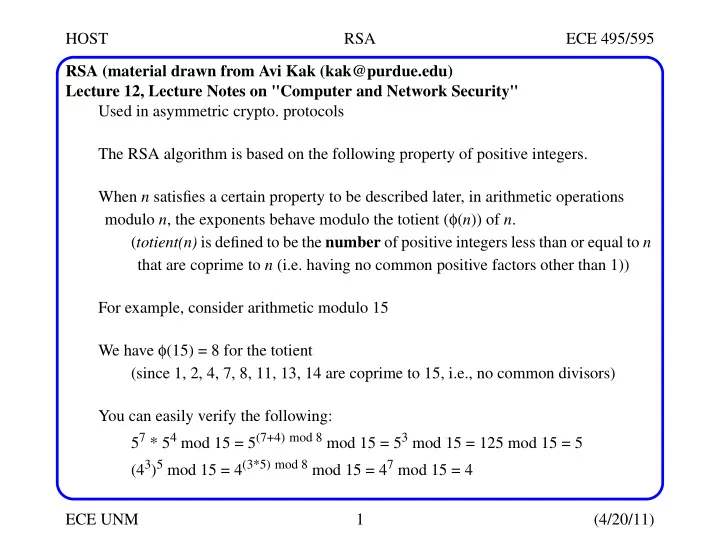
HOST RSA ECE 495/595 ECE UNM 1 (4/20/11) RSA (material drawn from Avi Kak (kak@purdue.edu) Lecture 12, Lecture Notes on "Computer and Network Security" Used in asymmetric crypto. protocols The RSA algorithm is based on the following property of positive integers. When n satisfies a certain property to be described later, in arithmetic operations modulo n, the exponents behave modulo the totient (φ(n)) of n. (totient(n) is defined to be the number of positive integers less than or equal to n that are coprime to n (i.e. having no common positive factors other than 1)) For example, consider arithmetic modulo 15 We have φ(15) = 8 for the totient (since 1, 2, 4, 7, 8, 11, 13, 14 are coprime to 15, i.e., no common divisors) You can easily verify the following: 57 * 54 mod 15 = 5(7+4) mod 8 mod 15 = 53 mod 15 = 125 mod 15 = 5 (43)5 mod 15 = 4(3*5) mod 8 mod 15 = 47 mod 15 = 4
SLIDE 2
HOST RSA ECE 495/595 ECE UNM 2 (4/20/11) RSA Again considering arithmetic modulo n, let’s say that e is an integer that is coprime to the totient φ(n) of n. Further, say that d is the multiplicative inverse of e modulo φ(n). These definitions are summarized as follows: n = a modulus for modular arithmetic φ(n) = the totient of n e = an integer that is relatively prime to φ(n) (This guarantees that e will possess a multiplicative inverse modulo φ(n)) d = an integer that is the multiplicative inverse of e modulo φ(n) Now suppose we are given an integer M , M < n, that represents our message, then we can transform M into another integer C that will represent our ciphertext by the fol- lowing modulo exponentiation: C = Me mod n We can recover M back from C by the following modulo operation M = Cd mod n
SLIDE 3
HOST RSA ECE 495/595 ECE UNM 3 (4/20/11) RSA How does the algorithm work? An individual who wishes to receive messages confidentially will use the pair of inte- gers {e, n} as his/her public key At the same time, this individual can use the pair of integers {d, n} as the private key Another party wishing to send a message to such an individual will encrypt the mes- sage using the public key {e, n} Only the individual with access to the private key {d, n} will be able to decrypt the message RSA could be used as a block cipher for the encryption of the message The block size would equal the number of bits required to represent the modulus n
SLIDE 4
HOST RSA ECE 495/595 ECE UNM 4 (4/20/11) RSA If the modulus required requires 1024 bits for its representation, message encryption would be based on 1024-bit blocks The important theoretical question here is under what conditions must be satisfied by the modulus n for this M ->C -> M transformation to work? How do we choose the modulus for the RSA algorithm? With the definitions given above for d and e, the modulus n must be selected in such a manner to satisfy the following: (Me)d == Med == M (mod n) We want this guarantee this because C = Me mod n is the encrypted form of the mes- sage integer M, and decryption is carried out by Cd mod n It was shown by Rivest, Shamir, and Adleman (RSA) that we have this guarantee when n is a product of two prime numbers: n = p*q for some prime p and prime q
SLIDE 5
HOST RSA ECE 495/595 ECE UNM 5 (4/20/11) RSA If two integers p and q are coprimes (meaning, relatively prime to each other), the following equivalence holds for any two integers a and b: {a == b (mod p) and a == b (mod q )} iff {a == b (mod p*q )} In addition to needing p and q to be coprimes, we also want p and q to be individu- ally primes. It is only when p and q are individually prime that we can decompose the totient of n into the product of the totients of p and q, φ(n) = φ(p) * φ(q) = (p - 1) * (q - 1) So that the cipher cannot be broken by an exhaustive search for the prime factors of the modulus n, it is important that both p and q be very large primes Finding the prime factors of a large integer is computationally harder than determin- ing its primality
SLIDE 6 HOST RSA ECE 495/595 ECE UNM 6 (4/20/11) Computational Steps for Key Generation in RSA The RSA scheme is a block cipher One typically encodes blocks of length 1024 bits This means that the numerical value of the message integer M will be less than 21024 If this integer is expressed in decimal form, its value could be as large as 10309 In other words, the message integer M could have as many as 309 decimal digits for each block of the plaintext! The computational steps for key generation are
- Generate two different primes p and q
- Calculate the modulus n = p * q
- Calculate the totient φ(n) = (p - 1) * (q - 1)
- Select for public exponent an integer e such that 1 < e < φ(n) and gcd(φ(n), e) = 1
- Calculate for the private exponent a value for d such that d = e-1 mod φ(n)
SLIDE 7 HOST RSA ECE 495/595 ECE UNM 7 (4/20/11) Computational Steps for Key Generation in RSA
- Public Key = [e, n]
- Private Key = [d, n]
For example, assume we want to design a 16-bit block encryption of disk files That is our modulus n will span 16 bits Since M (number of bits to encrypt) must be smaller than n, we need to choose a smaller block size, e.g., 8 bits We will pad with 0s the remaining 8 bits -- which turns out to be important to make RSA resistant to certain vulnerabilities (see standards doc RFC 3447) So for each 8-bit block read from disk, we pad to 16-bits with 0s to make M So, we need to find a modulus n with size 16 bits Remember, n must be a product of two primes p and q Assuming we want p and q to be roughly the same size, let’s allocate 8 bits each for them
SLIDE 8
HOST RSA ECE 495/595 ECE UNM 8 (4/20/11) Computational Steps for Key Generation in RSA So the issue now is how to find a prime suitable for our 8-bit example? (A random number generator can be used to do this) A simple approach is as follows: set the first two bits and last bit to 1 for both p and q 1 1 - - - - - 1 (p) 1 1 - - - - - 1 (q) Given these constraints, the minimum value is 193 for both p and q Setting the two high order bits also ensures the product will span 215 range So the question reduces to whether there exist two primes (hopefully different) whose decimal values exceed 193 but are less than 255 If you carry out a Google search with a string like ’first 1000 primes’, you will dis- cover that there exist many candidates for such primes http://primes.utm.edu/lists/small/1000.txt
SLIDE 9
HOST RSA ECE 495/595 ECE UNM 9 (4/20/11) Computational Steps for Key Generation in RSA Let’s select the following two p = 197 and q = 211 This gives us for the modulus n = 197 * 211 = 41567 The bit pattern for the chosen p, q, and modulus n are: 1 1 0 0 0 1 1 1 (p) (0xC5) 1 1 0 1 0 0 1 1 (q) (0xD3) 1 0 1 0 0 0 1 0 0 1 0 1 1 1 1 1 (n)(0xA25F) So you can see we have found a modulus for a 16-bit RSA cipher that requires 16 bits for its representation Now let’s try to select appropriate values for e and d For e we want an integer that is relatively prime to the totient φ(n) = 196 * 210 = 41160.
SLIDE 10
HOST RSA ECE 495/595 ECE UNM 10 (4/20/11) Computational Steps for Key Generation in RSA Such an e will also be relatively prime to 196 and 210, the totients of p and q respec- tively Since it is preferable to select a small prime for e, we could try e = 3 But that does not work since 3 is not relatively prime to 210 The value e = 5 does not work for the same reason Let’s try e = 17 because it is a small prime and because it has only two bits set With e set to 17, we must now choose d as the multiplicative inverse of e modulo 41160 We can use the Bezout’s identity based calculations; we write gcd(17, 41160) | = gcd(41160, 17) | residue 17 = 0 x 41160 + 1 x 17 = gcd(17, 3) | residue 3 = 1 x 41160 - 2421 x 17
SLIDE 11
HOST RSA ECE 495/595 ECE UNM 11 (4/20/11) Computational Steps for Key Generation in RSA = gcd(3,2) | res 2= -5 x 3 + 1 x 17 | = -5x(1 x 41160 - 2421 x 17) + 1 x 17 | = 12106 x 17 - 5 x 41160 = gcd(2,1) | res 1= 1x3 - 1 x 2 | = 1x(41160 - 2421x17) | - 1x(12106x17 -5x41160) | = 6 x 41160 - 14527 x 17 | = 6 x 41160 + 26633 x 17 (the last equality for the residue 1 uses the fact that the additive inverse of 14527 modulo 41160 is 26633) Use a program to do this! The Bezout’s identity shown above tells us that the multiplicative inverse of 17 mod- ulo 41160 is 26633 You can verify this fact by showing 17 * 26633 mod 41160 = 1 on your calcula- tor
SLIDE 12
HOST RSA ECE 495/595 ECE UNM 12 (4/20/11) Computational Steps for Key Generation in RSA Our 16-bit block cipher based on RSA therefore has the following numbers for n, e, and d: n = 41567 e = 17 d = 26633 Of course, as you would expect, this block cipher would have no security since it would take no time at all for an adversary to factorize n into its components p and q As mentioned already, the message integer M is raised to the power e modulo n, which gives us the ciphertext integer C Decryption consists of raising C to the power d modulo n The exponentiation operation for encryption can be carried out efficiently by simply choosing an appropriate e Note that the only condition on e is that it be coprime to φ(n))
SLIDE 13
HOST RSA ECE 495/595 ECE UNM 13 (4/20/11) Computational Steps for Key Generation in RSA As mentioned previously, typical choices for e are 3, 17, and 65537 All these are prime and each has only two bits set Modular exponentiation for decryption, meaning the calculation of Cd mod n, is an entirely different matter since we are not free to choose d The value of d is determined completely by e and n Computation of Cd mod n can be speeded up by using the Chinese Remainder Theo- rem Since the party doing the decryption knows the prime factors p and q of the modulus n, we can first carry out the easier exponentiations: Vp = Cd mod p Vq = Cd mod q Further speedup can be obtained using Fermatt’s Little Theorem
SLIDE 14
HOST RSA ECE 495/595 ECE UNM 14 (4/20/11) An Algorithm for RSA After we have simplified the problem of modular exponentiation considerably by using CRT and Fermat’s Little Theorem, we are still left with having to calculate: AB mod n for some integers A, B, and for some modulus n What is interesting is that even for small values for A and B, the value of AB can be enormous! For example, both A and B may consist of only a couple of digits, as in 711, but the result could still be a very large number For example, 711 equals 1, 977, 326, 743, a number with 10 decimal digits Now just imagine what would happen if, as would be the case in cryptography, A had, say, 256 binary digits (that is 77 decimal digits) and B was, say, 65537! Even when B has only 2 digits (say, B = 17), when A has 77 decimal digits, AB will have 1304 decimal digits!
SLIDE 15
HOST RSA ECE 495/595 ECE UNM 15 (4/20/11) An Algorithm for RSA The calculation of AB can be speeded up by realizing that if B can be expressed as a sum of smaller parts, then the result is a product of smaller exponentiations We can use the following binary representation for the exponent B: B == bk bk-1bk-2 . . . b0 (binary) Here, we find that it takes k bits to represent the exponent, each bit being represented by bi, with bk as the highest bit and b0 as the lowest bit In terms of these bits, we can write the following equality for B: Now the exponentiation AB may be expressed as: B 2i
bi ≠
∑
= AB A
2i bi ≠
∑
A2i
bi ≠
∏
= =
SLIDE 16
HOST RSA ECE 495/595 ECE UNM 16 (4/20/11) An Algorithm for RSA We could say that this form of AB halves the difficulty of computing AB This is true b/c assuming all the bits of B are set, the largest value of 2i will be roughly half the largest value of B We can achieve further simplification by bringing the rules of modular arithmetic into the multiplications on the right: Note that as we go from one bit position to the next higher bit position, we square the previously computed power of A The A2 terms in the above product are of the following form So instead of calculating each term from scratch, we can calculate each by squaring the previous value ABmodn A2i modn
bi ≠
∏
modn = A20 , A21 , A22 ,A23 ,…
SLIDE 17 HOST RSA ECE 495/595 ECE UNM 17 (4/20/11) An Algorithm for RSA We may express this idea in the following manner: Now we can write an algorithm for exponentiation that scans the binary representa- tion of the exponent B from the lowest bit to the highest bit: result = 1 while ( B > 0 ) if ( B & 1 ) # check the lowest bit of B result = ( result * A ) mod n B = B >> 1 # shift B by one bit to right A = ( A * A ) mod n return result Try: ssh-keygen -t dsa
ssh-keygen -t rsa A, Aprev
2
, … Aprev
2
, Aprev
2
,
SLIDE 18
HOST RSA ECE 495/595 ECE UNM 18 (4/20/11) Complexity of RSA
Symmetric Key Algorithm Key Size for the Comparable RSA Key Len. Symmetric Key Algorithm giving same level of Sec. 2-Key 3DES 80 1024 3-Key 3DES 112 2048 AES-128 128 3072 AES-192 192 7680 AES-256 256 15360
For RSA Doubling the size of the key will, in general, increase the time required for pub- lic key operations (encryption or signature verification) by a factor of four And it will increase the time taken by private key operations (decryption and signing) by a factor of 8 Public key operations don’t increase in cost as fast because e does not have to change size with an increase in the modulus -- while d does The key generation time goes up by a factor of 16 as the size of the key (fortunately, not a frequent operation)
SLIDE 19
HOST RSA ECE 495/595 ECE UNM 19 (4/20/11) Complexity of RSA This high cost makes RSA inappropriate for encryption/decryption of actual message content for high data-rate communication links However, RSA is ideal for the exchange of secret keys that can subsequently be used for the more traditional (and much faster) symmetric-key encryption/decryption