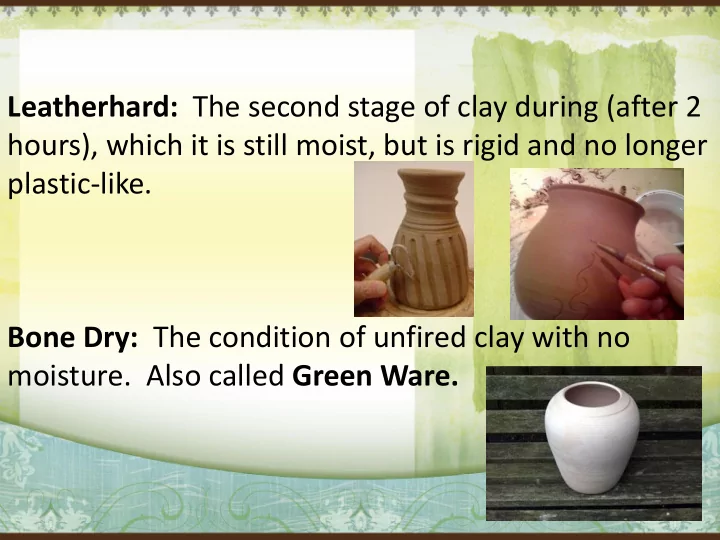
SLIDE 1 Leatherhard: The second stage of clay during (after 2 hours), which it is still moist, but is rigid and no longer plastic-like. Bone Dry: The condition of unfired clay with no
- moisture. Also called Green Ware.
SLIDE 2 Pop Art- An art style, started in England in the 1950s and made its way to the United States during the
- 1960s. Pop artists have focused attention upon familiar
images of the popular culture such as billboards, comic strips, magazine advertisements, and supermarket products
SLIDE 3
Glaze: A thin coating of minerals which produces a glassy transparent or colored coating on bisque. Applied by brushing, dipping, or spraying. It is fixed by firing the bisque ware in a kiln. This makes the surface smooth, shiny, and waterproof.
SLIDE 4 Canvas: Commonly used as a support for oil or acrylic painting, canvas is a heavy woven fabric made of flax
SLIDE 5
Topiary: The sculpting of live shrubs or trees into decorative shapes
SLIDE 6
Impressionism: An art movement and style of painting that started in France during the 1860s. Impressionist artists tried to paint candid glimpses of their subjects showing the effects of sunlight and movement.
SLIDE 7
Stretcher - Wooden bars, usually made of pine, that works as a frame over which the canvas of a painting is stretched. Although stretchers can be any shape, most are rectangular.
SLIDE 8
Portrait- A work of art that represents a specific person, a group of people, or an animal. Portraits usually show what a person looks like as well as revealing something about the subject's personality. Portraits can be made of any sculptural material or in any two-dimensional medium.
SLIDE 9
Photomontage: a combination of several photographs joined together for artistic effect or to show more of the subject than can be shown in a single photograph.
SLIDE 10
SLIDE 11
Radial Design– Radial means anything of, relating to, or arranged like rays. Radial or rotational balance is any type of balance based on a circle with its design extending from or focused upon its center.
SLIDE 12
Monogram - A design composed of one or more letters, typically the initials of a name, used as an identifying mark.
SLIDE 13
Medium: The material or technique used by an artist to produce a work of art.
SLIDE 14
Silhouette: An outline filled with a solid color, typically black on a white ground, and most often for a portrait. These are examples of artist Kara Walker’s work.
SLIDE 15
Sculpture - A three-dimensional work of art, or the art of making it. Such works may be carved, modeled, constructed, or cast.
SLIDE 16 Georgia O’Keeffe (1887-1986)- Born in
- Wisconsin. Known for her paintings of landscapes
- f southwestern US, flowers, and animal skulls.
SLIDE 17 Side-loading: loading a brush with two colors side by
- side. Using this technique, each brushstroke deposits
a gradation of the two blended colors.
SLIDE 18 Tuesday, May 7
Mask: An opaque edge or area placed between an image and a photosensitive surface to prevent its exposure to certain portions
SLIDE 19
Shahzia Sikander: Born 1969 in Punjab, Pakistan. Her art focuses on controversies between religion, politics, and gender roles. She has her Master’s degree in Fine Art.
SLIDE 20 Paul Klee: born in Switzerland. Loved cats, and used them as his subjects in his art. Used simple lines and strong
- colors. Primitive and surrealistic style of art.
SLIDE 21 Vincent van Gogh born March 30, 1853 Dutch Expressionist
his strong use of color. “Starry Night” famous work William Morris Hunt Born March 31, 1824 American artist from Vermont. Famous for his American landscapes. Painted a series of Niagara Falls.
SLIDE 22
Monday, May 13
Copy the term below… Edward Hicks (1780-1849) Folk Artist Born Attleboro, PA Born a Quaker Self taught Greatly inspired by religion
SLIDE 23 Tuesday, April 9
Claes Oldenberg - Born in Stockholm, Sweden. Grew up in United States in Chicago.
Studied literature at Yale, then onto art school in Chicago. Opened his own studio in New York City. Famous for his pop art of everyday objects (and large scale
SLIDE 24
Sfumato –In painting, the technique of blurring or softening sharp outlines by subtle and gradual blending (feathering) of one tone into another. A smoky, hazy effect with soft edges.
SLIDE 25
Scumbling: adding a thin layer of color over a dry underlayer, allowing the underlayer to show through
SLIDE 26
Color Wheel – A radial diagram of colors in which primary and secondary, and sometimes intermediate colors are displayed as an aid to color identification, choosing, and mixing.
SLIDE 27
Primary Colors – RED, BLUE, YELLOW All of the other colors are made from these colors. Secondary Colors – ORANGE, PURPLE, GREEN Each color is made by mixing 2 primary colors together RED + BLUE = PURPLE BLUE + YELLOW = GREEN YELLOW + RED = ORANGE
SLIDE 28
Complementary Colors: Colors that are directly across from each other on the color wheel such as
Red and Green, Blue and Orange, Yellow and Violet. When mixed together, they form NEUTRAL colors of brown and gray
SLIDE 29
SLIDE 30